

Editor's Choice
Trump Administration Unveils $65.8bn ‘Golden Fleet’ in Most Aggressive US Naval Expansion in Decades

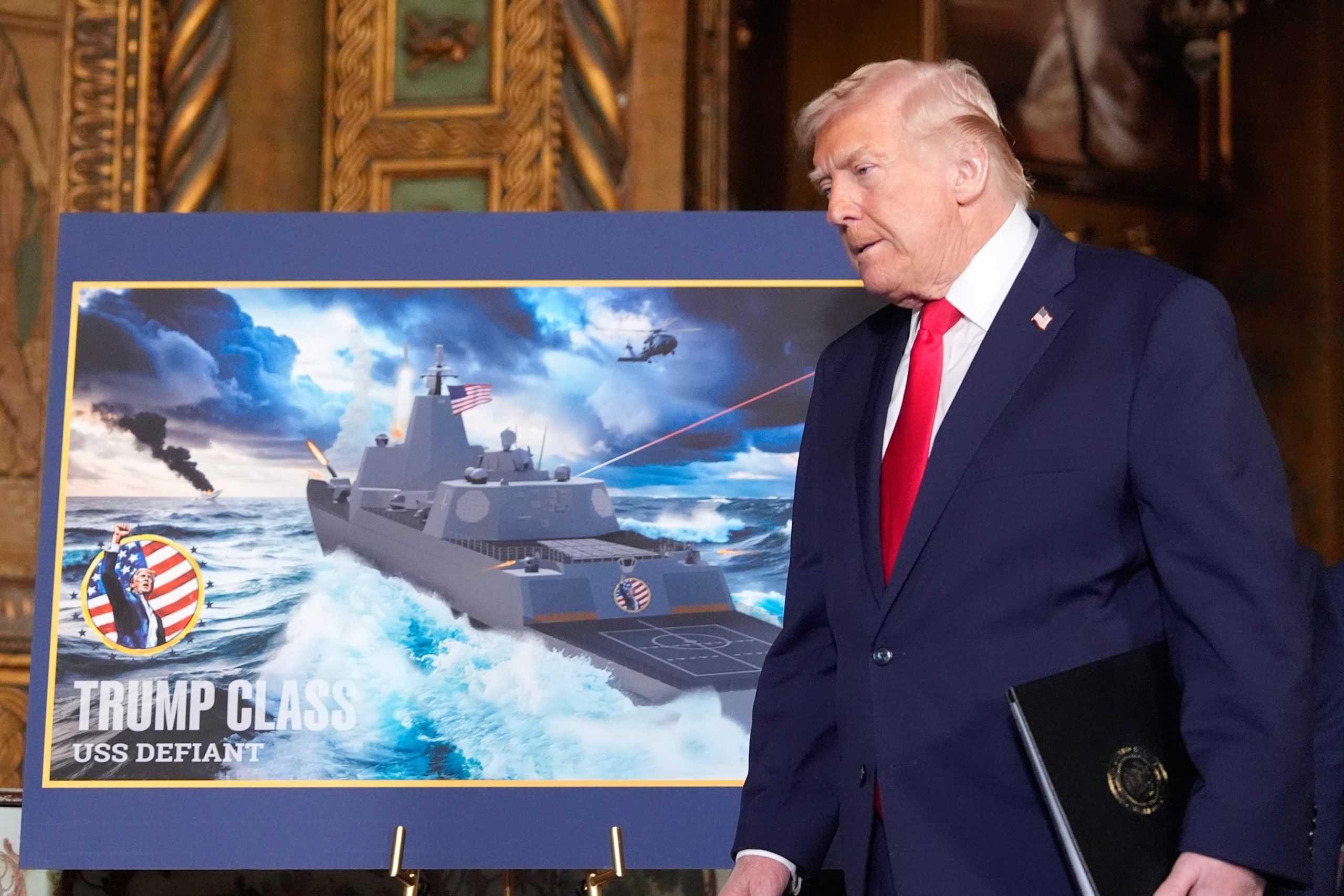

Trump Administration Unveils $65.8bn ‘Golden Fleet’ in Most Aggressive US Naval Expansion in Decades
By Aghogho Ejumedia | Washington D.C. | Waterways News
The United States has launched one of the most sweeping naval expansion programmes in its modern history, unveiling a 30-year shipbuilding strategy backed by a proposed $65.8 billion investment that its architects say will restore American maritime supremacy and rebuild an industrial base that has quietly eroded over the past two decades.
Presented as the Fiscal Year 2027 Shipbuilding Plan, the initiative — branded the “Golden Fleet” under the Trump administration — sets out to dramatically grow the size of the US Navy, overhaul how the country procures warships, and revive domestic shipbuilding capacity across a network of yards and suppliers spanning the entire country. The plan carries profound implications not only for American naval power but for the global balance of maritime strength at a time of rising tensions with China, ongoing instability in the Middle East, and intensifying competition over strategic sea lanes.
A Fleet in Decline
The United States Navy currently operates 291 battle force ships — significantly below the long-standing congressional target of 355 vessels that defence planners have cited for years as the minimum threshold for effective global power projection. The gap between ambition and reality has grown steadily wider, and the FY2027 plan does not shy away from acknowledging why.
The report delivers a remarkably candid assessment of the Navy’s recent record: despite shipbuilding budgets doubling over the past two decades, the overall size of the fleet has stubbornly failed to grow beyond what it was in 2003. Procurement delays, cost overruns, shifting strategic priorities, and the fragmentation of America’s industrial shipbuilding base have combined to blunt the impact of successive increases in naval spending.

Acting Secretary of the Navy, Hung Cao, framed the moment in stark terms. The United States, he argued, is at a strategic turning point that demands urgent, structural action — not incremental reform. The “Golden Fleet,” he said, is designed to be that response.
Three Pillars of Reform
The strategy rests on three central objectives that together represent a fundamental rethinking of how America builds and sustains its naval power.
The first is procurement reform. The Navy has acknowledged that the way it buys ships is broken. Long development timelines, over-engineered specifications, and a procurement culture that prizes customisation over efficiency have driven up costs and slowed delivery. The new plan calls for a shift towards more standardised, modular designs and streamlined acquisition processes intended to get ships into service faster and at lower unit cost.
The second pillar is maritime superiority through fleet diversification. Rather than concentrating investment solely in the most expensive, high-end platforms, the strategy envisions a two-tier fleet — retaining advanced destroyers, submarines, and carriers at the top end, while introducing lower-cost, high-volume vessels capable of taking on a wider range of missions. The logic is that numbers matter as much as capability in deterring adversaries who are themselves rapidly expanding their fleets.
The third, and perhaps most consequential, pillar is industrial base reconstruction. The United States has allowed much of its shipbuilding capacity to atrophy since the end of the Cold War. Today, only around 10 per cent of Navy shipbuilding work flows through distributed production networks — meaning most work is concentrated in a handful of large yards already operating at or near capacity. The new plan sets a target of 50 per cent through distributed production, achieved by expanding modular construction, accelerating digital ship design, and drawing a far wider network of regional suppliers and subcontractors into the shipbuilding ecosystem.
Officials have drawn a deliberate historical parallel, framing the “Golden Fleet” as a modern successor to Theodore Roosevelt’s Great White Fleet — the armada dispatched on a round-the-world voyage in 1907 that announced America’s arrival as a global naval power. The message is intentional: Washington intends to be unmistakably dominant at sea again.
What Is Being Built
The scale of planned procurement is considerable. In FY2027 alone, the Navy is seeking funding for 34 manned ships and five unmanned platforms. Over the following five years, from FY2027 through FY2031, the plan targets the acquisition of 122 ships and 63 unmanned platforms — a pace of building not seen in the United States since the 1980s Reagan-era naval build-up.
The five-year shopping list includes five Columbia-class ballistic missile submarines — the bedrock of America’s sea-based nuclear deterrent — alongside 10 Virginia-class attack submarines, which have become the Navy’s primary workhorse for undersea warfare and intelligence gathering. Seven Arleigh Burke-class guided-missile destroyers are also included, along with four frigates, two amphibious assault ships, five San Antonio-class amphibious transport docks, 23 Medium Landing Ships, seven fleet oilers, and five ocean surveillance vessels.
In a move that signals both urgency and strategic priority, the Navy is also accelerating the procurement of the future CVN 82 aircraft carrier — pulling its acquisition timeline forward by a full year, from FY2030 to FY2029.
The Return of the Battleship
Nothing in the plan has attracted more attention — or more debate — than the proposal for an entirely new class of warship: a nuclear-powered battleship, designated BBGN.
The battleship concept was effectively retired by the United States Navy in the 1990s, with the last Iowa-class vessels decommissioned after the Cold War. Their return, even in a radically modernised form, represents a dramatic departure from three decades of naval doctrine. The proposed BBGN would be built around four core capabilities: long-range precision strike, survivable command-and-control functions — meaning it is designed to keep fighting even when under attack — enhanced power generation to support advanced directed-energy and electronic warfare systems, and expanded magazine capacity for next-generation weapons.
Navy officials have been careful to stress that the battleship is not intended to replace destroyers. Rather, it is envisioned as an entirely new category of surface combatant — a heavily armed, highly survivable vessel capable of adding combat mass and staying power to a fleet that planners fear may be spread too thin across multiple theatres.
The New Frigate
Alongside the headline-grabbing battleship proposal, the plan also introduces a new generation of frigates intended to absorb missions currently handled by the Arleigh Burke destroyers. These include convoy escort, anti-submarine warfare, maritime interdiction, homeland defence patrols, and counter-narcotics operations in the Caribbean and Eastern Pacific.
By offloading these lower-intensity but operationally necessary tasks to frigates, the Navy hopes to free its destroyers to concentrate on the high-end warfighting roles for which they were designed — air defence, ballistic missile defence, and surface warfare in contested environments. The frigate programme is therefore as much about rationalising the existing fleet as it is about adding new hulls.
Unmanned Systems Take Centre Stage
The plan marks a significant deepening of the Navy’s commitment to unmanned systems, reflecting a broader shift in military thinking towards platforms that can take on dangerous missions without putting personnel at risk and that can be produced in larger numbers at lower cost than crewed vessels.
The FY2027 budget includes procurement of three Medium Unmanned Surface Vessels. Across the five-year plan, the Navy is seeking 47 such vessels alongside 16 Extra Large Unmanned Underwater Vehicles — autonomous submarines capable of operating independently over extended periods. These platforms are expected to take on roles ranging from mine-hunting and anti-submarine surveillance to logistics support and long-range strike.
What It Means for Global Maritime Trade
For international shipping and port communities, including those in Nigeria and across West Africa, the implications of this shift are considerable and worth watching closely.
A larger, more assertive US naval presence in the Atlantic, Indo-Pacific, and Gulf regions has direct consequences for the security environment in which global trade operates. American naval dominance has historically underwritten the freedom of navigation on which international shipping depends. A revitalised US fleet capable of projecting power more decisively — and across more theatres simultaneously — would generally be regarded as stabilising for global trade routes.
At the same time, the acceleration of US shipbuilding could tighten the global market for specialist maritime labour, steel, and naval engineering expertise. Countries seeking to develop their own shipbuilding industries, as Nigeria has long aspired to do, may find both inspiration and caution in the American experience: the United States has spent heavily on naval procurement for decades, yet allowed the underlying industrial base to hollow out. Rebuilding it, as Washington is now discovering, is far harder and more expensive than maintaining it in the first place.
A Test of Political Will
The “Golden Fleet” plan is, at this stage, a proposal — a detailed and ambitious one, but still subject to congressional approval and the political pressures that have derailed previous naval expansion programmes. Funding at the scale envisaged will require sustained bipartisan support in a legislature that has not always agreed on defence priorities.
What is not in doubt is the ambition. The United States is signalling, loudly and with considerable specificity, that it intends to be the dominant power on the world’s oceans for the next generation. How far it is prepared to go — and how much it is willing to spend — will become clearer when the FY2027 defence budget reaches the floor of Congress.
For those who sail, trade, and govern on the world’s waterways, the outcome matters enormously.
Waterways News | Covering Nigeria’s maritime, inland waterways, and blue economy sectors

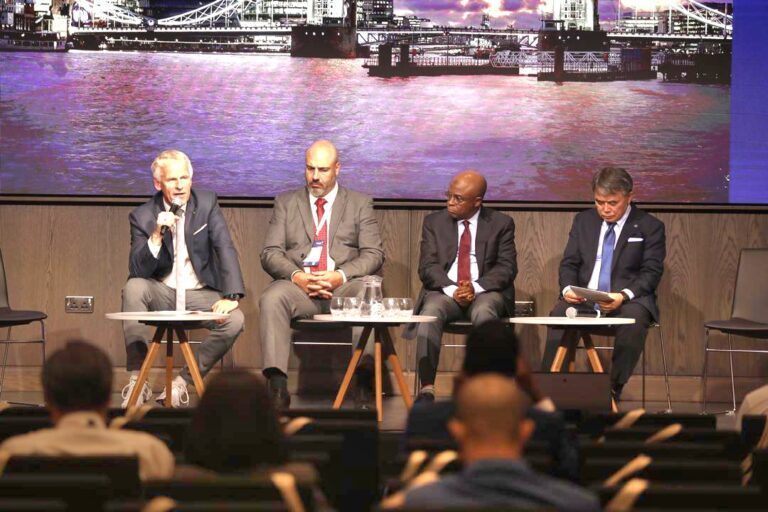
Nigeria’s Port Boom Is Outpacing Its Capacity, Dantsoho Tells World Ports Conference
Dantsoho Pitches Nigeria’s Ports to Global Investors in London, Says Lekki’s Capacity Is Exhausted
By Emamuzou Akatugba | Waterways News | London
The Managing Director of the Nigerian Ports Authority (NPA), Dr Abubakar Dantsoho, has told global port investors that Nigeria’s fast-growing cargo volumes make the country’s ports one of Africa’s most compelling investment opportunities. He said the Tinubu administration has put investor-friendly policies in place.
Dantsoho spoke on Tuesday at the IAPH World Ports Conference in London, which runs from November 3 to 6 at Olympia. He addressed a select group of maritime investors. He is Vice-President of the International Association of Ports and Harbors (IAPH) and Chairman of the Port Management Association of West and Central Africa (PMAWCA).
He said Nigeria’s population, rapid urbanisation and infrastructure gaps are what make the opportunity attractive. He argued that governments across Africa cannot alone fund bigger and deeper seaports, so private investment must move in quickly.
“The investment needed in ports to meet this expansion and growth can only happen if the requisite private investment is attracted and retained,” he said. He added that President Tinubu “has created the enabling atmosphere” for this
Dantsoho said Nigeria’s population has grown from about 45 million at independence in 1960 to over 260 million. In his words, the country needs capacity to receive bigger import vessels and to move higher export volumes.
His strongest example was the Lekki Deep Sea Port. It was funded with Chinese backing and built by China Harbour at a cost of $1.6 billion. He said it was commissioned only about three years ago, yet its capacity “has been exhausted”.
“Clearly, we need more capacity to be able to contain the volumes,” he said. He added that the NPA is pleased to be capturing more cargo, since rising volumes are what lift port revenue.
He also said most cargo arriving in West Africa, largely from China, ends up in the Nigerian market. He compared Nigeria’s population with Ghana (34 million), Côte d’Ivoire (32 million), Benin Republic (14 million) and Togo (9 million).
Other reports from the conference quote Dantsoho saying federal reforms have lifted Nigeria’s exports by about 25 per cent in two years, across oil and non-oil goods. He reportedly also cited two Nigerian ports in the World Bank’s top 20 global rankings, and a Single Window system the NPA developed in 2025 with a Singaporean firm.
NIGERIA WATCH
Capacity is now the story. A $1.6bn flagship port that is already full is the clearest sign yet that Nigeria’s problem has moved from attracting ships to handling them. It strengthens the case for the new deep seaport approvals (Badagry, Olokola, Ibom, Bakassi and Bonny) that have so far been announced faster than they have been built. Investors in London will want timelines, not just approvals.
Retaining investors is harder than attracting them. Dantsoho himself used the phrase “attracted and retained”. Concession renewal anxieties, regulatory overlap among agencies, and the Strait of Hormuz crisis’s effect on freight rates and war-risk insurance all weigh on retention. These are the questions investors will ask after the speech.
Where do the small operators fit? The pitch is about big terminals and big capital. Informal inland waterway operators, represented by WABOTAN and ATBOWATON, remain absent from the conversation.
Waterways News will keep asking how port-led growth and the NPA’s assessment of inland dry ports will translate into jetties, safety and livelihoods for the informal inland waterway operators.
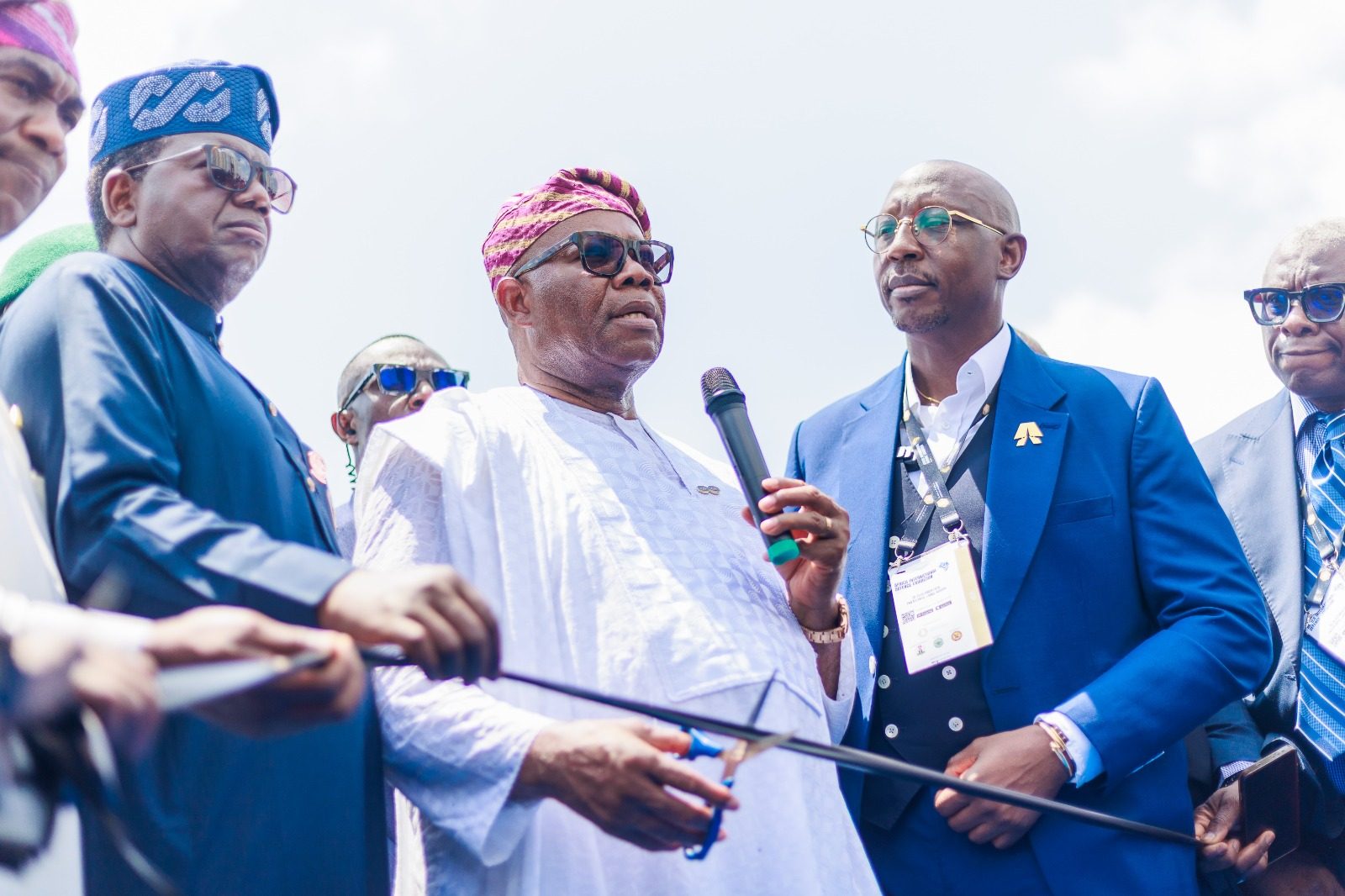
Nigeria Unveils Home-Built ADX-Barra 200 Autonomous Vessel at AFRIDEX 2026
Arridex, DICON joint venture Helagon delivers country’s first indigenously developed unmanned surface vessels%
By Ighoyota Onaibre | Waterways News
Nigeria has unveiled its first indigenously developed autonomous surface vessel, the ADX-Barra 200. Arridex Group, formerly RusselSmith Group, built it through Helagon, its defence joint venture with the Defence Industries Corporation of Nigeria (DICON).
The vessel was unveiled on 26 October at the inaugural Africa International Defence Exhibition (AFRIDEX 2026) at Eko Atlantic, Lagos. The exhibition ran from 26 to 29 October.
President Bola Ahmed Tinubu was represented by Senate President Godswill Akpabio. He said the administration prioritises defence industry growth because a nation is more secure when it can build and maintain its own capability. He described the vessel as that capability taking shape, designed and built by local engineers in partnership with DICON, and said it deserves government support and the confidence of the armed forces.
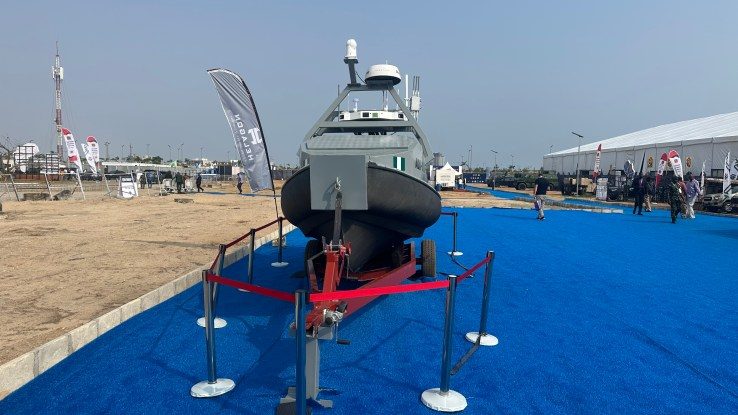
ADX-Barra 200
Arridex Group CEO Kayode Adeleke presented the vessel. He said Helagon was set up to design autonomous systems and that the ADX-Barra 200 is the result. For the forces that will use it, he called it a force multiplier.
The ADX-Barra 200 is one of two platforms in the ADX-Barra series launched at the exhibition. The other is the ADX-Barra 100. Arridex says both were designed, built and integrated in Nigeria by its engineers.
Adeleke tied the platforms to Gulf of Guinea security. He said the region’s waters carry its trade, support its coastal communities and hold much of its energy wealth, and that protecting them calls for capability the region can build, sustain and improve itself. He invited the armed services and other stakeholders to arrange demonstrations and to help shape later generations of the vessels.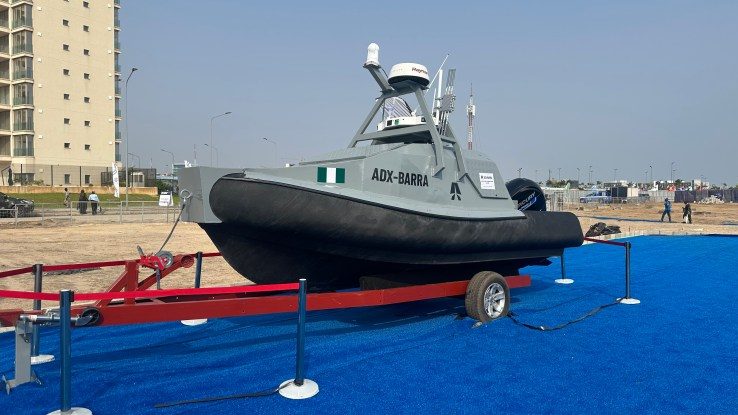
Others at the unveiling included Lagos State Deputy Governor Dr Obafemi Hamzat and the Minister of State for Defence, Dr Bello Matawalle. DICON Director-General Major General Babatunde Ibrahim Alaya, Helagon Chief Operating Officer Engr. Precious Omo-Agege and Arridex senior management were also present.
Arridex has not published the vessel’s technical specifications, including its length, endurance, payload and sensors. Both vessels remained on display at the exhibition.
NIGERIA WATCH
A home-built answer to a long-standing maritime problem: Nigeria’s waters have long needed more patrol capacity than its platforms and budgets can supply. A locally designed vessel that “can be supported, adapted and improved by the team that made it,” as Arridex puts it, addresses one persistent weakness. Imported hulls and systems often sit idle for want of spares, support and trained hands.
The questions that matter next: Unveilings are not deployments. The Navy, NIMASA’s Deep Blue Project and other agencies will want to know the vessel’s range, endurance, sensors and sea-state limits. They will also want to know whether it can work in the Gulf of Guinea. Until Arridex publishes specifications and arranges trials, the “game-changing” claim remains the company’s own.
Beyond defence: Waterways News readers should watch whether this technology filters into civil uses such as inland waterway surveillance, anti-vandalism patrols and search and rescue. The country’s inland operators, including those represented by WABOTAN and ATBOWATON, face insecurity and safety gaps that policy announcements have not closed. Local manufacturing capacity matters to them only if it eventually reaches the waterways where they work.
The accountability test: The industrial-policy argument is sound. It is build locally and maintain locally. It will be judged by procurement, deployment and sustained operation, not by launch-day speeches.
Editor's Choice
Australia Bars Repeat-Offender Bulk Carrier for 90 Days Over Falsified Crew Rest Records
Australia Bars Repeat-Offender Bulk Carrier for 90 Days Over Falsified Crew Rest Records
By Okeoghene Onoriobe | Waterways News
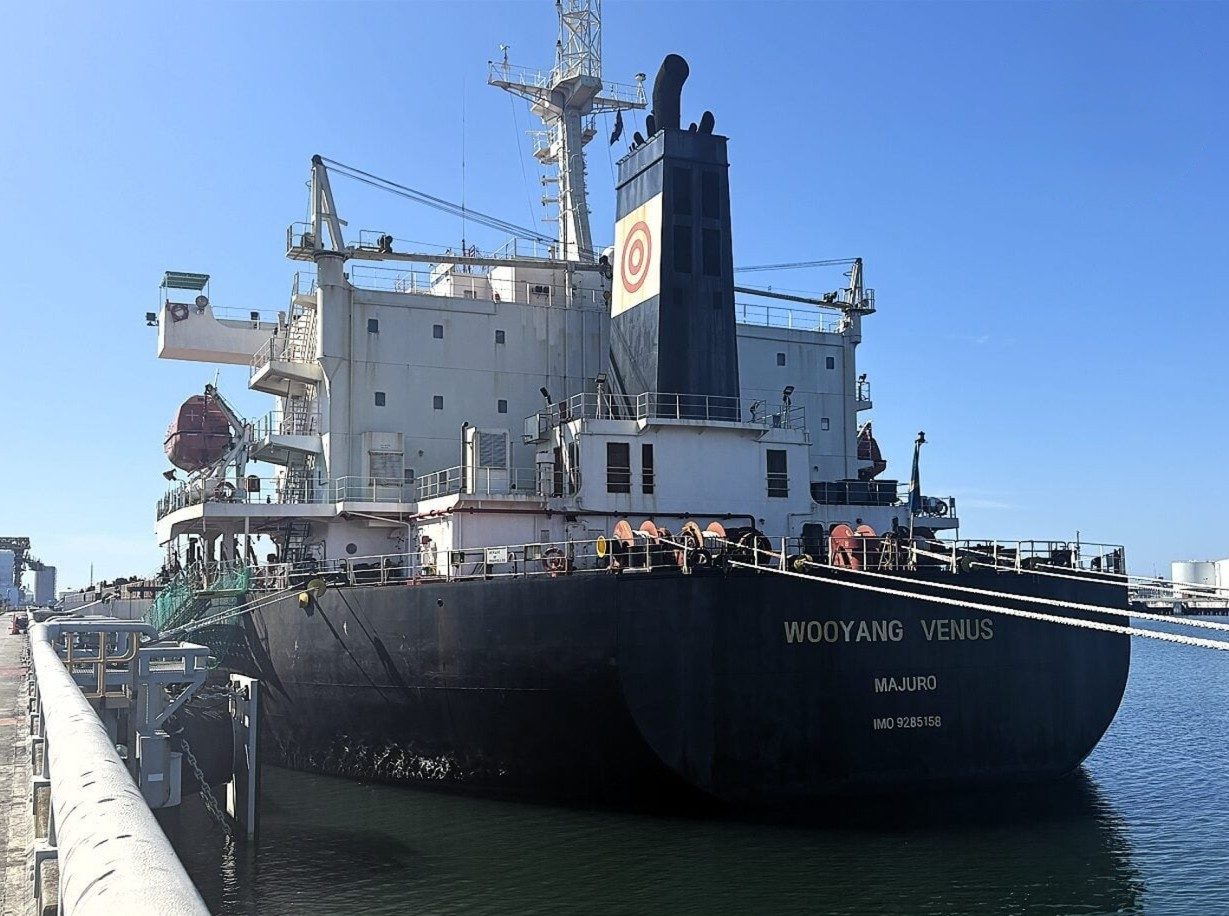
Australian maritime authorities have banned the Marshall Islands-flagged bulk carrier Wooyang Venus from its ports and waters for 90 days. Inspectors found that the ship’s crew work and rest-hour records had been deliberately falsified to hide excessive working hours.
The Australian Maritime Safety Authority (AMSA) boarded the vessel at the Port of Newcastle on 29 October after a complaint under the Maritime Labour Convention (MLC). Its port state control inspection found that the records did not match the hours the crew actually worked. The ship left Newcastle on 31 October for Korea, and the ban took effect afterwards.
This is the vessel’s third brush with Australian enforcement in under three years. AMSA detained it in August 2026 when crew hours were neither properly recorded nor monitored. It was first detained in December 2023, after a complaint from the International Transport Workers’ Federation (ITF).
That inspection found falsified hours records, poor food provisions and an allegation that the master had assaulted a crew member. AMSA’s annual MLC report says the operator then submitted a corrective action plan covering repatriation, better provisions and training on rest-hour compliance. The latest findings suggest those measures did not take hold.
AMSA Executive Director for Maritime Safety and Environmental Compliance, Greg Witherall, said falsifying records meant to protect seafarers undermines both crew welfare and ship safety. He warned that fatigue dulls judgement and slows reaction times, raising the risk of collisions, groundings and injuries, particularly during navigation and watchkeeping.
The ban was imposed under Section 246 of Australia’s Navigation Act 2012. AMSA cited the deliberate falsification, the repeated breaches and doubts over the effectiveness of the owner’s and operator’s safety management systems.
Nigeria Watch
The case matters for Nigeria for three reasons:
Records are the enforcement tool. Fatigue rules only work if rest-hour logs can be trusted. Australia treated falsification as a safety-system failure, not a paperwork lapse, and banned the ship rather than detaining it again.
Repeat offenders need escalating penalties. Two detentions and a corrective plan did not change this operator’s behaviour. Nigerian port state control should ask whether its own follow-up on repeat deficiencies has real consequences.
Seafarer welfare is a Nigerian issue. Nigerian seafarers serve on foreign-flagged ships, and those working boats and ferries on domestic waters face fatigue and welfare gaps too, often with no records at all.
The MLC regime Australia is enforcing shows what accountability looks like. It is the benchmark NIMASA and the inland regulators should be measured against, and one this publication will keep pressing.

 Oil and Gas8 months ago
Tantita’s Pipeline Deal: $144m Contract, Rising Output, and the Questions that Deserve Answers
 MARITIME TRADE & SHIPPING8 months ago
World’s Largest Container Ship Sets New Maritime Record with 22,233 TEUs on Single Voyage
 Blue Economy9 months ago
Nigeria’s Coast Guard Bill: A Solution in Search of a Problem?