
Maritime Labour and Trade Union
OPINION: When Seafarers Die, Condolences Are Not Enough — The World Must Do Better


OPINION: When Seafarers Die, Condolences Are Not Enough — The World Must Do Better
By Sunil Kapoor | Adapted for Waterways News
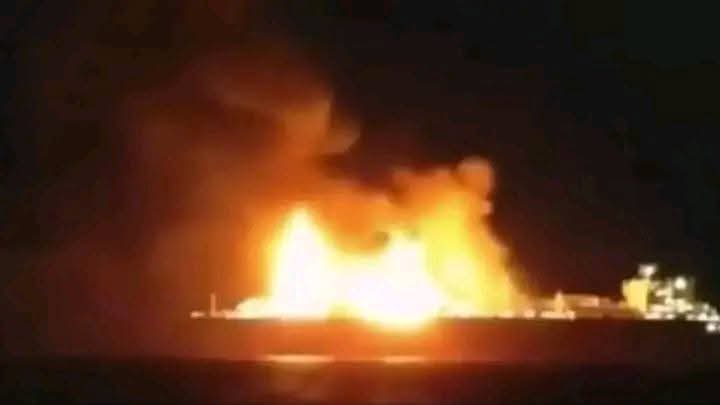
Merchant ships are burning at sea. Not warships. Not naval vessels. Ordinary commercial ships — carrying cargo that keeps the global economy turning — crewed by civilian seafarers simply doing their jobs.
Following the latest wave of attacks on merchant vessels in the Strait of Hormuz, IMO Secretary-General Arsenio Dominguez issued a statement expressing deep concern over seafarer casualties, reaffirming that attacks on innocent civilian shipping are unjustifiable under international maritime law. The words were appropriate. But they were also familiar.
Every time a merchant ship is attacked — every time a seafarer loses his life in someone else’s geopolitical conflict — the same kind of statements appear. What is never quite clear is what those statements mean for the man standing watch tonight on the bridge.
When the System Failed: Lessons from Covid
The pandemic offered a sobering preview of how badly the protective system around seafarers can break down under pressure.
Governments insisted that no seafarer could remain aboard beyond twelve months. Port state authorities enforced this strictly. Yet those same governments often refused to issue visas for incoming crew, or declined to allow serving crew to disembark. The result was an impossible catch-22: the rules demanded crew changes that the system made impossible to execute.
Ships began carrying relief crew who had joined but could not replace their predecessors — seafarers already beyond their contract limits continued sailing as unofficial “passengers.” On paper, compliance. In reality, a fiction everyone accepted.
One incident from that period stands as a symbol of the system’s failure. A vessel arrived in port carrying the body of a seafarer who had died onboard. His remains, kept in the ship’s freezer, were refused permission to be landed at port after port. The crew sailed on — carrying their dead colleague — while his family thousands of miles away waited for a funeral that could not happen.

War, Missiles, and the Weight on Nigerian Seafarers
When Russia invaded Ukraine, merchant vessels were suddenly trapped in Ukrainian ports as missiles fell around them. The crew aboard those ships were commercial seafarers — not soldiers. Yet the burden of getting them home fell almost entirely on ship managers and the seafarers themselves.
Today, the Strait of Hormuz has become a new crisis point. In March 2024, the bulk carrier True Confidence was struck by a missile off Yemen. Three seafarers were killed. They were not combatants. They were doing their jobs. The damaged vessel drifted for months before any port agreed to receive it.
Now more than 1,000 ships are reported stuck or transiting the strait under threat. Some political voices have publicly urged shipowners to show courage and sail through. But bravado spoken in political offices lands on the shoulders of masters and crew — people for whom the danger is not rhetorical.
When an incident happens and a seafarer dies, a basic question deserves an answer: who gave the order to sail? On what assessment was that instruction based? A vessel may be insured. Cargo may be insured. A human life cannot be replaced.
Nigeria Watch: What This Means for Our Maritime Sector
Nigeria has significant stakes in this conversation. A substantial number of Nigerian seafarers serve aboard international merchant vessels, including those transiting high-risk corridors like the Red Sea, the Gulf of Aden, and now the Strait of Hormuz. When geopolitical conflict puts commercial shipping in the crosshairs, Nigerian families are among those waiting at home.
Closer to our shores, the Gulf of Guinea has its own long record of attacks on merchant vessels — piracy, kidnapping for ransom, armed robbery at sea — where seafarers have repeatedly borne the human cost of systemic failures. NIMASA, the Nigerian Navy, and the Federal Ministry of Marine and Blue Economy have invested in frameworks like the Deep Blue Project to address maritime insecurity in our region. But the broader question raised by Kapoor applies here too: when seafarers are endangered, does the response match the rhetoric?
The industry has repeatedly demonstrated that it can organise practical solutions in emergencies — repatriating crew, rerouting vessels, supporting families — when official structures move too slowly. That should not be the norm.
Ninety percent of world trade moves by sea. Nigeria’s import-dependent economy, its crude oil exports, and its ambitions as a blue economy hub all rest on the safety and welfare of seafarers. Behind every crew list is a family waiting for a safe return.
Statements of concern will keep being issued after every tragedy. But for the families of seafarers who do not come home, the message from this industry must be unambiguous: statements are not enough.
Sunil Kapoor is a shipowner and maritime commentator. Thioriginal piece has been adapted for Waterways News readers by Raymond Gold, Co-publisher and Research Reporter for Waterways News

Blue Economy
MWUN LAGOS BOAT OPERATORS THROW WEIGHT BEHIND NIWA-PARTS CENTRAL CLEAN-UP, LINK REFUSE TO FATAL BOAT MISHAPS
MWUN LAGOS BOAT OPERATORS THROW WEIGHT BEHIND NIWA-PARTS CENTRAL CLEAN-UP, LINK REFUSE TO FATAL BOAT MISHAPS
Oghenewoke Osaweren | Waterways News
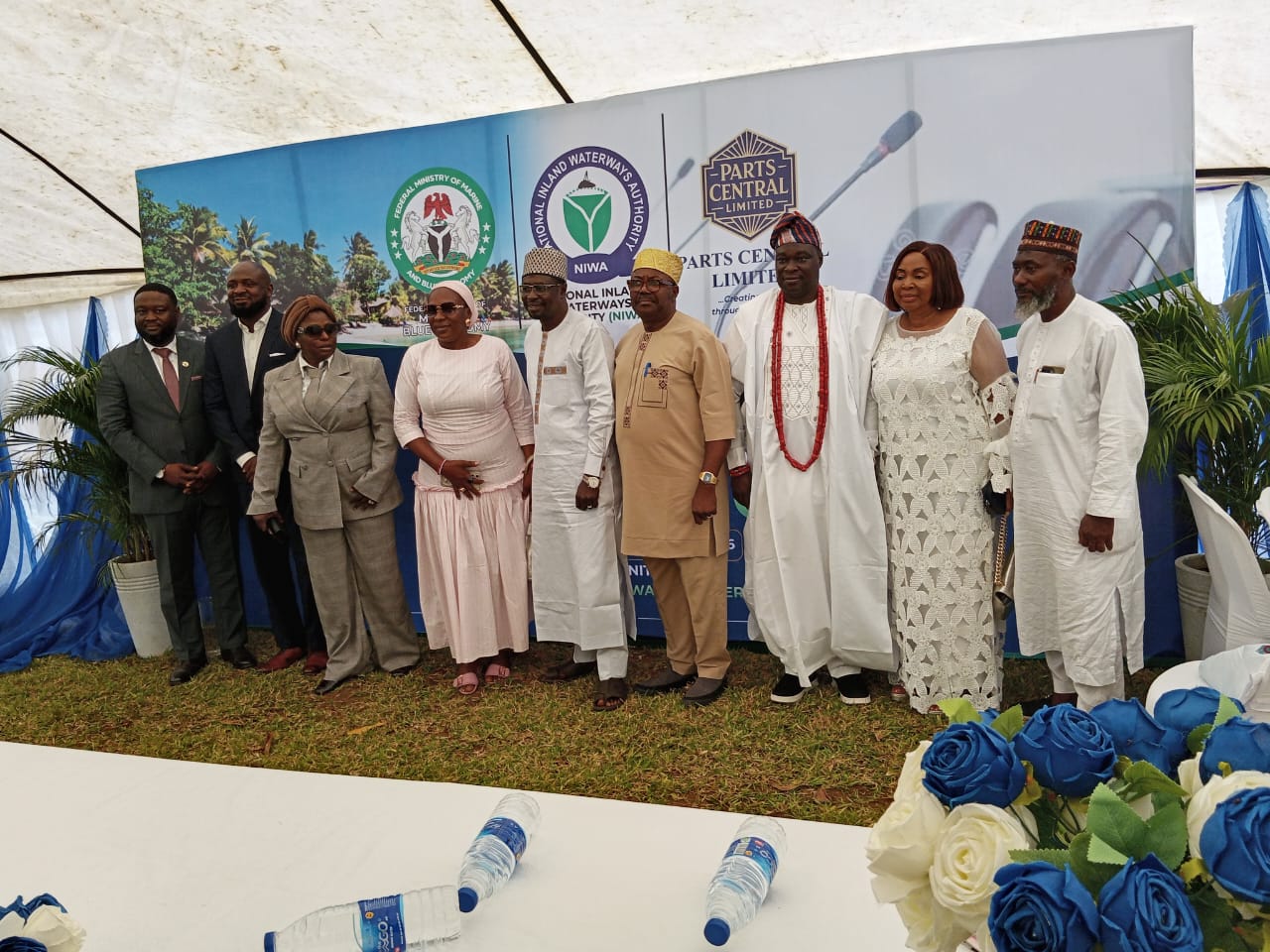
The Lagos Commercial Private Boat District of the Maritime Workers Union of Nigeria (MWUN) has thrown its full weight behind the nationwide inland waterways clean-up drive launched by the National Inland Waterways Authority (NIWA) in partnership with Parts Central Limited, with the union’s Lagos leadership tying refuse-choked channels directly to fatal accidents involving its members. District Chairman, Comrade Owolabi Omotayo, gave the commitment during a visit by Waterways News to his office, days after NIWA and Parts Central formally rolled out the 10-year renewable programme in Lagos on August 18.
Omotayo said dumped refuse had done considerable damage to boat operations under his district, with debris repeatedly fouling engines and, in some cases, triggering fatal mishaps on the water. He described MWUN as a formidable force in the maritime sector that would continue to back initiatives serving the positive development of Nigeria’s waterways.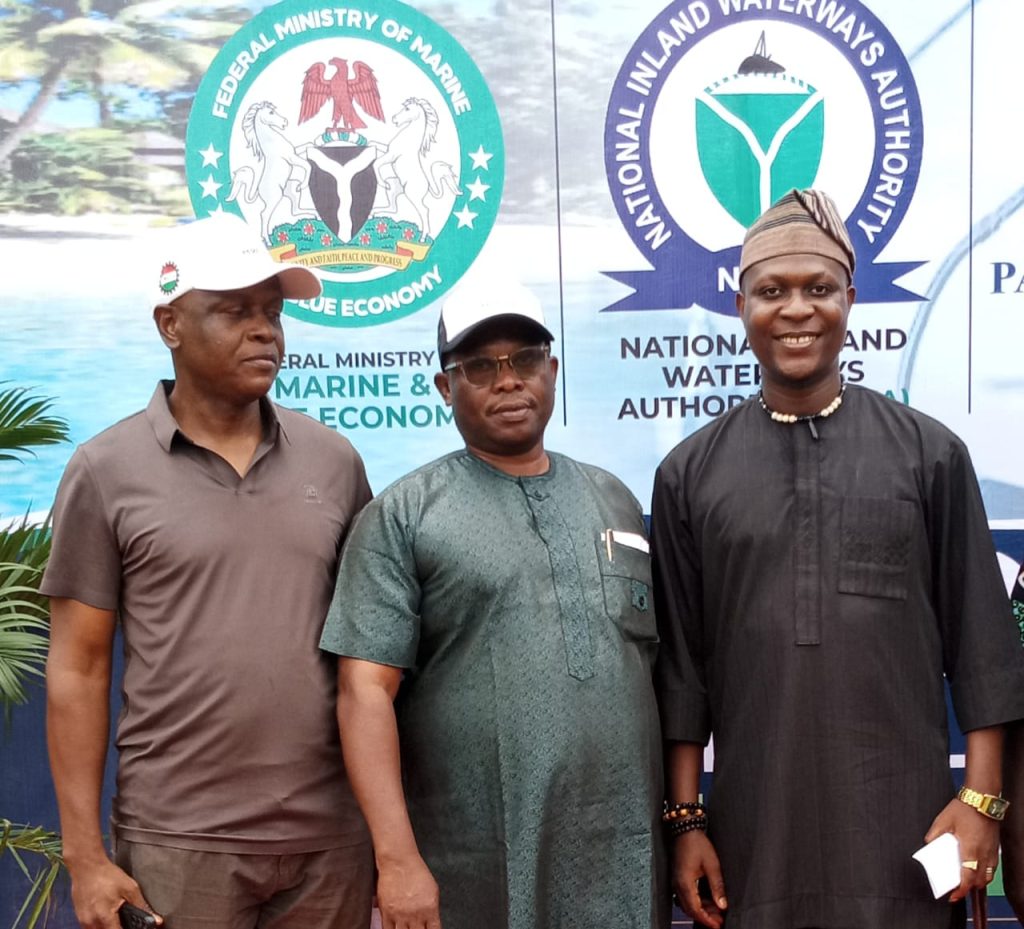
Officials of the Lagos Commercial and Private Boats District of Maritime Workers Union of Nigeria (MWUN) at the Waterways Clean-Up Initiative unveiling ceremony
His remarks align with concerns raised at the programme’s official unveiling, where NIWA’s Lagos Area Manager, Engr. Sarat Braimah, identified dredgers, tank farm operators, boat operators and waterfront owners as major contributors to pollution. Braimah pointed to waste-clogged stretches such as Kirikiri, where the water has turned blackish and unsafe, and argued that clean waterways are central to unlocking Lagos State’s blue economy potential, given that roughly a third of the state’s landmass is water.
Under the programme, boats and other watercraft are to be fitted with designated waste bins, while larger “mother bins” will be installed at jetties for operators to offload waste on docking. Parts Central’s Managing Director, Henry Onifade, said the company would deploy monitoring technology across waterfronts, landing ports and jetties to support enforcement and compliance.
For MWUN’s Lagos Commercial Private Boat District, the concern is immediate: members navigate the same debris-strewn channels daily, and engine damage from floating refuse remains a recurring hazard blamed for accidents on the water. Omotayo’s pledge marks a notable alignment between grassroots labour interests and a federal-private clean-up drive, one that will face its real test as the programme shifts from launch to enforcement across Lagos’s waterfronts.
NIGERIA WATCH
Omotayo’s endorsement adds MWUN’s Lagos boat operators to a widening coalition of inland waterway stakeholders lining up behind the NIWA-Parts Central initiative, following SWAAADO’s earlier backing of the same programme. That two separate operator groups, one a registered trade union, the other a registered NGO advocating for a safe and sustainable waterways, have independently, cited fatal engine-fouling incidents as their reason for support suggests the safety argument, not just the environmental one, is what is actually moving grassroots operators to embrace a clean-up scheme historically viewed with scepticism by informal waterway workers.
The pattern is familiar to anyone tracking Lagos’s inland waterways: policy launches attract enthusiastic institutional and labour endorsements, but delivery on the ground — mother bins actually installed at jetties, monitoring technology actually deployed, waste actually collected rather than left to drift back into the channels operators use daily — has historically lagged the announcements. NIWA and Parts Central have set themselves a 10-year renewable timeline; the coming months, as the programme moves from its August 18 unveiling into enforcement, will show whether the operational commitments match the goodwill MWUN and SWAAADO have extended.
Worth watching also is the jurisdictional backdrop: any waterfront enforcement regime in Lagos inevitably intersects with the long-running NIWA-LASWA tussle over control of the state’s waterways. Whether Parts Central’s monitoring technology and enforcement plans are coordinated with, or contested by, LASWA’s own waterfront authority will likely determine how smoothly this clean-up initiative translates from paper to practice.
Maritime Labour and Trade Union
Lekki Freeport Terminal Signs 150% Salary Increase for Dockworkers in Landmark CBA with MWUN, NPA Senior Staff Union
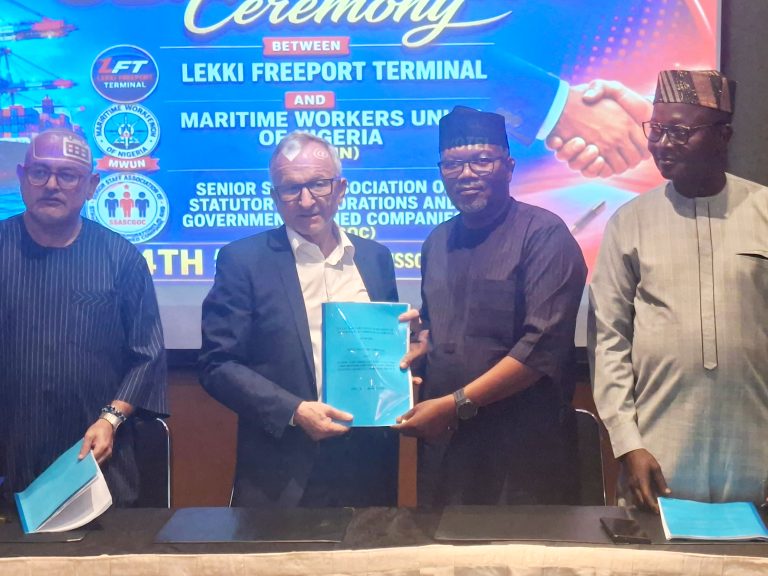
Lekki Freeport Terminal Signs 150% Salary Increase for Dockworkers in Landmark CBA with MWUN, NPA Senior Staff Union
By Okeoghene Onoriobe | Waterways News
Lekki Freeport Terminal (LFT) on Friday signed a new Collective Bargaining Agreement (CBA) granting dockworkers at the facility a salary and allowance increase of up to 150 percent, in what union leaders described as the highest wage package at any port terminal in Nigeria today.
The agreement was jointly signed at the Radisson Blu Hotel in Lagos by the President General of the Maritime Workers Union of Nigeria (MWUN), Comrade Francis Bunu Abi, and his counterpart at the Nigerian Ports Authority (NPA) branch of the Senior Staff Association of Statutory Corporations and Government Owned Companies (SSASCGOC), Comrade Akinola Bodunde. The LFT delegation was led by its Chief Executive Officer, Captain Jedrzej Mierzewsky.
Wages benchmarked against global peers
Speaking to maritime journalists after the signing, Comrade Bunu credited the outcome to sustained dialogue rather than industrial action, noting that the process was completed without a single protest or port shutdown. He said the union’s negotiating position rested on comparing Nigerian dockworkers’ pay with what counterparts earn at comparable terminals abroad, operating the same equipment and performing the same duties.
“We keep telling management that Africa is not where you come and get cheap labour, it is where you come and get quality labour,” Bunu said, adding that he had personally travelled to London to benchmark pay scales as part of the union’s ongoing wage advocacy.
He disclosed that the increases vary by category, some as high as 150 percent, others at 80 percent and 60 percent, spanning overtime, weekend and public holiday allowances, transport, feeding, utility, housing and hazard allowances, according to Bodunde.
Four months of negotiation
Mr Fubara Awanta, LFT’s General Manager for Government Relations and Security, described the talks as tense but ultimately productive, spanning more than four months of engagement between the two unions and terminal management. Awanta, who also midwifed the maiden CBA between the parties in 2024, said the new agreement reflects broader gains across the terminal’s workforce once implemented.
Bodunde noted that negotiations opened in February, building on the previous CBA signed with LFT in March 2024, and closing gaps left unaddressed in that earlier agreement. He urged workers to reciprocate management’s commitment as the terminal moves toward construction of Lekki Port’s Phase 2 expansion.
Bunu also signalled that a broader Dockworkers National Joint Industrial Council (NJIC) process, to be coordinated by the Nigerian Maritime Administration and Safety Agency (NIMASA), is expected to begin soon and could extend similar wage gains across other Nigerian port terminals.
Nigeria Watch: The Lifetime agreement lands as a rare good-news story on Nigerian port labour relations, a beat more often defined by pension disputes, casualisation grievances, and NPA retiree battles. That the deal was struck without a shutdown is itself notable in a sector where industrial action has periodically disrupted cargo flow at Apapa and Tin-Can.
But the real test that lies ahead is whether a 150 percent uplift at one privately-run terminal becomes the floor other operators are pressured to match once NIMASA’s promised NJIC process gets underway, or whether Lekki Freeport, still Nigeria’s newest and most capital-intensive port asset, remains the outlier it has been since inception.
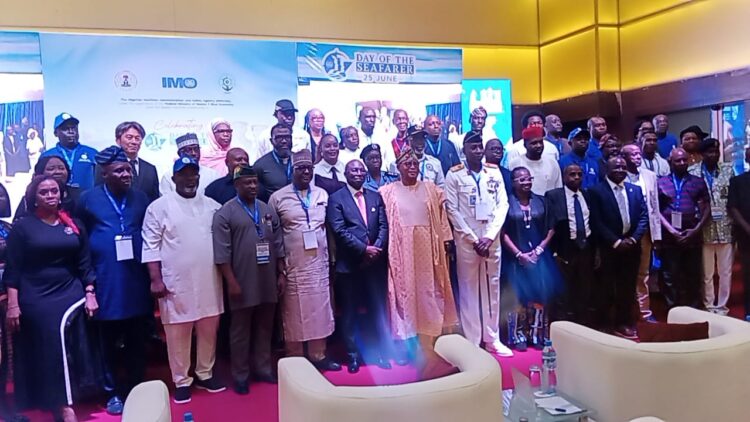
NIMASA Trains 2,459 Cadets, Secures 150% Wage Rise for Nigerian Seafarers — Mobereola
By Ighoyota Onaibre | Waterways News
The Nigerian Maritime Administration and Safety Agency (NIMASA) has declared seafarer welfare, safety and professional development as central priorities of its current agenda, with the agency’s Director-General, Dr. Dayo Mobereola, disclosing landmark gains in cadet training and earnings improvement as Nigeria marked the 2026 Day of the Seafarer in Lagos on Thursday.
Addressing maritime stakeholders at the event, Mobereola announced that NIMASA has trained 2,459 Nigerian cadets under the Nigerian Seafarers Development Programme (NSDP), with a significant number still undergoing training at maritime institutions across the world. The disclosure underlines the agency’s sustained push to build a pipeline of internationally competitive Nigerian seafarers capable of serving on vessels in the global merchant fleet.
The NIMASA chief also revealed a major breakthrough on seafarer remuneration. The National Joint Industrial Council (NJIC), he said, has formally adopted the wage scale endorsed by the International Transport Workers’ Federation (ITF) and the International Labour Organisation (ILO) into the conditions of service for Nigerian seafarers — producing a wage increase of more than 150 per cent. The development marks one of the most consequential improvements in Nigerian seafarer earnings in recent memory and directly aligns domestic conditions with internationally recognised standards.
Speaking to the 2026 theme, “Carrying World Trade, Carrying the Risk,” Mobereola underscored the outsized contribution of seafarers to global commerce, noting that more than 80 per cent of global trade by volume and over 70 per cent by value moves by sea, sustained by approximately two million seafarers manning the world’s merchant fleet. He stressed that beyond cargo movement, seafarers contend daily with unpredictable weather, security threats, geopolitical instability and prolonged family separation — risks that rarely receive sufficient public acknowledgement.
“Today, we stand in solidarity with the global maritime community to pay tribute to an extraordinary cadre of professionals whose dedication, courage and resilience form the bedrock of international trade and global prosperity,” he stated.
Mobereola said NIMASA’s commitment to seafarers goes beyond regulatory duty, framing it as both a moral obligation and a strategic investment in the sector’s long-term resilience. He pointed to ongoing work on Maritime Labour Convention (MLC) 2006 compliance as a mechanism for guaranteeing decent working conditions, alongside continued investment in certification and sea-time opportunities. He also called for broader collaboration across governments, maritime administrations, shipowners, training institutions and labour unions to build a maritime ecosystem that puts safety, dignity and professional excellence at its core.
Also speaking, the Chairman of the Senate Committee on Marine Transport, Senator Wasiu Eshinlokun-Sanni, pledged the National Assembly’s continued legislative backing for policies aimed at strengthening Nigeria’s maritime sector and improving seafarer welfare. The senator stressed the need for expanded investment in maritime education, certification and professional development to sharpen the competitiveness of Nigerian seafarers in the international labour market.
The event brought together maritime regulators, industry operators, labour representatives and seafarers to mark the occasion.
Nigeria Watch
Thursday’s Day of the Seafarer celebrations carried a weight beyond ceremony. The twin announcements from NIMASA — 2,459 cadets in the NSDP pipeline and a 150 per cent wage increase secured through the NJIC’s adoption of ITF/ILO wage scales — represent concrete, measurable progress on two of the most persistent pressure points in Nigerian seafarer development: the quantity of trained personnel entering the workforce and the quality of conditions awaiting them.
The wage development deserves particular attention. For years, Nigerian seafarers working on vessels governed by ITF-negotiated collective bargaining agreements have operated under conditions where the gap between international wage benchmarks and actual domestic pay structures created both financial hardship and reputational friction for Nigeria’s maritime labour market. The formal adoption of the ITF/ILO scale into NJIC conditions of service is a structural correction, not merely a gesture — and it comes at a moment when the Strait of Hormuz crisis has dramatically highlighted the risk premium attached to seafaring, reinforcing the moral and commercial case for competitive pay.
For NIMASA, the NSDP remains the cornerstone of Nigeria’s long-term seafarer supply strategy, and the 2,459 figure is a credible indicator of scale. However, the programme’s ultimate value will be measured not by enrolment numbers but by the rate at which trained cadets complete sea-time placements, obtain STCW certifications and gain employment on international vessels. The persistent challenge of securing sufficient shipboard berths for Nigerian cadets — particularly on vessels operated by foreign shipowners with no particular obligation to take Nigerian trainees — remains an area where NIMASA’s advocacy with the Federal Ministry of Marine and Blue Economy and with international shipping organisations needs sustained attention.
Senator Eshinlokun-Sanni’s assurances of legislative support are timely. The National Assembly’s role in providing the fiscal and regulatory architecture for seafarer development — through the Cabotage Vessel Financing Fund, through port concession frameworks that incentivise indigenous vessel ownership and through oversight of NIMASA’s budget — is consequential and often underappreciated in public discourse. That a Senate committee chair chose to appear at a seafarers’ day event and commit to specific legislative priorities is a positive signal, though stakeholders will watch for legislative follow-through on maritime education funding and MLC implementation in the months ahead.
Nigeria’s blue economy ambitions cannot be realised without a competitive, well-paid and professionally respected seafarer workforce. Thursday’s celebrations offered evidence that the building blocks are being assembled — slowly, but with increasing intentionality.
Waterways News | www.waterwaysnews.ng

 Oil and Gas7 months ago
Tantita’s Pipeline Deal: $144m Contract, Rising Output, and the Questions that Deserve Answers
- MARITIME TRADE & SHIPPING7 months ago
World’s Largest Container Ship Sets New Maritime Record with 22,233 TEUs on Single Voyage
- Blue Economy7 months ago
Nigeria’s Coast Guard Bill: A Solution in Search of a Problem?