

Maritime Labour and Trade Union
NPA Pensioners Storm Marina Headquaters, Vow Escalation Over 16-Year Pension Freeze

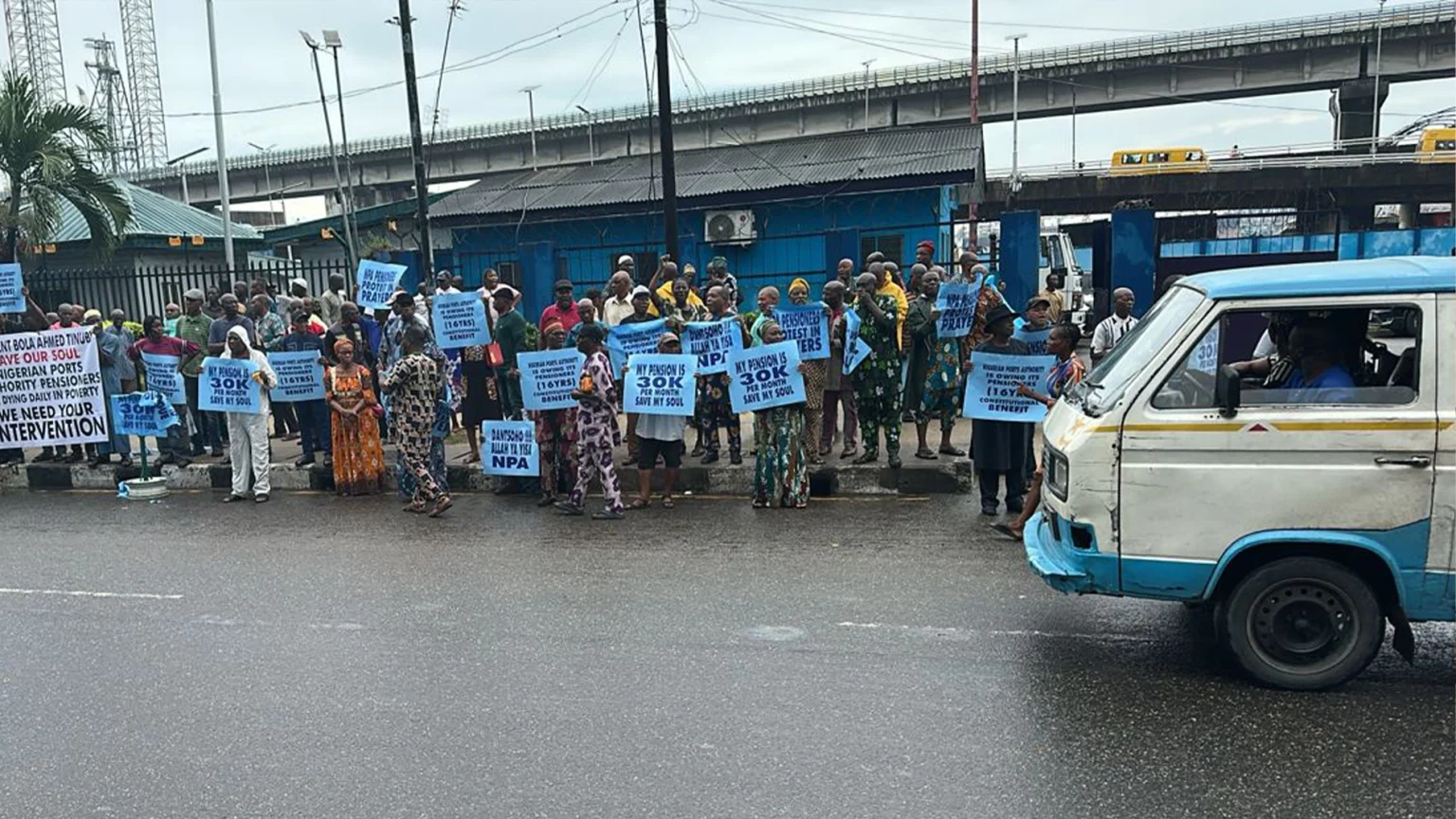

NPA Pensioners Storm Marina Headquaters, Vow Escalation Over 16-Year Pension Freeze
Retirees earning as low as N30,000 monthly; nationwide ports shutdown possible
By Ighoyota Onaibre | Waterways News Correspondent
Scores of retired workers of the Nigerian Ports Authority (NPA) descended on the agency’s Marina headquarters in Lagos on Monday, demanding immediate resolution of pension increments left unimplemented for nearly two decades — a standoff that has brought the spectre of nationwide port disruptions closer to reality.
The protesters, operating under the umbrella of the Nigerian Ports Authority Pensioners Welfare Association (NPAPWA), accused the NPA management of failing to fully implement statutory pension reviews as prescribed under Section 173(3) of the 1999 Constitution, as amended.

The demonstration drew a charged crowd of retirees bearing placards with stark messages. Inscriptions included: “Nigerian Ports Authority is owing its pensioners 16 years’ constitutional benefits,” “President Bola Tinubu, save our souls — NPA pensioners are dying daily; we need your intervention,” and “My pension is N30,000 per month, save my soul.” A 69-year-old woman was seen in tears during the demonstration.
Decades of Service, Peanuts in Return
The NPAPWA president, Charles Ayo Binitie, said the decision to protest follows years of frustration over the NPA management’s failure to implement the constitutionally mandated five-year pension increment, which he said has not been properly applied since 2008.
Binitie was unsparing in his assessment: “Notwithstanding the fact that the NPA remains a first-grade parastatal like the NNPC, its retirees are paid peanuts, and their so-called pay rise falls short of the constitutional provision in Section 173, Sub-Section 3. The law states that all pensioners are entitled to a pay rise every five years and whenever there is an increase for those in service; however, the management just adds whatever amount it likes, which mostly hovers between 3 and 11.5 percent.”
According to the retirees, some pensioners currently receive as low as N30,000 monthly, while previous increments described as arbitrary have proven wholly inadequate in the face of worsening economic hardship.
Former NPA worker James Igwe, who joined the agency in 1977, painted a grim picture of life after retirement. “I am still receiving N30,000. Many of us are now sick, paralysed and homeless. Some are sleeping in churches because we cannot pay rent. Our children are out of school, and many families have been scattered because of lack of money,” he told journalists.
Another pensioner, identified simply as Otaro, said he retired in 2006 during the administration of former President Olusegun Obasanjo and had struggled to survive ever since.
Suspended Shutdown, Not a Cancelled One
The protest follows earlier threats by the association to shut down port operations nationwide in April 2026, after issuing a seven-day ultimatum to the NPA. That planned shutdown was suspended following interventions by the Presidency, relevant government agencies, and NPA management — with negotiations over payment of arrears and pension reforms still ongoing.
Binitie made clear that Monday’s action was only a prelude to greater pressure. “Our protest is nationwide. The next protest will be larger and more aggressive, involving units in Lagos, Warri, Calabar and Port Harcourt if our demands are not met,” he warned.
On documentation, Binitie alleged a critical administrative failure: the NPA had yet to furnish the National Salaries, Income and Wages Commission with its documents for over 15 years, effectively blocking any upward review of pension entitlements.
Leadership Disputes Resolved
Binitie also addressed questions over NPAPWA’s internal cohesion. He pointed to a judgment by the Lagos High Court, Ikeja, which directed the association to hold an annual general meeting and conduct elections — processes that led to his emergence as president. A separate legal battle over alleged impersonation was resolved in September 2025, when a magistrate court in Apapa affirmed his leadership.
With internal disputes behind it, the association now insists it speaks with a single voice — and that voice is demanding urgent action.
Among their demands is a call on the federal government and relevant agencies to compel the NPA to implement all outstanding pension increases, including those tied to the 2024 minimum wage.
Nigeria Watch | Analysis for Maritime Sector Stakeholders
Monday’s protest at NPA’s Marina headquarters is not merely a welfare dispute — it carries direct implications for Nigeria’s port operations and the broader maritime economy.
For terminal operators and port users, the recurring threat of a port shutdown — even if suspended — introduces operational uncertainty into an environment already strained by congestion, infrastructure deficits, and cargo clearance bottlenecks. A coordinated withdrawal of participation by retiree associations, backed by active workers as observed during Monday’s demonstration, could cascade into disruptions at Lagos, Apapa, Warri, Calabar and Port Harcourt terminals simultaneously.
The constitutional dimension is equally significant. Section 173(3) of the 1999 Constitution is unambiguous on pension review obligations — a point that, if tested in court, could expose the NPA to substantial financial liability. With over 16 years of increments left unimplemented, the backlog represents a contingent liability that NPA management and its supervising ministry have, thus far, declined to quantify publicly.
For freight forwarders, shipowners and logistics operators, the central question is how long the current diplomatic holding pattern — sustained by Presidency interventions — can contain grievances that are, by all accounts, deepening by the month. Until the NPA addresses the Wages Commission documentation gap and tables a credible arrears settlement framework, the threat of escalation remains real and the cost of inaction continues to compound.
Dockworkers Threaten Nationwide Port Shutdown Over Stalled NJIC Wage Talks
Give Terminal Operators Until Week’s End to Open Wage Talks
By Emetena Ikuku | Waterways News | Lagos
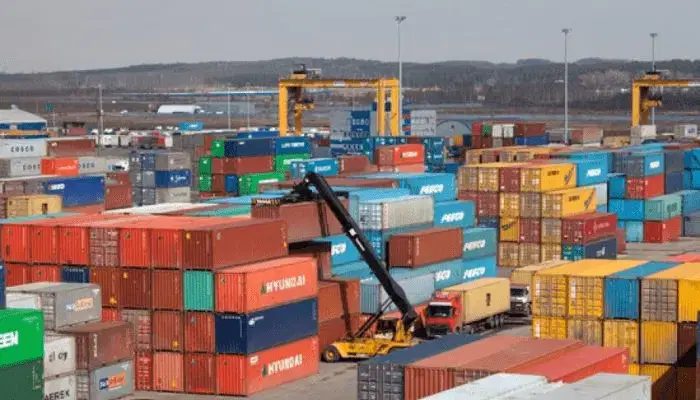
Dockworkers could shut down Nigeria’s ports next week unless terminal operators begin long-delayed negotiations on a new wage agreement. The warning comes from the Dockworkers Branch of the Maritime Workers’ Union of Nigeria (MWUN).
Speaking in Lagos on Wednesday, the branch President, Comrade Bolaji Agboola, said members were increasingly angry and frustrated. He accused operators of terminals and jetties covered by the National Joint Industrial Council (NJIC) agreement of stalling talks on a review of workers’ rates.
The previous agreement expired at the end of May 2026, with new rates due to take effect from June 1, according to Agboola. He argued that dockworkers should already be earning revised rates. He said the branch’s Executive Council could no longer contain the agitation.
He urged the Federal Government to intervene through the Nigerian Maritime Administration and Safety Agency (NIMASA). He wants operators at the table before the close of work this week. Otherwise, he warned, port operations may be disrupted next week.
Agboola said the leadership had kept engaging members to manage the situation, but patience was wearing thin.
Waterways News could not immediately reach terminal operators for comment.
NIGERIA WATCH
Why it matters. A shutdown at the ports would quickly reach importers, exporters, freight forwarders and the barge and jetty operators who feed cargo to and from the terminals. Any stoppage would also hit Nigeria’s push for faster cargo clearance.
Background. NIMASA convenes the NJIC. It is a tripartite arrangement for Collective Bargaining Agreements on minimum standards for the dock labour industry. Wage reviews have run on a roughly two-year cycle, and past rounds have also dragged. In 2021, union officials complained that talks were dragging even after proposals were tabled. In October 2023, MWUN threatened to resume a suspended strike after talks with shipping employers collapsed.
What to watch.
NIMASA’s move: Whether it convenes the parties before the end of the week.
Jetty coverage: Agboola’s complaint includes jetty operators under the NJIC. Jetties are already a flashpoint between dockworkers and operators.
Inland impact: Any slowdown at the terminals will affect the waterway operators and boat transporters who move goods and people around the Lagos ports.
Maritime Labour and Trade Union
Mental Health at Sea: Nigeria Leads Africa as NIMASA, ITF Seal Africa’s First Seafarer Mental Health Pact
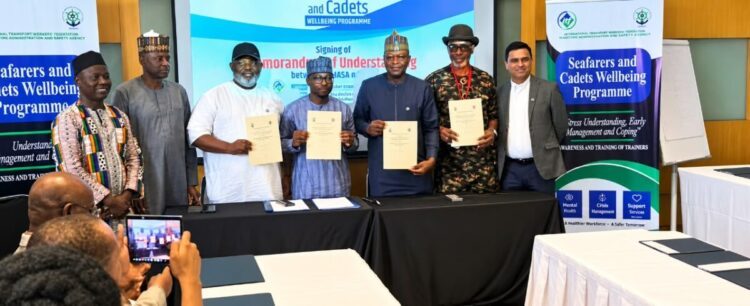
Mental Health at Sea: Nigeria Leads Africa as NIMASA, ITF Seal Africa’s First Seafarer Mental Health Pact
Agency and global transport union to embed wellbeing training in maritime curricula
By Okeoghene Onoriobe | Waterways News
The Nigerian Maritime Administration and Safety Agency (NIMASA) has signed a Memorandum of Understanding with the International Transport Workers’ Federation (ITF) to promote the mental health and wellbeing of Nigerian seafarers and cadets through training, awareness and capacity building.
The agreement was endorsed at the close of a three-day Seafarers’ and Cadets’ Wellbeing Awareness and Train-the-Trainers Programme, themed “Stress: Understanding, Early Management and Coping.” NIMASA organised the programme with the ITF.
NIMASA Director General Dr. Dayo Mobereola said the partnership will support capacity building and the integration of a wellbeing module into maritime training curricula. The goal is to make wellbeing a permanent part of preparing for life at sea. He was represented by the Executive Director, Maritime Labour and Cabotage Services, Mr. Jibril Abba, who signed for NIMASA.
In the DG’s words, seafarers’ wellbeing is “essential to safe shipping.” He said the programme will equip training institutions, agency officers and union partners to identify and manage stress and provide psychological first aid. He cited a 2019 ITF/Yale University study in which one in four seafarers surveyed showed signs of depression and about one in six showed signs of anxiety.
ITF Africa Regional Secretary Mr. Safiyanu Dauda Mohammed, who signed for the federation, said it is the first such agreement the ITF has entered into with any African country. “We are starting with Nigeria,” he said.
The President-General of the Maritime Workers Union of Nigeria (MWUN), Comrade Francis Bunu, welcomed the deal. He said seafarers need to be mentally sound to do their jobs, and called it a significant day for Nigerian seafarers.
Also present were the National President of the Nigerian Merchant Navy Officers and Water Transport Senior Staff Association, Chief Engr. Bob Joseph Yousou; ITF Wellbeing Coordinator Dr. Asif Altaf; and ITF Inspector Mr. Hamani Amadou.
The programme underscores the need to refocus attention on seafarers who work in difficult conditions and spend long periods away from their families. Both parties say the partnership reflects the principle that a healthy seafarer is a safe seafarer.
NIGERIA WATCH
A first for Africa, but delivery is the test. Nigeria’s lead position is a diplomatic win for NIMASA and the Federal Ministry of Marine and Blue Economy.
Seafarer welfare has been on NIMASA’s agenda for years. In 2018, then-DG Dakuku Peterside threatened sanctions on ship owners who defaulted on the seafarers’ contributory pension scheme. In early 2024, the ITF’s UK-based Seafarers Trust approved a grant for a seafarers’ recreation centre, to be built with MWUN and NIMASA. Stakeholders will want to know what became of those commitments before this one is celebrated.
What to watch out for:
Curriculum integration: Whether the wellbeing module actually enters the syllabi of Nigerian maritime institutions, and by when.
Funding and timelines: The announcement gives no budget, rollout schedule or reporting mechanism.
The Reach: The MoU speaks of seafarers and cadets. Many Nigerians who work on the water are informal inland operators, such as boat drivers and boat owners represented by groups like WABOTAN and ATBOWATON. They face stress, long hours and safety risks of their own. Whether wellbeing programmes will extend to this segment, or stop at the formal deep-sea workforce, is a fair question for NIMASA, NIWA and the ministry.
Mental health support is only as credible as its follow-through, and this MoU will be judged by what happens after the signing.
Maritime Labour and Trade Union
From Ship’s Deck to Union’s Helm: Bunu Honoured with MARCON Labour Leader Award

From Ship’s Deck to Union’s Helm: Bunu Honoured with MARCON Labour Leader Award
Named MARCON Labour Leader of the Year for Seafarer-to-President-General Rise
By Emetena Ikuku | Waterways News | Lagos
The President-General of the Maritime Workers’ Union of Nigeria (MWUN), Comrade Francis Bunu Abi, has been named Labour Leader of the Year by the Maritime Correspondents’ Organisation of Nigeria (MARCON). The award recognises his leadership, his push for workers’ welfare and his role in keeping industrial peace in the maritime sector.
MARCON said the honour reflects Bunu’s sustained advocacy for maritime workers’ rights, his commitment to collective bargaining and better conditions of service, and his efforts to promote safety and constructive engagement among organised labour, employers and government agencies.
The award was presented at the 2026 MARCON National Conference on Sustainable Fishing on Wednesday, September 30, at Rockview Hotel, Apapa, Lagos. Bunu was not physically present to receive it. The plaque was presented by the Secretary-General of the National Association of Government Approved Freight Forwarders (NAGAFF), Godfrey Nwosu, to MWUN Vice President-General, Comrade Matina Njoku, and Comrade Kenneth Ibanga, the union’s Deputy Secretary-General for Protocol and International Relations, who accepted on his behalf.
A career built at sea
Bunu is a seafarer by training. He worked aboard vessels, locally and internationally, before moving into union leadership.
His climb through MWUN spans more than two decades. It began as an ex-officio member of the Port Harcourt Seafarers Unit, and he became chairman of the unit in 2001. He was elected Rivers State District Chairman in 2005 and returned unopposed for a second term in 2009. In 2013 he became President of the Seamen/Seafarers Branch and served a second term there as well.
He was elected Deputy President-General of MWUN in 2021. In 2024, the International Transport Workers’ Federation (ITF) appointed him Dockworkers Regional Chairman.
On March 28, 2025, Bunu emerged unopposed as President-General at the union’s 6th Quadrennial National Delegates Conference in Lagos, succeeding Comrade Adewale Adeyanju. He is the first member of the Seafarers Branch to rise to the union’s top office.
Agenda under his leadership
Under Bunu, MWUN has stayed focused on workers’ welfare, collective bargaining, safety awareness and accident compensation. It has also kept up engagement with key agencies, including the Nigerian Maritime Administration and Safety Agency (NIMASA) and the Nigerian Ports Authority (NPA).
Bunu holds a Bachelor of Science degree in Business Administration from Rivers State University. He has also had international training in collective bargaining, employee rights, management, communication, performance enhancement and leadership.
Chairman of the MARCON Conference Planning Committee, Paul Ogbuokiri, said the award recognises Bunu’s long service to organised maritime labour and his steady progression through the union’s ranks. He said Bunu’s path shows the value of hands-on industry experience in representing workers and encouraging constructive engagement in the sector.
The conference, themed “Sustainable Fishing in Nigeria: Pathways to Growth, Food Security and Coastal Livelihoods,” brought together policymakers, regulators, industry operators, researchers and other stakeholders to discuss how to develop Nigeria’s fisheries sector sustainably.
Nigeria Watch
Bunu’s recognition is a reminder of who keeps Nigeria’s maritime economy running. Workers are the human backbone of shipping and port operations, yet their welfare and safety rarely get the attention that policy announcements, concession deals and investment pledges do.
His background deserves note. A union president who has worked as a seafarer is better placed to speak credibly on wages, safety and compensation. The test of that leadership is whether agreements reached with NIMASA, the NPA and employers translate into real protections on vessels and on the quayside.
The award also comes at a conference on fishing and coastal livelihoods. Many of the people in that value chain, from artisanal fishers to small-scale boat operators on creeks and inland waterways, work outside formal collective bargaining. For them, the gap between what policy promises and what is delivered is widest.
Waterways News will keep asking whether the welfare and safety gains won by organised labour reach informal operators who are also part of the union through the Commercial and Private Boats District.

 Oil and Gas8 months ago
Tantita’s Pipeline Deal: $144m Contract, Rising Output, and the Questions that Deserve Answers
 MARITIME TRADE & SHIPPING8 months ago
World’s Largest Container Ship Sets New Maritime Record with 22,233 TEUs on Single Voyage
 Blue Economy9 months ago
Nigeria’s Coast Guard Bill: A Solution in Search of a Problem?