
Blue Economy
MWUN LAGOS BOAT OPERATORS THROW WEIGHT BEHIND NIWA-PARTS CENTRAL CLEAN-UP, LINK REFUSE TO FATAL BOAT MISHAPS


MWUN LAGOS BOAT OPERATORS THROW WEIGHT BEHIND NIWA-PARTS CENTRAL CLEAN-UP, LINK REFUSE TO FATAL BOAT MISHAPS
Oghenewoke Osaweren | Waterways News
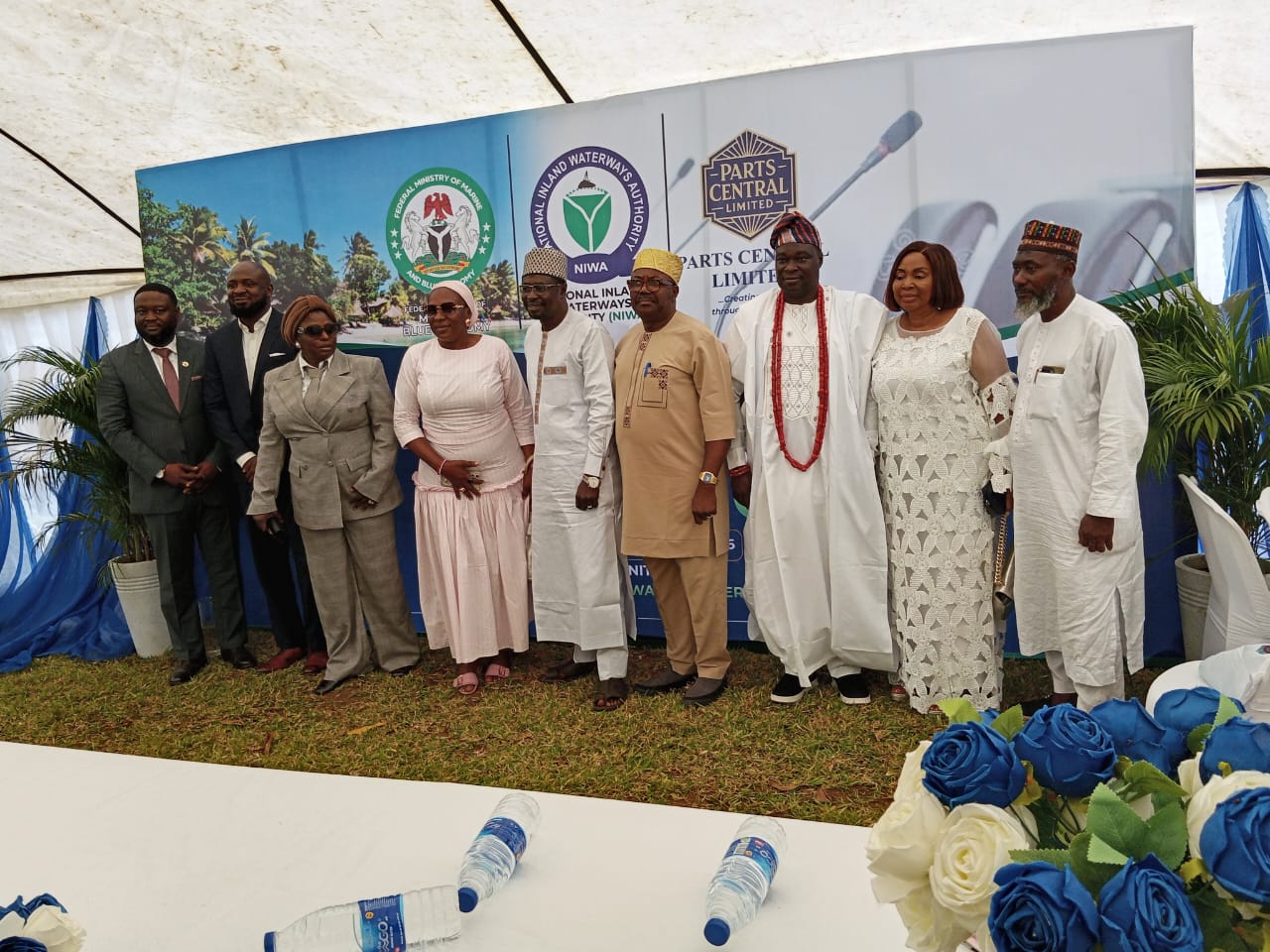
The Lagos Commercial Private Boat District of the Maritime Workers Union of Nigeria (MWUN) has thrown its full weight behind the nationwide inland waterways clean-up drive launched by the National Inland Waterways Authority (NIWA) in partnership with Parts Central Limited, with the union’s Lagos leadership tying refuse-choked channels directly to fatal accidents involving its members. District Chairman, Comrade Owolabi Omotayo, gave the commitment during a visit by Waterways News to his office, days after NIWA and Parts Central formally rolled out the 10-year renewable programme in Lagos on August 18.
Omotayo said dumped refuse had done considerable damage to boat operations under his district, with debris repeatedly fouling engines and, in some cases, triggering fatal mishaps on the water. He described MWUN as a formidable force in the maritime sector that would continue to back initiatives serving the positive development of Nigeria’s waterways.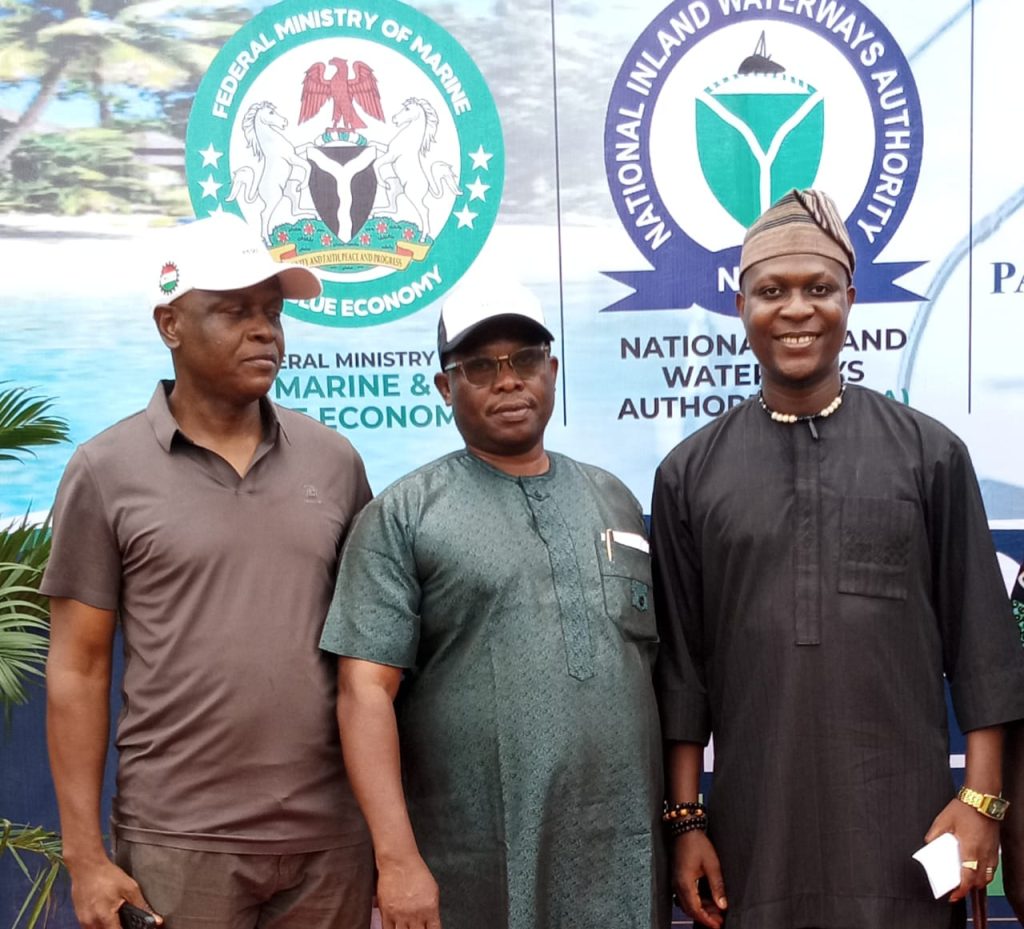
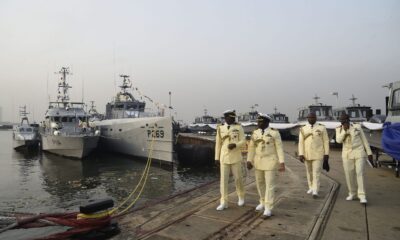
Officials of the Lagos Commercial and Private Boats District of Maritime Workers Union of Nigeria (MWUN) at the Waterways Clean-Up Initiative unveiling ceremony
His remarks align with concerns raised at the programme’s official unveiling, where NIWA’s Lagos Area Manager, Engr. Sarat Braimah, identified dredgers, tank farm operators, boat operators and waterfront owners as major contributors to pollution. Braimah pointed to waste-clogged stretches such as Kirikiri, where the water has turned blackish and unsafe, and argued that clean waterways are central to unlocking Lagos State’s blue economy potential, given that roughly a third of the state’s landmass is water.

Under the programme, boats and other watercraft are to be fitted with designated waste bins, while larger “mother bins” will be installed at jetties for operators to offload waste on docking. Parts Central’s Managing Director, Henry Onifade, said the company would deploy monitoring technology across waterfronts, landing ports and jetties to support enforcement and compliance.
For MWUN’s Lagos Commercial Private Boat District, the concern is immediate: members navigate the same debris-strewn channels daily, and engine damage from floating refuse remains a recurring hazard blamed for accidents on the water. Omotayo’s pledge marks a notable alignment between grassroots labour interests and a federal-private clean-up drive, one that will face its real test as the programme shifts from launch to enforcement across Lagos’s waterfronts.
NIGERIA WATCH
Omotayo’s endorsement adds MWUN’s Lagos boat operators to a widening coalition of inland waterway stakeholders lining up behind the NIWA-Parts Central initiative, following SWAAADO’s earlier backing of the same programme. That two separate operator groups, one a registered trade union, the other a registered NGO advocating for a safe and sustainable waterways, have independently, cited fatal engine-fouling incidents as their reason for support suggests the safety argument, not just the environmental one, is what is actually moving grassroots operators to embrace a clean-up scheme historically viewed with scepticism by informal waterway workers.
The pattern is familiar to anyone tracking Lagos’s inland waterways: policy launches attract enthusiastic institutional and labour endorsements, but delivery on the ground — mother bins actually installed at jetties, monitoring technology actually deployed, waste actually collected rather than left to drift back into the channels operators use daily — has historically lagged the announcements. NIWA and Parts Central have set themselves a 10-year renewable timeline; the coming months, as the programme moves from its August 18 unveiling into enforcement, will show whether the operational commitments match the goodwill MWUN and SWAAADO have extended.
Worth watching also is the jurisdictional backdrop: any waterfront enforcement regime in Lagos inevitably intersects with the long-running NIWA-LASWA tussle over control of the state’s waterways. Whether Parts Central’s monitoring technology and enforcement plans are coordinated with, or contested by, LASWA’s own waterfront authority will likely determine how smoothly this clean-up initiative translates from paper to practice.
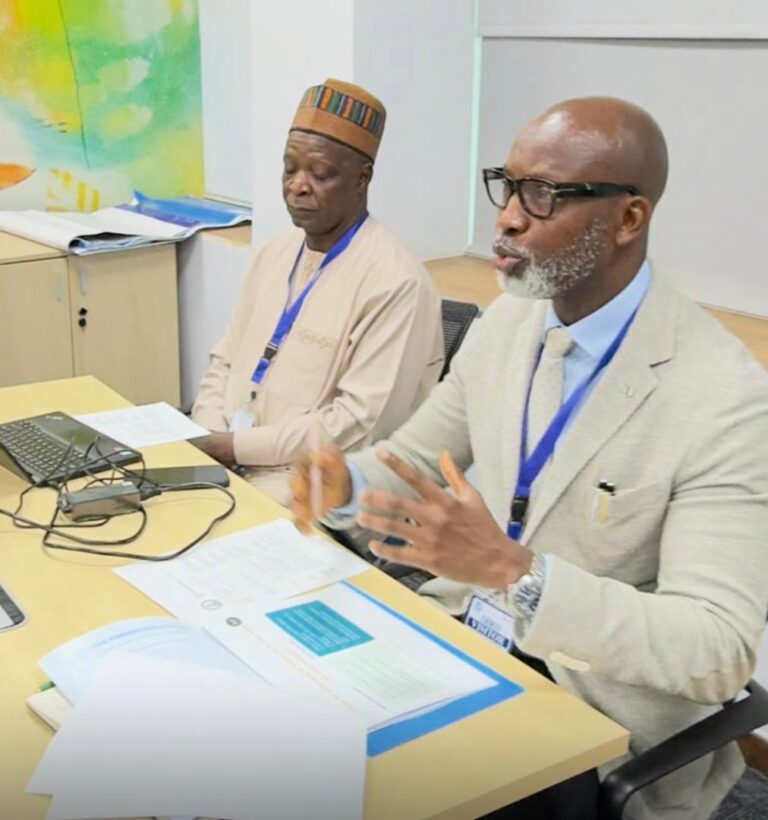
$200m Fish Lifeline: FG Taps World Bank Funds to Push States Towards Fish Sufficiency
Oyetola Sets Sights on Net Exporter Status as FG Secures $200m World Bank Backing for State-Led Aquaculture
By Okeoghene Onoriobe | Waterways News
The Federal Government says it has secured a $200 million commitment from the World Bank Group to drive fisheries and aquaculture production nationwide, as it moves to cut fish imports and close a supply gap of more than 2.2 million tonnes.
The money will be lent to state governments on concessional terms. It is meant to help them expand fish production, attract investment and build viable aquaculture projects.
The Minister of Marine and Blue Economy, Dr Adegboyega Oyetola, announced this at an Executive Training on the Aquaculture Investment Guide, organised by his ministry with the World Bank Group in Abuja. He was represented by the Senior Special Assistant to the President on Marine and Blue Economy, Professor Busayo Fakinlede.
Oyetola said fish is central to food security, household nutrition and rural livelihoods, and that Nigeria cannot be food secure while importing most of its fish. He said the goal is to “produce more, import less” and eventually become a net exporter, which he said requires every state to play its part.
The numbers
Nigeria needs about 3.6 million tonnes of fish a year but produces roughly 1.4 million tonnes. Imports cover the gap and cost nearly $1 billion annually in foreign exchange.
State-driven framework
Under the ministry’s framework, each state is expected to:
identify priority aquaculture value chains
assess investment readiness
develop bankable project pipelines
commit to measurable contributions to national fish output
The training brought together commissioners from Rivers, Bayelsa, Delta and Cross River States, plus permanent secretaries and directors of fisheries and aquaculture from across the federation. It covered business models, risk management, environmental and social safeguards, and public-private partnerships.
A Federal-State interface is also planned to coordinate a national fish security strategy.
Oyetola commended the World Bank for its support on analytical studies, cluster-based development, capacity building and the Aquaculture Investment Guide. He will oversee a post-training stakeholders’ roundtable with states and other stakeholders to sustain momentum.
Ministry’s scorecard
Fakinlede credited the minister’s leadership for:
the August 2026 inauguration of the Technical Committee on Accelerating Fish Production
digitisation of fish import licensing
a rise in national output from 1.1 million to 1.4 million tonnes
US shrimp-export certification after compliance with Turtle Excluder Device requirements
the Fish City and Fish Terminal investment portfolio to attract private capital
NIGERIA WATCH
Read the fine print. As of 9 November, I could not find a published World Bank project document for the $200 million, and the figure rests on the ministry’s statement. The repayment period, interest rate, per-state allocation and disbursement date have not been made public, and it is unclear whether this is new money or part of financing already agreed. Waterways News should press the ministry on these before treating the figure as settled.
Loans, not grants. States carry the debt and must show bankable projects. Strong states like Rivers, Bayelsa, Delta and Cross River, whose commissioners attended, sit on the water and are best placed to benefit. Inland and riverine communities lacking project-preparation capacity risk being left behind.
The missing small operators. The framework speaks of investors, PPPs and bankable pipelines. It says little about artisanal fishers, boat operators and fishing communities, including those represented by WABOTAN and ATBOWATON, who supply and move much of the country’s fish. Without cold chains, landing jetties, safe water transport and affordable engines, higher production will not reach markets.
Policy versus delivery. The target is ambitious, with output reportedly up from 1.1 million to 1.4 million tonnes. Yet Nigeria still meets under 40 per cent of its fish demand, and it has heard similar promises before, from the Cabotage Vessel Financing Fund onward. The test is whether the roundtable produces dates, allocations and measurable state commitments.
Blue Economy
Oyetola Takes Nigeria’s Case on Gulf of Guinea Security and Seafarer Welfare to IMO Council in London
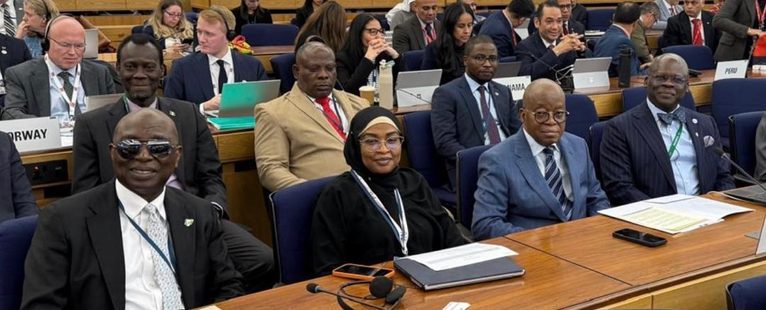
Oyetola Takes Nigeria’s Case on Gulf of Guinea Security and Seafarer Welfare to IMO Council in London
Minister says seafarers must not become casualties of geopolitical disputes as Nigeria presses for stronger technical support for developing maritime nations
By Ighoyota Onaibre | Waterways News
Nigeria’s Minister of Marine and Blue Economy, Dr. Adegboyega Oyetola, has restated the country’s commitment to safe, secure and sustainable international shipping. He is leading a high-level delegation to the 138th session of the International Maritime Organization (IMO) Council in London.
The five-day session opened on November 2 at the IMO headquarters and ends today, November 6, 2026. Nigeria’s participation is meant to strengthen its voice in global maritime governance and to advance the interests of developing maritime nations.
Nigeria sits on the 40-member Council under Category C. The session is considering the protection of vital shipping routes, the welfare and safety of seafarers, institutional governance and the sustainability of the global maritime industry.
Protecting vital shipping lanes
A central issue is the protection of strategic shipping routes against growing security threats and attacks on commercial vessels in high-risk zones. Under Agenda Item 11, “Protection of Vital Shipping Lanes,” Nigeria is expected to draw on its experience combating piracy and maritime crime in the Gulf of Guinea to push for stronger international cooperation and coordinated security responses.
“Nigeria recognises that the challenges confronting the global maritime industry require collective action, stronger international cooperation and effective regulatory frameworks,” Oyetola said. He added that Nigeria was at the Council to see its interests represented and to contribute to solutions that strengthen maritime security, protect seafarers and promote sustainable shipping.
He said the progress made in the Gulf of Guinea showed that maritime insecurity can be tackled “through political commitment, effective coordination and cooperation among regional and international partners.”
Seafarer welfare
Seafarer welfare is also high on the agenda. This follows IMO Secretary-General Arsenio Dominguez’s condemnation of the use of seafarers as pawns in geopolitical disputes. Nigeria is backing measures to prevent the arbitrary detention and abandonment of seafarers, and to ensure their fair treatment, safe repatriation and mental well-being.
“Seafarers are the lifeblood of international shipping,” Oyetola said. “Their safety, dignity and welfare must never be compromised by geopolitical tensions.”
Budget and capacity building
The Council is also reviewing financial allocations for the 2026–2027 biennium and strategic priorities for 2028–2029. Nigeria sees this as an opening to push for more technical cooperation and capacity-building support for developing maritime countries.
Oyetola said developing maritime nations “must have access to the technical expertise, institutional support and investment opportunities required to participate meaningfully in the evolving global shipping industry.”
The delegation
The minister is accompanied by:
The Permanent Secretary, Federal Ministry of Marine and Blue Economy, Mrs. Fatima Mahmood
The Director-General of NIMASA, Dr. Dayo Mobereola
The Director of Maritime Services, Mr. Oyinloye Meshack
Nigeria’s Alternate Permanent Representative at the IMO, Mr. William Bwala
Nigeria Watch
A heavy session. The Council has dealt with more than Nigeria’s agenda this week. Other delegations have also pressed seafarer protection and freedom of navigation, with Liberia and Indonesia among the countries that raised them. The session has also given attention to security in the Strait of Hormuz and the Black Sea. On Wednesday, the Council recommended a second four-year term for Secretary-General Arsenio Dominguez, running from 2028 to 2031. The IMO Assembly must still approve it in 2027. Nigeria’s message on the Gulf of Guinea has been delivered in a crowded room.
Hormuz is a Nigerian issue. This newsroom has followed the Strait of Hormuz crisis closely, from rising freight rates to war-risk insurance premiums at Nigerian ports. Oyetola’s call to shield seafarers from geopolitical tension is not abstract. Dominguez has said thousands of seafarers in the region live and work under heightened risk, and the IMO’s tally of seafarers killed in the region since February stood at 24 as of November 5.
Where the Gulf of Guinea story stands. Nigeria is presenting its Gulf of Guinea record as a model, and the Deep Blue Project is the backbone of that claim. NIMASA has just showcased upgraded assets at AFRIDEX 2026. Delegates in London will weigh the narrative against what stakeholders at home actually experience on the water.
The home test. Nigeria’s arguments at the IMO for seafarer dignity, fair treatment and capacity-building support will carry weight in proportion to how well they are matched at home.
Questions that Waterways News continues to raise:
Do Nigerian seafarers and inland waterway workers enjoy the safety and welfare standards the minister is championing abroad?
Will the technical cooperation Nigeria is seeking reach small-scale and informal waterway operators, such as those under WABOTAN and ATBOWATON, or stay at the policy level?
With Nigeria holding a Council seat, how will diplomatic wins in London be turned into delivery at home, from CVFF disbursement to NPERA implementation?
Waterways News will keep tracking the outcome of the 138th Council session and what it means for Nigerian maritime stakeholders.
Blue Economy
NIWA Deploys Enforcers to Niger Waterfronts as Boat Operators Cry Out Over Life Jacket Shortage
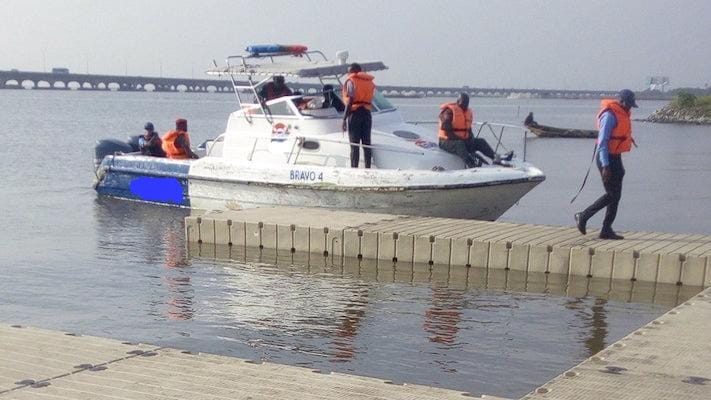
NIWA Deploys Enforcers to Niger Waterfronts as Boat Operators Cry Out Over Life Jacket Shortage
Operators say a 300-seater has only seven jackets, and ask for prices to drop from N20,000 to as low as N5,000
By Raymond Gold | Waterways News
The National Inland Waterways Authority (NIWA) has sent enforcement personnel to waterfronts across Niger State to make life jacket use compulsory and ensure compliance with inland waterways safety rules.
NIWA’s Minna Area Manager, Akapo Adeboye, announced this at the 2026 Sensitisation and Enlightenment Campaign on Inland Waterways Regulations at Zumba Waterfront, Shiroro Local Government Area. The campaign theme was “Total Safety Measures and Compliance on the Nation’s Inland Waterways.”
Adeboye said NIWA has given 3,500 life jackets to boat operators at waterfronts across the state. He was troubled, however, that some operators neither wear the jackets nor provide them for passengers during trips.
He also condemned operators who charge passengers extra to use a life jacket, saying this discourages compliance. He said the safety of lives and property remains a priority of the Federal Ministry of Marine and Blue Economy, and that operators and passengers alike must wear life jackets before boarding. Violators, he warned, will face the full weight of the law.
Some operators at the event said scarcity and cost make full compliance impossible.
Adamu Gunduma said his boat carries 300 passengers but he has seven life jackets, one of them for himself. The other six go to passengers on a first-come, first-served basis.
Adamu Tanko said his 150-passenger boat has three life jackets.
Saidu Sani said his 40-passenger boat has none, for himself or his passengers.
Abubakar Mamman-Kwanu appealed to government and other stakeholders for more jackets through donations and support programmes.
The operators said a life jacket costs about N20,000 on the market and asked authorities to bring the price down to between N5,000 and N6,000. They added that high prices and falling farm-produce prices could keep many farmers from buying one. Farmers, they said, make up a large share of water transport users in the area. They called for stronger government intervention, arguing that easier access to life jackets would improve compliance and prevent avoidable deaths.
The News Agency of Nigeria (NAN) first reported the development on Monday.
Nigeria Watch
Enforcement is arriving before supply. Gunduma, Tanko and Sani together operate boats licensed for 490 passengers, yet they reported 10 life jackets between them. Telling such operators to refuse boarding without a jacket is, for now, an order they cannot obey. Cheap jackets must reach waterfronts before penalties are enforced, or enforcement will fall hardest on the poorest operators.
NIWA has also faced a misuse problem. Adeboye said in an earlier interview that people sell the jackets, use them as pillows or farm tools. He said that when his team revisited a waterfront after a 3,500-jacket flag-off, they could not find one in use. Both complaints can be true at once, and the way out is a mix of local ownership, fitting by boat capacity and visible checks by marshals.
The stakes are real and well documented. After a July 2025 mishap at Zumba, Adeboye said 26 passengers wearing life jackets were rescued alive, 15 bodies were recovered and three people were missing. He noted that the incident came eight days after a NIWA sensitization campaign at the same waterfront.
Marshals and penalties are already in place. Waterways marshals were inaugurated at Zumba to enforce transport regulations. Adeboye has also said NIWA gazetted penalty codes for operators and passengers who fail to comply. The open question is whether operators get realistic access to compliance before sanctions bite.
Questions for NIWA and the Ministry of Marine and Blue Economy:
How many jackets are needed to cover the licensed capacity of boats at Niger waterfronts, against the 3,500 supplied?
Can bulk procurement or local assembly bring the N20,000 price down?
Will NIWA publish compliance figures and sanctions issued after the campaign?

 Oil and Gas8 months ago
Tantita’s Pipeline Deal: $144m Contract, Rising Output, and the Questions that Deserve Answers
 MARITIME TRADE & SHIPPING8 months ago
World’s Largest Container Ship Sets New Maritime Record with 22,233 TEUs on Single Voyage
 Blue Economy9 months ago
Nigeria’s Coast Guard Bill: A Solution in Search of a Problem?