
Maritime Education
NIMASA Hands New Building to UNIZIK Maritime Institute, But Handover Exposes Gaps Between Donation and Delivery



NIMASA Hands New Building to UNIZIK Maritime Institute, But Handover Exposes Gaps Between Donation and Delivery
By Okeoghene Onoriobe | Waterways News
A new one-storey facility built for the Institute for Maritime Studies (IMS) at Nnamdi Azikiwe University, Awka, changed hands on Friday, September 4, 2026, in a ceremony that combined celebration of a long-awaited capital project with candid admissions that the building is not yet ready for use.
The Nigeria Maritime Administration and Safety Agency (NIMASA) authorised the handover of the completed structure to the university’s management, though only for security monitoring pending a formal commissioning still to come. The facility, which houses an open-office unit and a lecture hall, was constructed by MP Infrastructure Limited under a contract NIMASA describes as part of its programme of giving back to maritime training institutions across the country.
Speaking at the event, the Director of IMS, Prof. Ifeanyi C. Enete, thanked NIMASA for the donation and praised the contractor for what he called a beautiful and befitting structure, while crediting the Vice Chancellor, Prof. Ugochukwu Bond Stanley Anyaehie, for sustained support to the Institute. But Prof. Enete used the same platform to flag what is missing: computers, projectors and screens, photocopiers and stabilisers still need to be supplied before the building can function, and he appealed to the university to demarcate and allocate offices so the Institute can begin using the space without further delay.

The Director of Projects at MP Infrastructure, Engr. Sunny Osuki, told the gathering that the project was originally meant for a site near Onitsha but was relocated after water-related problems there, on the suggestion of the firm’s Managing Director, Dr Clem Nwogbo, who proposed siting it at UNIZIK to bring the facility closer to students. He said the building had in fact been completed months ago, but NIMASA had wanted to commission it together with a separate lecture-hall building still under construction nearby.
The handover procedure itself briefly became a point of scrutiny. Prof. Anyaehie initially queried the process, noting that a contractor would ordinarily hand a facility over to the awarding agency, NIMASA, which would then hand it to the beneficiary institution, as NIMASA, being the party that set the contract terms, is best placed to confirm that the specifications had been met. After further explanation from the contractor’s representative, the Vice Chancellor accepted the building on the university’s behalf strictly for security purposes ahead of the formal commissioning, and instructed the Chief Security Officer, Mr Obi Collins, to secure and monitor the premises.
In a vote of thanks, the Dean of the Faculty of Engineering, Prof. Ugochukwu Okonkwo, acknowledged NIMASA’s award of two structures to the university — one complete, one still rising — and thanked Dr Nwogbo, recalling the contractor’s earlier donation of chairs to the Department of Mechanical Engineering and his honorary doctorate from UNIZIK.
Nigeria Watch
The UNIZIK handover lands in a familiar pattern for readers who track NIMASA’s institutional-support projects: a physical asset arrives, but its usability trails behind.
That the IMS Director felt compelled to publicly list outstanding fittings, down to stabilisers and photocopiers, at what was billed as a handover ceremony says as much about the state of maritime training infrastructure funding as the donation itself does. A lecture hall and office block are of limited value to a maritime studies institute if the computers and projectors needed to run modern maritime curricula are still pending procurement.
The awkward, publicly aired question over handover procedure — should the contractor hand over to NIMASA first, or can it go straight to the beneficiary institution — also points to a wider governance gap this desk has flagged repeatedly around agency-funded capital projects in the maritime education space: unclear lines of accountability for verifying that contract specifications are actually met before assets change hands. UNIZIK’s Vice Chancellor deserves credit for raising the question rather than simply accepting the keys.
For an Institute that trains the next generation of Nigerian maritime professionals, the real test will not be Friday’s ceremony but whether NIMASA and MP Infrastructure follow through on the outstanding equipment list, and whether the still-under-construction second building, cited by both the IMS Director and the Engineering Dean, is delivered on a timeline that matches NIMASA’s own commissioning plans.
Waterways News will be watching for the formal commissioning date and for confirmation that the Institute has taken physical possession of its offices.

Maritime Education
NIMASA Opens 2026 World Maritime Day Essay Contest, Offers N1m Top Prize to Students
NIMASA Opens 2026 World Maritime Day Essay Contest, Offers N1m Top Prize to Students
By Okeoghene Onoriobe | Waterways News
The Nigerian Maritime Administration and Safety Agency (NIMASA) has thrown open its 2026 World Maritime Day Essay Competition, calling on students of Nigerian tertiary institutions to put pen to paper on the theme “From Policy to Practice: Powering Maritime Excellence.”
The competition, organised annually to mark the International Maritime Organization’s World Maritime Day, is designed to draw young Nigerians into thinking critically about the maritime sector and to surface fresh ideas for closing the gap between policy pronouncements and what actually happens on the ground in the industry.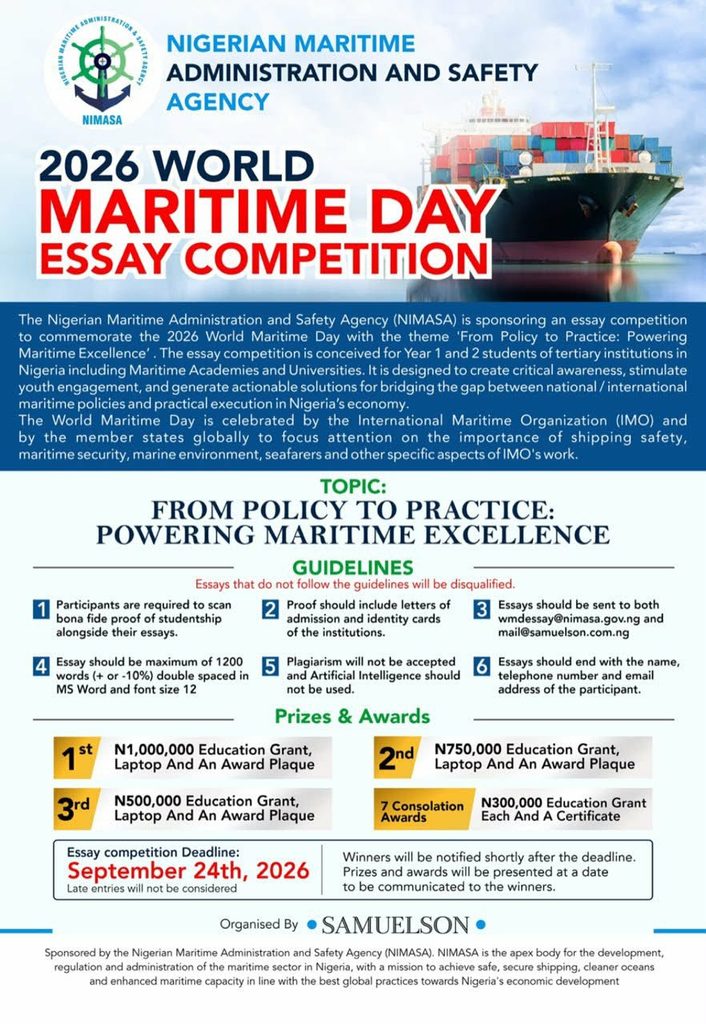
Entry is open to Year 1 and Year 2 students across Nigerian universities and maritime academies. Essays must not exceed 1,200 words (plus or minus 10 percent), typed double-spaced in 12-point font on Microsoft Word, and submitted alongside proof of studentship such as an admission letter and a valid institutional ID card. NIMASA has also stipulated that entries must be entirely original, with the use of artificial intelligence tools in drafting explicitly barred alongside the standard prohibition on plagiarism.
Prizes on offer are the most generous in the competition’s recent history. The overall winner takes home a N1,000,000 education grant, a laptop, and an award plaque, with the winning essay also earning wider publication. Second place attracts N750,000 plus a laptop and plaque, while third place comes with N500,000 and the same non-cash rewards. Seven consolation prizes of N300,000 each, alongside certificates, will also be awarded.
Interested students are to send completed essays to the designated NIMASA submission addresses ahead of the stipulated deadline, after which late entries will not be entertained. Winners will be contacted directly once judging is concluded, with a date for the prize presentation to be announced later.
Nigeria Watch: A Bigger Purse, and a Theme That Puts NIMASA’s Own Delivery Record on Trial
This year’s prize pool — nearly double the N500,000 top prize offered in previous editions — signals how much premium NIMASA under Dr. Dayo Mobereola is placing on youth engagement as a plank of its reform agenda. But the theme chosen, “From Policy to Practice: Powering Maritime Excellence,” is a double-edged one for an agency whose own record of translating maritime policy into delivered outcomes remains a live question for stakeholders across the sector.
Students asked to interrogate the space between policy and practice will not have to look far for material. The Cabotage Vessel Financing Fund’s long-running disbursement saga, the jurisdictional tug-of-war between NIWA and LASWA even after Supreme Court intervention, and the slow implementation runway of the NPERA Act are all live case studies of exactly the gap NIMASA is now asking undergraduates to write essays about. Whether the agency is prepared to have its own performance measured against the standard it is setting for the competition is a question worth watching as entries and, eventually, a winning essay, begin to surface.
For the informal and small-scale operators Waterways News covers closely, including cooperatives like WABOTAN and ATBOWATON, the competition is a reminder that youth-facing maritime initiatives tend to be better funded and more visible than the welfare and safety interventions aimed at operators already working the waterways. A fresh generation of maritime thinkers is welcome; so too would be faster movement on the policy questions this year’s essay theme itself puts in the spotlight.
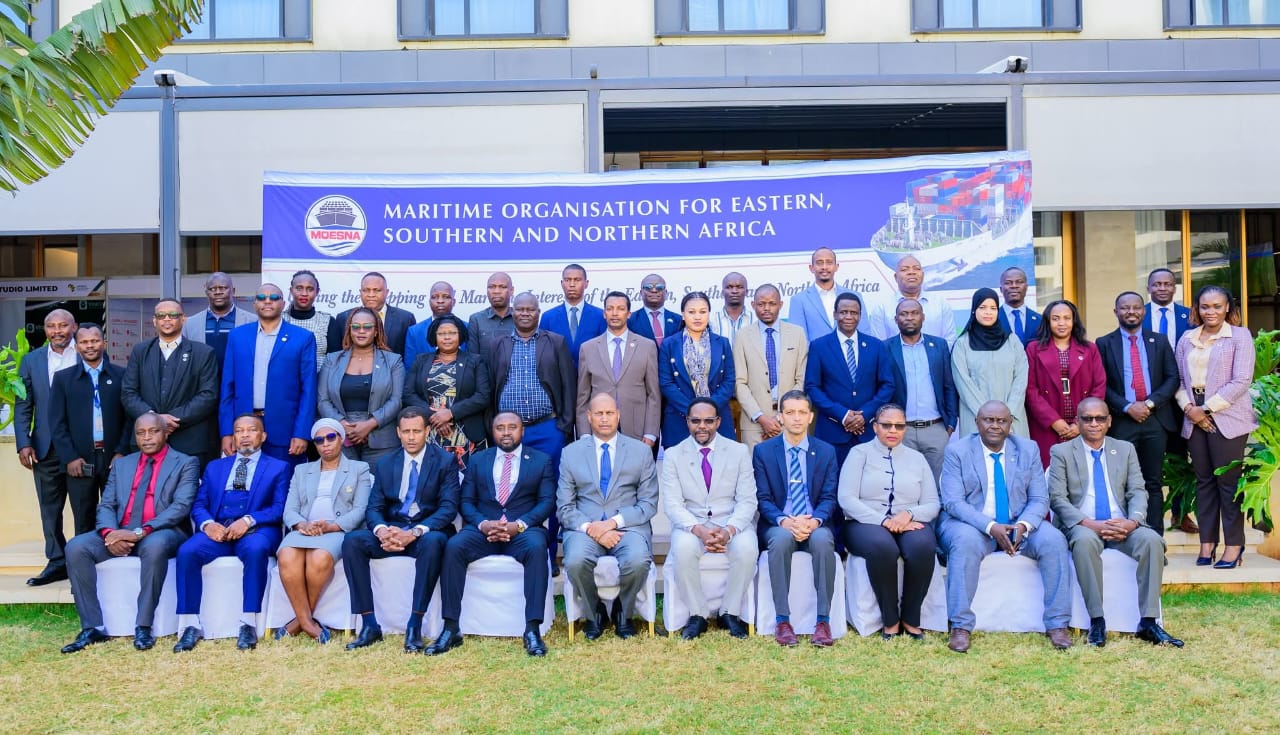
AFRICA MOVES TO PLUG MARITIME SKILLS GAP WITH PROPOSED REGIONAL MARITIME UNIVERSITY
A feasibility study has laid out plans for a Regional Maritime University (RMU) to serve Eastern, Southern and Northern Africa, aimed at closing a widening shortage of certified maritime professionals across the region through stronger training, deeper research capacity and better access to compulsory sea-time.
The study, carried out by Professor Anish Hebbar, an Associate Professor at the World Maritime University (WMU), reviewed maritime education and training systems in member states of the Maritime Organization for Eastern, Southern and Northern Africa (MOESNA). It examined existing institutions, training capacity, infrastructure, regulatory compliance and industry demand to test whether a regional university is viable.
Presented to industry stakeholders for validation, the study envisions an institution capable of producing seafarers, marine engineers, port specialists and maritime policy professionals who can compete internationally, while boosting the region’s share of the global maritime labour market.
Despite the MOESNA region hosting roughly 731 universities and higher institutions overall, only 21 are recognised Maritime Education and Training (MET) centres. Kenya leads with 11, Tanzania has four, Ethiopia and Uganda have two apiece, while the Democratic Republic of Congo and Malawi have just one each. Botswana, Burundi and Zambia have none.
Even where MET institutions exist, the study found they are struggling to turn enrolment into certified, employable graduates. Limited access to mandatory sea-time, weak practical facilities and thin ties to shipping companies were identified as the main reasons students fail to complete certification. Of 26 maritime agencies and institutions surveyed, 84.6 percent said training infrastructure, particularly simulators, workshops and sea-time placements, needs significant upgrading to meet the practical training standards under the IMO’s STCW Convention.
The report argues that a shared regional university would let member states pool resources for costly assets such as simulators, training vessels and engineering labs that individual countries cannot afford alone, and recommends the RMU build long-term partnerships with shipping lines, port authorities and maritime administrations to lock in cadet placements and improve graduate employability.
The push comes against a global backdrop of officer shortages. BIMCO and the International Chamber of Shipping project a worldwide shortfall of 39,100 certified officers by 2026, even with a surplus of ratings. Researchers say Africa, where over 60 percent of the population is under 25, is well placed to help fill that gap, yet the continent supplies only about 4 percent of the world’s seafarers. Within MOESNA specifically, the region contributed just 4,947 seafarers in 2021, or 0.26 percent of global supply, with Tanzania accounting for nearly 90 percent of that figure while Kenya, despite having the most MET institutions, supplied only 185.
Higher-level maritime education is another weak point. Out of the 21 MET institutions, only five offer bachelor’s degrees, one offers a master’s, and none offers a doctoral programme, limiting research and the pipeline of future maritime educators. The proposed university would offer degree and postgraduate programmes alongside certification and specialised training in marine engineering, maritime law, port management, logistics, environmental protection, safety, digital technologies and the blue economy, with stakeholders pushing for added focus on AI, automation, green shipping, maritime cybersecurity and alternative fuels.
International recognition remains limited too. Only Kenya, Tanzania and Ethiopia sit on the IMO White List, and only Ethiopia is recognised by the European Maritime Safety Agency. The study argues a single regional university could harmonise standards and improve the mobility of African seafarers internationally.
Gender representation was flagged as another gap, with women making up about 23 percent of enrolment at selected African maritime institutions and roughly 1 percent of the global seafaring workforce. The study recommends scholarships, mentorship, affordable tuition and stronger welfare support to widen access for women and disadvantaged students.
Overall, the study concludes an RMU would strengthen training, research and regional harmonisation, but cautions its success will hinge on sustained political will, predictable funding, sound governance and durable industry partnerships to guarantee graduates the practical exposure they need for certification and jobs.
Nigeria Watch
Nigeria is not a MOESNA member, but the story lands close to home. The skills and sea-time crisis the study describes in Eastern, Southern and Northern Africa is, almost point for point, the same crisis Nigerian maritime training has wrestled with for years at the Maritime Academy of Nigeria (MAN), Oron. Crises such as inadequate simulators, thin industry linkages, and cadets who complete coursework but stall at the certification stage for want of guaranteed sea-time berths.
The MOESNA study’s core diagnosis, that no single country can afford the full suite of simulators, training vessels and labs needed to meet STCW practical standards, so nations must pool resources, is a direct echo of arguments Nigerian stakeholders have made about NIMASA’s Nigerian Seafarers Development Programme (NSDP) and the long-running push to secure guaranteed cadet berths with international shipping lines. It also reinforces a point Nigerian commentary has made repeatedly that certification without sea-time is a dead end, and no amount of classroom capacity fixes that on its own.
There is a regional-diplomacy angle too. As West Africa’s Maritime Organization for West and Central Africa (MOWCA) region watches ECOWAS states debate similar training and cabotage-financing gaps, the MOESNA initiative is a useful comparison for how a regional bloc can formalise shared training infrastructure rather than each country building parochial, underfunded institutions. Nigeria’s own Cabotage Vessel Financing Fund (CVFF) debate, where small operators struggle to raise capital for modern vessels, mirrors the MOESNA study’s finding that individual states cannot shoulder capital-intensive maritime infrastructure alone.
The gender and youth findings also resonate. With women accounting for a small share of enrolment and an even smaller share of the seafaring workforce globally, and with Nigeria’s own maritime training bodies facing similar underrepresentation, the MOESNA recommendations on scholarships and welfare support add to a growing continental case for deliberate inclusion policy in maritime education, one Nigerian regulators and training institutions would do well to track as they shape their own reform agendas.
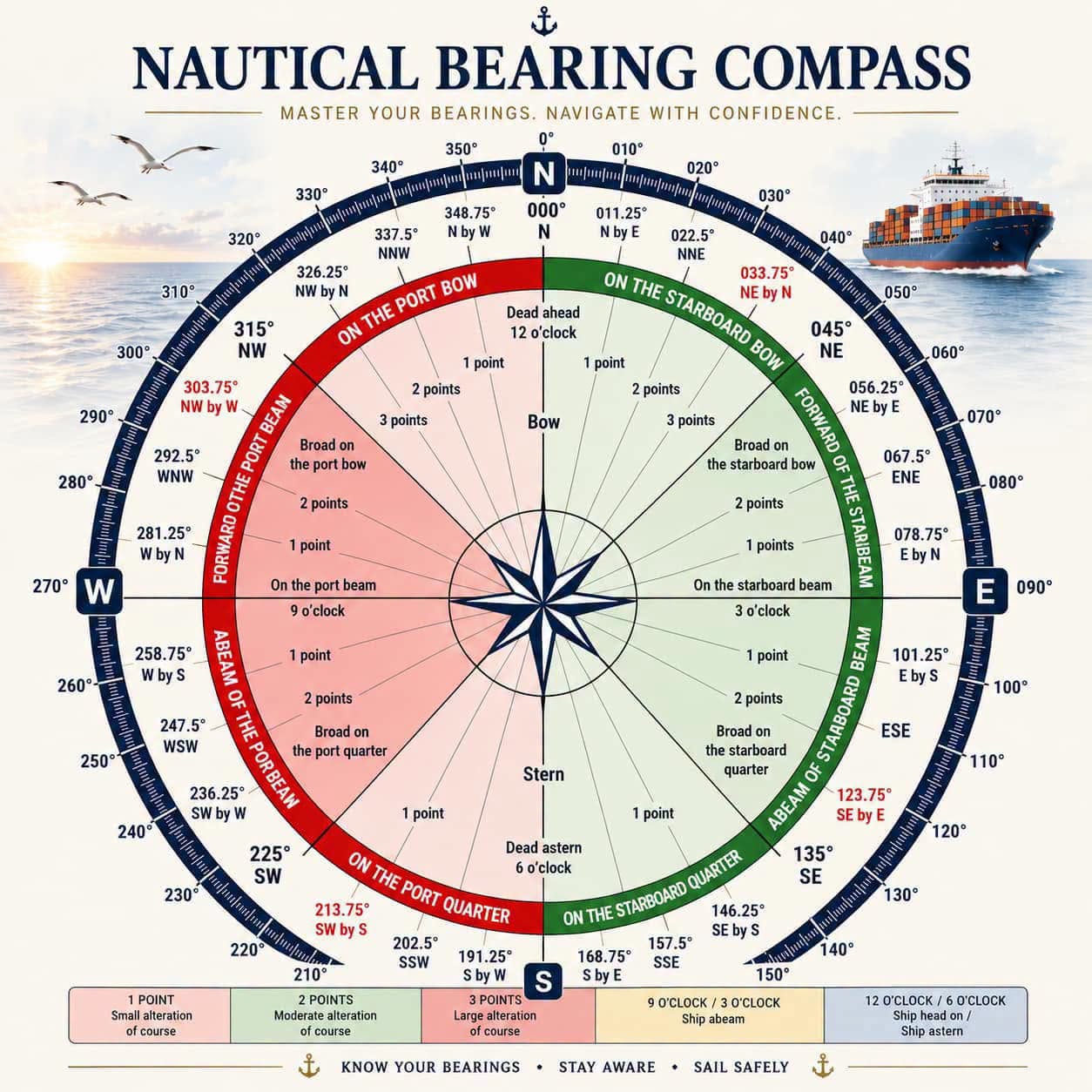
Reading the Compass: Why Every Seafarer Must Master the Art of Nautical Bearinngs
Okeoghene Onoriobe | Waterways News | Maritime Training & Safety Desk
For every cadet stepping onto the bridge for the first time, and for every seasoned officer who has spent decades navigating open water, one skill remains constant and non-negotiable: the ability to read a nautical bearing compass with speed, accuracy, and confidence. It is, in many ways, the language of the sea — a silent but precise system that tells a mariner exactly where danger, land, or another vessel lies in relation to their own ship.
Maritime trainers and navigation officers across Nigeria’s waterways continue to emphasise that bearings are not merely academic knowledge tested in cadet examinations. They are a working tool used every single day, in every watch, on every voyage, from the busy shipping lanes of Lagos and Bonny to the open expanse of the Gulf of Guinea.
What Exactly Is a Bearing?
In the simplest terms, a bearing is a direction, expressed in degrees, that shows the position of one object relative to another. At sea, this most often means the direction of another vessel, a navigational hazard, a buoy, or a landmark, relative to the observer’s own ship.
Bearings are measured using a full 360-degree scale, beginning at 000° and running clockwise back around to 360°. This system removes the ambiguity that comes with vaguer descriptions like “somewhere off to the side” or “up ahead” — replacing guesswork with a precise, universally understood figure that any officer, anywhere in the world, can immediately interpret.
The Ship as a Clock
One of the most effective ways navigation instructors teach bearings, particularly to new cadets, is by comparing the vessel to the face of a clock, with the ship’s bow representing 12 o’clock.
Using this method, the key reference points break down are as follows:
- 000° (12 o’clock) : Dead ahead, directly in line with the bow
- 090° (3 o’clock) : On the starboard beam, directly to the right of the vessel
- 180° (6 o’clock) : Dead astern, directly behind the ship
- 270° (9 o’clock) : On the port beam, directly to the left of the vessel
Every other bearing falls somewhere between these four cardinal reference points, allowing an officer to describe, with pinpoint accuracy, the exact direction from which another vessel is approaching or where a hazard has been sighted.
Beyond straight degree readings, seafarers also rely on nautical points of the compass, most commonly one, two, or three points, to describe how large or small a change in direction is. A one-point alteration signals a slight adjustment in course or bearing, while a two-point or three-point shift indicates a more moderate or significant change. This shorthand allows for quick, efficient communication on the bridge, particularly during time-sensitive manoeuvres.
Beam, Bow, Quarter and Stern: The Vessel’s Points of Reference
To fully grasp bearings, mariners must also understand the fixed reference points on their own vessel:
- Bow :- The forward-most point of the ship
- Beam :- The midpoint along either side of the vessel, at a right angle to its length
- Quarter :- The area between the beam and the stern, on either the port or starboard side
- Stern :- The rear-most point of the vessel
Together with the 360-degree bearing scale, these reference points form a complete navigational vocabulary, enabling officers to describe the position of any object around their ship with total clarity, whether it is fine on the port bow, broad on the starboard quarter, or dead astern.
Why Bearings Matter: Safety, Communication and Collision Avoidance
Maritime safety experts stress that a firm grasp of bearings is not simply a box to tick during officer certification. It is central to three pillars of safe seafaring:
1. Communication. A precise bearing eliminates confusion on the bridge. When an officer reports a vessel “fine on the starboard bow at 020°,” every crew member instantly understands the exact situation — no interpretation required.
2. Collision Avoidance. Bearings are the backbone of the COLREGs-based risk assessment mariners perform constantly at sea. By repeatedly checking the compass bearing of an approaching vessel, officers can determine whether that vessel is on a steady bearing, a classic warning sign of risk of collision, and take timely, appropriate action.
3. Safe Navigation. From plotting a ship’s position using cross-bearings of known landmarks, to reporting hazards to other vessels or shore authorities, bearings remain one of the most fundamental tools in a navigator’s arsenal, even in an era of advanced electronic charting and satellite positioning.
A Foundational Skill for Every Rank
Whether addressing a first-year cadet fresh out of maritime academy or a master mariner with decades of sea time, training officers are unanimous: mastering bearings is a rite of passage that never loses its relevance. Modern bridge technology, radar, ECDIS, AIS, has made navigation more sophisticated, but none of it replaces the fundamental human skill of looking outward, taking a bearing, and understanding precisely what it means.
As Nigeria’s maritime sector continues to grow, with increasing vessel traffic along its coastal and inland waterways, industry stakeholders say a renewed emphasis on foundational navigation skills, bearings chief among them, will remain critical to reducing incidents at sea and building a new generation of confident, capable Nigerian seafarers.
Waterways News will continue its ongoing series on maritime training fundamentals, bringing practical navigation and safety knowledge to seafarers across Nigeria’s waterways.
Waterways News is Nigeria’s foremost digital publication covering ports, shipping, inland waterways, and the blue economy.© Waterways News | www.waterwaysnews.ng | All rights reserved

 Oil and Gas7 months ago
Tantita’s Pipeline Deal: $144m Contract, Rising Output, and the Questions that Deserve Answers
- MARITIME TRADE & SHIPPING7 months ago
World’s Largest Container Ship Sets New Maritime Record with 22,233 TEUs on Single Voyage
- Blue Economy7 months ago
Nigeria’s Coast Guard Bill: A Solution in Search of a Problem?