
Business
AFRICA FUELS THE WORLD: How Global Shipping Chaos Is Turning African Ports Into the New Bunkering Powerhouses

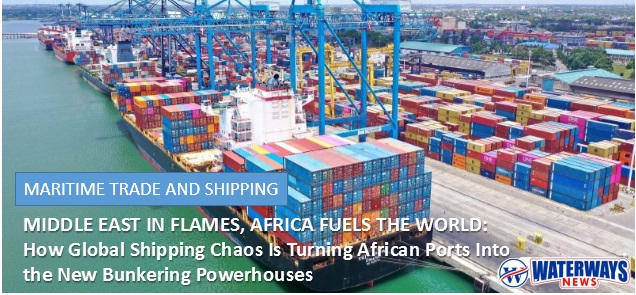

AFRICA FUELS THE WORLD: How Global Shipping Chaos Is Turning African Ports Into the New Bunkering Powerhouses
By Okeoghene Onoriobe, Waterways News Correspondent, Lagos
Africa is quietly cashing in on one of the most turbulent periods in modern maritime history.
As security crises continue to paralyse key shipping lanes across the Middle East — from the Suez Canal and the Bab el-Mandeb Strait to the increasingly volatile Strait of Hormuz — global shipping lines are abandoning their traditional routes and making a beeline for African waters. And with every diversion, demand for marine fuel across the continent is surging.

The crisis has been building since late 2023, when Houthi attacks on commercial vessels sent shockwaves through global trade. More recently, U.S. and Israeli strikes on Iran and fresh disruptions at the Strait of Hormuz have pushed the situation to breaking point, forcing shipping giants Maersk, Hapag-Lloyd, and CMA CGM to permanently reroute vessels around the Cape of Good Hope — the long way around Africa — rather than risk the Middle East corridors.
The detour adds days to voyage times and millions to operating costs. But for Africa’s ship-refuelling sector, it is nothing short of a goldmine.
Industry players are reporting a dramatic surge in bunker fuel demand, with major suppliers including Monjasa, Vitol, Peninsula, and Flex Commodities all scrambling to scale up operations along Africa’s coastline to capture the booming traffic.
The numbers are already telling a compelling story. Port Louis in Mauritius has seen bunker fuel sales nearly double in 2024 alone. On the Atlantic side, Namibia’s Walvis Bay and Lüderitz are fast emerging as critical refuelling stops for diverted vessels. In East Africa, Kenya’s Lamu Port — long considered underutilised — is recording a sharp uptick in vessel calls, signalling its growing strategic importance.
Fresh investment is now flowing into bunkering infrastructure, particularly across West and Southern Africa, where suppliers are aggressively expanding capacity in anticipation of what many analysts believe could be a permanent realignment of global shipping patterns.
For Nigeria and its West African neighbours, the opportunity is significant. With the right policy environment and port infrastructure, the region could entrench itself as an indispensable refuelling hub for the world’s largest shipping lines.
But the road to dominance is not without its potholes. Industry stakeholders point to persistent piracy risks, inadequate infrastructure, and tightening fuel supply chains partly linked to reduced Middle Eastern exports. High taxes and regulatory bottlenecks in several African markets are also blunting the continent’s competitive edge at a time when speed and efficiency matter most.
Analysts, however, remain cautiously optimistic. Africa’s geography — straddling the alternative Cape route now preferred by dozens of major carriers — gives it a natural advantage that no policy misstep can entirely erase. The continent, they say, holds the cards. The question is whether governments and investors will move fast enough to play them.
Waterways News | www.waterwaysnews.ng


Business
NIMASA to Launch Mandatory Registration Portal to Curb Foreign Takeover of Nigerian Shipping Agents Business

NIMASA to Launch Mandatory Registration Portal to Curb Foreign Takeover of Nigerian Shipping Agents Business
By Okeoghene Onoriobe, Waterways News Correspondent, Lagos
The Nigerian Maritime Administration and Safety Agency (NIMASA) has announced plans to establish a dedicated Shipping Business and Registration Unit at the Federal Ministry of Marine and Blue Economy, as part of measures to end the growing foreign encroachment into shipping agency operations — a sector long reserved for Nigerian indigenes.
NIMASA Director-General, Dr. Dayo Mobereola, disclosed this during a stakeholders’ engagement meeting organised by the Ministry in Lagos on Thursday.
Dr. Mobereola said the agency had observed with grave concern the increasing penetration of foreigners into aspects of ports and shipping business that are exclusively meant for Nigerian operators, including shipping agency and freight forwarding services — sectors where indigenous practitioners have long raised alarm.
“We need to establish a mandatory registration and licensing portal for Nigerian shipping agents. They would be the only ones with the rights to operate in the Nigerian shipping industry,” the NIMASA boss declared.
He added that the agency had also uncovered a troubling pattern where foreign nationals were registering companies through Nigerian fronts to circumvent existing rules.
“We noticed that these foreigners are registering companies with the assistance of Nigerians. The purpose here is to eliminate such acts and help us develop the Nigerian shipping sector — most importantly the shipping agents sector — to make it more economically friendly and create jobs for Nigerians,” he said.
Dr. Mobereola confirmed that the new department would be established soon, pending approval from the Honourable Minister of Marine and Blue Economy.
The proposed unit is expected to bring structure and legal clarity to a space that industry stakeholders say has been undermined for years by the activities of foreign interests — often operating covertly through proxy arrangements with local collaborators.
Waterways News gathered that the move has been broadly welcomed by indigenous shipping practitioners who have consistently called on regulatory authorities to enforce indigenisation policies in the maritime sector.
Waterways News — Nigeria’s Foremost Maritime Industry Publication | www.waterwaysnews.ng

NPA BOSS: PORT CONCESSION RENEWALS DELAYED FOR THOROUGH REVIEW, NOT NEGLIGENCE
Dantsoho says flawed agreements could create bigger problems; urges ICD operators to adapt to changing market realities
By Okeoghene Onoriobe | Waterways News Correspondent, Lagos
The Nigerian Ports Authority (NPA) has broken its silence on the prolonged delay in renewing seaport concession agreements, attributing the hold-up to an ongoing comprehensive review designed to strengthen contractual frameworks and shore up investor confidence.
Speaking to maritime journalists in Lagos, NPA Managing Director Abubakar Dantsoho said the Federal Government is deliberately prioritising the correction of structural deficiencies in existing agreements before any renewals are approved — a signal that the administration is unwilling to repeat the contractual pitfalls that have dogged Nigeria’s port sector for nearly two decades.
Background: Contracts Running Out
Nigeria’s seaports were handed over to private terminal operators in 2006 under the administration of former President Olusegun Obasanjo, with concession agreements ranging between 10 and 25 years. With many of those contracts now expired or expiring, uncertainty has deepened across the terminal operating community, with concessionaires growing increasingly anxious over the absence of fresh agreements.
“Get It Right” — Dantsoho
Dantsoho acknowledged the frustrations of terminal operators but held firm that quality must take precedence over speed. Both the NPA and concessionaires, he said, have identified unmet obligations on various sides — issues that must be resolved upfront to prevent costly disputes down the line.
“The focus is to get it right. A flawed agreement could create bigger problems later, while a well-structured one will provide long-term stability,” the NPA chief stated.
He also pushed back against the notion that slow processing undermines investor appeal, arguing that serious investors value legal clarity and contractual certainty far more than the pace of execution. A rigorous review, he noted, could even attract fresh investors should any existing operators choose not to renew.
ICD Operators Told to Restrategise
On the question of inland container depots (ICDs) and bonded terminals, Dantsoho issued a pointed advisory: adapt or risk irrelevance. He noted that while such facilities were critical pressure valves during periods of severe port congestion, the progressive easing of gridlock at Nigeria’s major ports has begun to erode the commercial rationale for their current operating models. Operators, he warned, must restrategise to remain competitive in a shifting maritime landscape.
NIGERIA WATCH: What this means for terminal operators, freight forwarders, and port stakeholders
The NPA’s position on concession renewals has far-reaching implications for virtually every layer of Nigeria’s maritime supply chain.
For terminal operators at Apapa, Tin Can Island, and the emerging Lekki Deep Sea Port, the delay introduces commercial uncertainty — investment decisions on equipment, berth upgrades, and staffing are difficult to commit to without clarity on tenure. Some operators are believed to be operating on tacit month-to-month arrangements, a situation that discourages capital expenditure.
For freight forwarders and shippers, stability of terminal operations directly affects cargo handling efficiency, tariff predictability, and turnaround times. Protracted uncertainty at the operator level has a downstream effect on the cost of doing business through Nigerian ports.
The NPA’s hint that new investors could enter if existing concessionaires step aside is significant. It opens the door to fresh capital and potentially more competitive terminal management — but only if the review produces the legally watertight agreements Dantsoho is promising.
On ICDs and bonded terminals, the warning is clear: the congestion-driven business model of the past is fading. As the NPA and the Nigerian Shippers’ Council (NSC) continue to push efficiency reforms, facilities that once thrived on cargo diversion and storage overflow must find new value propositions — whether in last-mile logistics, warehousing, or value-added trade facilitation services.
The Federal Ministry of Marine and Blue Economy and NIMASA will also be watching closely, as the outcome of the concession review will set the template for how Nigeria manages its blue economy assets going forward — and whether the country can finally position its ports as competitive gateways in the West African sub-region.
NSW Opens Apapa Support Centre as Digital Trade Platform Goes Live
By Emetena Ikuku, Waterways News Correspondent
LAGOS — The management of Nigeria’s National Single Window (NSW) has established a dedicated stakeholder support centre at 34 Wharf Road, Apapa, following the go-live of the country’s long-awaited digital trade facilitation platform last Friday.
The NSW platform — a Federal Government initiative to consolidate all port-related documentation and regulatory processes into a single digital environment — launched formally earlier in the week before transitioning to full commercial operations days later, marking a significant shift from pilot-phase testing to live deployment.
Support Centre Targets Smooth Onboarding
The Apapa facility is designed to assist port operators, freight forwarders, customs agents and other stakeholders encountering difficulties navigating the new system. Its location on Wharf Road, at the heart of Nigeria’s busiest port corridor, is intended to ensure ease of access for users operating within the Apapa axis.
Beyond physical walk-in support, the NSW management has activated a multi-channel helpdesk offering assistance via telephone, WhatsApp and email to address operational issues and resolve platform inquiries.
Management urged stakeholders to utilise the available support services, noting that effective onboarding is central to realising the platform’s full trade facilitation potential.
Platform Aims to Cut Cargo Dwell Time
The NSW is engineered to eliminate manual documentation bottlenecks by integrating all port clearance, regulatory and compliance processes under one digital roof. Authorities say full deployment is expected to reduce the cost of doing business at Nigerian ports and accelerate cargo throughput — objectives that have long ranked among the priorities of the Federal Ministry of Marine and Blue Economy.
Nigeria Watch
The go-live of the National Single Window carries direct implications for operators across the Nigerian port ecosystem. At Apapa and Tin Can Island — where manual documentation cycles and fragmented agency interactions have historically inflated cargo dwell times — the platform’s ability to centralise clearance processes could offer meaningful efficiency gains for importers, freight forwarders and terminal operators alike.
For the Nigerian Ports Authority (NPA) and the Nigerian Shippers’ Council (NSC), seamless NSW adoption among port users will be a key indicator of whether the digital trade agenda translates into measurable reductions in port congestion and logistics costs. NIMASA, whose regulatory mandate intersects with vessel and cargo documentation, will also have a stake in the platform’s integration architecture.
Freight forwarding associations and licensed customs agents — many of whom remain accustomed to manual and semi-manual clearance pathways — will likely represent the largest onboarding challenge. The placement of the support centre on Wharf Road, rather than at a government ministry or agency complex, signals a deliberate effort to meet practitioners where they operate.
The NSW’s full commercialisation also arrives against the backdrop of broader port reform efforts, including ongoing concession reviews and the Federal Government’s push to position Nigerian ports as competitive West African trade hubs. Whether the platform achieves critical mass adoption in its early weeks will depend heavily on the responsiveness of the helpdesk infrastructure now being put to the test.
Waterways News | Lagos
-

 Oil and Gas4 weeks ago
Tantita’s Pipeline Deal: $144m Contract, Rising Output, and the Questions that Deserve Answers
-
 Blue Economy2 months ago
Nigeria’s Coast Guard Bill: A Solution in Search of a Problem?
-
 Business1 month ago
CASABLANCA PORT SHUT DOWN AFTER VESSEL LOSES 85 CONTAINERS — SHIP SERVES NIGERIAN ROUTES