Blue Economy
Nigeria’s Coast Guard Bill: A Solution in Search of a Problem?

The bill to establish a Nigerian Coast Guard has refused to die quietly.
First introduced in 2021 by Senator Akon Eyakenyi during the 9th Senate, it was revived in late 2024 under the sponsorship of Senator Wasiu Eshinlokun (APC-Lagos), passing its second reading in October 2024.
Its stated ambition is bold: create a full-fledged military service branch under the Ministry of Marine and Blue Economy, charged with maritime security, law enforcement, and search-and-rescue operations across Nigeria’s 853-kilometre coastline and approximately 10,000 kilometres of inland waterways.
The response from virtually every major stakeholder has been swift and overwhelming — opposition.
Why the Navy Says No
The Nigerian Navy’s resistance is not merely institutional protectionism. At the December 2024 public hearing convened by the Senate Committee on Marine Transport, the Navy presented a substantive case rooted in both domestic realities and global precedent.
Rear Admiral Olusegun Ferreira, representing the Chief of Naval Staff, drew on international examples to challenge the bill’s logic, pointing out that the United Kingdom does not operate a Coast Guard with military powers. Instead, the Royal Navy handles military defence and maritime security, while the UK Coast Guard, operating under the Maritime and Coastguard Agency, manages search-and-rescue and occupational safety as essentially a civilian and volunteer body.
The Navy’s core argument is that Nigeria already has a functioning maritime security architecture. Beyond the Navy itself, agencies including NIMASA, the Nigerian Inland Waterways Authority, the Nigeria Police Marine Unit, and Nigeria Customs Marine Unit all operate within the same maritime domain.
Adding a Coast Guard with overlapping military powers, the Navy contends, would not strengthen this architecture — it would fracture it.
Why Was the Bill Proposed at All?
Supporters of the bill, including the Minister of Marine and Blue Economy, Gboyega Oyetola, argue that Nigeria’s waterways face threats that existing agencies have simply failed to contain — rampant boat mishaps, illegal fishing costing billions of naira annually, pollution, unregulated coastal development, and the persistent vulnerability of inland waterways. Their position is that the Navy’s primary orientation is military defence, and that a dedicated civilian-facing Coast Guard would fill a genuine governance and enforcement gap.
The argument has merit on its face. Many countries — including the United States — operate a Coast Guard distinct from their navy, precisely to manage the civilian, regulatory, and environmental dimensions of maritime governance that fall awkwardly within a military mandate.
However, the Nigerian proposal is not a civilian Coast Guard. The bill explicitly seeks to make the Coast Guard a full-fledged military service and a branch of the Armed Forces of Nigeria, which erases the very distinction that justifies a Coast Guard’s existence in most countries.
A Security Threat in the Making?
Beyond duplication, there is a darker concern. Security analysts warn that without a clearly defined mandate and strategic alignment with existing agencies; the proposed Coast Guard could complicate Nigeria’s already crowded maritime security domain.
The National Security Adviser, Mallam Nuhu Ribadu, has reportedly rejected the bill, citing intelligence reports suggesting that militant factions from the Niger Delta are already forming organizations in anticipation of absorption into the proposed structure. If accurate, the Coast Guard risks becoming not a security institution but a pipeline for legitimising armed groups — a profound threat in a region with a long history of militancy.
The Fiscal Absurdity
Senator Adams Oshiomhole put the financial dimension bluntly: “It is imprudent to take loans to establish a new agency when existing structures can be strengthened.”
Nigeria is a country where the Navy already operates under severe budgetary strain. House Committee chairman Gagdi was direct: “We have a Navy that is working hard but suffocated. It would be irrational to consider another agency when the Navy is not adequately funded.”
The cost of establishing a new military service branch — recruitment, training, equipment, platforms, jetties, uniforms, salaries, pensions — would run into hundreds of billions of naira, money Nigeria does not have and would likely borrow.
What Should Government Do Instead?
The consensus from the Navy, lawmakers, security experts, and civil society groups is clear, even if the government has been slow to hear it: fix what exists before building something new.
Concretely, this means adequately funding the Nigerian Navy to expand its operational reach, particularly on inland waterways where its presence is thin. It means strengthening NIMASA’s regulatory and enforcement capacity, reforming NIWA to better police inland waterways, and improving coordination and intelligence-sharing between the multiple agencies already operating in the maritime space. It also means addressing the legal and regulatory gaps in maritime safety enforcement — the kind of work that does not require a new institution, only the political will to resource and reform existing ones.
If Nigeria genuinely needs a civilian body focused on environmental protection, search-and-rescue, and inland waterway safety — functions the Navy is structurally ill-suited to prioritize — the answer is a lean, civilian Coast Guard clearly subordinate to civil authority, with no military powers, no armed mandate, and no overlap with naval operations. That is the model that works in countries like the UK. It is emphatically not what the current bill proposes.
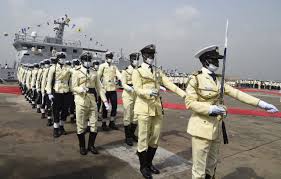
The Danger of Duplication
The deeper problem the Coast Guard Bill exposes is a pattern that has long weakened Nigerian governance: the habit of creating new institutions rather than fixing broken ones. Every duplicate agency adds bureaucratic friction, jurisdictional disputes, and competition for resources. In the maritime domain, where coordination between agencies is already a documented weakness, adding another armed actor with an overlapping mandate is not a reform — it is a recipe for operational paralysis and, potentially, armed confrontation between agencies of the same government.
Nigeria’s waters deserve better. So does the public that depends on them.
Facebook Comments Box
Promise Nwaobilor
March 31, 2026 at 7:45 pm
Nigeria Coast guard should be signed under the law and it will help the society to get jobs in the country