Blue Economy
$10BN Cargo Crises: Over 270,000 TEUs Stranded as Global Shipping Giant Halt Gulf Bookings — Nigeria’s Trade Lanes at Risk


$10BN Cargo Crises: Over 270,000 TEUs Stranded as Global Shipping Giant Halt Gulf Bookings — Nigeria’s Trade Lanes at Risk
By Okeoghene Onoriobe | Waterways News Correspondent | Lagos
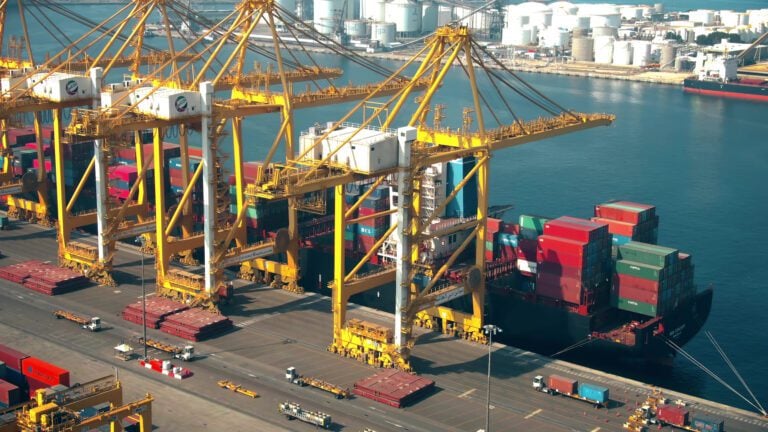
The global shipping industry is facing one of its most severe disruptions in recent memory, as leading container carriers suspend cargo bookings across the Arabian Gulf amid intensifying Middle East tensions — a crisis that threatens to ripple through Nigeria’s import-dependent economy and raise costs at the ports of Lagos, Apapa, and Tin Can Island.
Industry data now confirms that more than 270,000 twenty-foot equivalent units (TEUs) — valued at an estimated $10 billion — are stranded at Gulf ports or adrift in surrounding waters, with no clear timeline for resolution.

Ben Tracy, Vice President of Strategic Business Development at shipping intelligence firm Vizion, described the scale of the paralysis as staggering. “You are looking at about $10 billion worth of cargo stranded at ports or in the Arabian Gulf. That’s over 270,000 TEUs,” Tracy stated.
Global shipping giant A.P. Moller–Maersk, which operates several key routes serving West Africa including Nigeria, has suspended all cargo booking acceptance for shipments to and from ports in the United Arab Emirates, Iraq, Kuwait, Qatar, Bahrain, Saudi Arabia, and most Omani ports, with the exception of Salalah. The Danish carrier currently has approximately 14 vessels with a combined capacity of roughly 70,000 TEUs either trapped or operating in the affected zone.
French carrier CMA CGM, another major player on Nigeria-bound trade lanes, has halted hazardous cargo bookings to multiple Middle Eastern destinations and suspended Suez Canal transits entirely. Between 14 and 17 of its vessels — representing close to 70,000 TEUs — are reported to be sheltering or stranded in the region.
German liner Hapag-Lloyd has gone further, implementing an immediate and comprehensive booking suspension covering all cargo types to and from Gulf ports, including those in the UAE, Iraq, Kuwait, Qatar, Bahrain, Oman’s Sohar terminal, and Saudi Arabia’s Dammam and Jubail ports. Hapag-Lloyd’s Chief Executive Officer, Rolf Jansen, confirmed that approximately 50,000 TEUs belonging to the carrier have been caught in the conflict zone.
Ocean Network Express (ONE) and COSCO Shipping Lines have also announced temporary booking suspensions on critical Gulf routes. ONE’s CEO, Jeremy Nixon, noted that around 100 container vessels are among approximately 750 ships currently navigating the Strait of Hormuz — a choke point through which a significant portion of global energy and trade cargo passes. COSCO, meanwhile, has issued a navigation advisory ordering vessels to prioritise crew safety by reducing speed, anchoring, or relocating to safer anchorages, with logistics sources estimating that six of its ships are directly affected. Shipping data firm Kpler adds that MSC has between 15 and 16 vessels either trapped or sheltering in the Gulf.
The disruption, experts warn, is not confined to vessels already at sea. Cargo waiting at origin ports worldwide — including goods destined for Nigeria from Asian and European manufacturers — is equally frozen. “Containers destined to the region are waiting in their origin ports. These containers have nowhere to go,” Tracy said.
For Nigerian importers and manufacturers who depend heavily on goods transiting through Gulf hubs, the consequences could prove severe. Logistics firms have warned that carriers are now invoking emergency clauses written into Bills of Lading, which allow them to divert vessels to alternative ports or terminate voyages ahead of schedule. SEKO Logistics, in a notice to clients, cautioned that shippers could face a cascade of additional charges — including container handling fees, storage costs, diversion surcharges, and onward transportation expenses.
MSC has already moved to monetise the disruption, reportedly imposing an $850 charge per container for diverted cargo — a levy that, applied across all affected shipments, could yield approximately $158 million in fees for the carrier alone.
The unfolding crisis at the Strait of Hormuz adds fresh urgency to longstanding calls within Nigeria’s maritime sector for supply chain diversification, stronger bilateral shipping agreements, and accelerated development of domestic port infrastructure capable of absorbing such global shocks. For now, Nigerian traders, port operators, and logistics managers will be watching developments in the Gulf closely — knowing that what happens in the Hormuz could very quickly be felt on the Lagos shoreline.


Blue Economy
NSC BOSS WARNS SHIPPING FIRMS, FREIGHT FORWARDERS: RETURN TO THE TABLE OR FACE FEDERAL ESCALATION
NSC BOSS WARNS SHIPPING FIRMS, FREIGHT FORWARDERS: RETURN TO THE TABLE OR FACE FEDERAL ESCALATION
By Okeoghene Onoriobe | Waterways News Correspondent, Lagos
The Nigerian Shippers’ Council (NSC) has issued a firm warning to foreign shipping companies and clearing agents locked in a bitter standoff over recently approved port tariff increases — resolve your differences or face intervention at the highest levels of government.
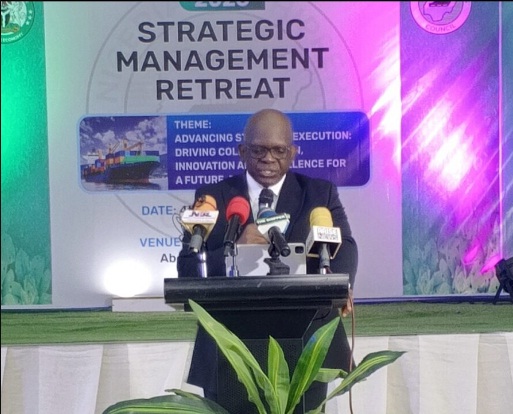
Dr. Pius Akutah, Executive Secretary of the NSC, delivered the stark message while speaking to journalists on the sidelines of the Council’s management retreat in Abeokuta, making clear that the regulator will not stand idle as the dispute threatens to destabilise operations at Nigeria’s seaports.
Akutah revealed that the Council had twice declined requests from shipping companies to raise charges before approving the current tariff hike — a decision he said was driven not by profit motives, but by the need to address mounting operational costs facing maritime operators.
“I think that they need to work together more harmoniously to resolve these issues. We, as a regulator have given the approval. It is left for the shipping companies and the freight forwarders to come to a harmonious stand where they can implement this,” Akutah said.
The NSC boss, however, stressed that any resolution must involve genuine compromise from both sides, cautioning that a deadlock serves no one.
“There must be a reason for people to move and shift ground. It should be a give-and-take relationship. Whenever there is a standstill and nobody is moving, then there is a problem,” he warned.
Akutah disclosed that the Council had already attempted to broker peace between the warring parties, but the dispute had dragged on — prompting the renewed public call for both sides to get back to the negotiating table.
“Recently, we tried to see how we can wade into this to see how they can resolve this, but this has kept going on. We are calling on both sides to go back to the table and see how they can resolve this issue and move on,” he said.
With patience wearing thin, Akutah put both camps on notice that federal involvement was now on the cards if the impasse continues.
“We cannot sit and watch this without taking steps. It will get to a point where we can escalate this to the level of the minister, if they fail to resolve it,” he stated.
The NSC chief rounded off with a broader warning to all maritime stakeholders, cautioning that the sustainability of Nigeria’s entire shipping sector depends on a spirit of cooperation.
“If they say there won’t be any hike in charges and at the end of the day the cost of operation has hindered them from carrying out their functions, then we will not have a maritime sector,” he said.
Blue Economy
Coastal Communities Key to Blue Economy Success, Says GMA Founder Onakughotor at Ondo Summit

Coastal Communities Key to Blue Economy Success, Says GMA Founder Onakughotor at Ondo Summit
By Okeoghene Onoriobe | Waterways News Correspondent
The President and Founder of the Global Maritime Academy (GMA), Mr. Ejiro Dennis Onakughotor, has declared that Nigeria’s Blue Economy ambitions can only succeed if coastal communities are placed at the heart of its implementation — and not treated as afterthoughts.
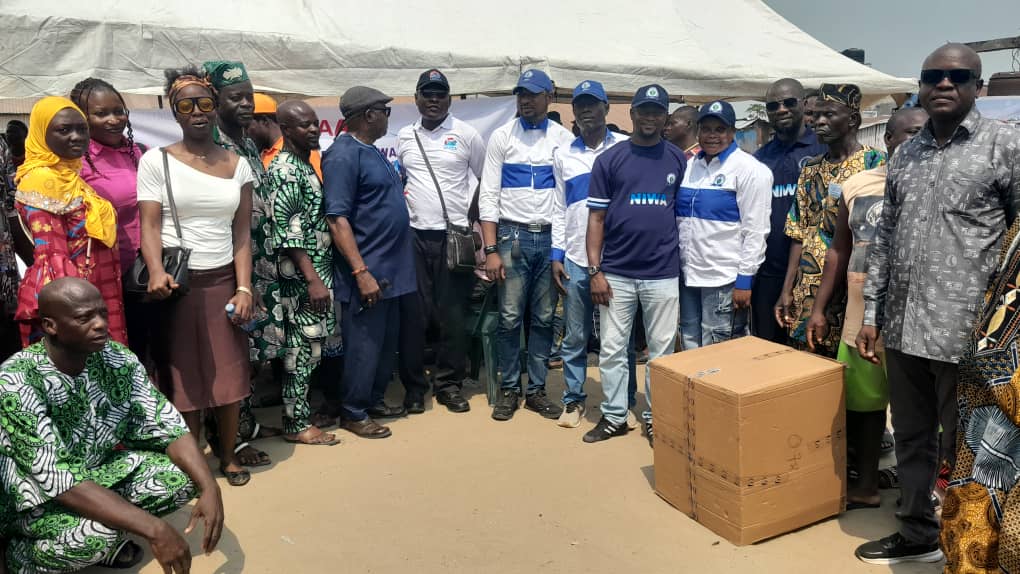
Onakughotor made this assertion at the maiden Maritime Summit on Marine and Blue Economy held in Igboegunrin Kingdom, Ondo State, where traditional rulers, maritime experts, and key government stakeholders gathered to chart a new course for Nigeria’s ocean-based economic future.
Themed “The Marine and Blue Economy Policy and Its Implementation: The Game Changer to the Nigerian Economy,” the summit drew overwhelming support from participants who expressed readiness to help Nigeria harness its vast marine and coastal resources for sustainable national growth.
Grassroots-Driven Development
Describing coastal communities as “the heartbeat of Nigeria’s emerging ocean economy,” Onakughotor argued that investment in the Blue Economy must flow from the ground up. He stressed that the full implementation of Nigeria’s marine and ocean-based development policies must be community-driven to achieve genuine national economic transformation.”This gathering is more than a conference — it is a turning point for coastal development, economic diversification, and inclusive growth,” he said.
“This gathering is more than a conference — it is a turning point for coastal development, economic diversification, and inclusive growth”
He noted that the establishment of the Federal Ministry of Marine and Blue Economy marked a deliberate pivot away from Nigeria’s longstanding oil dependence, aligning the country with a global ocean economy valued at over $1.5 trillion.
Jobs, Infrastructure and Opportunity
Onakughotor cited Federal Government projections of creating three million jobs within four years across fisheries, aquaculture, shipping services, coastal tourism, and maritime security — sectors in which riverine and coastal communities like Igboegunrin stand to benefit most.
He also highlighted planned government investments in smart ports and the dredging of more than 2,000 kilometres of inland waterways, positioning host communities along Nigeria’s water corridors as emerging hubs for maritime transport and logistics.
Onakughotor urged youths in Igboegunrin Kingdom and other coastal areas to proactively acquire relevant skills and position themselves to take advantage of the opportunities ahead.
GMA’s Community-Driven Agenda
As a practical step toward capacity building, the Global Maritime Academy president unveiled a community-driven initiative that includes:
Vocational training for local cadets and youths in marine engineering, shipping management, logistics, and maritime security
Upskilling for artisanal fishers in modern aquaculture practices, sustainable fishing methods, and improved post-harvest handling
Coastal safety and surveillance training to strengthen waterway security for trade, tourism, and community wellbeing
Scholarships for deserving students from Igboegunrin Kingdom to access maritime education and vocational training
Onakughotor also made a passionate appeal to indigenes of Igboegunrin Kingdom — at home and in the diaspora — to support the establishment of a GMA Vocational Centre in the community, describing it as a future hub for skills acquisition, youth empowerment, and long-term economic transformation.
Sustainable Roadmap
The summit outlined a broader development roadmap anchored on integrated coastal management, digital inclusion through port automation and marine technologies, and community-owned eco-tourism designed to preserve local culture while generating income for households.
Closing his remarks, Onakughotor reminded participants that the Blue Economy is ultimately a people-centred agenda — one that directly affects fishermen, students, and local entrepreneurs. He called on all stakeholders to move beyond dialogue and take decisive action in unlocking shared prosperity along Nigeria’s coastlines.
Dignitaries
Prominent figures at the event included the Ondo State Governor, represented by his Senior Special Assistant on Marine and Blue Economy, Hon. Olugbemiro Aladenusi; the Chief of Staff to the Governor, Hon. Oluwasegun Omojuwa; and the royal host, Phillip Olatunji Kalejaye, the traditional ruler of Igboegunrin Kingdom.
Waterways News | Covering Nigeria’s Maritime and Inland Waterways Sector
Blue Economy
Warri Port Revival: Technical Challenges and Infrastructure Requirements for Alternative Maritime Gateway
Warri Port Revival: Technical Challenges and Infrastructure Requirements for Alternative Maritime Gateway
By Oghenewoke Onoriode | WaterwaysNews.ng | March 6, 2026
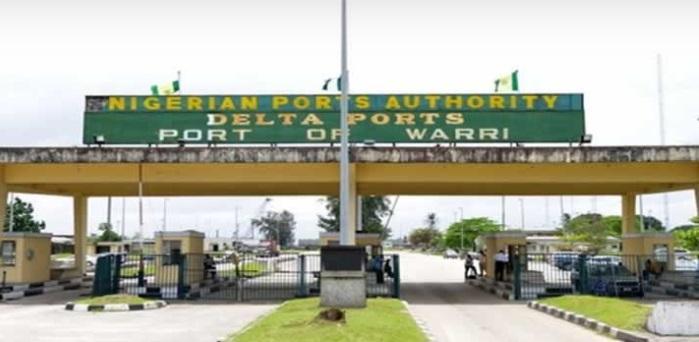
As congestion at Lagos ports continues to impose significant costs on Nigeria’s trade infrastructure, a comprehensive analysis of Warri Port’s potential has revealed that its rehabilitation could provide an alternative maritime gateway for the country’s South-South and North-Central regions.
The underutilized facility in Delta State, which currently handles a fraction of its designed capacity, faces a combination of technical and operational challenges that experts say are solvable with coordinated interventions
Technical Challenges Documented
According to maritime infrastructure assessments, Warri Port operates under several constraints that limit its competitiveness. The port’s draft restrictions, currently at 6-7 meters during low tide, prevent larger commercial vessels from accessing the facility. Modern container ships typically require 12-14 meters of draft for safe navigation.
Siltation in the Escravos channel and approach routes has progressively reduced navigable depths, while deteriorated breakwater infrastructure has accelerated sediment accumulation in the port basin. Industry observers note that these conditions create operational difficulties for vessels attempting to access the facility.
The port’s cargo handling equipment, installed decades ago, operates below the efficiency standards that have become industry benchmarks at modernized facilities. Terminal operators report that aging cranes and handling systems affect vessel turnaround times, a critical factor in shipping line route planning decisions.
Infrastructure Investment Requirements
Engineering estimates for addressing these technical constraints suggest capital dredging of the Escravos Bar, approach channels, and port basin would require substantial investment, with ongoing maintenance dredging necessary to sustain navigable depths.
Breakwater rehabilitation, which engineers say would protect dredging investments and reduce long-term siltation rates, would require extended construction periods to restore structural integrity.
Maritime infrastructure specialists indicate that achieving a minimum draft of 9-10 meters would open the port to Panamax-class vessels and modern feeder ships operating West African routes.
Policy Options Under Discussion
Industry stakeholders have identified several policy mechanisms that could enhance Warri Port’s competitiveness during a rehabilitation phase.
Graduated tariff incentives have been discussed as a potential tool to attract initial traffic while infrastructure improvements proceed. Similar approaches have been implemented at other Nigerian ports during development phases, though specific waiver structures would require Nigerian Ports Authority board approval and federal government policy alignment.
Terminal concession models, comparable to those implemented at Lagos facilities, represent another option for equipment modernization. Private sector participation in port operations has historically transferred capital investment requirements from government budgets while introducing operational efficiency improvements.
Cargo Generation Potential
Geographic analysis indicates Warri Port’s proximity to several cargo-generating regions currently reliant on Lagos facilities. Manufacturing centers in Edo State, agricultural production zones in Delta and Edo States, and industrial activity in the Mid-Western region represent potential traffic sources.
The port’s location also positions it for petroleum products distribution, potentially reducing the concentration of such cargo at Lagos terminals. Regional shipping services connecting West African ports present additional traffic opportunities.
Trade data shows that businesses in states including Delta, Edo, Kogi, and Benue currently route imports and exports through Lagos, incurring additional inland transportation costs that alternative port access could reduce.
Hinterland Connectivity Requirements
Transportation infrastructure connecting Warri Port to its potential hinterland represents a critical component of competitiveness assessments. The Warri-Benin-Ore Road corridor provides an alternative to Lagos-bound routes, though current road conditions affect transit efficiency.
Rail connectivity through the Itakpe-Warri railway, with potential extensions to Benin City and connections to planned coastal rail infrastructure, has been identified in transportation planning documents as infrastructure that would enhance port accessibility.
Inland Container Depot development in cities including Benin and Asaba would provide cargo consolidation points that reduce port dwell times and improve logistics efficiency.
Institutional Coordination Challenges
Implementation of comprehensive port rehabilitation requires coordination among multiple government levels and agencies. The Nigerian Ports Authority, Federal Ministry of Transportation, Delta State Government, and private sector terminal operators each control different aspects of port development and operations.
Historical port development projects have faced challenges related to budget allocation consistency, policy continuity across political administrations, and alignment between federal infrastructure priorities and state-level complementary investments.
Stakeholder engagement mechanisms that include shipping lines, freight forwarders, manufacturing associations, and chambers of commerce in cargo-generating regions have been identified as components of successful port development initiatives in other locations.
Regional Context
Nigeria’s port infrastructure currently concentrates the majority of maritime traffic at Lagos facilities, despite the existence of functional ports in Calabar, Port Harcourt, and Onne. This concentration has generated recurring congestion issues that affect trade facilitation efficiency.
The Lekki Deep Sea Port, which became operational in recent years, provides additional Lagos-area capacity but does not directly serve cargo generators in Nigeria’s Mid-Western and North-Central regions.
Regional ports in West Africa have competed for transshipment traffic and hinterland cargo by investing in infrastructure improvements and implementing competitive tariff structures. Ghana’s Tema Port and Togo’s Port of Lomé have attracted cargo that might otherwise route through Nigerian facilities.
Free Trade Zone Integration
The Warri Export Processing Zone, located adjacent to port facilities, represents potential for integrated industrial and maritime logistics development. Free trade zones at other Nigerian ports have generated guaranteed port traffic through manufacturing and processing activities that require import and export services.
Operational activation of the Warri zone, with appropriate customs facilitation and business incentive structures, could provide an anchor tenant base for port services while generating industrial employment in Delta State.
Infrastructure Financing Models
Port infrastructure development in Nigeria has utilized various financing approaches, including direct government budgetary allocations, public-private partnerships, concessional development finance from multilateral institutions, and private sector terminal concessions with investment requirements.
Maritime infrastructure projects in other countries have demonstrated that coordinated public investment in channels, breakwaters, and approach infrastructure can catalyze private sector investment in terminal equipment and operations when combined with credible policy commitments.
Comparative Investment Analysis
Recent port development initiatives in Nigeria have involved substantial capital commitments for new facilities. Rehabilitation of existing infrastructure at underutilized ports represents an alternative investment approach with different risk-return profiles.
Port economics analysis typically evaluates marginal returns on infrastructure investment, comparing the costs of expanding existing facilities versus developing new capacity. Warri Port’s existing infrastructure base, despite requiring rehabilitation, reduces total capital requirements compared to greenfield port development.
Next Steps and Policy Processes
Port development initiatives typically require coordination through Nigeria’s budget planning processes, Nigerian Ports Authority strategic planning, and state government infrastructure prioritization.
Federal transportation policy documents, including the National Transport Master Plan, provide frameworks for multi-modal infrastructure investment decisions. Port-specific development plans require Nigerian Ports Authority board consideration and Federal Executive Council approval for major capital expenditures.
Environmental impact assessments, marine engineering studies, and economic feasibility analyses represent standard preliminary requirements for major port rehabilitation projects. International development finance institutions typically require such documentation for project financing consideration.
About This Analysis
This report synthesizes information from maritime infrastructure assessments, port engineering studies, and transportation planning documents. Technical specifications reflect maritime engineering industry standards and comparable port rehabilitation projects in West Africa.
Stakeholder perspectives incorporated in this analysis include views from shipping industry associations, port economics specialists, logistics service providers, and regional business organizations. Government policy options described represent approaches implemented at other ports and do not constitute confirmation of specific planned initiatives.
WaterwaysNews.ng provides coverage of maritime infrastructure, shipping, and water transport operations across Nigeria’s waterways. For questions regarding this report, contact our editorial desk.
EDITOR’S NOTE: This analysis is based on publicly available information, industry assessments, and expert consultations. Specific policy decisions regarding Warri Port development remain with relevant government authorities and the Nigerian Ports Authority. Readers are encouraged to consult official sources for current project status and policy positions.
CONTACT: WaterwaysNews.ng welcomes responses from the Nigerian Ports Authority, Federal Ministry of Marine and Blue Economy, Delta State Government, and other stakeholders regarding port infrastructure development initiatives. Comments can be submitted to editorial@waterwaysnews.ng