

Blue Economy
$4,000 War Surcharge: MSC Shipping Move Threatens Nigeria’s Maritime Sector, Stokes Inflation Fears

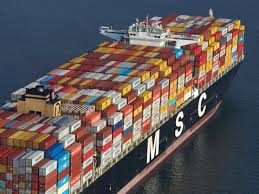

$4,000 War Surcharge: MSC Shipping Move Threatens Nigeria’s Maritime Sector, Stokes Inflation Fears
By Okeoghene Onoriobe | News Correspondent, Waterways News (www.waterwaysnews.ng)
A wave of anxiety is sweeping through Nigeria’s maritime industry following the decision by MSC Mediterranean Shipping Company to impose a war risk surcharge of up to $4,000 on cargo shipments bound for Nigeria and other African countries — a development industry stakeholders warn could trigger a fresh round of inflation and deal a severe blow to the nation’s already stressed trade ecosystem.
MSC announced on its website that effective March 5, 2026, until further notice, it will apply the surcharge on all cargo moving from the Arabian Peninsula — including Bahrain, Iraq, Kuwait, Oman, Qatar, Saudi Arabia, and the UAE — to West Africa, East Africa, South Africa, Mozambique, and the Indian Ocean Islands.
The charges are structured as follows: $2,000 for 20-foot containers, $3,000 for 40-foot containers, and $4,000 for refrigerated (reefer) cargo.

“The evolving security situation in the Middle East is affecting maritime traffic in the Straits of Hormuz and Bab El-Mandeb and causing disruption throughout our network,” MSC stated, adding that it is working with relevant authorities to ensure the safety of its operations.
Industry Voices Alarm
Maritime and trade experts who spoke with Waterways News expressed serious concern over the ripple effects the surcharge will have on Nigeria’s import-dependent economy.
Former acting National President of the National Association of Nigerian Licensed Customs Agents, Mr. Kayode Farinto, said the surcharge was largely inevitable given the deteriorating security situation along key shipping routes.
“Any shipping company bringing cargo will want to charge. Most insurance companies are already dropping policies because of this war, and the routes are being taken over by Iran. So shipping lines are being forced to manoeuvre and take alternative routes — possibly through South Africa — which increases costs,” Farinto explained.
He warned that the consequences would be far-reaching: cargo volumes will decline, freight rates will climb, and the prices of goods will rise as importers pass on overhead costs and insurance premiums to consumers. He added that products from the Dangote Refinery could also be affected, with the full impact expected to be felt more acutely in the coming weeks.
Muda Yusuf, Chief Executive Officer of the Centre for the Promotion of Private Enterprise, was equally blunt in his assessment.
“It’s going to affect trade significantly. Cost has already gone up and may go higher. If costs rise that much, trade volumes will drop — and that means less business for the maritime industry, job losses, loss of income, and a whole lot of issues that will cascade through the sector,” he said.
Manufacturers Sound Export Warning
The manufacturing sector is also bracing for impact. Dr. Benedict Obhiosa, Secretary of the Manufacturers Association of Nigeria Export Group, said the surcharge would erode the competitiveness of Nigerian-made products in international markets.
“The hike in prices will discourage exports and affect the volume and value of non-oil exports in the current and possibly the next quarter, if the problem is not resolved by the Nigerian government and shipping authorities,” Obhiosa said. He noted, however, that some exporters may pivot to road transport as an alternative.
Freight Forwarders Demand Government Intervention
The Africa Association of Professional Freight Forwarders and Logistics of Nigeria (APFFLON) has described the surcharge as a major economic shock that could deepen Nigeria’s vulnerability as an import-dependent nation.
In a strongly worded statement, APFFLON’s National President, Frank Ogunojemite, warned that Nigeria — which relies on maritime transport for over 80 percent of its international trade — faces sharp increases in the prices of food and pharmaceuticals, with reefer containers carrying frozen foods, dairy products, fish, and medicines bearing the heaviest burden.
Ogunojemite called on the Federal Government, the Ministry of Marine and Blue Economy, the Nigerian Shippers’ Council, and other maritime regulators to urgently engage international shipping lines and global maritime stakeholders to cushion the impact of the surcharges on Nigerian trade.
Blue Economy
Oyetola Takes Nigeria’s Case on Gulf of Guinea Security and Seafarer Welfare to IMO Council in London
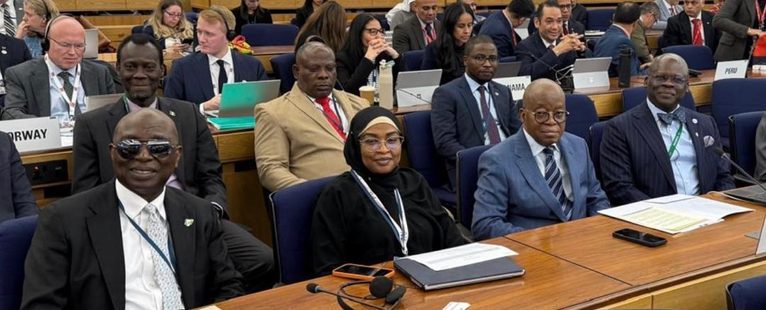
Oyetola Takes Nigeria’s Case on Gulf of Guinea Security and Seafarer Welfare to IMO Council in London
Minister says seafarers must not become casualties of geopolitical disputes as Nigeria presses for stronger technical support for developing maritime nations
By Ighoyota Onaibre | Waterways News
Nigeria’s Minister of Marine and Blue Economy, Dr. Adegboyega Oyetola, has restated the country’s commitment to safe, secure and sustainable international shipping. He is leading a high-level delegation to the 138th session of the International Maritime Organization (IMO) Council in London.
The five-day session opened on November 2 at the IMO headquarters and ends today, November 6, 2026. Nigeria’s participation is meant to strengthen its voice in global maritime governance and to advance the interests of developing maritime nations.
Nigeria sits on the 40-member Council under Category C. The session is considering the protection of vital shipping routes, the welfare and safety of seafarers, institutional governance and the sustainability of the global maritime industry.
Protecting vital shipping lanes
A central issue is the protection of strategic shipping routes against growing security threats and attacks on commercial vessels in high-risk zones. Under Agenda Item 11, “Protection of Vital Shipping Lanes,” Nigeria is expected to draw on its experience combating piracy and maritime crime in the Gulf of Guinea to push for stronger international cooperation and coordinated security responses.
“Nigeria recognises that the challenges confronting the global maritime industry require collective action, stronger international cooperation and effective regulatory frameworks,” Oyetola said. He added that Nigeria was at the Council to see its interests represented and to contribute to solutions that strengthen maritime security, protect seafarers and promote sustainable shipping.
He said the progress made in the Gulf of Guinea showed that maritime insecurity can be tackled “through political commitment, effective coordination and cooperation among regional and international partners.”
Seafarer welfare
Seafarer welfare is also high on the agenda. This follows IMO Secretary-General Arsenio Dominguez’s condemnation of the use of seafarers as pawns in geopolitical disputes. Nigeria is backing measures to prevent the arbitrary detention and abandonment of seafarers, and to ensure their fair treatment, safe repatriation and mental well-being.
“Seafarers are the lifeblood of international shipping,” Oyetola said. “Their safety, dignity and welfare must never be compromised by geopolitical tensions.”
Budget and capacity building
The Council is also reviewing financial allocations for the 2026–2027 biennium and strategic priorities for 2028–2029. Nigeria sees this as an opening to push for more technical cooperation and capacity-building support for developing maritime countries.
Oyetola said developing maritime nations “must have access to the technical expertise, institutional support and investment opportunities required to participate meaningfully in the evolving global shipping industry.”
The delegation
The minister is accompanied by:
The Permanent Secretary, Federal Ministry of Marine and Blue Economy, Mrs. Fatima Mahmood
The Director-General of NIMASA, Dr. Dayo Mobereola
The Director of Maritime Services, Mr. Oyinloye Meshack
Nigeria’s Alternate Permanent Representative at the IMO, Mr. William Bwala
Nigeria Watch
A heavy session. The Council has dealt with more than Nigeria’s agenda this week. Other delegations have also pressed seafarer protection and freedom of navigation, with Liberia and Indonesia among the countries that raised them. The session has also given attention to security in the Strait of Hormuz and the Black Sea. On Wednesday, the Council recommended a second four-year term for Secretary-General Arsenio Dominguez, running from 2028 to 2031. The IMO Assembly must still approve it in 2027. Nigeria’s message on the Gulf of Guinea has been delivered in a crowded room.
Hormuz is a Nigerian issue. This newsroom has followed the Strait of Hormuz crisis closely, from rising freight rates to war-risk insurance premiums at Nigerian ports. Oyetola’s call to shield seafarers from geopolitical tension is not abstract. Dominguez has said thousands of seafarers in the region live and work under heightened risk, and the IMO’s tally of seafarers killed in the region since February stood at 24 as of November 5.
Where the Gulf of Guinea story stands. Nigeria is presenting its Gulf of Guinea record as a model, and the Deep Blue Project is the backbone of that claim. NIMASA has just showcased upgraded assets at AFRIDEX 2026. Delegates in London will weigh the narrative against what stakeholders at home actually experience on the water.
The home test. Nigeria’s arguments at the IMO for seafarer dignity, fair treatment and capacity-building support will carry weight in proportion to how well they are matched at home.
Questions that Waterways News continues to raise:
Do Nigerian seafarers and inland waterway workers enjoy the safety and welfare standards the minister is championing abroad?
Will the technical cooperation Nigeria is seeking reach small-scale and informal waterway operators, such as those under WABOTAN and ATBOWATON, or stay at the policy level?
With Nigeria holding a Council seat, how will diplomatic wins in London be turned into delivery at home, from CVFF disbursement to NPERA implementation?
Waterways News will keep tracking the outcome of the 138th Council session and what it means for Nigerian maritime stakeholders.
Blue Economy
NIWA Deploys Enforcers to Niger Waterfronts as Boat Operators Cry Out Over Life Jacket Shortage
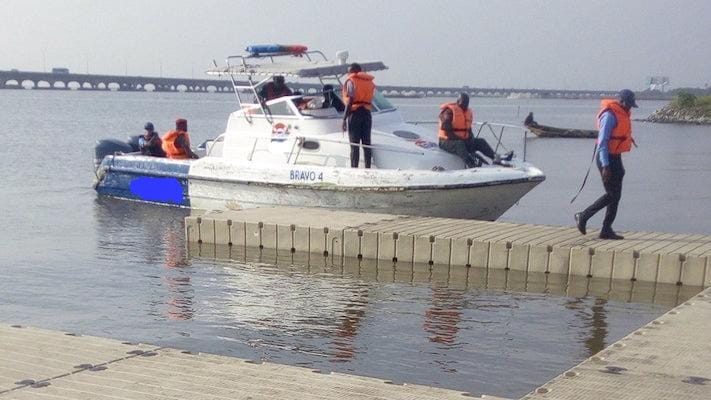
NIWA Deploys Enforcers to Niger Waterfronts as Boat Operators Cry Out Over Life Jacket Shortage
Operators say a 300-seater has only seven jackets, and ask for prices to drop from N20,000 to as low as N5,000
By Raymond Gold | Waterways News
The National Inland Waterways Authority (NIWA) has sent enforcement personnel to waterfronts across Niger State to make life jacket use compulsory and ensure compliance with inland waterways safety rules.
NIWA’s Minna Area Manager, Akapo Adeboye, announced this at the 2026 Sensitisation and Enlightenment Campaign on Inland Waterways Regulations at Zumba Waterfront, Shiroro Local Government Area. The campaign theme was “Total Safety Measures and Compliance on the Nation’s Inland Waterways.”
Adeboye said NIWA has given 3,500 life jackets to boat operators at waterfronts across the state. He was troubled, however, that some operators neither wear the jackets nor provide them for passengers during trips.
He also condemned operators who charge passengers extra to use a life jacket, saying this discourages compliance. He said the safety of lives and property remains a priority of the Federal Ministry of Marine and Blue Economy, and that operators and passengers alike must wear life jackets before boarding. Violators, he warned, will face the full weight of the law.
Some operators at the event said scarcity and cost make full compliance impossible.
Adamu Gunduma said his boat carries 300 passengers but he has seven life jackets, one of them for himself. The other six go to passengers on a first-come, first-served basis.
Adamu Tanko said his 150-passenger boat has three life jackets.
Saidu Sani said his 40-passenger boat has none, for himself or his passengers.
Abubakar Mamman-Kwanu appealed to government and other stakeholders for more jackets through donations and support programmes.
The operators said a life jacket costs about N20,000 on the market and asked authorities to bring the price down to between N5,000 and N6,000. They added that high prices and falling farm-produce prices could keep many farmers from buying one. Farmers, they said, make up a large share of water transport users in the area. They called for stronger government intervention, arguing that easier access to life jackets would improve compliance and prevent avoidable deaths.
The News Agency of Nigeria (NAN) first reported the development on Monday.
Nigeria Watch
Enforcement is arriving before supply. Gunduma, Tanko and Sani together operate boats licensed for 490 passengers, yet they reported 10 life jackets between them. Telling such operators to refuse boarding without a jacket is, for now, an order they cannot obey. Cheap jackets must reach waterfronts before penalties are enforced, or enforcement will fall hardest on the poorest operators.
NIWA has also faced a misuse problem. Adeboye said in an earlier interview that people sell the jackets, use them as pillows or farm tools. He said that when his team revisited a waterfront after a 3,500-jacket flag-off, they could not find one in use. Both complaints can be true at once, and the way out is a mix of local ownership, fitting by boat capacity and visible checks by marshals.
The stakes are real and well documented. After a July 2025 mishap at Zumba, Adeboye said 26 passengers wearing life jackets were rescued alive, 15 bodies were recovered and three people were missing. He noted that the incident came eight days after a NIWA sensitization campaign at the same waterfront.
Marshals and penalties are already in place. Waterways marshals were inaugurated at Zumba to enforce transport regulations. Adeboye has also said NIWA gazetted penalty codes for operators and passengers who fail to comply. The open question is whether operators get realistic access to compliance before sanctions bite.
Questions for NIWA and the Ministry of Marine and Blue Economy:
How many jackets are needed to cover the licensed capacity of boats at Niger waterfronts, against the 3,500 supplied?
Can bulk procurement or local assembly bring the N20,000 price down?
Will NIWA publish compliance figures and sanctions issued after the campaign?
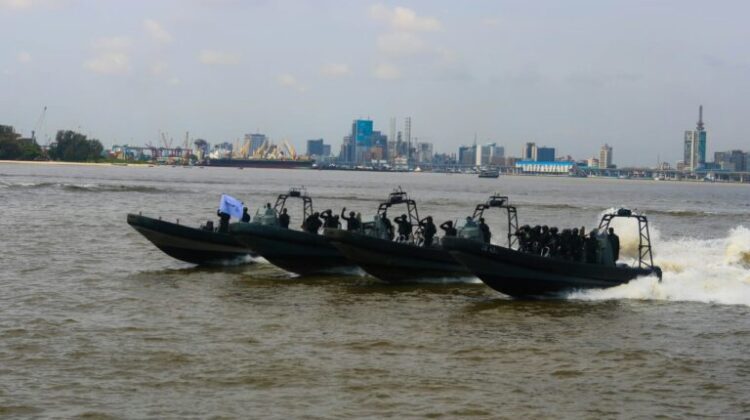
Agency says new assets will sustain the fight against piracy as technical partner calls for regular upgrades and a land-sea security approach
By Raymond Gold | Waterways News
The Nigerian Maritime Administration and Safety Agency (NIMASA) has added a new batch of high-tech equipment to the Integrated National Security and Waterways Protection Infrastructure, better known as the Deep Blue Project. The assets were unveiled at the 2026 Africa International Defence Exhibition (AFRIDEX).
The showcase included vertical take-off and landing (VTOL) drones that can operate from sea vessels, newly delivered armoured vehicles, rugged light utility vehicles built for bush and littoral terrain, and integrated intelligence systems. The equipment is meant to sharpen surveillance and response across both coastal and inland waters.
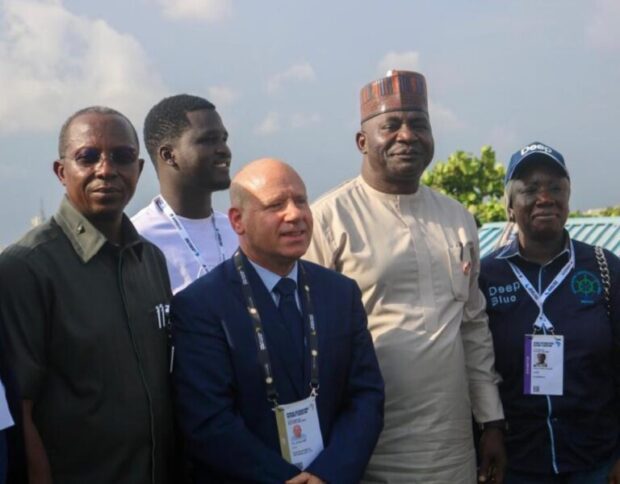
From Right to Left: Head, Deep Blue, Nigerian Maritime Administration and Safety Agency (NIMASA), Mrs. Aisha Yakubu Idris; Honourable Minister of Defence, General Christopher Gwabin Musa; Chief Executive Officer, Homeland Security International (HLSI); Tal Spektor and a guest at the 2026 Africa International Defence Exhibition (AFRIDEX).
The Minister of Defence, General Christopher Gwabin Musa (rtd), toured the Deep Blue stand and watched a live simulation of a piracy interdiction in Nigerian waters.
Speaking for NIMASA Director-General Dr. Dayo Mobereola, the Head of the Deep Blue Unit, Mrs. Aisha Yakubu Idris, said the new assets would strengthen the project’s sustainability. They would also ensure that military personnel deployed under it have the equipment to keep up the fight against piracy. She said Nigeria would maintain zero tolerance for illegal activity in its waters.
Tal Spektor, CEO of HLS International, the project’s technical partner, said assets must be upgraded regularly to keep pace with evolving maritime threats. He argued that maritime security cannot stop at the shoreline, since offshore crime is often tied to land-based networks. He added that upgrades to the intelligence systems have improved cargo monitoring and information-sharing between NIMASA and other government agencies.
AFRIDEX 2026 drew security organisations from several countries, senior military officers and key stakeholders from Nigeria’s maritime sector.
Nigeria Watch
What this means for Nigerian maritime stakeholders
Deep Blue is expanding. The showcase follows NIMASA’s earlier signals about growing the project. In February, the agency said it was considering an expansion after the IMO’s commendation of Deep Blue. In May, Minister of Marine and Blue Economy Adegboyega Oyetola spoke of extending coverage to Bakassi and other vulnerable corridors at the graduation of 492 advanced combat personnel in Elele, Rivers State. AFRIDEX shows the hardware side of that expansion.
The “land link” matters. Spektor’s point that offshore crime has onshore roots is worth noting. It suggests the project is moving beyond patrolling the Gulf of Guinea towards intelligence-led enforcement, including cargo monitoring and inter-agency data-sharing. How well NIMASA, the Navy, the NPA and other agencies actually share data will decide whether that holds up.
Open questions remain. The reports give no figures on the quantity or cost of the new assets, or on how they will be deployed and maintained. For a project that has run on public funds since 2021, stakeholders are entitled to those details.
Inland operators are not in the picture. The showcase focused on offshore and coastal security. Nothing reported addresses whether the new capabilities will reach the creeks and inland waterways where small-scale operators, including WABOTAN and ATBOWATON members, face insecurity daily.
Waterways News will keep asking how far Deep Blue’s protection extends beyond the high seas.
-

 Oil and Gas8 months ago
Tantita’s Pipeline Deal: $144m Contract, Rising Output, and the Questions that Deserve Answers
-
 MARITIME TRADE & SHIPPING8 months ago
World’s Largest Container Ship Sets New Maritime Record with 22,233 TEUs on Single Voyage
-
 Blue Economy9 months ago
Nigeria’s Coast Guard Bill: A Solution in Search of a Problem?