Blue Economy
China Cements Shipbuilding Dominance; Sets New Maritime Benchmark with World’s Largest Car Carrier

China Cements Shipbuilding Dominance; Sets New Maritime Benchmark with World’s Largest Car Carrier
Glovis Leader’s delivery signals shifting tides in global auto transport and green shipping
The global maritime industry has a new crown jewel. The Glovis Leader, a car carrier with a maximum capacity of 10,800 car equivalent units (CEU), was formally delivered on Tuesday in the southern Chinese city of Guangzhou — officially making it the largest vessel of its kind anywhere in the world.
The handover ceremony, held at the Nansha district shipyard in Guangzhou, marked a significant moment not just for the companies involved, but for the entire seaborne vehicle transport industry. Measuring 230 metres in length and 40 metres in width, and spread across 14 dedicated vehicle decks, the Glovis Leader was constructed by two firms — Guangzhou Shipyard International Company Limited, a subsidiary of the China State Shipbuilding Corporation (CSSC), and China Shipbuilding Trading Co., Ltd.


To appreciate the sheer scale of the vessel, consider this: if all the standard-sized five-metre cars the Glovis Leader can carry were arranged bumper-to-bumper in a straight line, they would stretch over 50 kilometres. And if fully loaded with vehicles priced at a conservative 100,000 yuan each, the total cargo value would exceed one billion yuan.
A New Era for Auto Shipping
The vessel was delivered to HMM, a leading South Korean shipping company, and will subsequently be operated by Hyundai Glovis Co., Ltd., a logistics firm also based in the Republic of Korea.
Speaking at the delivery ceremony, Lee Kyoo-bok, CEO of Hyundai Glovis, described the Glovis Leader as far more than an ordinary means of transport. With its enormous capacity and enhanced green operating system, he said, the vessel is expected to set a new benchmark for global seaborne automobile transport and mark an important milestone for the shipping industry.
The ship is capable of cruising at a speed of 19 knots, with a design draft of 10.5 metres. Its 14 decks are built to accommodate a wide array of vehicles, from electric cars and hydrogen-powered vehicles to heavy trucks — a reflection of the evolving demands of global automotive trade as the energy transition accelerates.
Green Technology at the Forefront
Beyond its record-breaking size, the Glovis Leader represents a major step forward in sustainable maritime operations. The vessel is powered by a dual-fuel system using liquefied natural gas (LNG) and conventional fuel, meeting the International Maritime Organization’s Tier III emissions standards. It also incorporates energy-saving technologies, including an optimised hull design, waste heat recovery systems, and shore power capability — allowing the ship to shut down its engines while docked and eliminate local air pollution in port.
A shaft generator developed by a research institute under the CSSC further enables the vessel to generate electricity while underway, reducing fuel consumption during voyages. Industry observers say these features are not merely compliance measures but represent a deliberate industry shift toward lower-carbon global shipping.
China’s Shipbuilding Momentum
The delivery of the Glovis Leader is the latest milestone in what has been a remarkable run for Chinese shipbuilders. Guangzhou Shipyard International has secured more than 40 orders for car carriers and delivered 26 to date. All vessels delivered so far were completed ahead of schedule, with 11 ships delivered in 2025 averaging 151 days early. The company currently holds orders worth approximately 100 billion yuan (about $14.58 billion USD), with overseas contracts accounting for more than 95 percent of the total, and production scheduled through 2030.
The Glovis Leader does not stand alone as evidence of China’s growing dominance in this segment. Just weeks before its delivery, the BYD Shenzhen, with a capacity of 9,200 standard vehicle spaces, completed its maiden export voyage, followed closely by the Anji Ansheng, capable of carrying 9,500 vehicles, which sailed from Shanghai to Europe — both vessels independently built by Chinese shipyards. Each record was broken in rapid succession, with the Glovis Leader now sitting at the top.
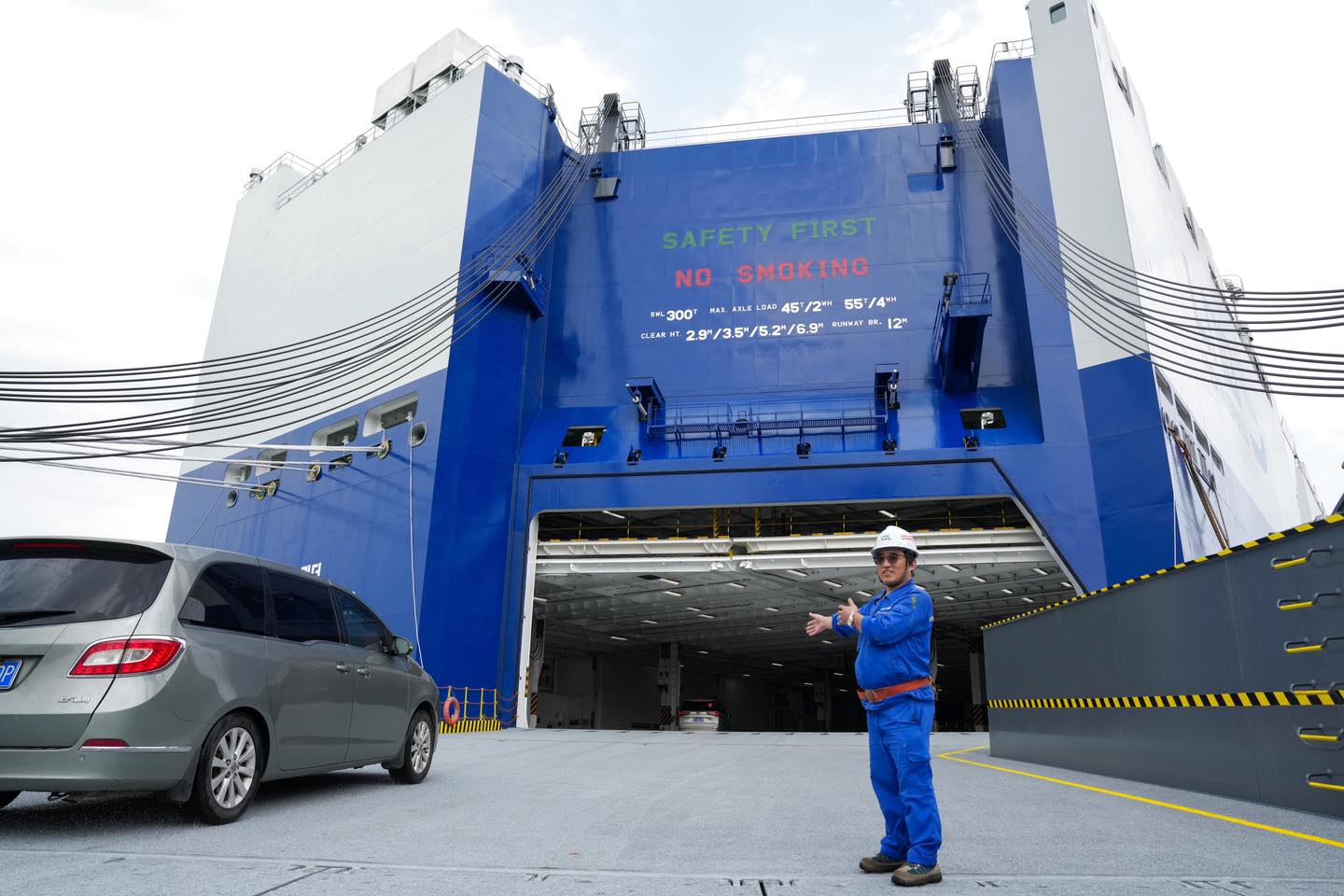

Nationally, China remains the world’s largest shipbuilder. Government data shows that the country built 53.69 million deadweight tons of vessels in 2025, accounting for 56.1 percent of global shipbuilding output. In 2025, China’s three major shipbuilding indicators — completed shipbuilding output, new orders, and orders on hand — accounted for the largest share of the global market for the 16th consecutive year.
NIGERIA WATCH: What this means for Nigerian ports, importers, and the auto trade
The arrival of the world’s largest car carrier on the high seas is not a distant headline for Nigeria — it lands squarely in the middle of one of the country’s fastest-growing import categories.
Nigeria’s passenger car imports rose to ₦1.58 trillion in 2025, a 24.64 percent increase year-on-year from ₦1.26 trillion in 2024. The broader transport equipment picture is even more striking: transport equipment and parts imports reached ₦6.54 trillion in 2025, up from ₦4.77 trillion in 2024, with passenger vehicles, industrial machinery, and spare parts making up the bulk of this bill.
Despite this surge in demand, Nigerian consumers are not necessarily getting a better deal. Automotive experts note that the increase in import values reflects the continued impact of foreign exchange volatility, a combination of higher vehicle prices globally and currency-related pressures locally that have significantly raised the cost of importing vehicles. For ordinary Nigerians, the result is vehicles that are increasingly out of reach — pushing more buyers toward the Tokunbo market.
Used vehicles, popularly known as Tokunbo, have become the default option for households and businesses squeezed by high interest rates, volatile foreign exchange markets, and persistent inflation, with Nigeria spending an estimated ₦1.71 trillion on used vehicle imports in 2025. Projections suggest Nigeria’s used vehicle import bill could rise further to about ₦1.85 trillion in 2026, assuming current trends persist.
This is precisely where vessels like the Glovis Leader could begin to make a difference. As ultra-large car carriers increase the volume of vehicles that can be moved per voyage, shipping costs per unit are expected to come down — a shift that could gradually ease the cost burden on Nigerian importers and, eventually, on consumers at the forecourt.
The United States has consistently dominated Nigeria’s vehicle import sourcing, accounting for over 41 percent of total passenger car imports in the first nine months of 2025 — far ahead of South Africa, the UAE, and European sources. The emergence of high-capacity vessels operating trans-Pacific and trans-Atlantic routes could intensify competition among shipping lines serving these corridors, with potential knock-on benefits for Nigerian ports and clearing agents.
On the policy front, Nigeria’s automotive authorities are watching the global fleet closely. The National Automotive Design and Development Council (NADDC) has announced that from 2026, Nigeria will introduce mandatory pre-export certification for used vehicles to curb the importation of unroadworthy and end-of-life vehicles — a policy move that could reshape which vehicles arrive at Tin Can Island and Apapa, and from where.
Under the broader classification of vehicles, aircraft, and related transport equipment, Nigeria’s total imports in this category increased from ₦4.49 trillion in 2024 to ₦5.92 trillion in 2025, representing a 31.8 percent year-on-year rise — a trajectory that shows no signs of slowing. As Nigeria’s appetite for vehicles grows and global shipping capacity expands, the case for routing more car carrier traffic through West African ports strengthens with each record-breaking vessel that enters service.
The Glovis Leader may fly a South Korean flag and carry a Chinese pedigree — but its ripple effects will be felt from Lagos to Port Harcourt.
Waterways News | Maritime Intelligence for Nigeria and Beyond