

Business
Dangote Refinery Ships 456,000 Tonnes of Fuel to Five African Nations, Signalling Nigeria’s Rise as Regional Energy Hub


Dangote Refinery Ships 456,000 Tonnes of Fuel to Five African Nations, Signalling Nigeria’s Rise as Regional Energy Hub
By Okeoghene Onoriobe, Waterways News Correspondent, Lagos
The Dangote Petroleum Refinery has made a significant entry into Africa’s regional energy trade, completing the sale and shipment of 12 cargo parcels totalling 456,000 tonnes (456KT) of refined petroleum products to five African countries — Côte d’Ivoire, Cameroon, Tanzania, Ghana, and Togo.
The cargoes, sold on a Free on Board (FOB) basis to international trading firms, represent the refinery’s first major export push of Premium Motor Spirit (PMS) since the plant achieved its 650,000 barrels-per-day processing capacity in February. The refinery confirmed the development in an official statement on Sunday.
Middle East Crisis Opens Door for Nigerian Exports
The timing of the export milestone is significant. A Bloomberg report published last Friday noted that African nations are increasingly looking to the Dangote Refinery as an alternative fuel source, as the ongoing conflict involving Iran continues to disrupt petroleum supplies from the Middle East — a development with direct implications for Nigerian shipping and cargo flows through West African ports.

The Hormuz crisis, which has roiled global tanker markets and driven up freight costs, appears to be accelerating a structural shift in Africa’s fuel supply chains — with Nigeria now positioned at the centre of that realignment.
Euro 5 Quality, West African Scale
In its statement, the refinery said the export activity underscores its capacity to not only satisfy Nigeria’s domestic fuel demand but to supply the wider region. The refinery highlighted its production of Euro 5-standard gasoline and diesel — a grade that far exceeds the quality of fuel historically available in West Africa, a market it described as one long regarded as a destination for substandard petroleum products.
Nigeria Watch
For Nigeria’s maritime sector, the implications of this development run deeper than energy policy. Increased export volumes from the Dangote Refinery translate directly into higher vessel call frequencies at Lagos anchorages, greater tanker traffic through Nigerian waters, and potentially stronger cargo throughput at the Apapa and Lekki Deep Sea Port terminals.
Nigerian shipping operators, maritime logistics firms, and freight forwarders stand to benefit from expanded tanker chartering activity, with FOB terms placing the responsibility for vessel arrangement on the buying traders — a structure that opens opportunities for Nigerian-flagged vessels and local maritime service providers under the Cabotage Act framework, where applicable.
The refinery’s emergence as a regional supplier also reinforces the strategic case being made by the Federal Ministry of Marine and Blue Economy for positioning Nigeria as the maritime logistics anchor of West and Central Africa.
Waterways News | Maritime. Inland Waterways. Blue Economy.
NPA, Stakeholders Chart Course to End Lekki Port Corridor Traffic Crisis
By Okeoghene Onoriobe | Waterways News
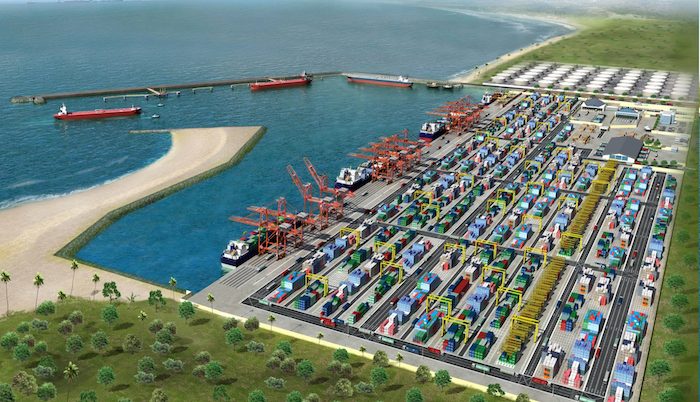
The Nigerian Ports Authority (NPA) has convened a high-level stakeholders’ meeting to tackle the chronic traffic gridlock that has paralysed access roads to Lekki Deep Seaport and its surrounding industrial corridor for over a year, with participants agreeing on concrete measures to restore order to one of Nigeria’s most strategically important port gateways.
The meeting, chaired by Lekki Port Manager Emmanuel Anda, brought together representatives of the Lagos State Government, Lekki Port management, Dangote Refinery, truck owners’ associations, and the Electronic Truck Call-Up System operator, Mycallup — signalling a coordinated multi-agency response to a problem that has long frustrated port users and logistics operators.
A central resolution from the meeting was the outright prohibition of stationary trucks and tankers along the Lekki port corridor. Going forward, all trucks must remain in designated holding bays and waiting areas until they receive electronic clearance to proceed to the port or adjacent industrial facilities.
The agreement followed a joint inspection of the Lekki access roads by meeting participants, who observed firsthand the scale of the congestion. Stakeholders subsequently resolved that the situation could no longer be allowed to continue unchecked.
Dangote Refinery Trucks Identified as Key Factor
Mycallup’s representative, Timi Koteolu, identified trucks servicing Dangote Refinery outside the electronic scheduling platform as a significant contributor to the bottleneck. He noted that many drivers operating with Dangote’s Authority to Collect (ATC) permits had been parking indiscriminately along corridor roads while awaiting refinery access — and that these trucks are currently not integrated into the port’s electronic call-up system.
Dangote Refinery’s representative, Jaiyeola Moshood, clarified that the ATC permits represent the approved access mechanism for tankers entering the refinery. However, Mycallup maintained its position: trucks without an active call-up must not approach the port corridor and should remain in designated waiting areas until required.
Lekki Port Manager Anda specifically urged Dangote Refinery to fully integrate with the electronic truck call-up platform, noting that such collaboration would substantially reduce indiscriminate truck presence on access roads. He further assured participants that discussions with Dangote Refinery management would continue to strengthen coordination of truck movements, with ATC-permit vehicles only permitted to proceed when duly cleared.
The Association of Maritime Truck Owners (AMATO) and the National Association of Road Transport Owners (NARTO) pledged support for the initiative, committing to sensitise their members while calling for firm enforcement of traffic regulations. NUPENG’s Dangote Refinery Coordinator, Ademola Adeshina, also assured stakeholders of his members’ readiness to comply with the established Standard Operating Procedures.
Nigeria Watch
The Lekki port corridor gridlock is more than a traffic management problem — it is a symptom of the infrastructural and coordination deficit that continues to shadow Nigeria’s ambitions for a world-class port ecosystem.
Lekki Deep Seaport was designed as a transformational asset: a deep-draft facility capable of receiving the large vessels that historically bypassed Nigeria for Lomé, Abidjan, and Tema. Its proximity to the Dangote Refinery — the largest single-train refinery in the world — amplified that promise, creating what should be a uniquely powerful industrial and logistics corridor on the Lagos coast.
Yet the gridlock that has persisted for over a year on those same access roads tells a different story. It exposes a coordination gap that was foreseeable: two enormous, truck-intensive operations — a major seaport and a 650,000-barrel-per-day refinery — sharing corridor infrastructure without a unified traffic and scheduling framework from the outset.
The NPA deserves credit for convening this meeting and driving a stakeholder-wide response. Equally important is the frank identification of the Dangote Refinery’s ATC-permit trucks as a key factor — an acknowledgement that is necessary before any durable solution can take hold. The call for the refinery to integrate with the Mycallup electronic call-up platform is the right prescription. Until the corridor’s two dominant traffic generators operate on a single, synchronised scheduling system, ad hoc enforcement alone will struggle to hold.
For Nigeria’s maritime sector, the stakes extend beyond Lekki. The port’s performance directly influences how global shipping lines and terminal operators assess Nigeria’s readiness to handle increased cargo volumes — and whether the country can translate its port infrastructure investments into measurable trade competitiveness. A corridor choked with waiting tankers and unscheduled trucks undermines that case.
The broader lesson is one that NPA, NIMASA, and Lagos State should absorb as Badagry Deep Seaport, Ibom Deep Seaport, and other greenfield port projects advance: corridor traffic management frameworks must be designed and agreed before operations begin, not retrofitted after a crisis has taken hold.
Business
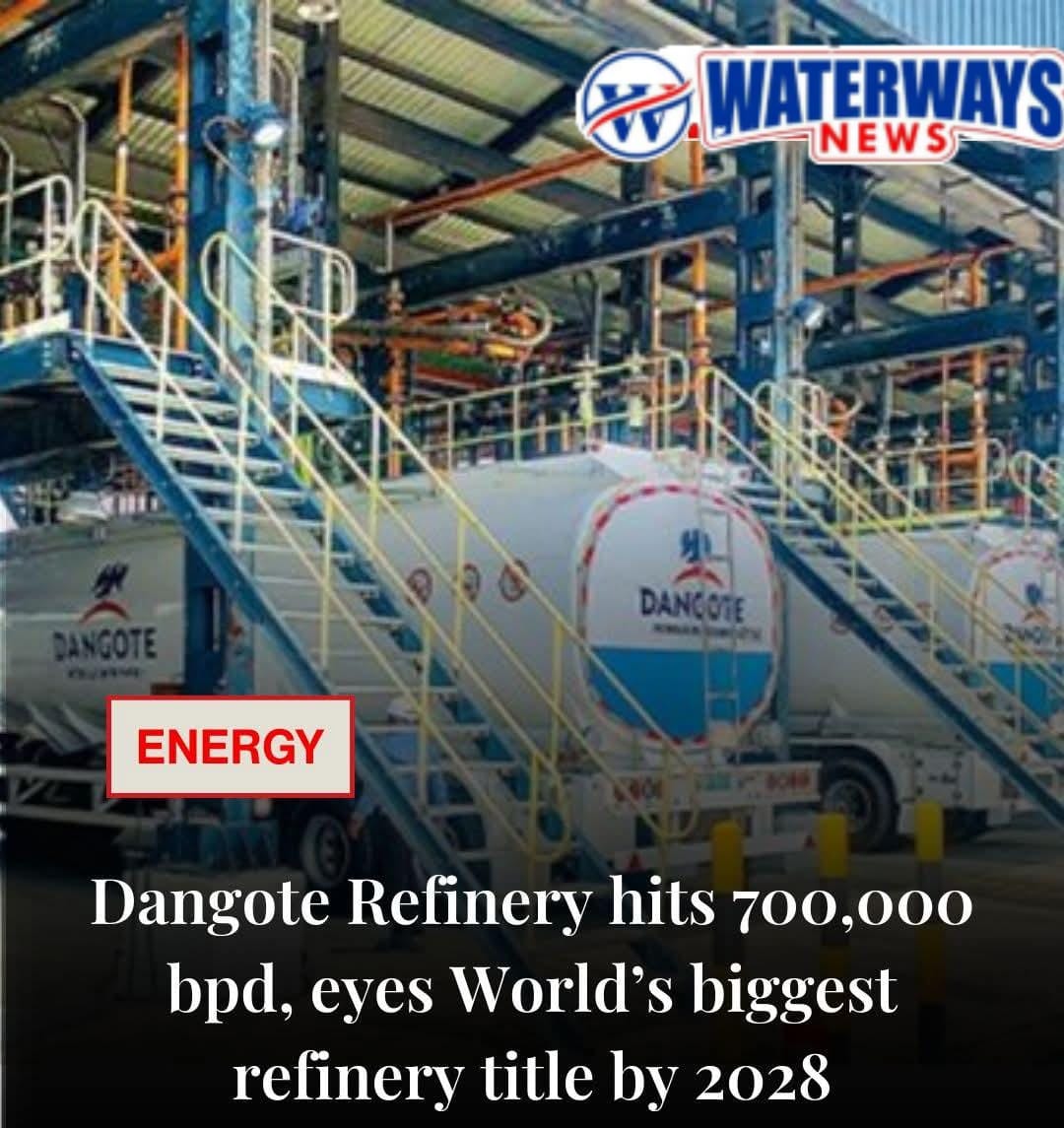
Dangote Refinery Surpasses Nameplate Capacity, Processes 700,000 Barrels Per Day in Independent Test — Eyes World’s Largest Refinery Crown by 2028
Dangote Refinery Surpasses Nameplate Capacity, Processes 700,000 Barrels Per Day in Independent Test — Eyes World’s Largest Refinery Crown by 2028
Landmark throughput milestone confirmed by independent process licensors; facility now targets 1.4 million bpd expansion within 30 months as European buyers queue up and domestic forex pressure begins to ease
By Okeoghene Onoriobe | Waterways News Correspondent | LAGOS
Dangote Petroleum Refinery & Petrochemicals has achieved a historic throughput milestone, processing crude oil at 700,000 barrels per day — surpassing its own nameplate capacity by 50,000 barrels — in a performance test independently verified by process licensors. The result, officially disclosed by the refinery, cements the Lekki Free Zone facility’s standing as the world’s largest single-train petroleum refinery, a title it has carried since commissioning but now backs, for the first time, with independently verified throughput figures.
The significance of the milestone extends well beyond the technical. For a country that spent decades as one of Africa’s foremost crude oil producers while simultaneously haemorrhaging billions of dollars in foreign exchange importing refined petroleum products it could not produce at home, the data represents a turning of a page — perhaps the most consequential industrial turning Nigeria has seen since the oil boom era.
From Paradox to Proof
Nigeria’s refining story has long been one of institutional failure and squandered potential. For much of the past three decades, the country’s four state-owned refineries — at Port Harcourt, Warri, and Kaduna — operated at negligible capacity or lay idle entirely, leaving Africa’s most populous nation dependent on imported petrol, diesel, and aviation fuel. The downstream sector became a monument to mismanagement, a drain on the public treasury through fuel subsidies that persisted even as ordinary Nigerians queued for hours at petrol stations.
Dangote’s refinery, planted on a sprawling 2,635-hectare plot at the Lekki Free Zone on the eastern outskirts of Lagos, was conceived as the direct industrial answer to that national embarrassment. When Aliko Dangote, Africa’s richest man, first announced the project, it was met with the particular scepticism reserved in Nigeria for projects of outsized ambition. Construction delays, financing complexities, and repeated revised timelines tested that scepticism. But the facility began fuel production in 2024, and since then has steadily ramped output across its product slate — petrol, diesel, aviation fuel, liquefied petroleum gas, and a range of petrochemical feedstocks.
The 700,000-barrel-per-day result, now independently confirmed, is the most concrete performance data the refinery has released since it came online, and it removes whatever residual doubt remained about the facility’s core engineering credentials.
A Waypoint, Not a Destination
Devakumar Edwin, Vice-President for Oil and Gas at Dangote Industries, was careful to frame the milestone as a point on a longer trajectory rather than a finishing line. The refinery, he indicated, is targeting a throughput capacity of 1.4 million barrels per day within 30 months — a figure that, if achieved, would transform the Lekki facility from the world’s largest single-train refinery into potentially the largest refinery of any configuration on earth.
That projection would put the Dangote complex ahead of South Korea’s Ulsan refining complex and Saudi Aramco’s Ras Tanura — both perennial occupants of the top rungs of global refining capacity rankings. Edwin did not detail the capital expenditure required to double throughput, nor the feedstock contracting strategy that would be needed to secure sufficient crude supply for such a dramatic ramp-up. Those are not trivial questions. But the 30-month timeline — pointing to somewhere around the end of 2028 — has been clearly stated, and the market will hold the company to it.
A Global Export Footprint
The refinery’s commercial reach has expanded significantly beyond Nigeria’s borders. Since first production, the plant has found buyers across multiple African countries and, more remarkably, across Europe — the United Kingdom, France, Spain, Italy, and the Netherlands are among confirmed destination markets for its refined products. It has also supplied gasoline to the United States market and jet fuel to Saudi Arabia, the latter carrying a particular symbolic resonance given the Kingdom’s own deep refining heritage and global energy stature.
The geopolitical context has worked in the refinery’s favour. Disruptions in global energy supply chains — most acutely from tensions in the Middle East — have accelerated African governments’ efforts to diversify their energy sourcing, and the Dangote plant has positioned itself as a credible regional anchor. In April 2026, data from S&P Global Commodities placed Dangote Petroleum as the world’s largest exporter of jet fuel for that month — a data point the company has been understandably quick to amplify.
The Forex and Domestic Supply Equation
On the home front, the strategic implications of the refinery’s expanding output are significant and directly felt in Nigeria’s macroeconomic architecture. For years, the importation of petroleum products was one of the primary drivers of Nigeria’s chronic foreign exchange demand — placing sustained pressure on central bank reserves, fuelling naira depreciation, and feeding the cycle of inflation that has eroded purchasing power across the country. By substituting domestic refining capacity for those imports at scale, the Dangote facility provides structural relief to that pressure, and analysts have begun to observe measurable reductions in Nigeria’s net fuel import bill.
However, analysts are also quick to note that the refinery’s output alone cannot solve Nigeria’s downstream distribution challenges. Ageing pipeline infrastructure, logistics bottlenecks, and the still-unresolved depot and retail distribution architecture mean that benefits that should flow from domestic refining capacity do not always materialise efficiently at the pump for the average Nigerian consumer. The refinery may win every throughput test; the last-mile challenge remains a separate, stubborn problem.
Petrochemicals: The Higher-Margin Frontier
Beyond fuel products, the Dangote facility is pressing into higher-value petrochemical derivatives. The company has flagged plans to significantly scale up production of liquefied petroleum gas and industrial feedstocks — among them polypropylene, which feeds Nigeria’s packaging and plastics manufacturing sector, and Linear Alkylbenzene, a key precursor in detergent production. Both represent product streams with stronger margins than conventional fuels, and their domestic production has the additional strategic value of reducing Nigeria’s import dependence across a wider range of industrial goods.
Nigeria Watch
Waterways News analysis of the domestic maritime and coastal trade implications
The Dangote refinery’s 700,000-barrel-per-day throughput is not merely an energy story — it is a maritime story, and one that reshapes the freight and logistics calculus across Nigeria’s entire coastal and inland waterway economy.
For port operators, terminal managers, and shipping lines operating along the Nigerian coast, the refinery’s ramp-up carries direct operational significance. The facility’s product slate — refined fuels, LPG, petrochemicals — will increasingly require coastal distribution to terminals along Nigeria’s riverine and coastal belt, from the Warri axis to Calabar and beyond. The National Inland Waterways Authority (NIWA) and state waterway agencies such as LAGFERRY and the Lagos State Waterways Authority (LASWA) must reckon with the fact that a refinery now producing at this scale generates downstream logistics demand that Nigeria’s coastal fleet is not yet fully equipped to absorb efficiently.
The Cabotage Act, which reserves domestic cargo movement to Nigerian-flagged vessels, is directly implicated. If the Dangote refinery’s coastal product distribution is to comply fully with cabotage provisions — as it should — then the availability and capacity of Nigerian-flagged tankers and product carriers becomes a live operational constraint. This is precisely the moment when the long-delayed disbursement of the Cabotage Vessel Financing Fund (CVFF) matters most. A refinery of this size producing for domestic coastal distribution needs a coastal fleet to match. The CVFF’s continued inaccessibility to Nigerian shipowners represents a structural bottleneck at exactly the wrong historical moment.
The refinery’s growing export footprint — supplying jet fuel to Saudi Arabia, gasoline to the United States, and petroleum products across Europe — also signals a future where Nigerian-controlled shipping lines could, in principle, handle a portion of that trade. That is a conversation Nigeria’s maritime policy establishment has barely begun to have. The Nigerian Maritime Administration and Safety Agency (NIMASA), the Shipping Council, and the Ministry of Marine and Blue Economy should be asking, with urgency, what it would take for Nigerian tonnage to carry Nigerian-refined crude into European and American ports. That is the blue economy dividend this refinery milestone makes newly conceivable, even if not yet reachable.
For freight forwarders and logistics operators, the implications of a 1.4-million-barrel-per-day Dangote refinery by 2028 are transformative. The volume of petroleum products, petrochemicals, and derivatives that would require movement — by sea, river, pipeline, and road — would fundamentally alter Nigeria’s freight market. Those who position now — in tonnage, in terminal capacity, in skills — will define the sector’s landscape for a generation.
Nigeria has long been accused of building upstream wealth and exporting raw value. The Dangote refinery, at its current throughput and with its stated expansion trajectory, represents the most significant structural rebuttal to that accusation in the country’s economic history. For the maritime sector, the imperative is clear: grow to meet it.

NIMASA, Liberia Forge Closer Maritime Ties, Eye Sea-Time Training for African Youths
By Okeoghene Onoriobe | Waterways News Correspondent
The Nigerian Maritime Administration and Safety Agency (NIMASA) has signalled renewed determination to deepen inter-African maritime cooperation, following a high-level consultative visit by the Honorary Consul of the Republic of Liberia in Lagos, Mr. Dapo Akinosun, SAN, to the Agency’s Lagos headquarters.
Receiving the envoy, NIMASA Director General Dr. Dayo Mobereola described the engagement as a reflection of the enduring bilateral maritime relationship between Nigeria and Liberia, and called for accelerated continent-wide collaboration to unlock Africa’s vast maritime potential.
Capacity, Youth and the Blue Economy
Dr. Mobereola placed particular emphasis on the urgent need to expand sea-time training and practical maritime exposure for African youth, arguing that structured capacity development programmes could position Nigerian and other African seafarers to compete credibly in the global maritime labour market.
“The time has come for African nations to upscale maritime collaboration. The partnership between Nigeria and Liberia will help us build capacity, strengthen regional cooperation, and create opportunities for African youths within the global maritime industry,” the NIMASA DG stated.
He added that maritime capacity must be built beyond national borders, noting that hands-on sea-time experience remains the critical bridge between classroom training and international competitiveness.
IMO Seat and Diplomatic Goodwill
Dr. Mobereola also used the occasion to acknowledge Liberia’s support for Nigeria’s successful campaign for a Category C seat at the International Maritime Organization (IMO), describing the backing as a demonstration of the productive diplomatic and technical relationship both countries have sustained over the years.
Liberia’s Position
Consul Akinosun, for his part, said the visit was designed to reinforce bilateral maritime ties and explore concrete pathways for expanded cooperation across maritime administration, port safety, and trade facilitation. He commended NIMASA’s management for recent reform efforts and pledged Liberia’s readiness for deeper engagement.
“Nigeria has demonstrated genuine commitment to maritime partnership and regional growth. Liberia looks forward to deeper collaboration with NIMASA in maritime administration, safety, capacity development, and trade promotion for the advancement of Africa’s Blue Economy,” Akinosun said.
Also present at the meeting were NIMASA Executive Director, Maritime Labour and Cabotage Service, Mr. Jibril Abba; Director of Reforms Coordination and Strategic Management/Blue Economy Unit, Mrs. Nneka Obianyor; and Mr. Kehinde Ogundimu, Head of the Media Department at the Liberian Consulate in Lagos.
Nigeria Watch: Why This Bilateral Engagement Matters Beyond the Handshake
Diplomatic courtesy visits between maritime regulators and foreign consuls are often dismissed as ceremonial. The NIMASA-Liberia engagement this week, however, carries layered significance that warrants closer reading — particularly for Nigerian shipping stakeholders tracking the Agency’s strategic direction under Dr. Mobereola.
The IMO Dimension
Nigeria’s Category C seat at the International Maritime Organization is not merely a prestige acquisition. It translates into real influence over the rule-setting architecture that governs flag state responsibilities, port state control regimes, and the international conventions under which Nigerian-flagged vessels trade and Nigerian ports are assessed. Liberia’s support for Nigeria’s IMO bid was not incidental — Liberia is one of the world’s largest open registries, operating a flag state of enormous commercial weight through its Liberian International Ship and Corporate Registry (LISCR). When a registry of that scale backs Nigeria’s multilateral ambitions, it signals mutual interest in shaping how African maritime governance is represented at the global table. Nigeria would do well to translate that goodwill into substantive co-sponsorship of positions at IMO sessions, particularly on issues affecting Gulf of Guinea security, seafarer certification equivalences, and the decarbonisation transition costs borne disproportionately by developing maritime states.
The Seafarer Supply Chain Gap
Dr. Mobereola’s emphasis on sea-time training is a pointed acknowledgement of one of the most persistent structural weaknesses in Nigeria’s maritime sector. Nigeria produces maritime academy graduates at a respectable rate across institutions such as the Nigerian Seafarers Development Programme (NSDP) and the various state maritime schools. The bottleneck, long identified by industry insiders, lies not in classroom supply but in the availability of berths — approved vessel positions on internationally recognised ships where cadets can accumulate the documented sea service hours required for STCW certification. Liberia’s registry connections, if properly leveraged, could open pathways for Nigerian cadets to secure sea-time placements on vessels under the Liberian flag, many of which are operated by major international shipowners. This is not a novel idea, but it has never been formalised into a bilateral protocol. The Mobereola-Akinosun meeting presents an opportunity to move that conversation from aspiration to implementation.
Cabotage and Regional Trade Connectivity
Beyond the bilateral, NIMASA’s renewed push for African maritime integration fits within a broader strategic logic that Nigerian policymakers have long articulated but inconsistently executed. The Cabotage Vessel Financing Fund (CVFF), still largely undisbursed, was designed in part to build indigenous fleet capacity that could anchor Nigeria as a regional shipping hub. A more integrated West African maritime space — with harmonised port state control inspections, aligned seafarer certification regimes, and cooperative vessel traffic management — would increase the commercial viability of Nigerian-flagged coastal traders operating routes to Liberia, Sierra Leone, Ghana, and Côte d’Ivoire. Until that regulatory architecture exists, the economics of regional cabotage will remain fragile. Engagements like this week’s Liberia visit are, at minimum, the diplomatic groundwork on which that architecture must eventually be built.
-

 Oil and Gas3 months ago
Tantita’s Pipeline Deal: $144m Contract, Rising Output, and the Questions that Deserve Answers
-
 MARITIME TRADE & SHIPPING3 months ago
World’s Largest Container Ship Sets New Maritime Record with 22,233 TEUs on Single Voyage
-
 Blue Economy4 months ago
Nigeria’s Coast Guard Bill: A Solution in Search of a Problem?