Blue Economy
Delta State Launches Blue Economy Committees to Harness Wealth of Its Waters

Delta State Launches Blue Economy Committees to Harness Wealth of Its Waters
By Okeoghene Onoriobe | Blue Economy Correspondent | Asaba-Delta State | Wednesday 25th February 2026
In a bold step toward economic diversification, the Delta State Government inaugurates dual committees to unlock the multi-billion-naira potential of its oceans, rivers, creeks and coastal belts.


Delta State has taken a decisive step toward reshaping its economic future — one that looks not to the oilfields beneath its land, but to the rivers, creeks, coastlines and waterways that define its geography. On Tuesday, Deputy Governor Sir Monday Onyeme, Ph.D., formally inaugurated the Delta State Blue Economy Steering Committee and Technical Committee in Asaba, setting in motion a structured policy effort to tap into what experts describe as a largely underexploited frontier of economic growth.
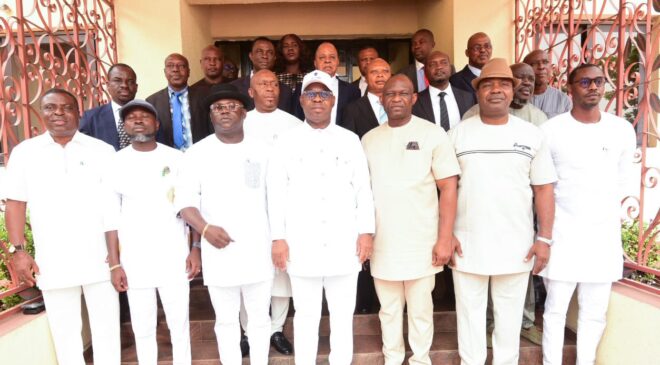

Delta State Deputy Governor, Sir Monday Onyeme (front row, centre), flanked by members of the Blue Economy Steering and Technical Committees, shortly after their inauguration at Government House, Asaba, on Tuesday
With hundreds of kilometres of waterways, a rich aquatic biodiversity, coastal communities, and direct access to the Atlantic Ocean through the Bight of Benin, Delta State sits on a goldmine that has, for decades, remained in the shadows of crude oil. The new committees are tasked with changing that narrative.
What Is the Blue Economy? Understanding the Concept
Before examining Delta’s strategic move, it is important to understand what the Blue Economy actually means — and why it matters.
The Blue Economy refers to the sustainable use of ocean and water resources for economic growth, improved livelihoods and jobs, while preserving the health of aquatic ecosystems. The term — popularised globally by the World Bank and the United Nations — covers a wide range of sectors:
- Fisheries and Aquaculture: Commercial fishing, fish farming, and seafood processing industries that feed populations and generate export revenue.
- Marine and Inland Water Transport: Freight and passenger movement across rivers, lakes, coastal waters and seas — cheaper and often more efficient than road transport.
- Coastal and Nautical Tourism: Eco-tourism, boat cruises, beach resorts, heritage water festivals and recreational water sports.
- Offshore Energy: Renewable energy such as wave, tidal and offshore wind power, as well as existing offshore oil and gas operations.
- Marine Mineral Resources: Extraction of sand, gravel, salt and other minerals from seabeds and riverbeds.
- Shipbuilding and Marine Engineering: Construction and maintenance of boats, vessels, barges and offshore platforms.
- Coastal Real Estate and Infrastructure: Development of ports, jetties, waterfront markets and riverine residential communities
Globally, the Blue Economy is valued at over $1.5 trillion annually and is expected to double by 2030, according to the World Bank. For a riverine state like Delta — home to approximately 60% waterways and coastal territory — the sector represents a transformational opportunity.
“The Blue Economy encompasses all economic activities linked to oceans, seas, coastal areas and inland waterways — including the production, distribution and consumption of goods and services connected to marine and mineral resources.” — Dr. Barry Pere-Gbe, Chief Economic Adviser to the Governor
The Two Committees: Their Roles and Composition
To translate policy ambition into concrete action, the state government has established two distinct but complementary bodies — each with a defined function in the Blue Economy governance architecture.
1. The Blue Economy Steering Committee
This is the high-level policy organ. Chaired by Deputy Governor Sir Monday Onyeme, the Steering Committee is responsible for setting strategic direction, approving frameworks and ensuring that all participating ministries, departments and agencies (MDAs) align their work with the state’s Blue Economy vision.
Members are drawn from the following key sectors of government:
- Ministry of Environment — oversees ecosystem protection, pollution control and environmental sustainability.
- Ministry of Transport — responsible for waterway transport policy, jetty infrastructure and maritime regulation.
- Ministry of Agriculture — focuses on fisheries development, aquaculture expansion and food security.
- Ministry of Riverine Infrastructure — handles construction of waterfront facilities, bridges and creek development.
- Ministry of Housing — integrates waterfront urban planning and development.
- Ministry of Energy — explores offshore and tidal renewable energy opportunities.
- Ministry of Trade and Investment — drives private sector engagement, investment promotion and trade partnerships.
- Ministry of Culture and Tourism — develops coastal tourism, water festivals and recreational economy.
- Delta State Internal Revenue Service (DTIRS) — manages taxation, revenue collection and fiscal planning.
- Delta State Investment Development Agency (DIDA) — coordinates inward investment and foreign direct investment (FDI) promotion.
2. The Blue Economy Technical Committee
Operating beneath the Steering Committee, this is the operational engine of the framework. Composed of senior directors drawn from the same MDAs, the Technical Committee provides expert analysis, coordinates implementation across ministries, monitors performance and ensures that policy decisions are practically executable.
The relationship between the two committees mirrors best practice in public administration: policy is set at the top, and technical expertise drives delivery from below — both working in tandem.
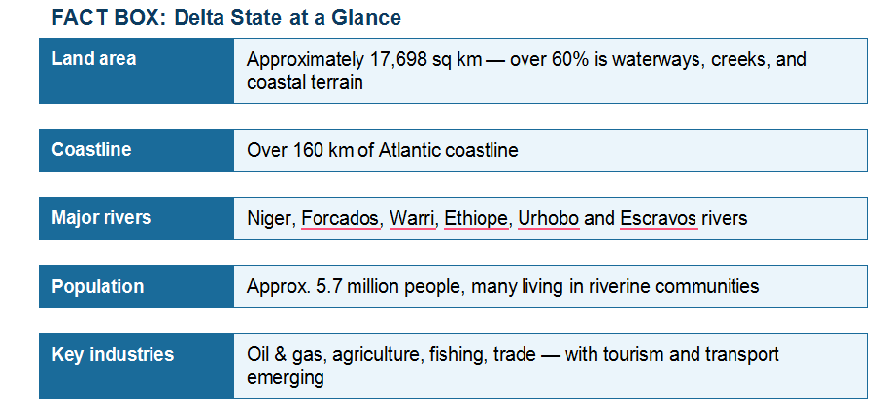
FACT BOX: Delta State at a Glance

Economic Potential: What the Blue Economy Offers Delta
Experts and government officials alike have pointed to several areas where the Blue Economy can generate measurable economic returns for Delta State:
Fisheries and Aquaculture: Delta’s waters support diverse species of fish, shrimp, crab and periwinkle. With improved infrastructure, cold chain logistics and aquaculture investment, the state could significantly boost fish production, reduce Nigeria’s fish import bill — currently estimated at over $700 million annually — and create thousands of direct and indirect jobs.
Inland Waterways Transport: Road infrastructure in riverine communities is often poor or nonexistent. Developing reliable water transport routes — with passenger ferries, cargo barges and standardised jetties — can reduce logistics costs, open up remote markets and stimulate commerce in historically underserved areas.
Blue Tourism: Delta’s waterways, mangroves, river deltas and oil-palm lined creeks present unique eco-tourism opportunities. Boat safaris, fishing tourism, cultural water festivals and river heritage trails could attract both domestic and international visitors.
Coastal Energy: Offshore wind and tidal energy remain largely untapped across Nigeria’s coastline. As global energy transition accelerates, Delta’s Atlantic-facing coast positions it as a potential site for future renewable energy infrastructure.
“The committees must work collaboratively to ensure the state maximises opportunities in marine resources, inland waterways, fisheries, transport, tourism and energy.” — Deputy Governor Sir Monday Onyeme, Ph.D.
Governance Structure: Coordinated Under the Deputy Governor
A notable feature of Delta’s Blue Economy architecture is its placement under the Office of the Deputy Governor rather than a single sector ministry. This is significant for several reasons.
First, it gives the initiative cross-ministerial authority — the Deputy Governor can direct coordination across Agriculture, Transport, Tourism, Energy and Revenue without being constrained by any one ministry’s mandate. Second, it ensures that the Blue Economy remains a whole-of-government priority rather than a siloed project. Third, it elevates the framework’s political profile, signalling that implementation will be supervised at the highest executive level.
Commissioners and directors of the participating MDAs also presented ministerial briefs at the inauguration — outlining their sectors’ specific contributions to the Blue Economy agenda. This signals an early commitment to institutional buy-in, which is often the first casualty in cross-government policy efforts
What Success Would Look Like
For Delta State’s Blue Economy framework to deliver real impact, analysts and policymakers typically point to the following benchmarks:
- A comprehensive Blue Economy Master Plan with sector-specific targets, timelines and investment requirements.
- Increased foreign and domestic investment in fisheries, water transport, and coastal tourism.
- Improved waterway infrastructure — functional jetties, navigation aids, flood management systems.
- Job creation in riverine communities that have historically been economically marginalised.
- Diversification of state revenue away from federal oil allocations toward locally generated Blue Economy income.
- Institutional capacity building — training of officers in marine law, aquaculture management, and environmental governance.
Conclusion: A Turning Tide
For a state that has long watched its wealth flow outward through oil pipelines and its communities remain underdeveloped despite sitting atop immense natural riches, the inauguration of Delta’s Blue Economy committees may mark a turning tide — quite literally.
The challenge now is execution. Committees and frameworks are only as powerful as the political will and technical capacity behind them. But the structural decisions made on Tuesday — broad ministerial representation, placement under the Deputy Governor, alignment with federal policy — suggest that Delta State is approaching this not as a tokenistic gesture, but as a serious platform for economic transformation.
If realised, Delta’s Blue Economy could become a model for other riverine states in Nigeria — proving that sustainable water-based prosperity is not just possible, but achievable.