Oil and Gas
Floating Giants of the Deep: How Offshore Oil and Gas Factories Are Reshaping the Global Energy Frontier

Floating Giants of the Deep: How Offshore Oil and Gas Factories Are Reshaping the Global Energy Frontier (Part 2)
WATERWAYS NEWS SPECIAL FEATURE | OFFSHORE ENERGY | IN-DEPTH REPORT
Far beyond the sight of land, colossal floating industrial complexes extract, process, and export the world’s energy — silently powering economies on every continent. Waterways News, in this two parts feature report, takes you inside the hidden world of offshore floating production systems. Here is part two of the report
By Raymong Gold | Co-Publisher and Research Reporter, Waterways News, Lagos


The FSRU: Gateway to a Nation’s Energy Future
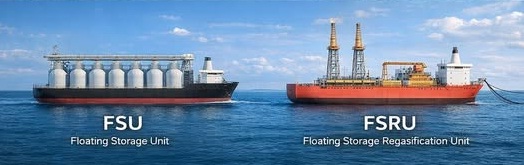
On the receiving end of the global LNG supply chain is another floating facility type that has gained enormous strategic importance in recent years: the Floating Storage and Regasification Unit, or FSRU.
While an FLNG liquefies gas at the production end, the FSRU performs the reverse operation at the import end. LNG tankers arrive and transfer their cargo to the FSRU, which then heats the liquefied gas in a controlled process — known as regasification — causing it to revert to its gaseous state. The gas is then injected into subsea pipelines that deliver it to onshore networks for power generation, industrial use, and domestic consumption.
Why FSRUs Matter for Nigeria and Africa
FSRUs have become particularly significant for developing economies seeking to expand their access to natural gas without the enormous cost and time investment of building permanent onshore LNG import terminals. A conventional onshore regasification terminal can take a decade to plan, permit, and construct — and cost billions of dollars. An FSRU can be deployed within two to three years at a fraction of the cost.
For Africa, where chronic energy deficits continue to constrain economic growth and industrial development, FSRUs represent a transformative opportunity. Several African nations have already commissioned or are actively pursuing FSRU deployments as part of their energy transition strategies, seeking to reduce dependence on petroleum products and expand cleaner-burning gas in their energy mix.
“For Africa, where chronic energy deficits constrain economic growth, FSRUs represent a transformative opportunity — faster and cheaper than building permanent onshore terminals.”
The FSU: The Ocean’s Silent Warehouser
Completing the picture of offshore floating storage systems is the Floating Storage Unit — or FSU — the simplest of all the vessel types reviewed in this report. An FSU is a floating vessel dedicated entirely to storage, without any processing or regasification capability.

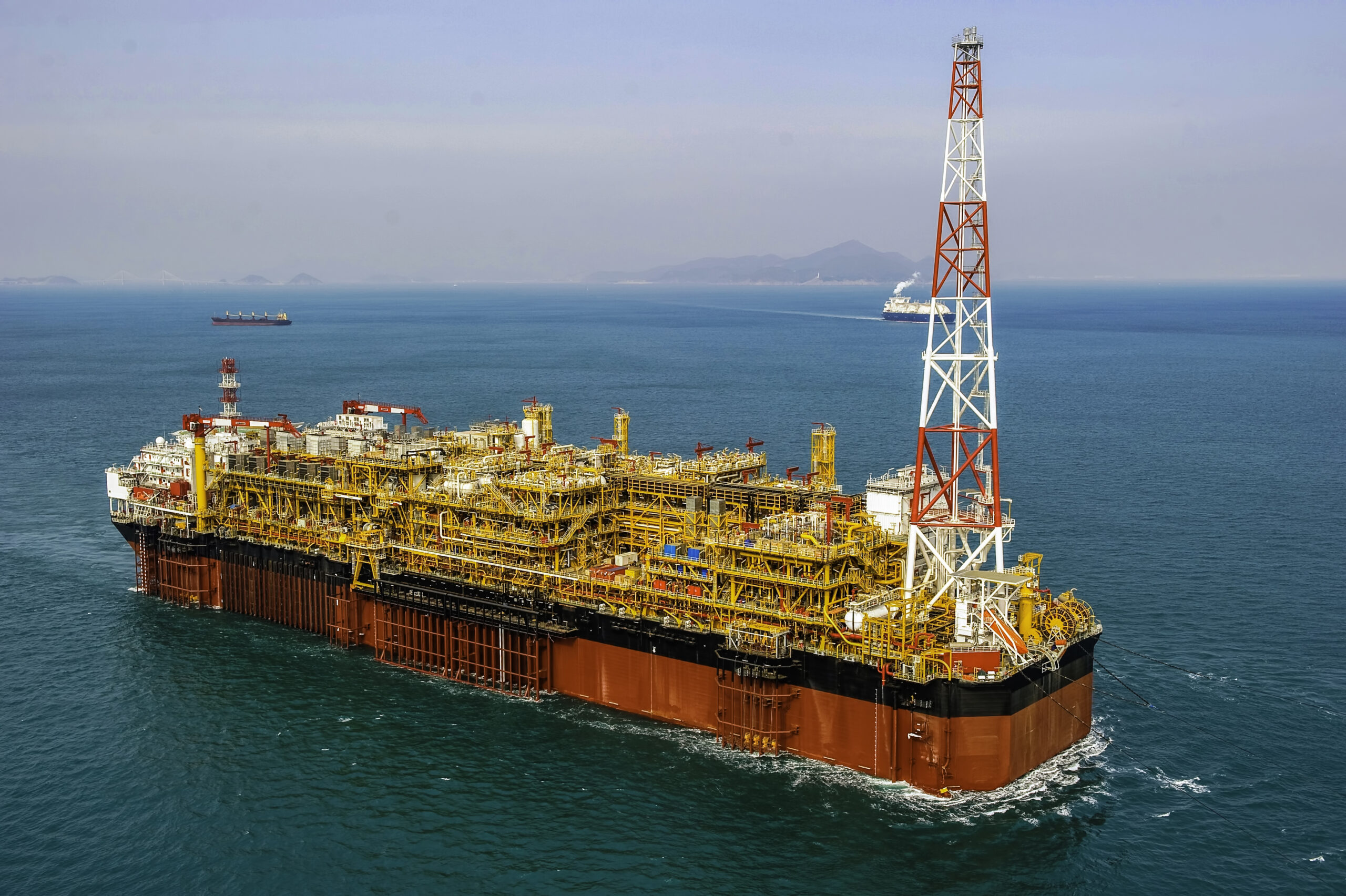
View of FPSO oil rig, floating production, storage and offloading vessel used to explore the crude oil & gas under the seabed.
FSUs hold crude oil or LNG as intermediate storage points within the broader energy logistics chain. They may serve as buffer storage between production facilities and export tankers, or as strategic reserves positioned at offshore anchorages to optimise the flow of cargoes to market.
While they may lack the technological drama of an FLNG or the production complexity of an FPSO, FSUs serve a critical logistics function. In a global energy system that demands the uninterrupted flow of oil and gas through complex multi-link supply chains, strategic floating storage is often the invisible glue that keeps the entire system functioning.

The People Behind the Giants
Any account of offshore floating facilities that focuses solely on technology and engineering risks overlooking the most important element of all: the human beings who design, build, operate, and maintain these extraordinary structures.
Operating a floating production facility in the middle of the open ocean is one of the most demanding professional environments on Earth. Personnel on these vessels work in an environment that is isolated, often physically challenging, and subject to weather extremes that land-based workers can scarcely imagine. They typically work in rotation — spending several weeks on board, followed by an equal period at home — in a cycle that demands exceptional physical and mental resilience.
A Multi-Disciplinary Workforce
The range of professional expertise required to operate an FPSO or FLNG facility mirrors that of a small industrial city. Marine engineers are responsible for the vessel’s propulsion, power generation, and hull integrity systems. Offshore process engineers oversee the complex production systems that separate oil from gas and water. Electrical engineers manage the vast networks of power distribution and instrumentation that control production operations. Mechanical technicians maintain compressors, pumps, valves, and heat exchangers that would fill several warehouses if laid out flat.
Automation and control specialists — a profession of growing importance in an era of increasing digitalisation — manage the sophisticated control systems that monitor production in real time, often from centralised control rooms that look more like the bridge of a space mission than a conventional oil facility. Chemical engineers oversee the injection of chemicals into the production stream to prevent corrosion, scaling, and hydrate formation in the subsea pipelines.
And then there are the maritime professionals: the ship officers and professional seafarers who are responsible for the safety, stability, and positioning of the vessel itself. On a dynamically positioned FPSO — one that holds its position using computer-controlled thrusters rather than mooring chains — the bridge officers and the dynamic positioning operators carry a particularly critical responsibility.
A Career on the Water
For young Nigerians considering careers in the maritime and energy sectors, offshore floating facilities represent a compelling frontier. The combination of maritime skills, engineering knowledge, and operational expertise required aboard these vessels creates a demand for highly trained professionals that is unlikely to diminish in the coming decades.
Nigeria’s National Content Development and Monitoring Board (NCDMB) has actively championed the development of Nigerian expertise in the offshore energy sector, working to increase the proportion of Nigerian professionals employed on the facilities that extract the country’s own oil and gas resources. The growth of the country’s maritime training institutions, combined with the development of indigenous engineering and marine services companies, is building the foundation for a generation of Nigerians who may one day lead the operation of these floating giants.
The Environmental Dimension
No examination of offshore floating energy facilities in the modern era would be complete without addressing their environmental context. The extraction and processing of fossil fuels at sea carries inherent environmental risks — from oil spills and gas flaring to the disturbance of marine ecosystems and the contribution to greenhouse gas emissions.
The offshore industry has invested heavily in safety systems designed to prevent and contain spills, and regulatory regimes governing offshore operations — including those administered by Nigeria’s Department of Petroleum Resources and its successor the Nigerian Upstream Petroleum Regulatory Commission (NUPRC) — set standards that operators are required to meet.
At the same time, the role of LNG-related facilities — particularly FSRUs — in the energy transition narrative is worth noting. Natural gas produces significantly lower carbon emissions per unit of energy than coal or heavy fuel oil, and for many developing nations, the expansion of gas access through floating LNG infrastructure represents a pragmatic bridge towards a lower-carbon future, even as the global energy system undergoes its longer-term transformation towards renewables.
The Ocean as Industrial Frontier
Stand again on that beach at dusk. The distant structure on the horizon has not moved. But you now know what it is — and what is happening within it. Somewhere on that vessel, a control room operator is monitoring the separation of crude oil from seawater in real time. A marine engineer is carrying out a scheduled inspection of a bilge pump in the engine room below the waterline. An offshore process technician is adjusting the settings on a heat exchanger. A dynamic positioning officer is watching the vessel’s position with the precision of a surgeon.
All of them are doing their work so that the oil in those tanks can eventually become the petrol in a car in Lagos, the jet fuel in an aircraft climbing out of Murtala Muhammed International Airport, the cooking gas in a household in Port Harcourt, or the diesel powering a generator somewhere across Nigeria’s vast interior.
The ocean, in other words, is not simply a route. It is not merely a barrier or a horizon. It is one of the most productive and consequential industrial environments in the world — and at the heart of this oceanic industry sit the floating giants that most of us have never truly seen, but upon whose continued operation much of the modern world depends.
For a maritime nation like Nigeria — with coastlines stretching across the Atlantic, deepwater fields holding billions of barrels of reserves, and a government that has staked significant economic ambition on the petroleum sector — understanding these floating facilities is not merely a matter of academic interest. It is a matter of national importance.
— END OF FEATURE REPORT —
Raymond Gold is a Co-Publisher and Research Reporter for Waterways News. He is based in Lagos.
For more maritime and energy reporting, visit: www.waterwaysnews.ng