Oil and Gas
Floating Giants of the Deep: How Offshore Oil and Gas Factories are Reshaping the Global Energy Frontier

Floating Giants of the Deep: How Offshore Oil and Gas Factories Are Reshaping the Global Energy Frontier
WATERWAYS NEWS SPECIAL FEATURE | OFFSHORE ENERGY | IN-DEPTH REPORT
Far beyond the sight of land, colossal floating industrial complexes extract, process, and export the world’s energy — silently powering economies on every continent. Waterways News, in this two parts feature report, takes you inside the hidden world of offshore floating production systems. Here is part one of the report
By Raymong Gold | Co-Publisher and Research Reporter, Waterways News, Lagos


You are standing on a beach at dusk somewhere along Nigeria’s Atlantic coastline. The sun is bleeding orange across the horizon, and there — barely visible at the edge of where the sky meets the sea — sits a massive structure. It looks like a ship, yet it does not move. It has the silhouette of a building, but it rests on water. For a moment, you wonder: what exactly is that?
If you have ever found yourself asking that question, you are not alone. For most people living in coastal communities, these distant structures are nothing more than curious features of the maritime horizon. But to the global energy industry, they are nothing short of revolutionary — floating factories that quietly power the modern world.
Welcome to the world of offshore floating production and storage systems: towering feats of engineering, human ingenuity, and industrial ambition that are transforming how oil and natural gas are extracted and delivered to markets across the globe.
“In the middle of a vast and often turbulent ocean, a facility the size of a small town operates continuously — 24 hours a day, 365 days a year.”
When the Sea Becomes an Industry
The ocean has long been regarded as a highway — a vast corridor across which goods, people, and ideas travel. But the ocean is also something else entirely: it is one of the world’s most productive industrial landscapes. Beneath its waves lie enormous deposits of oil and natural gas, resources that the global economy depends upon for fuel, electricity, and industrial production.
The challenge, historically, has been extraction. Offshore oil and gas fields are often located hundreds of kilometres from the nearest coastline, in waters so deep that conventional fixed platforms — the kind anchored permanently to the seafloor — are either impossible or prohibitively expensive to construct. This is where floating offshore production systems have made their most dramatic contribution.
Rather than building massive permanent infrastructure on the seabed, oil and gas companies deploy purpose-built floating vessels that can be positioned over a field, extract and process the resource, store it, and transfer it to waiting tankers — all without setting foot on dry land. These are not temporary solutions. Many of these floating facilities are designed to operate continuously for 20 to 30 years.
The FPSO: Workhorse of the Offshore World

What It Is
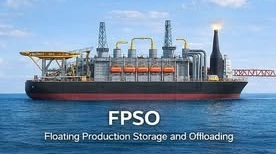
At the heart of the offshore floating energy system is a vessel type that has become ubiquitous in deep-water fields across Africa, Asia, South America, and beyond: the Floating Production Storage and Offloading vessel, universally known as the FPSO.
An FPSO is, in simple terms, an offshore oil processing plant that floats. Crude oil extracted from subsea wells on the ocean floor is pumped up to the vessel through a complex network of flexible risers and pipelines. Once onboard, the oil goes through a series of processing stages: gas is separated from the oil, water is removed, and various contaminants are treated so that the crude can meet market specifications.
The processed crude is then transferred into the vessel’s own onboard storage tanks — tanks that can hold millions of barrels of oil — before being offloaded onto shuttle tankers that transport the cargo to refineries on shore. The entire operation is a continuous cycle: receiving raw crude, processing it, storing it, and dispatching it, day after day, in the middle of the open ocean.
Scale and Complexity
The sheer scale of an FPSO is difficult to comprehend unless you have stood next to one. The largest FPSOs in operation today stretch beyond 300 metres in length — longer than three football pitches laid end to end. They carry tens of thousands of tonnes of equipment: separators, compressors, heat exchangers, power generators, water injection systems, gas flare booms, and accommodation blocks capable of housing crews of 100 to 200 personnel.
Nigeria has been one of the world’s most active FPSO markets for decades. The country’s deepwater fields — including Bonga, Egina, and Agbami — are all developed using FPSOs, making this vessel type central to the country’s oil export economy.
“Nigeria’s deepwater fields — Bonga, Egina, Agbami — are all developed using FPSOs, making this vessel type central to the nation’s oil export economy.”
The FSO: The Quiet Custodian
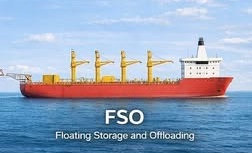

Closely related to the FPSO — but simpler in design — is the Floating Storage and Offloading unit, or FSO. As its name suggests, the FSO does not carry out oil processing. Instead, it serves purely as a floating storage hub, receiving crude oil produced by nearby offshore platforms or subsea production systems and holding it until a shuttle tanker arrives to collect it.
Think of it as an offshore warehouse positioned at sea. FSOs are often deployed in shallower water fields or in areas where the oil processing is handled elsewhere — either on a separate FPSO or through a pipeline to an onshore terminal. Their relative simplicity compared to FPSOs makes them a cost-effective option for certain field configurations.
Although they are less technologically complex than FPSOs, FSOs are by no means small operations. They require sophisticated cargo handling systems, mooring arrangements capable of withstanding powerful ocean swells and currents, and trained maritime crews to manage their day-to-day operations safely.
The FLNG: A Revolution in Natural Gas at Sea
Perhaps the most audacious engineering achievement in the offshore floating energy sector is the Floating Liquefied Natural Gas facility — the FLNG. If the FPSO represents a processing plant at sea, then the FLNG is nothing less than an entire gas liquefaction factory, floating on the ocean surface.
Natural gas, in its raw form, is invisible, highly flammable, and notoriously difficult to transport over long distances without a pipeline. The solution developed by the energy industry is to cool the gas to extreme temperatures — as low as minus 162 degrees Celsius — at which point it transforms into a liquid, shrinking to approximately one six-hundredth of its original volume. This liquefied natural gas, or LNG, can then be loaded onto specially designed tanker ships and transported efficiently to any market in the world.
For many decades, this liquefaction process could only be carried out at massive onshore LNG terminals. But the FLNG has changed this equation fundamentally. An FLNG vessel sits directly above a subsea gas field, extracts the gas, processes it, and liquefies it — all while floating at sea. The LNG produced is then transferred to LNG carrier ships for export.
A Technical Marvel
The engineering challenges involved in building an FLNG are extraordinary. Cryogenic equipment must be designed to handle the violent motion of a vessel at sea. Safety systems must be capable of managing the risk of leaks in environments where there is no easy evacuation route. The thermal insulation required to maintain such extreme temperatures in tropical ocean environments demands materials of remarkable precision and durability.
Shell’s Prelude FLNG — deployed off the coast of Australia and currently the largest floating structure ever built — is a sobering illustration of what these facilities represent. At 488 metres long and weighing 600,000 tonnes when fully loaded, it is a floating city of steel and technology, designed to produce LNG, liquefied petroleum gas (LPG), and condensate simultaneously from an offshore gas field.
— END OF PART ONE OF THIS FEATURE REPORT —
Raymond Gold is a Co-Publisher and Research Reporter for Waterways News. He is based in Lagos.