Blue Economy
Lagos Rides the Wave of Nigeria’s Blue Economy Boom

Lagos Rides the Wave of Nigeria’s Blue Economy Boom
How Lagos Is Riding the Wave of Water Transportation, Electric Racing, and Africa’s $400 Billion Blue Economy
Special Report by: Okeoghene Onoriobe | Marine and Blue Economy Correspondent | Lagos-Nigeria
Lagos — Africa’s largest megacity — sits on a paradox. Despite having one of the most expansive waterway networks on the continent, less than 1% of its daily transportation uses water. But a major shift is underway. From passenger ferries multiplying five-fold at Ikorodu terminal, to Lagos hosting E1’s first-ever electric boat race in Africa, Nigeria is finally tapping into a resource that could help solve one of its most chronic urban problems: gridlock. And with the UNDP projecting Africa’s blue economy to hit $400 billion by 2030, the stakes — and the opportunities — have never been bigger.

1. The Problem: A City Drowning in Traffic — But Ignoring Its Waterways
Lagos is home to over 20 million people. On any given weekday, its road network — groaning under the weight of overcrowded buses, danfo minivans, and an ever-growing fleet of private cars — grinds to a near standstill. Commuters routinely spend four to six hours in traffic for journeys that should take under an hour. Yet few look out of their car window and consider the broader solution that flows quietly alongside them: the Lagos Lagoon and its vast network of creeks, rivers, and coastal waterways.
According to Professor Charles Asenime, an expert in Transport and Mobility at Lagos State University, this underutilisation is both staggering and entirely reversible:
“If you look at the structure of Lagos State, about 16% of the land mass is made up of water. And then we have the water network that is capable of taking you almost anywhere in Lagos. Despite this, the usage was very, very low — less than 1%.” — Prof. Charles Asenime, Lagos State University
Think about what that means: 16% of Lagos is water — a network of natural highways that could carry tens of thousands of commuters daily. For decades, this resource sat largely idle, not because it lacked potential, but because it lacked investment, political will, and public awareness.
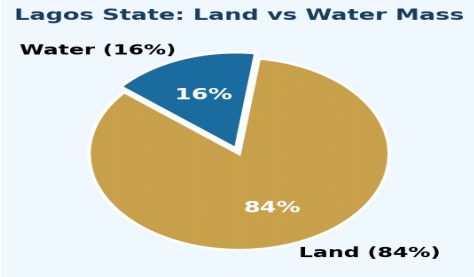

Figure 1 — Lagos State Land vs Water Composition. Source: Lagos State University Research
2. The Turning Tide: Government Steps In
The shift began when the Lagos State Government formally committed to developing its waterways as a strategic transport corridor. The Lagos State Waterways Authority (LASWA) was tasked with creating an enabling environment — improving terminal infrastructure, licensing operators, and setting safety standards. The effects have been tangible and swift.
At the Ikorodu terminal, one of the busiest hubs in the state, the transformation is most visible. Private operators like GT Waterline Ferry Services have dramatically scaled their operations, attributing much of their growth directly to increased government engagement.
“In 2018, when this particular terminal where we are was still under construction, we were moving about 10, 15 boats per day. Now as of today we move nothing less than 50 boats in a day. On an average of 1,000 passengers daily, around about 7 destinations from our major hub.” — Atinuke Oyenuga, CEO — GT Waterline Ferry Services
The numbers tell a compelling story of growth — a 4x increase in vessel movements and a burgeoning daily ridership that rivals many land-based transit systems in the country.
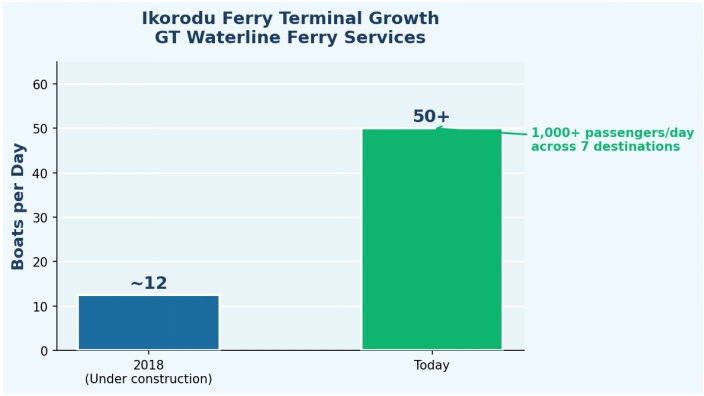

Figure 2 — Ikorodu Terminal: Boats per Day (2018 vs. Today). Source: GT Waterline Ferry Services
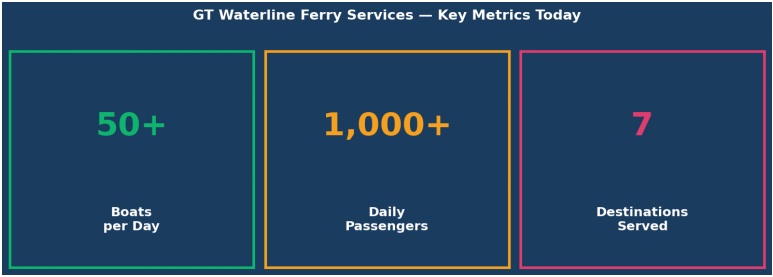

Figure 3 — GT Waterline Ferry Services: Key Performance Metrics Today
- Enter E1: When Electric Racing Meets Blue Economy Ambition
Water transportation in Lagos got a glamorous — and globally connected — boost when the E1 electric boat racing series chose Lagos as the site of its first-ever African race. E1, which describes itself as the “Formula E of the seas,” features sleek, fully electric race boats called RaceBirds that foil above the water at speeds of up to 50 knots. The spectacle of these futuristic vessels skimming across Lagos Harbour sent a powerful message: the waterways of Lagos are not just functional — they are world-class.
For Rodi Basso, CEO and co-founder of E1, the choice of Lagos was deliberate and deeply symbolic:
“E1 goes beyond the sport. The sport needs to play this kind of role which is inspirational. This comes with thought leadership, some concrete action on the coastal area.” — Rodi Basso, CEO & Co-Founder — E1 Racing
Basso envisions a legacy that goes well beyond the race itself — one where Lagos becomes a global reference point for sustainable water mobility, attracting investment, innovation, and talent to the city’s waterfront.
“We want to show that a different water mobility is possible for the future. This will bring developments, this will bring jobs, innovation, and will put Lagos potentially on the map as the place to go if you want to learn about the water mobility of the future.” — Rodi Basso, CEO & Co-Founder — E1 Racing
For local operators and regulators, the E1 race was more than a spectacle — it was a masterclass in possibility. Damilola Emmanuel, General Manager of LASWA, described the impact:
“It was where sustainability met innovation because what we saw happening with that boat race was a dynamic way of looking at water transport. A lot of the local operators could see the future — saying this is where we want to eventually be.” — Damilola Emmanuel, General Manager — LASWA
4. The $400 Billion Prize: Africa’s Blue Economy Opportunity
The excitement in Lagos is not occurring in isolation. Across Africa, governments, investors, and international bodies are waking up to the enormous untapped potential of the continent’s oceans, rivers, and lakes — what economists collectively call the “Blue Economy.” The United Nations Development Programme (UNDP) has estimated that Africa’s blue economy could generate over $400 billion annually by 2030, through sectors including fisheries, aquaculture, maritime trade, coastal tourism, offshore energy, and water transport.
Nigeria, with its extensive coastline along the Gulf of Guinea, the Niger Delta’s labyrinthine waterways, and the vast lagoon system of Lagos, is uniquely positioned to claim a significant share of this wealth. But experts are quick to note that seizing this opportunity requires more than infrastructure investment — it demands a commitment to sustainability.
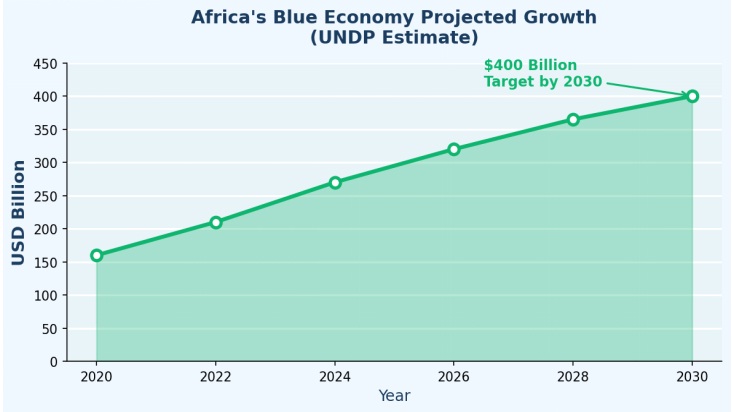

Figure 4 — Africa’s Blue Economy: Projected Revenue Growth to $400 Billion by 2030. Source: UNDP
- Sustainability: The Non-Negotiable Condition
Perhaps the most important voice in this story belongs not to a boat operator or a racing executive, but to an academic who has spent years studying how cities interact with water. Professor Asenime’s call for sustainability is both a warning and a roadmap:
“We must have waterways that are clean and clear. Then it will help the economy to come up. The bottom line is that it must be sustainable — so we don’t want to use it now and cause problems in the future. We want it to grow to the extent that those in the future will partake, they will benefit from what we are doing now.” — Prof. Charles Asenime, Lagos State University
This is a crucial insight. Lagos’s waterways currently face significant environmental pressures — plastic waste, oil spills, industrial runoff, and informal settlement encroachment. Without aggressive clean-up and protection measures, the same waterways being celebrated today could become degraded to the point of unusability within a generation.
The integration of electric vessels — as demonstrated by E1 — offers a glimpse of what zero-emission water transport can look like. If Lagos and Nigeria can align their blue economy ambitions with strong environmental governance, the model they build could become a template for cities across the Global South.
Key Takeaways at a Glance
|
Metric / Insight |
Data / Finding |
| Lagos water as % of total land mass | 16% |
| Water transport share of Lagos commuters | Less than 1% (pre-initiative) |
| Ikorodu ferry boats per day (2018) | ~10–15 |
| Ikorodu ferry boats per day (today) | 50+ |
| Daily passengers at Ikorodu hub | ~1,000 |
| Destinations served from Ikorodu | 7 |
| E1 Africa — first race location | Lagos, Nigeria |
| Africa Blue Economy (UNDP 2030 projection) | $400 Billion+ |
Additional reports by: Emetena Ikuku, Waterways News Reporter Researcher; Warri
For a follow up on this news report, always log on to Waterways News: www.waterwaysnews.ng