Security & Safety
MAERSK PULLS BACK FROM RED SEA AGAIN — WHAT IT MEANS FOR WEST AFRICAN SHIPPING

MAERSK PULLS BACK FROM RED SEA AGAIN — WHAT IT MEANS FOR WEST AFRICAN SHIPPING
The world’s largest container line has reversed course on its Red Sea comeback, raising fresh concerns for Nigerian importers and shippers already navigating tight supply chains.
Danish shipping giant Maersk has announced a temporary withdrawal from the Suez–Red Sea corridor on two of its major services, just weeks after cautiously resuming transits through the troubled waterway.
In a customer advisory dated February 27, the carrier described the move as “temporary adjustments” affecting its ME11 and MECL services — but for cargo interests across West Africa, the implications could be anything but temporary.


Why Maersk Is Turning Back
The company cited what it called “unforeseen constraints” stemming from the wider operating environment in the Red Sea region. After consultations with security partners, Maersk concluded that reliably avoiding delays through the area had become too difficult to guarantee.
As a result, several upcoming voyages on both affected services will be diverted away from the Suez Canal and rerouted around the Cape of Good Hope — adding thousands of nautical miles, additional sailing days, and higher fuel costs to each voyage.
The Services Affected
The MECL service — an independently operated route linking Saudi Arabia and other Middle East ports with the U.S. East Coast — will see its next three eastbound and westbound sailings rerouted via southern Africa through mid-March.
More significantly, the ME11 service connecting India and the Middle East to the Mediterranean will have its next three westbound and four eastbound voyages diverted around the Cape. The ME11 operates under the Gemini Cooperation, the vessel-sharing alliance between Maersk and Germany’s Hapag-Lloyd, giving the decision added weight across the industry.
Maersk said it was giving customers three weeks’ notice to adjust supply chain plans, with updated transport schedules to follow.

A Fragile Return Unravels
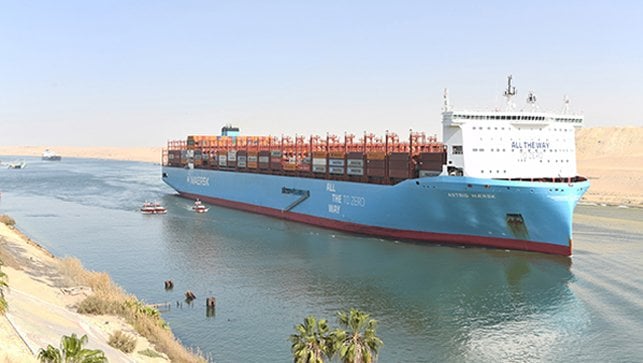
The reversal is notable for its timing. Just over two weeks ago, a Maersk vessel completed the first eastbound Suez transit on the reinstated ME11 route — a carefully watched moment that many in the shipping world had hoped signalled a durable return to the corridor.
That optimism now appears premature. Earlier in January, Maersk had cautioned that sailings through the region would depend on stable security conditions and reliable naval protection. Those conditions, it now says, are not holding consistently enough.
Security Challenges Persist
The broader security picture in the Red Sea remains uneasy. Yemen’s Houthi movement has made intermittent threats, though no confirmed attacks on merchant vessels have been recorded since last September. Meanwhile, rising U.S.-Iran tensions and an expanded American naval presence in the Middle East have added layers of unpredictability to the region.
On the protection side, the European Union’s maritime security mission, Operation Aspides — which deploys three warships to escort commercial vessels through the corridor — was recently extended through February 2027. However, limited escort capacity has created scheduling bottlenecks, with French carrier CMA CGM previously flagging long waits for available naval cover as a major operational headache.
What This Means for Nigerian Shippers
For cargo stakeholders in Nigeria and across the Gulf of Guinea, renewed Red Sea disruptions carry direct consequences. Longer Cape of Good Hope routings push up transit times and freight costs — pressures that typically filter through to Nigerian importers and end consumers.
The ME11 service in particular feeds cargo flows between Asia, the Middle East, and Europe, with knock-on effects for connecting services that serve West African ports. Any sustained return to Cape routing by major carriers would likely tighten vessel availability and complicate scheduling on feeder and direct services calling at Nigerian terminals.
Industry watchers say Maersk’s decision could prompt other carriers to slow or reconsider their own Red Sea comeback plans — further prolonging a disruption that has reshaped global shipping patterns since late 2023.
Maersk maintains the rerouting is short-term and continues to describe the Suez corridor as the fastest, most sustainable option for customers. But as confidence in the route proves fragile once again, the Cape of Good Hope remains, for now, the safer bet.
Waterways News NG will continue to monitor developments in the Red Sea and their implications for Nigerian and West African maritime trade.
— Waterways News NG | www.waterwaysnews.ng