Editorial
NCS Revenue Surge Raises Hard Questions on Trade, Ports, and the Real State of Nigeria’s Economy

NCS Revenue Surge Raises Hard Questions on Trade, Ports, and the Real State of Nigeria’s Economy
28 April 2026 | Waterways News
As Customs collections hit ₦7.28 trillion in 2025, maritime stakeholders and port operators ask: who is this growth working for?
The Numbers Tell One Story. The Ports Tell Another.


The Nigeria Customs Service has recorded a remarkable revenue trajectory over the past five years — from ₦1.562 trillion in 2020 to ₦2.24 trillion in 2021, ₦2.60 trillion in 2022, ₦3.21 trillion in 2023, ₦6.1 trillion in 2024, and a historic ₦7.28 trillion in the 2025 fiscal year.
For an agency that passes enormous volumes of cargo through Nigeria’s seaports — Apapa, Tin Can Island, Onne, Lekki, and beyond — these figures represent a significant institutional achievement. But they also raise uncomfortable questions that the maritime industry cannot afford to ignore.
Nigeria’s ports are the primary gateway through which the bulk of this revenue is generated. Yet the broader economic context in which they operate — rising inflation, declining consumer purchasing power, factory closures, and stubbornly high unemployment — sits in sharp and troubling contrast to the customs revenue boom. Port-side operators, freight forwarders, and cargo owners continue to report shrinking cargo volumes and tightening margins. If trade is booming enough to generate ₦7.28 trillion, the question industry must ask is: what exactly is being traded, and who bears the cost?
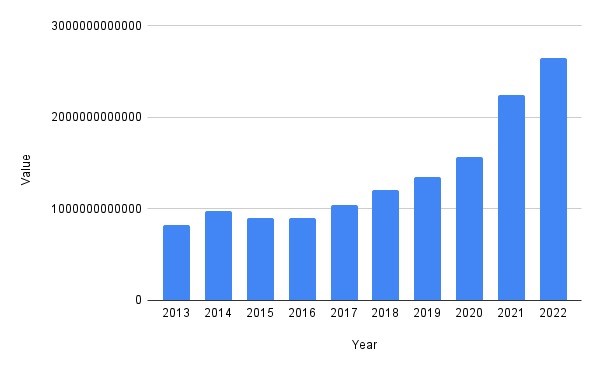

What Is Driving the Revenue Growth?
Several plausible factors are in circulation among port stakeholders. The increasing use of Nigeria’s deep-water terminals by neighbouring landlocked countries — as transit hubs — may be contributing to throughput volumes. Elevated import values driven by naira depreciation naturally inflate duty assessments even where actual cargo volumes are flat or declining. Improved compliance enforcement and the deployment of technology under the leadership of Comptroller-General Dr. Wale Adeniyi may also be playing a role.
The NCS itself has been emphatic that modernisation and automation are central to its revenue performance. For port users and trade facilitators, however, the concern is whether this modernisation is translating into faster cargo clearance, reduced dwell times, and a more competitive port environment — or simply higher collections at the same inefficient pace.
Port Modernisation: Sustained Momentum or Another False Dawn?
Nigeria’s seaport sector has seen its share of well-announced reforms that stalled or reversed. The current wave of trade facilitation measures — the Nigeria National Single Window, the ICTN cargo tracking scheme, and broader port concession renewal processes — must not suffer the same fate.
Maritime stakeholders have a direct stake in ensuring that port modernisation programmes are not merely collection-optimisation exercises for government revenue but genuine improvements in the ease of doing business at Nigerian ports. Reduced cargo dwell times, elimination of multiple documentation bottlenecks, and clear interagency coordination between Customs, the Nigerian Ports Authority, NIMASA, and the Nigerian Shippers’ Council are the benchmarks against which reform must be measured.
There is also the question of interagency alignment. Customs modernisation, however well-funded, cannot function at peak effectiveness in an environment where other agencies at the ports operate on different — and sometimes conflicting — technological and operational platforms. The call for harmonisation is not new, but it remains unheeded at considerable cost to port efficiency.
Anti-Smuggling: Warehouses Bursting, Disposal Lagging
The NCS’s anti-smuggling operations have yielded substantial seizures across all its zones — covering narcotics, foodstuffs, machinery, drones, and contraband clothing and footwear. The Duty Paid Value of these seizures has grown in parallel with revenue figures.
But a problem persists that directly concerns port and logistics operators: the timely disposal of seized goods. Customs warehouses and holding facilities are reportedly overwhelmed, with perishable and time-sensitive items deteriorating while awaiting resolution. In a country where poverty and food insecurity are daily realities, the spectacle of seized rice and foodstuffs rotting in government custody is both a logistical failure and a moral indictment. Faster, more transparent disposal mechanisms — including structured auctions and regulated redistribution frameworks — must be prioritised.
Security Collaboration: The Port Dimension
On maritime and border security, the NCS has strengthened its collaborative frameworks with both domestic agencies and international partners. At a recent international Customs conference, CG Adeniyi stated that crime has evolved beyond borders and that coordinated global action is now a necessity rather than an option.
For the port and maritime sector, this translates directly to the effectiveness of joint operations between Customs, the Nigerian Navy, NIMASA’s Deep Blue Project assets, and port security authorities in combating container fraud, arms trafficking, and narcotics transit through Nigeria’s terminals. The gains recorded in this space deserve acknowledgment, even as gaps in inland container depot oversight and the informal coastal trade corridor continue to attract scrutiny.
CSR: Customs Cares — But What About the Port Community?
The NCS under Dr. Adeniyi has expanded its Corporate Social Responsibility footprint, extending support to institutions across the country. This is commendable. The maritime community, however, has a specific expectation: that CSR initiatives extend meaningfully to port-host communities — the residents of Apapa, Tin Can, Onne, and Warri — whose daily lives are most directly disrupted by port operations and whose infrastructure needs are most acute.
Port-adjacent community investment by the NCS, in partnership with the NPA and terminal operators, would represent a more targeted and impactful use of goodwill resources than broad national CSR campaigns.
Nigeria Watch
The NCS revenue story is ultimately a mirror held up to Nigeria’s broader economic contradictions. For maritime and port stakeholders, the headline numbers matter less than the structural questions underneath them: Is port trade actually growing, or are inflated naira values masking volume stagnation? Is modernisation accelerating cargo clearance, or simply digitising existing bottlenecks? And critically — is the revenue generated at Nigeria’s ports being recycled into the port infrastructure, security architecture, and community development frameworks that would make those ports more competitive, not just more extractive?
The Federal Ministry of Marine and Blue Economy, the NPA, and the NCS must align on a shared port productivity agenda that treats revenue performance and operational efficiency as inseparable goals. Trillion-naira collections mean little if Nigeria’s ports continue to lose cargo to Cotonou, Lomé, and Tema.
Waterways News | Maritime | Ports | Shipping | Blue Economy