Connect with us

Editor's Choice

Nigerian Navy at 70: Fleet Review, New Gulf of Guinea Task Force Signal a Force Reborn

Published

on

Stay connected via Google News
Follow us for latest news and information on Nigeria water ways.
Add as preferred source on Google

Nigerian Navy at 70: Fleet Review, New Gulf of Guinea Task Force Signal a Force Reborn
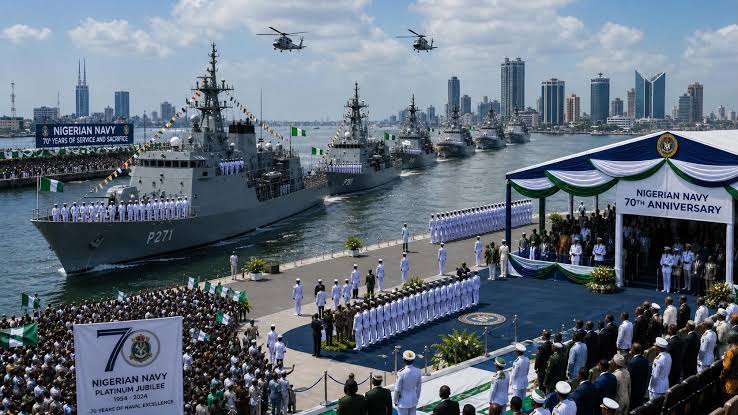
As platinum jubilee festivities open, the Nigerian Navy positions itself as Africa’s foremost maritime security provider — with direct implications for shipping costs, port throughput, and waterways trade across the region

By Ighoyota Onaibre | Waterways News Correspondent | Lagos

Celebrations Open a Window into Seven Decades of Strategic Evolution

Seven decades after a modest 250-man coastal policing unit was assembled to patrol Nigeria’s shorelines, the Nigerian Navy has opened its platinum jubilee with a declaration that should resonate far beyond the parade grounds: it is now Africa’s leading maritime security provider, principal logistics backbone, and most productive indigenous shipbuilder on the continent.

Advertisement

The two-week anniversary programme, which commenced this week in Abuja, was formally announced at a news conference by the Chief of Policy and Planning, Rear Admiral Olatunde Olodude, who set the stage for what promises to be the most significant public showcase of naval capability in Nigeria’s post-independence history.

For the maritime trade and waterways community — port operators, freight forwarders, terminal concessionaires, shipping agents, and inland waterway operators alike — the jubilee is more than a ceremonial occasion. The policy announcements and institutional milestones embedded within it carry concrete implications for Nigeria’s maritime trade environment, vessel security, insurance premiums, and the long-term viability of Gulf of Guinea shipping corridors.

From Naval Defence Force to Blue-Water Navy: A Historical Arc
Rear Admiral Olodude traced the service’s origins to the Naval Defence Force established in 1956, describing its evolution into the Royal Nigerian Navy before the royal prefix was dropped when the country became a republic in 1963.

What began as a coastal surveillance outfit has, over seven decades, been transformed by war, peacekeeping obligation, and deliberate strategic investment into a force with blue-water ambitions. The 1967–1970 civil war was a defining crucible: naval blockades, amphibious operations, and sealift logistics were decisive instruments during that conflict forcing a rapid maturation of operational doctrine and fleet management that would shape the Navy’s posture for generations. Post-war, Nigeria’s Navy extended its reach well beyond domestic waters. Peacekeeping and regional stabilisation deployments followed in Lebanon, Liberia, and, most recently, The Gambia in 2017 and Guinea-Bissau in 2022.

Advertisement

Each deployment added institutional knowledge and reinforced Nigeria’s position as the indispensable security anchor in West Africa’s maritime geography.
That regional credibility has now been formally codified. The Navy cited a 2025 Strategic Sealift Memorandum of Understanding between Nigeria and the African Union, under which Nigeria has been designated as an approved sealift provider for peacekeeping operations, disaster response, and troop movement across the African continent.

For Nigeria’s indigenous shipbuilding and logistics industries, this MOU opens a significant commercial frontier — one that Waterways News readership in the port and ferry sectors should track closely.

June 1 Fleet Review and the Combined Maritime Task Force
The centrepiece of the jubilee calendar is a presidential fleet review scheduled for June 1, to be inspected by President Bola Tinubu at Lagos. The review will be accompanied by the formal flag-off of a landmark institutional development: the Combined Maritime Task Force (CMTF) for the Gulf of Guinea, which will bring together regional navies including those of The Gambia, Ghana, Liberia, Sierra Leone, and Nigeria to coordinate patrols and tackle transnational organised crime across the Gulf’s approximately 6,000-kilometre maritime expanse.

The CMTF is a direct operational response to years of pressure from global shipping insurers, cargo owners, and port users who have consistently flagged the Gulf of Guinea as one of the world’s most hazardous maritime zones. Its establishment — formalised at a jubilee event rather than a behind-closed-doors diplomatic summit — signals a deliberate effort by Nigeria to anchor the arrangement publicly and make multilateral accountability visible.
In addition to the fleet review, the jubilee programme includes the arrival of friendly foreign warships, the inauguration of commissioned vessels, and the 6th Sea Power for Africa Symposium, themed “Leveraging Technology for Enhanced Maritime Security in Africa.” Heads of navies from 15 African countries are expected, alongside delegations from numerous international maritime organisations. Naval vessels from Benin, Brazil, Cameroon, Côte d’Ivoire, and Ghana will visit Lagos — a display of regional goodwill that carries practical significance for port managers at Apapa, Tin Can Island, and the Lekki Deep Sea Port, who will need to accommodate visiting warships alongside commercial traffic.

Advertisement

The Piracy Dividend: What Improved Security Means for Trade
Perhaps the most consequential metric Rear Admiral Olodude cited for the maritime commercial community is Nigeria’s removal from the International Maritime Bureau’s list of piracy-prone nations — an achievement the Navy credits to its sustained anti-piracy operations, which it says was realised in 2022. The consequences for trade are not abstract. The Navy noted that this development has directly lowered shipping and insurance costs and improved the trade outlook across the Gulf of Guinea.

For freight forwarders and importers moving cargo through Lagos ports, reduced war-risk and kidnap-and-ransom insurance loadings translate to a tangible reduction in landed cost — a benefit that tends to go underreported in commercial narratives dominated by port congestion and customs dwell time.

The Navy’s inter-agency security collaboration has also yielded measurable results in the energy sector with direct waterways relevance. Olodude pointed to a joint crackdown on oil theft and illegal refining in the Niger Delta, attributing a rise in Nigeria’s average crude output — from 1.3 million barrels per day in January 2023 to 1.7 million barrels per day as of April 2026 — partly to the Navy’s partnership with other security agencies. Higher crude production means higher tanker traffic through Nigeria’s offshore loading terminals, sustained demand for tug and vessel support services, and stronger freight volumes transiting the country’s creeks and waterways.

Indigenisation and Shipbuilding: A Growing Industrial Footprint
One dimension of the jubilee narrative that deserves particular attention from Nigeria’s waterways industry is the Navy’s indigenous shipbuilding track record. The Navy’s dockyard and shipyard have delivered five vessels since 2010, comprising a ferry, a tug, and three seaward defence boats, while continuing to build additional craft and carry out refits for friendly navies. This is not merely a patriotic statistic. It represents a growing ecosystem of indigenous naval architecture, marine engineering, and vessel maintenance capacity that, with deliberate policy support, could extend its services to the commercial waterways sector — passenger ferries, cargo barges, and workboats serving Nigeria’s inland waterway routes.

Advertisement

The refit programme is already generating regional revenue. Between 2024 and 2025, the dockyard refitted three warships for Benin and is currently refitting three more — a service export that validates the commercial viability of Nigerian shipyard capacity when properly managed and resourced.

Digitisation and Fleet Recapitalisation on the Horizon
Looking ahead, Rear Admiral Olodude outlined an ambitious modernisation agenda. The Navy has signalled its commitment to fleet recapitalisation, the induction of new patrol vessels, investments in training, and a broader push toward becoming a highly digitised and networked blue-water navy capable of confronting asymmetric and fifth-generation maritime threats.

For the waterways and ports sector, digitisation at the Navy level has knock-on significance. A more networked naval presence in Nigeria’s creeks, rivers, and offshore zones — feeding into platforms like the National Single Window — can accelerate the kind of real-time maritime domain awareness that port users, vessel operators, and waterways regulators have long called for.

Nigeria Watch: What the Navy’s Jubilee Means for Waterways Stakeholders

Advertisement

The Nigerian Navy’s platinum jubilee arrives at a pivotal moment for the country’s blue economy. The formal commissioning of the Combined Maritime Task Force, the presidential fleet review, and the hosting of 15 African naval chiefs in Lagos all affirm Nigeria’s strategic centrality in Gulf of Guinea governance — but for the waterways community, the more pressing questions are domestic.

Will the jubilee momentum translate into sustained budgetary support for the Navy’s fleet recapitalisation programme? Can the Navy’s indigenous shipbuilding capacity be leveraged to supply commercial ferry and barge operators on the Lagos-Badagry, Baro-Warri, and Niger-Benue waterway corridors? Will the inter-agency security frameworks that have suppressed Delta oil theft be extended into a broader waterways safety architecture that protects passenger and cargo ferries on inland routes?

As Lagos’s waterways governance continues to evolve — with LASWA, NIWA, and the Federal Ministry of Marine and Blue Economy navigating overlapping mandates — a more capable, more regionally respected Nigerian Navy represents both a security guarantee and a potential institutional partner for the inland waterways sector. The jubilee has put the Navy’s achievements on full display. Whether those achievements catalyse the deeper policy and investment reforms that Nigeria’s waterways economy needs remains the central question for stakeholders to press in the months ahead.
Stay connected via Google News
Follow us for latest news and information on Nigeria water ways.
Add as preferred source on Google
Continue Reading
Advertisement
Click to comment

Leave a Reply

Your email address will not be published. Required fields are marked *

Editor's Choice

The Four Pillars of Maritime Governance: Understanding the Conventions That Hold Global Shipping Together

Published

on

Stay connected via Google News
Follow us for latest news and information on Nigeria water ways.
Add as preferred source on Google

The Four Pillars of Maritime Governance: Understanding the Conventions That Hold Global Shipping Together

By Raymond Gold O. | Waterways News Maritime Education Desk

The global maritime industry does not run on goodwill alone. Behind every vessel that departs a port, every seafarer who stands watch through the night, and every cargo consignment that crosses an ocean lies a complex and carefully constructed framework of international regulations.

These rules — forged through decades of maritime disasters, environmental catastrophes, labour abuses, and hard-won diplomatic consensus — exist to ensure that ships are safe, seas are clean, workers are treated with dignity, and the men and women who crew the world’s vessels are professionally competent.

At the centre of this regulatory architecture stand four landmark international conventions, commonly referred to in maritime circles as the four pillars of maritime governance: SOLAS, MARPOL, MLC, and STCW. Individually, each addresses a critical dimension of maritime operations. Collectively, they represent the most comprehensive attempt in human history to bring order, safety, and accountability to one of the world’s oldest and most vital industries.

Advertisement

For Nigerian maritime professionals — from seafarers sailing under foreign flags to port operators managing berths at Apapa and Tin Can Island, from freight forwarders at Lekki Deep Sea Port to marine engineers aboard coastal vessels — a thorough understanding of these conventions is not merely academic. It is a professional and legal obligation.

SOLAS: The Convention Born From Tragedy
The Safety of Life at Sea Convention — known universally as SOLAS — stands as the oldest and arguably the most consequential of the four pillars.
Its origins are rooted in catastrophe. On the night of 14 April 1912, the RMS Titanic struck an iceberg in the North Atlantic and sank, claiming the lives of more than 1,500 people. The disaster exposed glaring inadequacies in the safety standards of the era — insufficient lifeboats, no standardised distress communication protocols, and no international framework compelling shipowners to prioritise passenger safety.

The first SOLAS convention was adopted in 1914, directly in response to the Titanic disaster. The current version, adopted in 1974 under the International Maritime Organization (IMO) and significantly amended over subsequent decades, remains the primary treaty governing ship safety worldwide.

SOLAS establishes minimum standards for the construction, equipment, and operation of merchant ships. Its chapters cover an extraordinarily wide range of subject matter: the structural integrity of hulls, the reliability of fire detection and suppression systems, the standards and quantity of lifesaving appliances (lifeboats, life rafts, immersion suits, and emergency position-indicating radio beacons), navigation equipment requirements, radio communications systems, and the management of cargo — including dangerous goods.

Advertisement

One of SOLAS’s most significant modern contributions is the International Safety Management (ISM) Code, which requires shipping companies to implement documented safety management systems onboard every vessel. Under the ISM Code, companies must identify risks, establish procedures for emergencies, conduct regular drills, and maintain records that demonstrate compliance.

For Nigerian shipping companies operating internationally, ISM certification is not optional — it is a prerequisite for trading.
SOLAS also incorporates the International Ship and Port Facility Security (ISPS) Code, introduced after the September 2001 terrorist attacks in the United States. The ISPS Code mandates security assessments, security plans, and the designation of security officers at both ship and port facility levels — a framework that directly affects all terminals and port facilities operating under the Nigeria Ports Authority (NPA).

For Nigerian seafarers, compliance with SOLAS is a daily reality. Every fire drill, every muster at lifeboat stations, every inspection of firefighting equipment, every voyage data recorder check — these are the tangible expressions of a convention that has, over more than a century, driven a profound transformation in maritime safety culture.

MARPOL: Defending the Oceans From the Ships That Use Them
The International Convention for the Prevention of Pollution from Ships — MARPOL — addresses one of the most pressing environmental challenges of the modern age: the damage that shipping can inflict on the world’s oceans.
MARPOL was born from a dual catastrophe. The first MARPOL convention was adopted in 1973, and was subsequently modified by a Protocol adopted in 1978 following a series of devastating tanker accidents. Today, the combined instrument — formally known as MARPOL 73/78 — is administered by the IMO and is structured around six technical Annexes, each targeting a different category of ship-generated pollution.

Advertisement

Annex I regulates the discharge of oil and oily mixtures. Every maritime professional familiar with the sight of oil slicks in Lagos Harbour or around Apapa anchorage understands the destructive power of petroleum contamination on marine ecosystems, fisheries, and coastal livelihoods. Annex I requires ships to maintain Oil Record Books, mandates the use of Oil Water Separators for bilge water, and establishes strict discharge limits — with outright prohibitions in designated Special Areas and Emission Control Areas.

Annex II addresses noxious liquid substances carried in bulk — the hazardous chemicals transported by tankers that, if discharged at sea, can cause severe ecological damage.

Annex III covers harmful substances in packaged form, governing the labelling, documentation, and stowage of hazardous cargoes.

Annex IV regulates sewage discharge from ships, prohibiting the release of untreated sewage within specified distances from land — a provision of direct relevance to the passenger ferries, water taxis, and ro-ro vessels operating on Lagos waterways.

Advertisement

Annex V governs garbage management. It prohibits the disposal of plastics into the sea entirely, and imposes strict controls on the dumping of other waste materials. Ships are required to maintain Garbage Management Plans and Garbage Record Books. Given Nigeria’s ongoing challenges with plastic pollution in coastal and riverine environments, the principles embedded in

Annex V have particular resonance for inland waterway operators.

Annex VI, arguably the most consequential annex for the current era of shipping, regulates air pollution from ships — specifically sulphur oxide emissions, nitrogen oxide emissions, and the use of ozone-depleting substances. The 2020 global sulphur cap — which reduced the permitted sulphur content in marine fuel from 3.5% to 0.5% — sent shockwaves through the global bunkering industry and accelerated the adoption of scrubber technology and alternative fuels such as LNG.

For Nigeria, with its major bunkering operations and the enormous implications of the Dangote Refinery for marine fuel supply, the requirements of MARPOL Annex VI are of direct commercial and strategic significance.

Advertisement

MLC: The Seafarers’ Bill of Rights
If SOLAS protects ships and MARPOL protects oceans, the Maritime Labour Convention — MLC 2006 — exists to protect the human beings who make global shipping possible.

Adopted by the International Labour Organization (ILO) in Geneva in February 2006 and entering into force in August 2013, the MLC is the most comprehensive international treaty ever developed for the welfare of workers in any industry. It consolidates more than 65 pre-existing ILO instruments on maritime labour into a single, enforceable framework. Informally but fittingly, it is known as the Seafarers’ Bill of Rights.

The MLC is structured around five Titles, each addressing a fundamental aspect of seafarer welfare:

Title 1 covers minimum requirements to work on a ship — including minimum age (no seafarer below 16 years of age), medical fitness requirements, and the mandatory provision of seafarer employment agreements (SEAs).

Advertisement

Title 2 addresses conditions of employment — including wages, working hours and rest periods, paid annual leave, repatriation rights, and compensation in the event of a ship’s loss or foundering. The MLC mandates that seafarers receive a minimum wage established periodically by the ILO’s Joint Maritime Commission, and that wage payments are made regularly and documented.

Title 3 sets standards for accommodation, recreational facilities, food, and catering. It establishes minimum cabin sizes, noise and vibration limits, air conditioning requirements, and standards for the quality and nutritional value of food provided to crew.

Title 4 addresses health protection, medical care, and social security. Every vessel subject to the MLC must carry a medicine chest, have access to medical advice by radio, and maintain arrangements for the medical evacuation of seriously ill seafarers. Flag states and port states are jointly responsible for ensuring that injured or sick seafarers receive prompt medical treatment ashore where necessary.

Title 5 provides the enforcement architecture — establishing the inspection and certification regime through which flag states and port state control authorities (such as NIMASA, in the Nigerian context) verify compliance.

Advertisement

For Nigerian seafarers — who number in the tens of thousands, with many serving on foreign-flagged vessels in international trade — the MLC provides a floor of rights that cannot be bargained away. Abusive employment practices, the withholding of wages, inadequate living conditions, and the refusal to repatriate stranded crew members are not merely ethical failures; they are violations of a binding international legal instrument that port state control officers are empowered to enforce.

The MLC also has direct implications for Nigerian shipping companies seeking to operate internationally and for the ongoing work of the Maritime Workers’ Union of Nigeria (MWUN) in advocating for the welfare of its members.

STCW: Building Competent Seafarers for a Complex Industry
The International Convention on Standards of Training, Certification and Watchkeeping for Seafarers — STCW — is the convention that answers a deceptively simple question: how do we know that the people operating ships are actually qualified to do so?
Adopted in 1978 and significantly revised by the Manila Amendments of 2010, STCW establishes the global minimum standards for the training, certification, and watchkeeping of officers and ratings aboard seagoing ships. It applies to seafarers serving on ships engaged in international voyages and sets out the competencies that must be demonstrated before a seafarer can be certified at any level — from Able Seaman to Master Mariner or Chief Engineer.

The STCW Convention is complemented by the STCW Code, which contains the mandatory and recommended standards of competence in detail. Seafarers and maritime training institutions alike are required to align their programmes and assessments with the competency frameworks established in the Code.
Among the most widely recognised STCW certifications are those covering:

Advertisement

Basic Safety Training (BST): Personal survival techniques, firefighting and fire prevention, elementary first aid, and personal safety and social responsibilities — the foundation upon which every seafarer’s career is built.

Proficiency in Survival Craft and Rescue Boats (PSCRB): Advanced training in the operation of lifeboats and rescue boats.
Advanced Firefighting: For officers and others with responsibility for fire-fighting operations.

Medical Care and Medical First Aid: For those designated to provide medical assistance onboard.

Bridge Resource Management (BRM) and Engine Room Resource Management (ERM): Competencies in team coordination, situational awareness, and decision-making under pressure.

Advertisement

GMDSS (Global Maritime Distress and Safety System): Certification for radio operators managing ship-to-shore and ship-to-ship communications in emergencies.

The Manila Amendments of 2010 introduced important additions, including requirements for training in security awareness, leadership and teamwork, and updated standards for electro-technical officers — reflecting the increasing complexity of modern ship systems.

In Nigeria, STCW certification is administered through the Nigerian Maritime Administration and Safety Agency (NIMASA), which accredits maritime training institutions and issues Certificates of Competency. Institutions such as the Nigerian Merchant Navy Officer Cadet Training Scheme and various maritime academies across the country provide STCW-aligned programmes. However, concerns about the quality and currency of training provision, alignment with the Manila Amendments, and the international recognition of Nigerian seafarer certificates have been persistent topics of debate within the industry — debates that go directly to the heart of Nigeria’s ambitions to expand its pool of internationally certified maritime professionals.

The Four Pillars as a Unified System
It is important to understand that SOLAS, MARPOL, MLC, and STCW do not operate in isolation. They are interrelated and mutually reinforcing. A vessel that complies with SOLAS safety standards but whose crew is inadequately trained — in violation of STCW — is still an unsafe vessel. A ship whose engineers are brilliant but who are denied rest hours — in violation of MLC — creates the conditions for fatigue-induced accidents that SOLAS exists to prevent. A vessel that meets every environmental standard under MARPOL but lacks certified personnel to manage its oil water separators correctly is a vessel awaiting an environmental incident.

Advertisement

Port state control regimes — including the Tokyo MOU, Paris MOU, and the Abuja MOU, which covers the West and Central African region — inspect vessels against the requirements of all four conventions simultaneously. A deficiency in any pillar can result in detention.

For Nigerian port state control officers operating under the Abuja MOU framework and supervised by NIMASA, these four conventions constitute the primary inspection checklist against which every foreign vessel calling at Nigerian ports is measured.

Nigeria Watch: Why This Matters for Nigeria
Nigeria’s maritime industry is at a critical juncture. The country possesses one of the largest exclusive economic zones in Africa, a vast network of inland waterways, significant offshore oil and gas operations, and increasingly busy commercial ports at Apapa, Tin Can Island, Onne, Calabar, and the Lekki Deep Sea Port. The Federal Ministry of Marine and Blue Economy has articulated ambitious development goals, and the Nigerian content agenda continues to push for greater participation of Nigerian seafarers, vessels, and companies in the country’s maritime trade.

In that context, the four pillars of maritime governance are not abstract international obligations. They are the terms and conditions upon which Nigeria participates in global shipping — and the standards against which the competence and professionalism of Nigerian maritime actors will be judged by the international community.

Advertisement

Every maritime professional in Nigeria — whether studying at a maritime academy, working on an offshore support vessel, operating a passenger ferry on the Lagos waterways, managing a freight forwarding business, or sitting in a regulatory office at NIMASA or the NPA — has both a stake in these conventions and a responsibility to understand and uphold them.

The sea does not forgive ignorance. Neither, ultimately, does the international regulatory framework that governs it.

Waterways News is Nigeria’s foremost maritime, shipping, ports, and blue economy publication, dedicated to informing and educating maritime industry stakeholders across Nigeria and the wider Gulf of Guinea region.

Advertisement
Stay connected via Google News
Follow us for latest news and information on Nigeria water ways.
Add as preferred source on Google
Continue Reading

Editor's Choice

Saudi Arabia Launches New Shipping Corridors as Hormuz Remains Closed to Commercial Traffic

Published

on

Stay connected via Google News
Follow us for latest news and information on Nigeria water ways.
Add as preferred source on Google

Saudi Arabia Launches New Shipping Corridors as Hormuz Remains Closed to Commercial Traffic

Riyadh activates Red Sea alternatives and pipeline bypasses as the world’s worst maritime supply crisis since WWII enters its third month — with Nigeria’s tanker revenues, crude export premiums, and port traffic in the balance

By Okeoghene Onoriobe | Waterways News Correspondent

Since 28 February 2026, the Strait of Hormuz has been effectively closed to most commercial shipping — triggering what maritime analysts and global energy bodies are describing as the most severe disruption to seaborne trade since the Second World War. Through that narrow artery linking oil and gas producers in the Gulf to the open seas, some 20 percent of the world’s oil and liquefied natural gas normally flows during peacetime. Today, that flow has been reduced to a trickle, and the tremors are being felt from Rotterdam to Lagos.

Iran imposed a selective blockade on 28 February 2026, and the United States subsequently imposed a parallel naval blockade of Iranian ports on 13 April, creating a structural “dual blockade.”

Advertisement

About 2,000 ships remain stranded in the Gulf, waiting to be allowed through. Even as the United States launched “Project Freedom” — a major naval escort operation in early May — the Strait remains far from safe for routine commercial navigation. As of this week, commercial vessel movement through the Strait remains heavily restricted and inconsistent, with a significant number of vessels still waiting outside the Gulf or operating under controlled routing arrangements.

The scale of the economic shock is staggering. With Hormuz tanker traffic still restricted, cumulative supply losses from Gulf producers already exceed one billion barrels, with more than 14 million barrels per day of oil now shut in — an unprecedented supply shock. Oil prices surged sharply after the outbreak of conflict, with Brent recording its highest monthly rise ever by the end of March.

RIYADH’S RESPONSE: TWO NEW SERVICES, ONE CLEAR MESSAGE
Against this volatile backdrop, Saudi Arabia’s port authority, Mawani, has moved decisively to protect its own trade lifelines and demonstrate to the world that Gulf commerce will not be held hostage indefinitely to the fate of a single chokepoint.

Mawani has inaugurated a new shipping service connecting the ports of Jeddah, Salalah, and Djibouti, with a capacity of 1,730 standard containers, to boost connectivity with global ports. Additionally, the Saudi Port Authority has launched a Red Sea Express linking Jeddah, Yanbu, Egypt’s Sukhna, and the Jordanian port of Aqaba, with a capacity of 1,100 containers.

Advertisement

In total, Saudi Arabia’s port authority has now added five new maritime shipping services following Iran’s near-closure of the Strait of Hormuz, in a move designed to strengthen connectivity via the Red Sea and provide supply chain continuity and flow of goods.

Beyond container services, Riyadh has also leaned heavily on pipeline infrastructure. When the conflict peaked in March, Saudi Arabia reportedly used the East–West Pipeline to bypass the Iranian blockade on Hormuz, moving up to five million barrels per day. Another pipeline was also activated, as Riyadh and Abu Dhabi diverted massive volumes of oil from the Hormuz route through Red Sea ports at Yanbu and Al-Muajjiz.

Saudi Arabia and the United Arab Emirates have successfully redirected some exports to terminals loading outside of the Strait, even as mounting supply losses from Hormuz continue to deplete global oil inventories at a record pace.

The new services and pipeline diversions are also part of a broader Saudi diplomatic posture. Riyadh has been pressing the United States to end its blockade of Hormuz and Iranian ports, fearing further strikes by Iran and the potential closure of the Bab-al-Mandab Strait by Iran or its allies like Yemen’s Ansarallah — a development that would effectively shut down the Red Sea corridor that Saudi Arabia is now betting heavily upon.

Advertisement

NIGERIA WATCH: OPPORTUNITY AND EXPOSURE IN EQUAL MEASURE
For Nigeria’s maritime and energy sector, the Hormuz crisis is playing out in contradictory directions simultaneously — creating short-term windfalls while exposing structural vulnerabilities that industry stakeholders and the Federal Ministry of Marine and Blue Economy cannot afford to ignore.

The Revenue Upside
Nigeria sits outside the Hormuz corridor entirely, loading its crude from Atlantic Basin terminals at Bonny, Forcados, Brass, and Escravos. In a market suddenly starved of Gulf supply, this geography has become a premium asset. Producers outside of the Middle East have pushed output higher and lifted exports to record levels in response to the crisis, (IEA) and Nigeria’s OPEC output, still recovering from years of production shortfalls, is now commanding elevated differentials as European and Asian refiners scramble for Atlantic crude alternatives.

The Dangote Petroleum Refinery — which was already reconfiguring Nigeria’s crude trading relationships before the Hormuz crisis — is now operating in an environment where domestic crude retention and refined product exports carry significantly higher value. With Gulf refinery throughputs severely curtailed, Nigerian refined products have found expanded export windows, and the refinery’s forward commercial strategy deserves close scrutiny in light of these geopolitical shifts.

Tanker earnings on West African routes have also surged. Nigerian crude is predominantly carried on Very Large Crude Carriers (VLCCs) and Suezmax vessels. With Gulf loadings choked off and global ton-mile distances extended by Cape of Good Hope rerouting, freight rates have spiked — a boon for shipowners calling at Nigerian terminals, and a factor that NPA and terminal operators at Apapa and the Lekki Deep Sea Port should be monitoring closely in terms of berth demand and port revenue projections.

Advertisement

The Exposure
The same crisis that boosts Nigeria’s crude premium also raises the cost of everything the country imports by sea. Nigeria remains heavily dependent on imported fuel, machinery, fertiliser, and manufactured goods — commodities that now travel longer, more expensive routes under inflated war-risk insurance premiums.

Port users, freight forwarders, and clearing agents operating at Apapa, Tin Can Island, and Lekki are already absorbing these elevated costs in their logistics chains.
Container freight rates on Asia-to-Europe lanes are rising again, and the Strait of Hormuz closure, combined with resumed Houthi attacks, has eliminated any near-term prospect of a return to Suez Canal routing.

Nigerian importers sourcing goods from Asia — electronics, textiles, vehicles, and machinery — are facing extended transit times and higher freight invoices. The Nigeria Customs Service, which has been posting record port revenue figures in recent months, may find collection growth under pressure if import volumes contract in response to elevated landed costs.
Port congestion is also building at accessible alternative hubs such as Jeddah and Salalah — the very ports now being connected by Mawani’s new services.

For Nigerian importers and exporters routing through the Middle East, these congestion-driven delays add another layer of uncertainty to already stretched supply chains.

Advertisement

The Cabotage and NIMASA Dimension
The crisis also carries implications for Nigeria’s domestic maritime policy architecture. NIMASA’s Cabotage Vessel Financing Fund (CVFF), long a subject of debate over disbursement timelines, was designed partly to build a Nigerian-flagged fleet capable of participating in regional and international trade. In a moment when freight rates are elevated and demand for alternative routing through the Atlantic is at a historic high, the absence of a substantial Nigerian-flagged deep-sea presence means that the windfall accruing from higher tanker rates flows overwhelmingly to foreign shipowners rather than Nigerian maritime operators.

This is precisely the structural gap that cabotage policy was meant to address over the long term. Industry voices — including those within the Maritime Workers Union of Nigeria (MWUN) — have argued for years that delays in CVFF deployment deprive Nigerian seafarers and vessel operators of the capacity to participate meaningfully in exactly these kinds of market moments.

THE BROADER PICTURE: HOW LONG DOES THIS LAST?
Even if the Strait is reopened to all traffic, there will still be obstacles to shipping. The United States has said it will take six months to clear mines it believes have been laid by Iran. Underwriters are unlikely to restore normal insurance ratings for Hormuz transits until that demining is well advanced and a sustained ceasefire holds. Assuming flows through the Strait gradually resume from June, global oil supply is projected to decline by 3.9 million barrels per day on average for the full year 2026.

That projection carries significant uncertainty. Iranian Supreme Leader Mojtaba Khamenei — who assumed authority following the death of his father, Ayatollah Ali Khamenei, in the February strikes — has shown no sign of yielding control of Hormuz as a strategic lever. Diplomatic talks in Islamabad in April yielded no breakthrough. The current impasse, in other words, may define the global shipping environment for the remainder of 2026 and beyond.

Advertisement

For Nigeria’s maritime community — port operators, terminal concessionaires, freight forwarders, tanker operators, inland waterway transporters, and policymakers alike — the Hormuz crisis is not a distant geopolitical story. It is actively reshaping the commercial environment in which every Nigerian maritime stakeholder operates, daily.

Waterways News continues to monitor developments in the Strait of Hormuz and their implications for Nigerian ports, shipping, and the blue economy. Feedback and industry perspectives are welcome.

Stay connected via Google News
Follow us for latest news and information on Nigeria water ways.
Add as preferred source on Google
Continue Reading

Editor's Choice

Violent Storm Devastates NIWA Headquarters in Lokoja, Disrupts Operations Across Kogi State Capital

Published

on

Stay connected via Google News
Follow us for latest news and information on Nigeria water ways.
Add as preferred source on Google

Violent Storm Devastates NIWA Headquarters in Lokoja, Disrupts Operations Across Kogi State Capital

By Okeoghene Onoriobe | Waterways News Correspondent


A ferocious rainstorm swept through Lokoja, the Kogi State capital, last Thursday night, unleashing widespread destruction across the city and dealing a particularly severe blow to the National Inland Waterways Authority (NIWA), whose headquarters bore the brunt of the tempest’s fury.

The storm, which raged between 8:30 p.m. and 9:30 p.m., reduced the agency’s main office block to a scene of ruin, ripping off roofs, shattering windows, and leaving critical departments exposed to torrential downpours that followed in the storm’s wake. The incident has raised urgent concerns about the operational continuity of one of Nigeria’s most strategically important inland waterways institutions.

NIWA’s Core Operations Crippled

NIWA’s spokesperson, Suleiman Makama, confirmed the scale of destruction in an official statement, painting a picture of an institution grappling with sudden and severe disruption to its day-to-day functions.

Advertisement

According to Makama, the storm directly hit the sections of the headquarters housing the Engineering, Survey, Special Duties, Project Management, and Area Office Coordination Departments — five of the agency’s most operationally vital units. Staff working in these departments have been displaced, temporarily rendered without office space as engineers and waterways administrators scramble to find alternative arrangements.

“One major challenge is that the affected staff have been displaced and temporarily rendered without offices,” Makama stated.

Beyond the physical displacement of personnel, the damage to documents, equipment, and sensitive materials is of particular concern. Critical records, technical instruments, and administrative files were left exposed to heavy rainfall during the incident, raising fears that irreplaceable operational data may have been compromised or destroyed. For an authority that coordinates the management and development of Nigeria’s vast inland waterways network — spanning over 10,000 kilometres of navigable rivers and lakes — such losses could have significant downstream consequences for ongoing projects and regulatory functions.

The NIWA spokesperson described the incident as both devastating and unfortunate, stopping short of announcing an immediate assessment of financial losses or a timeline for restoration. Waterways News understands that emergency response efforts were activated overnight, with staff and management working to salvage what they could from the wreckage.

Advertisement

A City Under Siege: Widespread Destruction Across Lokoja

The NIWA headquarters was far from the only casualty of the violent weather event. Across Lokoja, the storm left a trail of destruction that spared neither public institutions nor private businesses, cutting a wide swathe through the commercial and residential fabric of the city.

One of the most alarming incidents occurred near the Kogi State Specialist Hospital, where a 33KVA electricity transformer sustained severe damage during the storm. The failure of the transformer triggered a fire outbreak at the nearby A.A. Rano Filling Station, quickly turning a weather emergency into a public safety crisis. The inferno engulfed five of the filling station’s fuel dispensing pumps before it was brought under control, leaving only one pump operational. The proximity of the fire to a major medical facility added a layer of danger to an already chaotic night, though no reports emerged of injuries to hospital patients or staff.

Elsewhere in the city, the Police Area Command in the vicinity of the Ministry of Health and the Federal Ministry of Works axis was also affected, with a large tree uprooted by the violent gusts crashing onto the premises. The IBB Way corridor, one of Lokoja’s busier arterial roads, saw multiple trees torn from the ground, while billboards across various parts of the metropolis were shredded and flung aside by the wind’s force — some landing on roads and creating hazards for early-morning commuters.

Despite the scale of the destruction, authorities confirmed that no casualties were recorded, a relief given the intensity of the event and the densely populated nature of several of the affected areas.

Advertisement

Questions of Infrastructure Resilience

The storm’s impact on NIWA’s headquarters raises broader questions about the state of federal infrastructure in Lokoja and, more specifically, about the structural integrity of public buildings that house critical agencies. As the apex body responsible for developing and regulating Nigeria’s inland waterways — an increasingly important component of the country’s transportation and trade infrastructure — NIWA’s ability to function at full capacity is not merely an administrative concern but one with tangible implications for maritime commerce, riverine communities, and national development planning.

The timing is particularly sensitive. Nigeria’s inland waterways sector has in recent years attracted renewed attention from federal authorities as a viable alternative to the chronically overburdened road network. NIWA has been at the forefront of efforts to unlock the commercial potential of routes along the Niger, Benue, and other major river systems. Any prolonged disruption to the authority’s core functions — engineering assessments, survey work, project management — could slow momentum on several ongoing waterways development initiatives.

Waterways News will continue to monitor the situation and provide updates as NIWA authorities assess the full extent of the damage and communicate plans for the rehabilitation of the affected offices. Residents and stakeholders with information about the storm’s impact on waterways infrastructure across the Lokoja area are encouraged to reach out to our editorial desk.


Waterways News is Nigeria’s dedicated publication for inland and coastal waterways affairs. For more stories on waterways infrastructure, maritime policy, and river transportation, visit waterwaysnews.ng.

Advertisement

Stay connected via Google News
Follow us for latest news and information on Nigeria water ways.
Add as preferred source on Google
Continue Reading

Trending

Copyright © 2026