Maritime Security and Safety
Nigerian, Spanish Navies Deepen Maritime Security Ties as Gulf of Guinea Emerges Key Global Shipping Hub

Nigerian, Spanish Navies Deepen Maritime Security Ties as Gulf of Guinea Emerges Key Global Shipping Hub Following Middle East Tensions
By Okeoghene Onoriobe
The Nigerian and Spanish navies have intensified their naval cooperation to bolster maritime security across the Gulf of Guinea, as shifting global shipping dynamics triggered by rising Middle East tensions continue to place the region at the centre of international maritime trade.
This was the thrust of discussions on Tuesday, April 7, 2026, during the port visit of the Spanish offshore patrol vessel, BAM Furor, to the Western Naval Command in Apapa, Lagos — a visit that underscored growing strategic ties between both nations and their shared commitment to securing one of the world’s most commercially significant waterways.
Spanish Ambassador to Nigeria, Félix Costales, who addressed journalists at the event, said the rerouting of merchant vessels away from the Middle East had dramatically elevated the Gulf of Guinea’s role in global commerce. “The Gulf of Guinea is gaining increasing importance in maritime traffic globally, especially now, with the situation in the Middle East. Many merchant ships are rerouting, and the Gulf of Guinea is becoming a key player in this new framework of shipping routes,” he said.


Costales stressed that the surge in vessel traffic across the region made enhanced maritime security not just desirable but imperative. He added that Spain’s engagement is anchored within its Africa Plan — a foreign policy framework covering 2024 to 2028 — which identifies West Africa as its foremost priority on the continent. Within that framework, he said Nigeria occupies a central position. “Nigeria is at the forefront. It goes without saying, being the biggest country in the region,” he noted.
The Flag Officer Commanding, Western Naval Command, Rear Admiral Abubakar Mustapha, affirmed that the visit of BAM Furor aligns with the Nigerian Navy’s strategic thrust of building robust partnerships with foreign counterparts. He noted that within the past three months alone, the Command had received delegations from the Pakistani Navy staff course, Indonesian Navy ships, and now the Spanish patrol vessel. “One of the pillars of the mission of the Chief of the Naval Staff, Vice Admiral Idi Abbas, is synergy with other services, sister agencies, strategic stakeholders and partner countries,” he said.
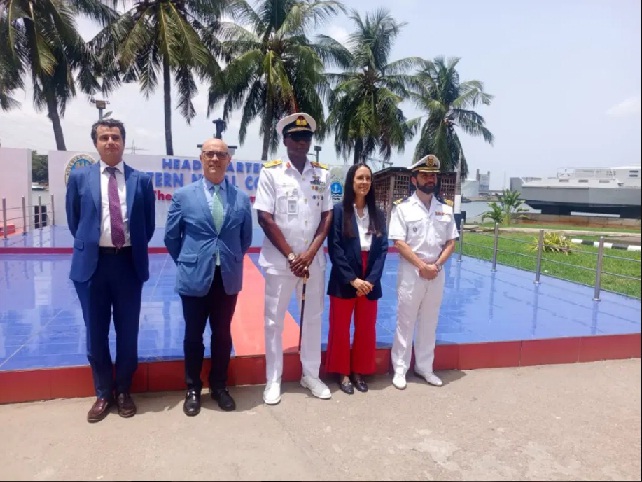

From left: Consulate General of Spain in Lagos, Jose Ferrer ; Spanish Ambassador to Nigeria, Félix Costales; Flag Officer Commanding Western Naval Command, Rear Admiral Abubakar Mustapha; Deputy Head of Mission, Embassy of Spain , Abuja, María Higón Velasco and Commanding Officer, BAM Furor, Lieutenant Commander Ángel Estrada.
Rear Admiral Mustapha recalled that BAM Furor’s sister vessel, BAM Rayo, had visited in 2024, the same year BAM Furor itself participated in the Obangame Express multinational maritime exercise. He further noted that the Spanish Navy operates under the European Union’s Coordinated Maritime Presences initiative — a multilateral deployment involving Italy, France, Portugal, and Denmark — which deploys warships across the Gulf of Guinea to combat piracy in support of the Yaoundé Architecture and the ECOWAS Integrated Maritime Strategy.
He credited this sustained collaboration with a significant security milestone for Nigeria: its delisting as a piracy-prone country. Looking ahead, the Rear Admiral disclosed that the impending operationalisation of a Combined Maritime Task Force, to be headquartered in Nigeria, would further streamline joint operations across the Gulf of Guinea.
The Commanding Officer of BAM Furor, Lieutenant Commander Ángel Estrada, who described it as his maiden visit to Nigeria, praised the professionalism of the Nigerian Navy, saying the service had made an impressive showing from the moment his crew arrived. He disclosed that the vessel had made port calls in Mauritania, Senegal, Gabon and Ghana before docking in Lagos — its fifth stop on a deployment that began on January 19 and is scheduled to conclude on June 3, 2026.
Estrada outlined the rationale driving Spain’s presence in the region, pointing to both economic and security imperatives. “The oil trade with Nigeria and the illegal activities that take place on the high seas have an impact on Spain and Europe. That is the main reason for our presence,” he said.
During the five-day stay, both navies are expected to conduct a series of joint exercises including Visit, Board, Search and Seizure operations with Special Forces, as well as drills targeting illegal, unreported, and unregulated fishing. Cultural exchange activities are also planned.
Rear Admiral Mustapha noted that joint exercises serve a dual purpose — strengthening operational capacity while identifying gaps through after-action reviews. “When you collaborate, you look at your tactics, techniques, and procedures. At the end of the exercise, we conduct what we call an after-action review to identify gaps and improve on them. It benefits both their Navy and our Navy,” he said.