Security & Safety
NIGERIA’S MARINE ECONOMY CRISIS: CAN ₦10.5 BILLION SAVE A SECTOR THAT HANDLES 90% OF TRADE?

Minister Oyetola’s Budget Plea Exposes Decade of Systematic Neglect
A Waterways News Special Report
Abuja, February 11, 2026
When Dr. Adegboyega Oyetola, Minister of Marine and Blue Economy, stood before a joint session of the National Assembly on Tuesday to defend his ministry’s ₦10.5 billion budget proposal for 2026, his presentation was less a defense and more an indictment—not of his ministry, but of a fiscal system that has systematically starved the very sector responsible for keeping Nigeria’s economic lifeline open.


The numbers tell a damning story. A ministry overseeing subsectors that collectively handle over 90 percent of Nigeria’s international trade by volume, manage national food security through fisheries, and coordinate the nation’s maritime safety apparatus has been allocated less money than what some individual federal legislators spend on constituency projects annually.
But the crisis runs deeper than mere underfunding. What Oyetola revealed to the joint committee was a perfect storm of fiscal strangulation: excessive revenue deductions, structural misalignments, infrastructural decay, and a budget release mechanism so dysfunctional that in 2025, only 1.7 percent of the ministry’s revised capital budget actually reached its coffers.
THE ANATOMY OF A GROSSLY INADEQUATE BUDGET
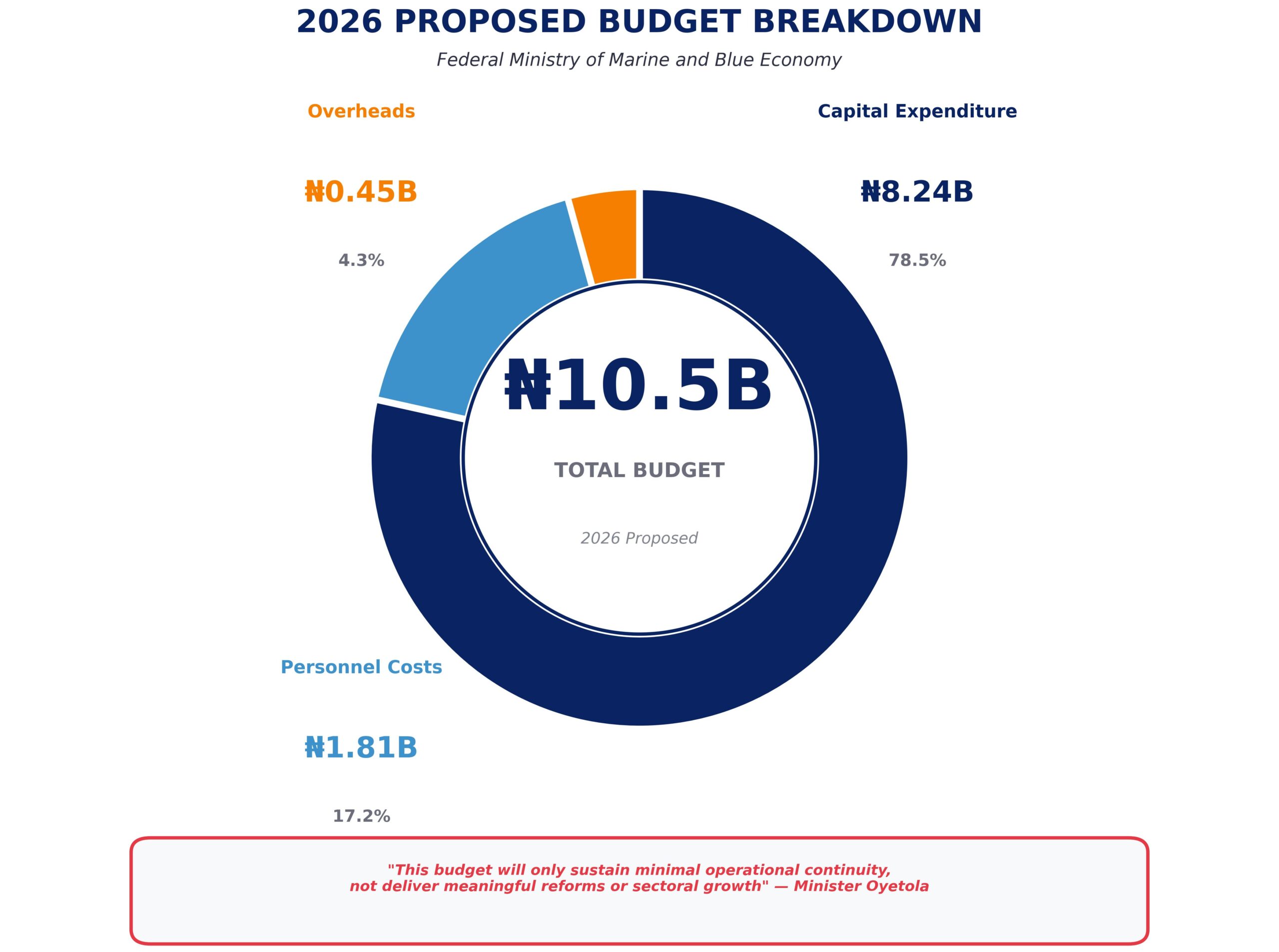
The proposed ₦10.5 billion breaks down into three components, each revealing the ministry’s straitjacket. Capital expenditure receives the lion’s share at ₦8.24 billion—78.5 percent of the total allocation. Personnel costs account for ₦1.81 billion (17.2 percent), while overhead expenses receive a mere ₦453.86 million (4.3 percent).
On paper, the capital-heavy allocation suggests infrastructure focus. In reality, Oyetola was blunt: this budget “would only sustain minimal operational continuity rather than deliver meaningful reforms or sectoral growth.”
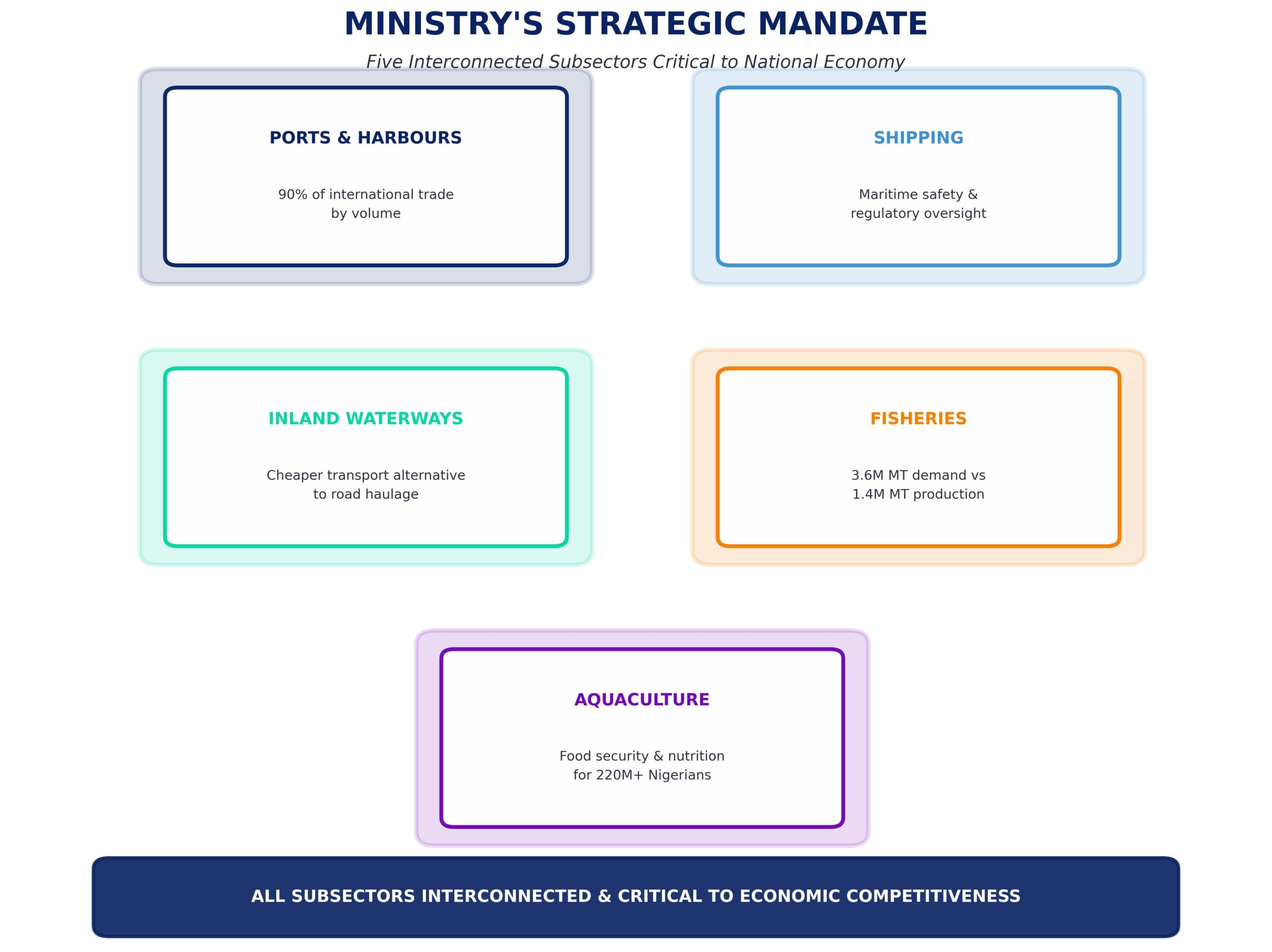
Consider what “minimal operational continuity” means for a ministry responsible for:
- Ports operations that process 90 percent of international trade
- Maritime safety across Nigeria’s territorial waters
- Inland waterways that could revolutionize freight transport
- Fisheries and aquaculture feeding a nation of over 220 million people
- Regulatory oversight of shipping, freight forwarding, and ocean resources
This is not a ministry that can afford to merely “continue operations.” It must innovate, expand, modernize, and regulate. Yet its budget suggests it will be fortunate to keep the lights on.
THE 2025 LESSONS: WHEN APPROVED BUDGETS BECOME FICTION
Perhaps the most revealing aspect of Oyetola’s presentation was the autopsy of 2025’s budget performance. The ministry’s revised capital budget stood at ₦3.53 billion. The actual cash release? A paltry ₦202.47 million—representing just 1.7 percent of the approved amount.
Overhead releases fared marginally better at 35 percent, but even this seemingly respectable figure masks operational paralysis. When you cannot access funds for capital projects, and only a third of your operational expenses are released, “minimal continuity” becomes an aspiration rather than a guarantee.
This pattern of approval-without-release has become endemic in Nigeria’s budget process, but its impact on the maritime sector is particularly catastrophic. Unlike many ministries whose inefficiency affects only internal operations, maritime sector dysfunction radiates through the entire economy.
When ports experience congestion due to inadequate investment, importers bear the cost. When cargo movement slows, manufacturers feel the pinch. When logistics costs spike, consumers pay higher prices. The ₦3.3 billion that never reached the ministry in 2025 wasn’t merely a bureaucratic shortfall—it was a stealth tax on the entire economy.
THE DEDUCTION PARADOX: STARVING REVENUE-GENERATING AGENCIES
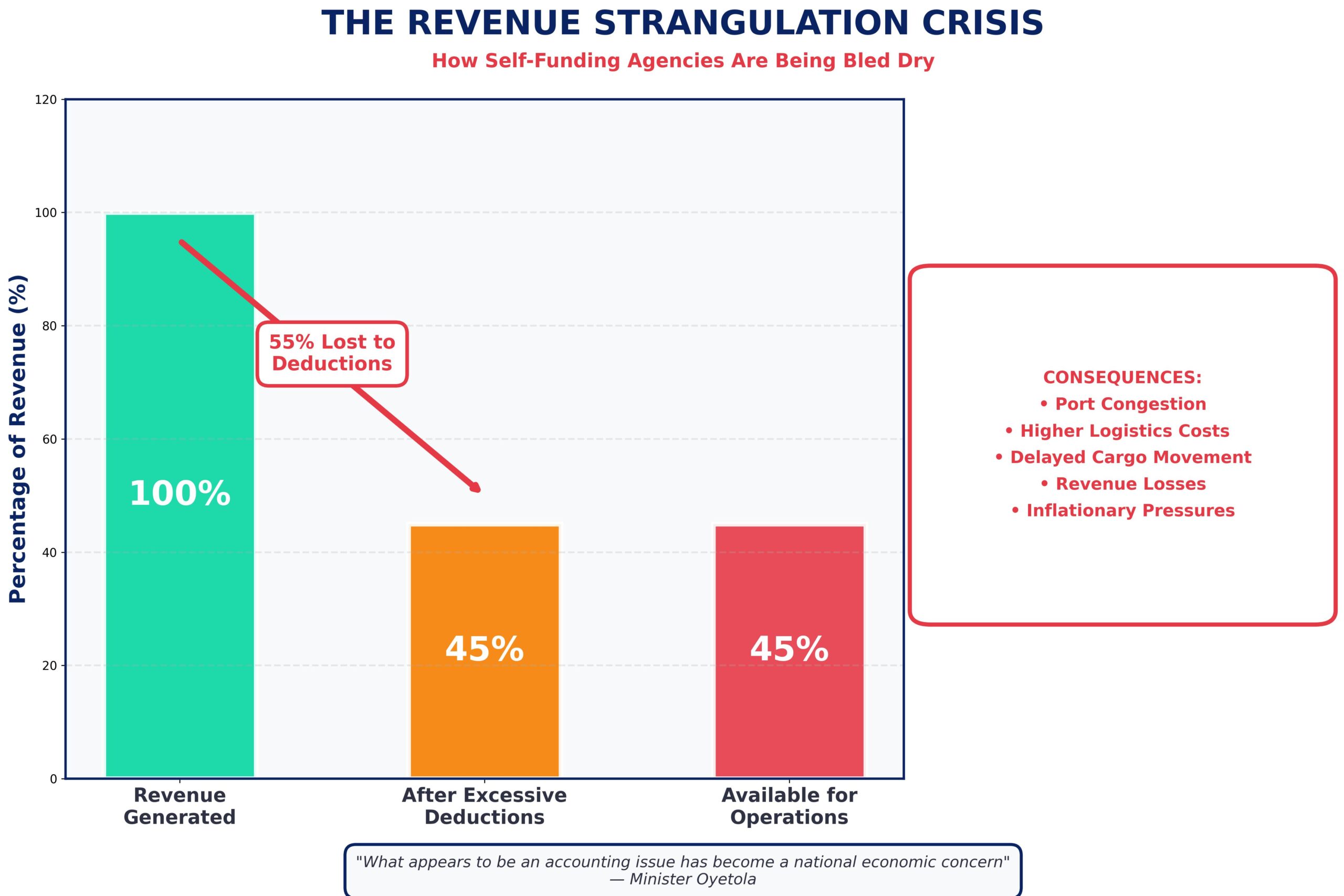
One of Oyetola’s most pointed criticisms targeted what he termed “excessive deductions at source” by the Office of the Accountant-General of the Federation. This practice targets self-funding agencies under the ministry—the Nigerian Ports Authority (NPA), Nigerian Maritime Administration and Safety Agency (NIMASA), and the Nigerian Shippers’ Council.
These agencies are remarkable entities within Nigeria’s federal structure. Unlike most government agencies that depend entirely on budgetary allocations, they generate substantial revenue from their operations and remit significantly to the Consolidated Revenue Fund. They are, in effect, profit centers that contribute to federal coffers rather than drain them.
Yet the very success of these agencies has made them targets for what economists might call “predatory extraction.” The Accountant-General’s office deducts so heavily at source that the agencies’ liquidity has been “severely constrained,” according to the minister.
The consequences are both immediate and far-reaching:
- Port congestion that delays cargo clearance and increases demurrage costs
- Higher logistics expenses that cascade through supply chains
- Delayed cargo movement that disrupts just-in-time manufacturing
- Revenue losses as inefficiency drives business to competing ports
- Inflationary pressures as imported goods become more expensive
Oyetola’s characterization was precise: “What appeared to be an accounting issue had become a national economic concern.”
This is fiscal policy at its most counterproductive. The federal government effectively weakens revenue-generating entities to capture short-term cash flow, sacrificing long-term productivity and economic efficiency. It is akin to a farmer who, desperate for immediate food, slaughters his breeding livestock instead of waiting for them to reproduce.
STRUCTURAL DYSFUNCTION: THE CRFFN MISALIGNMENT
Adding insult to injury, the minister revealed that the 2026 budget of the Council for the Regulation of Freight Forwarding in Nigeria (CRFFN) was wrongly placed under the Federal Ministry of Transportation by the Budget Office, despite CRFFN being an agency under the Marine and Blue Economy Ministry.
This may seem like bureaucratic minutiae, but such misalignments have real consequences. They undermine oversight clarity, weaken policy coherence within the maritime logistics value chain, and create confusion about accountability and reporting lines.
More fundamentally, they reflect the casual disregard with which the maritime sector is treated within federal budget architecture. If budget officials cannot even correctly align agencies with their parent ministries, what hope exists for nuanced understanding of the sector’s resource needs?
Bode Animashaun is our correspondent who coves maritime, fiscal policy and economic development.