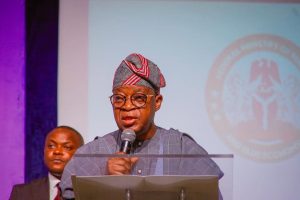
The Managing Director of the National Inland Waterways Authority (NIWA), Dr. Bola Oyebamiji, has responded to a recent appeal by the Lagos State Government urging a stop to sand-filling approvals on the state’s waterways, clarifying that NIWA does not issue sand-filling licenses as commonly believed.
This clarification follows comments made by Lagos State Deputy Governor, Dr. Obafemi Hamzat—who represented Governor Babajide Sanwo-Olu—at the 2025 Regional Ferry Safety Conference in Lagos. Dr. Hamzat accused NIWA of enabling unregulated sand-filling, which he said is undermining the state’s water transportation infrastructure and endangering the long-term viability of ferry services.
“We must say it clearly: NIWA must stop giving licenses for sand filling in Lagos waters,” the deputy governor said, noting that such activities have adverse environmental consequences and pose threats to the sustainability of water transport in the state.
In a reaction, Dr. Oyebamiji, during an exclusive interview with our correspondent, clarified that NIWA does not issue licenses for sand-filling. Instead, he explained, the agency grants access to the waterways only after rigorous evaluation, and based on land allocation documents obtained from relevant authorities.
Advertisement
“NIWA does not grant licenses for sand-filling as is widely assumed,” he stated. “What we do is give conditional access to the waterways, and such access must be backed by a letter of allocation—either from the Lagos State Government or the Federal Ministry of Lands and Housing.”
He emphasized that, following a recent court ruling, NIWA now primarily recognizes allocation letters from the Federal Ministry or the Office of the Surveyor General. Upon receiving such documentation, the authority conducts a detailed technical assessment of the proposed site to ensure that the natural water flow and safety standards are not compromised.
Where an application passes technical scrutiny, a provisional permit—subject to further review—is issued. Oyebamiji stressed that these are not permanent licenses but temporary access rights based on professional evaluation.
“We do not issue licenses. The permits are provisional and only granted after site inspections,” he said. “Where the findings show possible obstruction to water flow or safety risks, we withhold approvals entirely.”
Advertisement
He also pointed out that NIWA’s procedures involve inter-agency collaboration and environmental impact considerations, pushing back against the perception that the agency enables unchecked sand-filling.
At the ferry safety conference, Dr. Hamzat reiterated the importance of protecting the state’s waterways beyond physical infrastructure. He stressed that investments in jetties, terminals, monitoring systems, and patrol vessels would be meaningless if the ecological integrity of the waterways is destroyed by sand-filling.
“Safety is not only about the vessels and the passengers—it’s also about preserving the waterways themselves,” he said. “If sand-filling is allowed to continue unchecked, the future of water transport in Lagos is at serious risk.”
The ongoing exchange reflects long-standing jurisdictional tensions between federal and state authorities over control and regulation of Nigeria’s inland waterways. Experts believe that while both NIWA and the Lagos State Government are aligned on the need to develop a safe and sustainable water transport system, a clearer regulatory framework and stronger intergovernmental cooperation are essential.
Advertisement
As Lagos intensifies efforts to expand its ferry network as an alternative to road traffic, stakeholders stress that coordinated oversight between NIWA and the state will be critical to balancing environmental protection, public safety, and economic development.