Blue Economy
NIWA’s Achievements in Proper Perspective

NIWA’s achievements should not be judged by whether accidents have disappeared, but by how far the sector has moved from chaos toward order. In this light, NIWA has indeed made tangible progress in formalizing and securing Nigeria’s inland waterways — a foundation upon which safer and more efficient water transport can continue to grow.
By Bode Animashaun


For decades, Nigeria’s inland waterways have been plagued by poor regulation, unsafe practices, and fragmented oversight. The National Inland Waterways Authority (NIWA) was established to bring order to this critical sector, but its achievements are often misunderstood or misrepresented. Too often, success is framed in terms of accident statistics alone — a narrow lens that fails to capture the broader impact of NIWA’s work.
Beyond Accident Numbers
It is true that accidents have not been eliminated. Boat mishaps still occur, and challenges remain in enforcement and compliance. However, measuring NIWA’s success solely by accident reduction risks overlooking the structural reforms that have reshaped Nigeria’s maritime landscape.
NIWA’s achievements are better understood as tangible progress in formalizing and securing inland waterways. This means creating systems, rules, and infrastructure that transform water transport from an informal, risky activity into a regulated, safer, and more reliable mode of transport.
Tangible Achievements
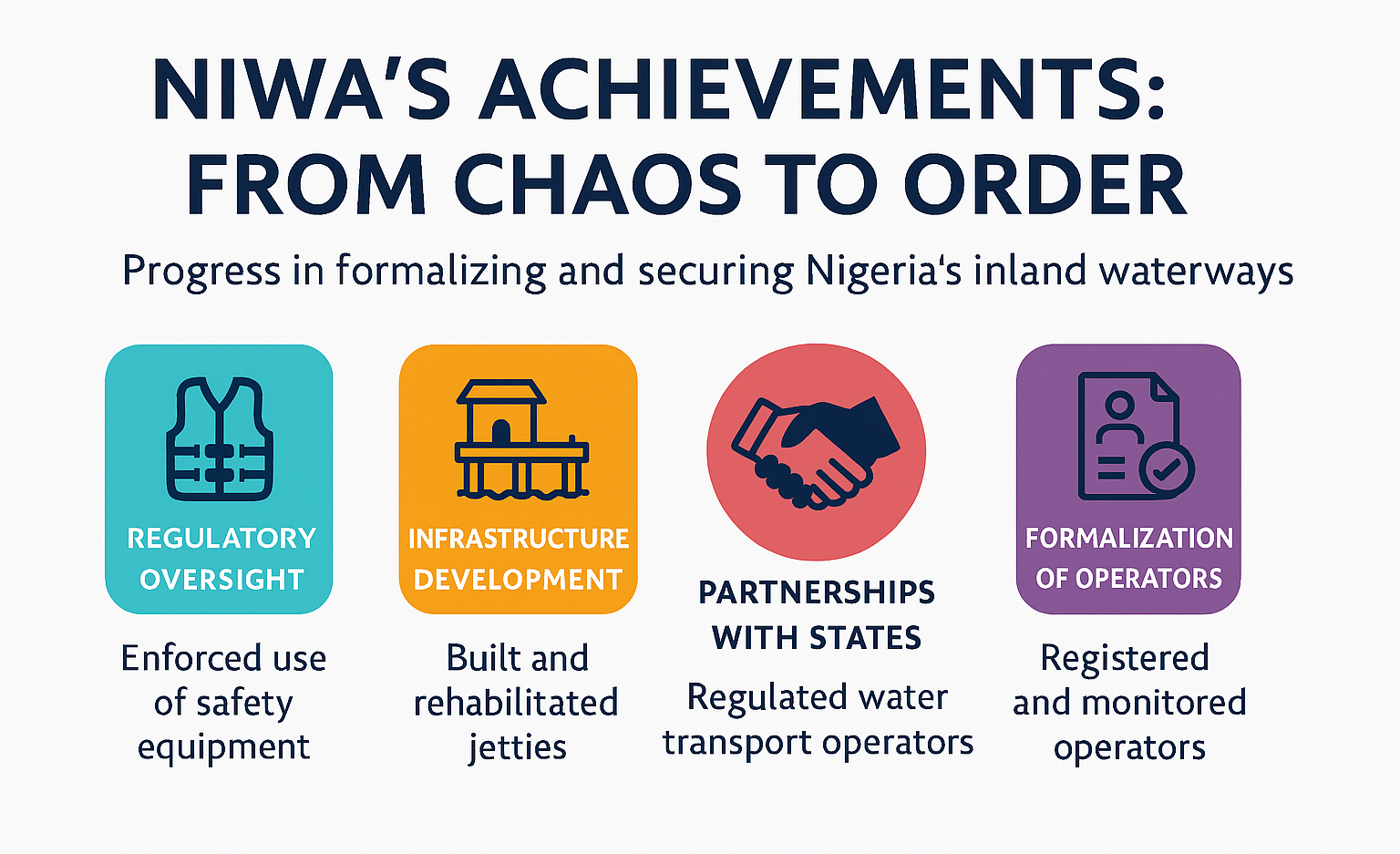
- Regulatory Oversight: NIWA has enforced mandatory use of life jackets and safety equipment, ensuring that passenger boats meet minimum safety standards.
- Infrastructure Development: The authority has invested in building and rehabilitating jetties and terminals, providing organized points of embarkation and disembarkation.
- Partnerships with States: Collaboration with Lagos and other states has helped regulate operators, reducing unlicensed and unsafe boat services.
- Formalization of Operators: By registering and monitoring water transport businesses, NIWA has brought more operators into the formal economy, improving accountability.
These efforts have not eliminated accidents entirely, but they represent real progress in building a safer, more structured inland waterway system.
Why This Classification Matters
By classifying NIWA’s achievements as progress in formalization and security, rather than accident elimination, we set a more realistic benchmark for success. This perspective acknowledges that systemic reforms take time, but also highlights the authority’s role in laying the foundation for long-term safety and efficiency.
It also helps the public and stakeholders appreciate that NIWA’s work is about institutional transformation — creating rules, infrastructure, and oversight mechanisms that will continue to reduce risks over time.
Looking Ahead
The path forward requires:
- Stronger enforcement of safety regulations.
- Investment in digital monitoring systems to track compliance in real time.
- Community engagement to build awareness among operators and passengers.
- Policy consistency to avoid disruptions in regulatory frameworks.
With these steps, NIWA can consolidate its progress and move closer to the ultimate goal: a safe, efficient, and fully formalized inland waterway system that supports Nigeria’s economic growth.
Final Thought
NIWA’s achievements should not be judged by whether accidents have disappeared, but by how far the sector has moved from chaos toward order. In this light, NIWA has indeed made tangible progress in formalizing and securing Nigeria’s inland waterways — a foundation upon which safer and more efficient water transport can continue to grow.