Blue Economy
Oyetola Takes Nigeria’s Case for Equity to IMO’s Green Shipping Session in London

Oyetola Takes Nigeria’s Case for Equity to IMO’s Green Shipping Session in London
By Ighoyota Onaibre | Waterways News Reporter | May 5, 2026
Nigeria’s Minister of Marine and Blue Economy, Dr. Adegboyega Oyetola, has thrown his weight behind a fair and inclusive global transition to net-zero shipping, insisting that any decarbonization framework that ignores the economic constraints of developing nations is one Africa and the Global South cannot afford to accept.
Speaking at the 84th session of the Marine Environment Protection Committee (MEPC 84) of the International Maritime Organization (IMO) in London last week, Oyetola reaffirmed Nigeria’s support for the global push toward zero emissions in international shipping — but drew a firm line: the 2050 net-zero target must align with sustainable development goals and be backed by tangible support for nations still building their economies.


The session, which drew environment and shipping ministers from across the world, has become a focal point for tension between developed maritime nations pushing aggressive decarbonisation timelines and developing economies demanding that equity, not just ambition, shape the rules.
On the sidelines of MEPC 84, Oyetola held high-level bilateral engagements with IMO Secretary-General Arsenio Dominguez and the President of Saudi Arabia’s Transport General Authority, H.E. Fawaz Al Sehali — meetings that underscored Nigeria’s growing weight in global maritime diplomacy.
In his discussions with Dominguez, Oyetola reiterated Nigeria’s commitment to a productive and mutually reinforcing relationship with the IMO, anchored on maritime safety, institutional capacity development, and sustainable blue economy growth. The IMO chief, in turn, expressed appreciation for the warmth shown during his recent visit to Nigeria, noting that his meeting with President Bola Ahmed Tinubu was a strong signal of the country’s seriousness about maritime governance.
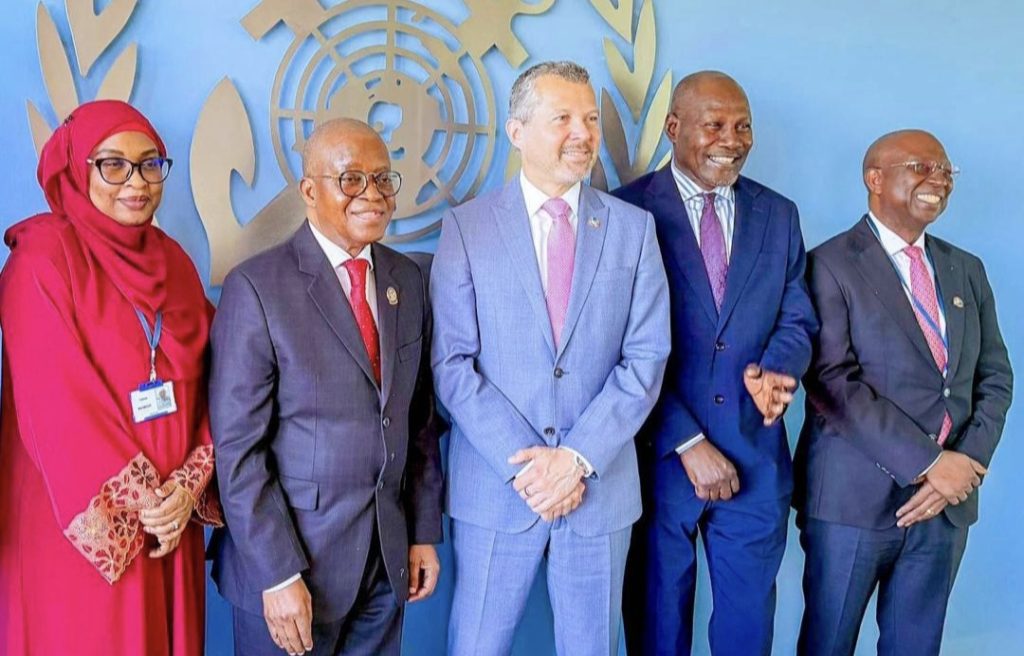

L-R: Permanent Secretary, Federal Ministry of Marine and Blue Economy, Mrs. Fatima Mahmood; Minister of Marine and Blue Economy, Dr. Adegboyega Oyetola; Secretary-General of International Maritime Organization (IMO), Mr. Arsenio Dominguez; Acting High Commissioner of Nigeria to the UK, Ambassador Mohammed Maidugu, and Director General, Nigerian Maritime Administration and Safety Agency, Dr. Dayo Mobereola, during a meeting on the sidelines of the 84th session of the Marine Environment Protection Committee in London last week.
Dominguez also singled out Nigeria’s leadership in tackling maritime insecurity in the Gulf of Guinea, commending the significant reduction in piracy incidents and the improved regional coordination that has followed. His remarks aligned with Nigeria’s recent four-year zero-piracy milestone — a record that has drawn attention from maritime security bodies worldwide.
Talks with the Saudi delegation centred on strengthening bilateral maritime ties and reinforcing mutual support within the IMO framework — a relationship that could carry strategic weight as both nations navigate the politics of the global energy transition.
Broader discussions at MEPC 84 also touched on Nigeria’s expanding role on the IMO Council, port modernisation and digitalisation reforms, and efforts to raise human capital development to international maritime standards.
The minister’s London engagements come at a pivotal moment. Climate activists recently stormed IMO headquarters during the MEPC 84 sessions — a confrontation Waterways News reported — as pressure mounts on the organisation to tighten its green shipping commitments. Nigeria’s position, as articulated by Oyetola, reflects a careful balance: supporting the direction of travel while refusing to let speed override justice.
For a country that handles a significant share of West Africa’s maritime trade and is deepening its blue economy ambitions, how the IMO’s net-zero framework ultimately shapes up could have far-reaching consequences for Nigeria’s shipping costs, port competitiveness, and energy choices for years to come.