Maritime Security and Safety
Special Report: Know Your Navigation Marks

KNOW YOUR NAVIGATION MARKS
Out at sea, there are no roads, no lanes, no traffic lights — yet ships move safely every single day. Here is how.
SPECIAL REPORT | NAVIGATION & SAFETY :By Raymond Gold O. | Co-publisher & Research Reporter | Waterways News
The ocean is vast, unforgiving, and utterly unmarked by the familiar grid of roads that govern movement on land. No white lines divide one lane from another. No traffic officers wave ships into position. No overhead signs point toward a distant port. And yet, in one of the oldest and most remarkable feats of human coordination, thousands of vessels — from artisanal canoes to thousand-foot supertankers — navigate these waters in disciplined, near-flawless order. The secret is not technology alone. The secret is a universal language of marks.


Navigation marks are the vocabulary of the sea. They are the silent sentinels posted at critical junctures in the waterway — warning of danger here, confirming safe passage there, defining the channels through which commerce and livelihood flow. To the untrained eye, a buoy bobbing off the Lagos shoreline or the Niger Delta estuary may look like a modest piece of hardware. To the mariner who knows the system, it is as clear and authoritative as a highway sign. This special report, produced by the research desk of Waterways News, unpacks the three primary families of navigation marks that govern maritime movement the world over: Cardinal Marks, Lateral Marks, and Safe Water Marks.
“At sea, you don’t rely on instinct. You rely on marks, systems, and rules — and that discipline is what keeps every vessel alive.”

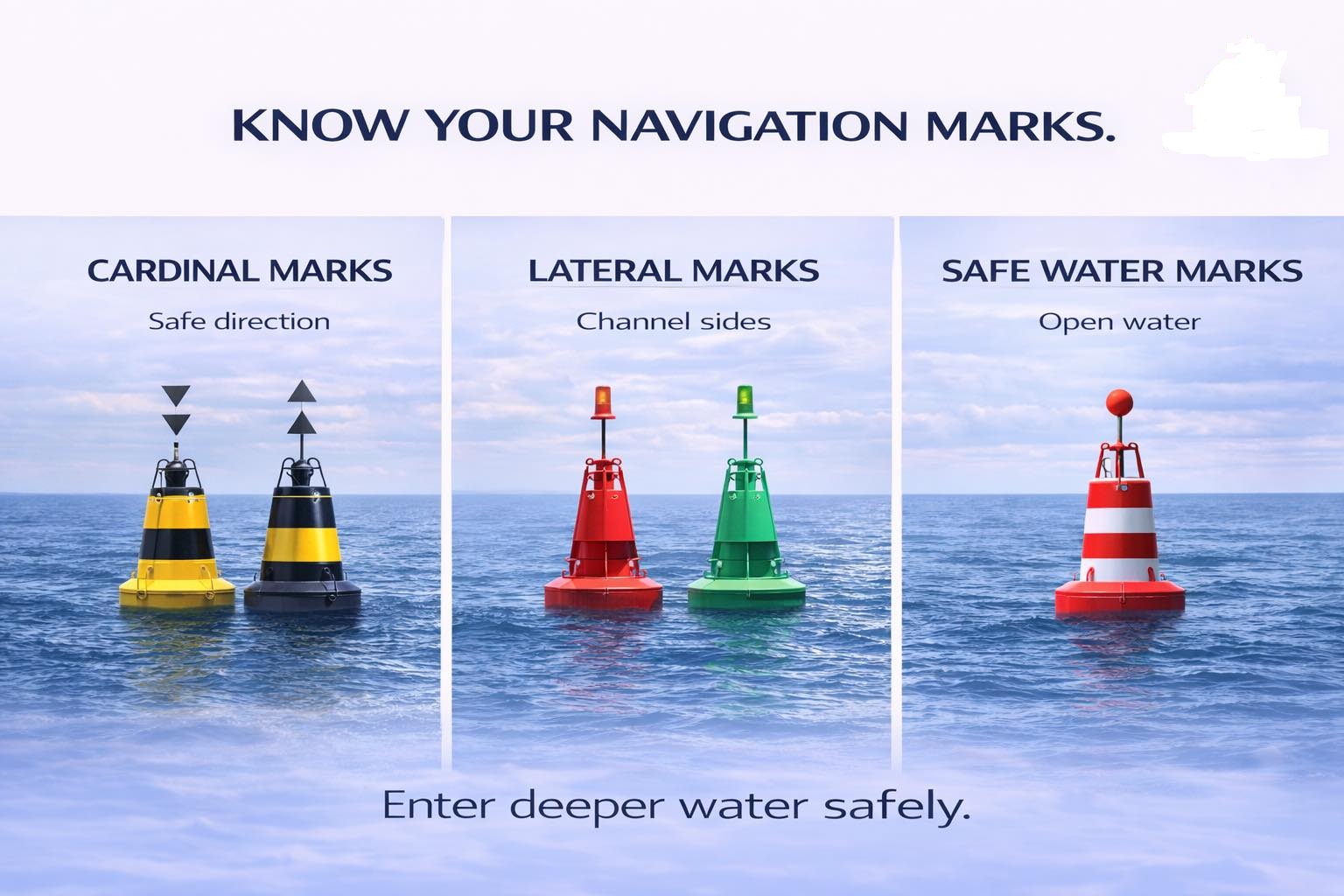
PART ONE: CARDINAL MARKS — WHERE SAFETY LIVES
Of all the mark types in use across the world’s shipping lanes, cardinal marks carry perhaps the most important directive: they do not tell you where to go, they tell you where it is safe to go. Positioned around a hazard — a reef, a shoal, a shallow bank, a submerged wreck — cardinal marks are named after the four principal compass directions: North, South, East, and West. Each mark tells the approaching mariner the side on which safe, navigable water lies.
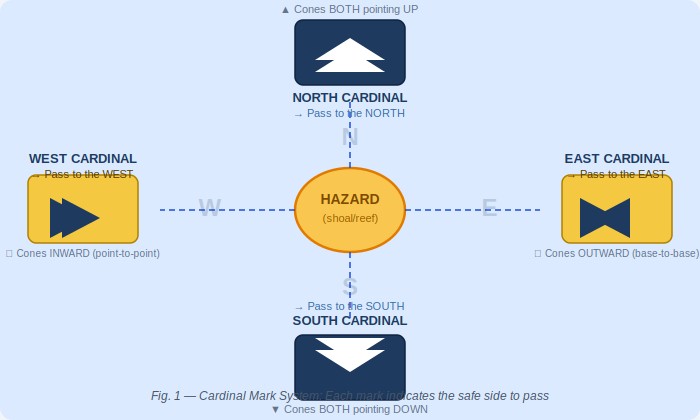

Fig. 1 — The Cardinal Mark System: Each mark signals safe water on its named compass side
The visual identity of cardinal marks is internationally standardised and deeply intentional. Each mark carries a combination of black and yellow bands, with the arrangement of those bands — and of the double-cone topmarks above — varying by direction:
- North Cardinal: both cones pointing UPWARD — pass to the north
- South Cardinal: both cones pointing DOWNWARD — pass to the south
- East Cardinal: cones base-to-base (pointing outward) — pass to the east
- West Cardinal: cones point-to-point (pointing inward) — pass to the west
After dark, each cardinal mark also displays a distinct flash pattern, ensuring that mariners relying on their night-watch do not need to approach closely to read the mark’s identity. The North Cardinal displays a continuous quick flash (Q); the South Cardinal a Q(6) plus a long flash every fifteen seconds; the East Cardinal a Q(3) every ten seconds; and the West Cardinal a Q(9) every fifteen seconds. These patterns are published in the Admiralty List of Lights and are reproduced on every official nautical chart.
In Nigerian waters — across the Gulf of Guinea, through the Niger Delta’s intricate web of channels, and along the coastline from Badagry to Calabar — cardinal marks play a critical role wherever shifting sediment, sandbars, or underwater obstacles create seasonal and permanent hazards. The lesson of the cardinal mark system is fundamental: knowing which side of the mark to pass is not optional knowledge. It is survival knowledge.
PART TWO: LATERAL MARKS — THE ROAD AT SEA
If cardinal marks define where the danger is, lateral marks define where the road is. The lateral mark system is among the oldest and most universally recognised in maritime navigation. It uses red and green buoys — and their associated shapes, light colours, and topmarks — to delineate the safe navigable channel through a port approach, a river, an estuary, or any defined waterway. Follow them like lanes on a highway, and your vessel stays in safe water.
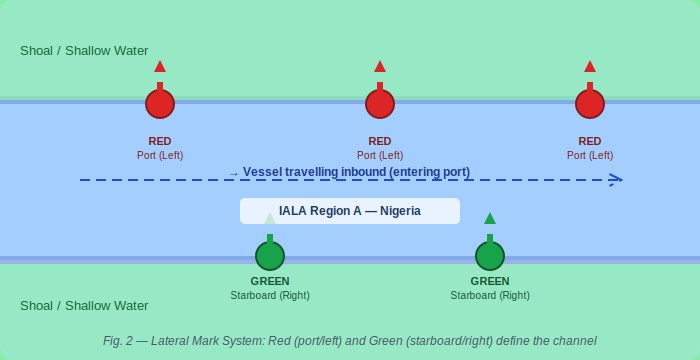

Fig. 2 — Lateral Mark System: Red (port/left) and Green (starboard/right) define the navigable channel
The world’s lateral mark system operates under two broad frameworks: IALA Region A and IALA Region B. Nigeria, like all African nations, falls under IALA Region A — meaning that when entering a channel from seaward, red marks are kept on the port (left) side and green marks on the starboard (right) side. This distinction is not academic. A vessel that mistakes its IALA region risks driving itself directly onto the hazard the lateral system was designed to avoid.
Red and Green: The Universal Lane Markers
Red lateral marks (port hand) in IALA Region A are cylinder- or can-shaped buoys displaying a red light. They mark the left side of the channel when entering port — the port hand. Green lateral marks (starboard hand) are conical buoys displaying a green light, marking the right side of the channel — the starboard hand. At channel junctions, modified lateral marks with red-green or green-red banding indicate the preferred route through divided waterways.
For fishermen operating in the creeks of the Niger Delta, for ferry operators crossing Lagos Harbour, for the crew of an LNG carrier threading the Escravos Channel, the lateral mark system is the spine of safe navigation. These marks define where the dredged channel lies, where water depth is adequate, and where the walls of the safe corridor begin and end. Ignore them and the consequences are mechanical, commercial, and sometimes fatal.
PART THREE: SAFE WATER MARKS — THE OPEN SEA SALUTE
If cardinal marks warn of danger and lateral marks define the channel, safe water marks do something simpler and altogether more reassuring: they confirm that you are in open, deep, unobstructed water. No shoals beneath you. No rocks to port or starboard. No channel restrictions. The safe water mark is the maritime equivalent of finding clear, open highway after hours of careful city driving.
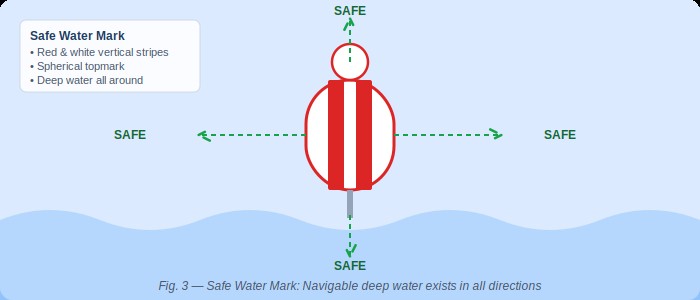

Fig. 3 — Safe Water Mark: Red and white vertical stripes signal navigable deep water in all directions
What a Safe Water Mark Tells You: A safe water mark — characterised by red and white vertical stripes, a spherical topmark, and either an Isophase, Occulting, or single long flash every ten seconds — signals that navigable deep water exists in all directions. No hazards. No restrictions. These marks are commonly positioned at the seaward approach to port channels, at the entrance to fairways, and at mid-channel positions in wide open passages. They are an invitation to proceed with confidence.
Safe water marks are frequently the first official marks a vessel encounters when approaching from deep ocean. Positioned at the start of a fairway, they signal to the navigator: the channel begins here — deep water, all clear. From that mark, the mariner picks up the lateral mark system and follows the defined channel inward toward berth.
For vessels approaching the Bight of Benin, making for the Tin Can Island terminals or the Apapa complex in Lagos, safe water marks serve as critical reference points for initial positioning. Offshore supply vessels heading for the deep-water oil terminals of the Niger Delta use them to confirm their approach corridors. Coastal traders rounding Cape Formoso watch for them as they transition from open sea to coastal navigation. In every case, the safe water mark is a confirmation, not a warning — a green light at the gateway to the port.
THE ARCHITECTURE OF MARITIME ORDER
It is worth pausing to consider the full elegance of what the navigation mark system represents. Across the world’s oceans — from the Arctic shipping lanes to the busy equatorial corridors of the Gulf of Guinea — vessels of every nation, crewed by seafarers of every language, follow the same colour codes, the same shapes, the same flash patterns. A Nigerian deck officer trained in Lagos can read the marks in Rotterdam harbour. A Dutch pilot brought aboard in Port Harcourt reads the marks in Bonny River as fluently as at home.
“The mark system is a universal language — one of the few truly global standards that requires no translation.”
The International Association of Marine Aids to Navigation and Lighthouse Authorities (IALA) maintains and evolves this system. Nigeria is a signatory to the IALA conventions, and the Nigerian Maritime Administration and Safety Agency (NIMASA), along with the Nigerian Ports Authority (NPA), bears responsibility for the placement, maintenance, and integrity of marks in Nigerian waters. Where marks are missing, damaged, or incorrectly positioned, the consequences range from commercial delay — a vessel that must anchor pending guidance — to catastrophe: a grounding that blocks a channel, spills cargo, or claims lives.
In recent years, concerns have been raised within the Nigerian maritime community about the state of navigational marking in some of the country’s secondary waterways — the creeks, river approaches, and coastal channels that serve Nigeria’s inland and nearshore maritime economy. The fishermen, ferry operators, and small cargo carriers who depend on these waterways navigate with imperfect information, sometimes relying on local memory rather than confirmed marks. Waterways News has documented incidents in the Niger Delta where absent or damaged marks contributed to groundings and near-misses. The case for investment in comprehensive, well-maintained navigation marking infrastructure along Nigerian waterways is not merely technical — it is an economic and safety imperative.
WHAT EVERY NIGERIAN SEAFARER MUST KNOW
Whether you are a vessel master bringing a bulk carrier into the Tin Can Island terminal, a crew-boat operator ferrying workers to an offshore platform, a fisherman navigating the channels of the Ijaw creeks, or a student at the Nigerian Maritime University in Okerenkoko preparing for your first sea posting — the navigation mark system is not optional knowledge. It is the foundation of safe maritime practice.
The three families of marks — Cardinal, Lateral, and Safe Water — together form a complete vocabulary for communicating hazard, direction, and clearance. They operate day and night, in clear weather and in fog, and they do so in silence, at a fraction of the cost of any active monitoring system. They require no electricity to understand. They require only training, attention, and respect for the system.
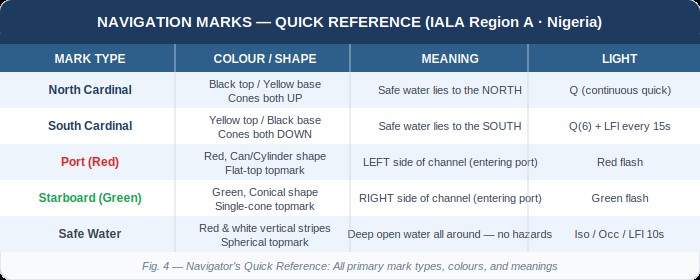

Fig. 4 — Navigator’s Quick Reference: Primary mark types, colours, and meanings at a glance
Enter deeper water safely. That is the promise — and the demand — of every navigation mark on every waterway in the world. It is a promise that only holds if mariners know the language, if authorities maintain the marks, and if the system is treated with the seriousness it deserves.
Waterways News will continue to monitor and report on the state of navigational infrastructure in Nigerian waters. We will advocate for adequate marking of the creeks, estuaries, and coastal approaches that form the backbone of Nigeria’s maritime economy. And we will continue to educate — because knowledge of the marks is the first line of safety at sea.
WATERWAYS NEWS | Report by Raymond Gold O., Co-publisher & Research Reporter | Navigation & Safety Desk • waterwaysnews.ng