Blog
The Trucks Choke on Nigeria’s Ports: The Case for an Intermodal Transport Revolution


The Trucks Choke on Nigeria’s Ports: The Case for an Inter-modal Transport Revolution
By Raymond Gold Co-publisher and Research Reporter| Waterways News | Lagos
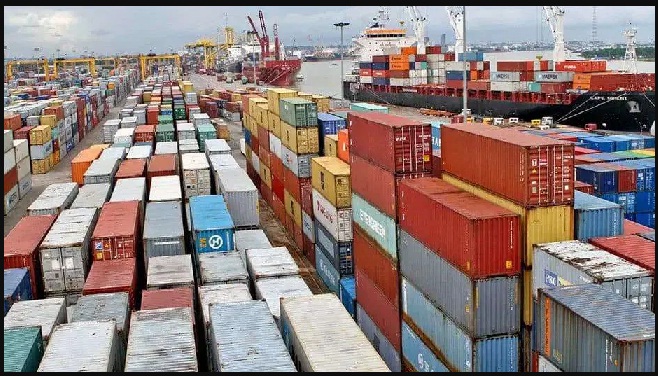
Nigeria is sitting on one of Africa’s most expansive inland waterway networks — yet barges carry barely seven per cent of the cargo moving in and out of its seaports, while trucks haul more than 90 per cent. That glaring imbalance is now costing the country billions of naira annually in congestion losses, road deterioration and eroded trade competitiveness.
The scale of the missed opportunity is thrown into sharp relief by the Nigerian Ports Authority’s 2025 Operational Performance Report, which showed cargo throughput surging by 24.8 per cent last year, with container traffic rising 25.7 per cent to surpass 2.1 million twenty-foot equivalent units (TEUs). The boom in maritime trade has piled even more pressure onto an already overstretched road network — with trucks bearing virtually the entire burden of moving cargo to and from the ports.

A Structurally Broken System
The International Maritime Organisation (IMO) has long advocated seamless integration of inland waterways, rail and road transport as the gold standard for port efficiency and hinterland connectivity. Nigeria’s reality falls far short of that vision.
Industry data compiled by the Sea Empowerment and Research Centre (SEREC) paints a stark picture: between 90 and 95 per cent of port cargo leaves by road, seven per cent via barge, and just five per cent by rail. The result, SEREC warns, is chronic port congestion, inflated logistics costs, rapid road degradation and a steady loss of regional trade competitiveness.
“An efficient intermodal transport system is critical to maritime trade facilitation, economic growth, and regional competitiveness,” said Dr Eugene Nweke, Head of Research at SEREC, in a policy advisory paper titled Reviving Nigeria’s Intermodal Transport System for Efficient Maritime Trade. “In Nigeria, however, the disconnect between seaports and inland logistics networks continues to undermine trade efficiency.”
The problem is structural. Nigeria’s three busiest cargo gateways — Lekki Port (40.6 per cent of national throughput), Apapa Port (26.7 per cent) and Onne Port (19.1 per cent) — have no functional rail connections. Even at Apapa, where a rail line exists, the overwhelming bulk of cargo evacuation still happens by road. Inland waterways, despite Nigeria’s vast potential, remain largely untapped.
The Waterways Opportunity
Nigeria’s waterway network links approximately 22 states — a natural freight corridor that remains almost entirely idle for commercial cargo movement. The Sunday Ademuyiwa, Director of International Trade at the Maritime Researchers and Authors Association of Nigeria (MARASSON), says this is a strategic asset that the country is squandering.
“Given Nigeria’s heavy dependence on maritime imports, improving intermodal connectivity is essential to unlocking economic growth,” Ademuyiwa said. “Inland waterways, which could serve as a viable alternative for cargo movement, remain largely underutilised despite Nigeria’s vast potential. With about 22 states interconnected by waterways, improved investment in water transport could ease pressure on roads and enhance logistics nationwide.”
He warned that persistent port congestion delays shipments, drives up logistics costs and disrupts supply chains — with cascading consequences for businesses and consumers across the country.
The Cost of Inaction
The economic toll is significant. SEREC estimates that high inland transport costs inflate commodity prices, reduce Nigeria’s export competitiveness and are increasingly driving cargo diversion to neighbouring ports with better logistics infrastructure. Nigeria, the research centre warns, is losing billions of naira annually to inefficiencies and delays.
Haruna Omolajomo, Managing Director of HARSECOM Logistics Limited, points out that Apapa and Tincan Island ports together handle over 70 per cent of Nigeria’s imports and exports, generating more than N5 trillion in annual Customs revenue. Yet investment in the infrastructure serving these ports has failed to keep pace.
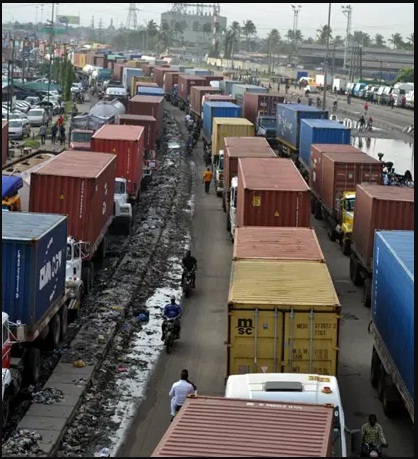
Trucks returning empty containers to the port spillover into the roads in Lagos
“This is very sad,” Omolajomo said. “With these finances, the federal government is still finding it difficult to take even N1 trillion to improve its infrastructure.”
What Must Change
Experts are calling for a phased multimodal reform agenda. SEREC recommends that immediate action — within three years — should include mandatory rail connectivity to all major ports, targeted incentives to grow barge operations on Nigeria’s inland waterways, and the activation and integration of inland dry ports.
Over the medium term (three to seven years), the recommendations include liberalising rail freight, implementing a national single window logistics system, and developing integrated cargo corridors. The long-term goal is a fundamental rebalancing of Nigeria’s freight modal split: 50–60 per cent road, 25–30 per cent rail, and 15–20 per cent waterways.
Crucially, realising the waterways component of that ambition will require urgent action on safety and security. Omolajomo says the National Inland Waterways Authority (NIWA) and the Nigerian Maritime Administration and Safety Agency (NIMASA) must step up patrols and enforce order on Nigeria’s waterways to make barge operations viable for commercial cargo.
“The railway system must be revamped to connect all ports in Nigeria to stimulate a multimodal transport system,” he said. “The same applies to the use of standard barges and tugboats. Security must be provided by NIWA and NIMASA to make our waterways safe and secure. Maritime regulators must do their jobs adequately.”
The Bottom Line
Nigeria cannot afford to keep ignoring its rivers and creeks while trucks gridlock its ports and grind down its roads. With cargo volumes growing year on year and regional competitors investing heavily in multimodal logistics, the window to act is narrowing. The waterways are there — what is missing is the political will and coordinated investment to put them to work.
Raymond Gold is Co-publisher and Research Reporter at Waterways News, Lagos.

Blog
GHOST TANKER ON THE RUN: How U.S. Navy SEALs Hunted Down the Marinera Across the Atlantic — And What It Means for Nigeria
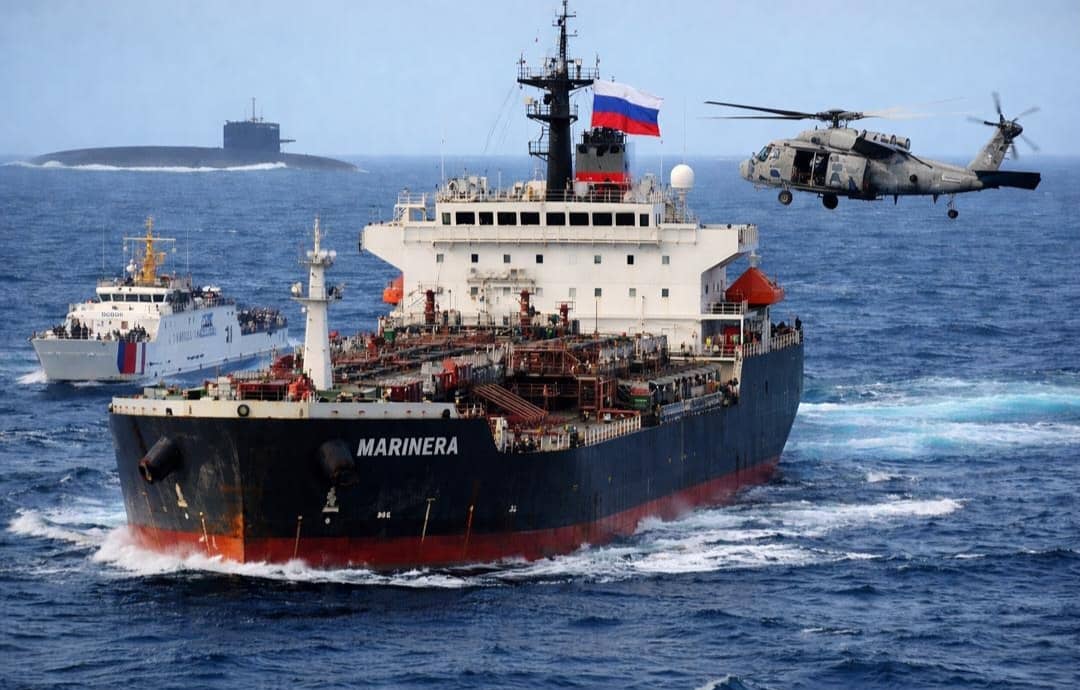
GHOST TANKER ON THE RUN: How U.S. Navy SEALs Hunted Down the Marinera Across the Atlantic — And What It Means for Nigeria
A Weeks-Long High Seas Chase, a Daring Pre-Dawn Boarding, and a Bold New Era of Global Oil Sanctions Enforcement
By Oghenewoke Osaweren, Research Reporter | WaterwaysNews.ng | March 25, 2026
In the early morning darkness of January 7, 2026, United States Navy SEALs descended from military helicopters onto the deck of a rust-streaked oil tanker cutting through the frigid North Atlantic — roughly 190 miles off the coast of Iceland. The dramatic boarding was the culmination of a weeks-long maritime chase that had gripped global shipping circles, strained U.S.-Russia diplomatic relations, and pulled the shadowy world of illicit oil trafficking into the full glare of international scrutiny.
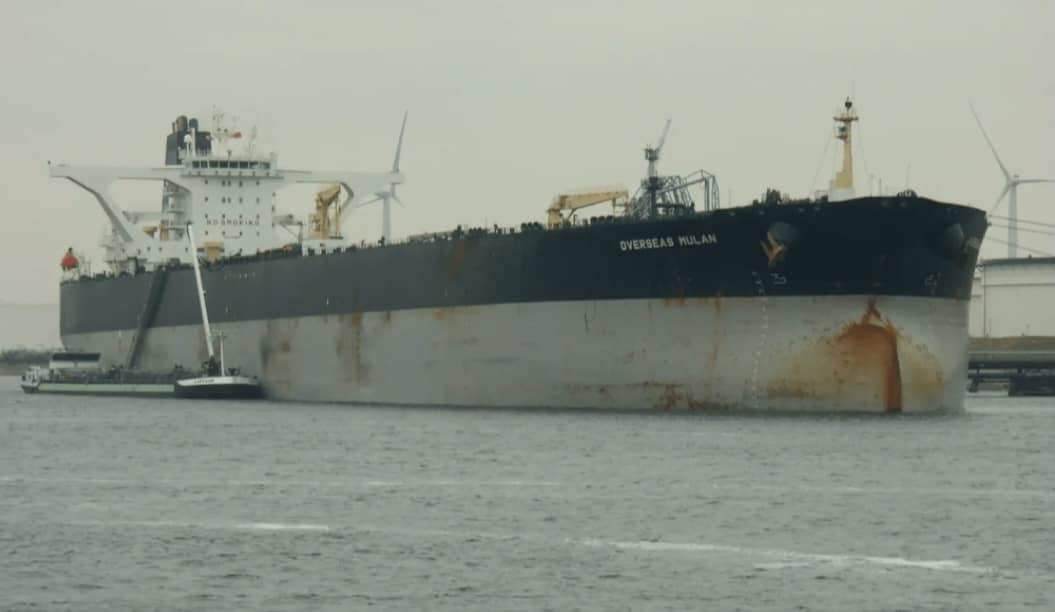
The vessel — originally named the Bella 1, hastily renamed the Marinera mid-voyage in a desperate bid to escape American jurisdiction — had spent months ferrying sanctioned crude oil for Venezuela, Iran, and Russia. It routinely switched off its tracking transponders and painted over its hull markings to evade detection. On that January morning, north of Iceland, its luck ran out.
A Tanker Born in the Shadows
The Bella 1 had a deeply troubled history long before it became the centrepiece of an international crisis. U.S. authorities classify vessels like it as part of a “shadow fleet” — a network of aging, poorly maintained tankers used by sanctioned nations to move crude oil in defiance of international restrictions.
Analysis of Automatic Identification System (AIS) tracking data showed the Bella 1 first departing Iran’s exclusive economic zone in February 2025, sailing through the Strait of Malacca before heading toward South America. The vessel went completely dark between legs of its journey — switching off its AIS transponder off the coast of Sri Lanka on March 24, 2025, only to reappear in Iranian waters on July 1, 2025. During that blackout period, analysts recorded 379 AIS “pings” while the ship lingered in Iranian coastal waters, with its transmitter switched off no fewer than 17 times — a pattern strongly consistent with clandestine ship-to-ship oil transfers designed to disguise the cargo’s origin.
The U.S. Treasury Department sanctioned the Bella 1 in June 2024, citing its role in transporting illicit oil for companies linked to Hezbollah, the Iran-backed Lebanese militant organisation. The designation cut the tanker off from the international financial system — but did not stop it from sailing.
December 2025: The Caribbean Standoff
By late 2025, the Bella 1 had joined a growing fleet of sanctioned tankers quietly loading crude at Venezuelan state oil terminals. The U.S. under President Donald Trump — who had returned to the White House in January 2025 — had adopted an aggressive posture toward Venezuelan President Nicolás Maduro’s government, reimposing sweeping sanctions and pressing allies to sever economic ties with Caracas.
On December 10, 2025, Washington made its first move, seizing a tanker called the Skipper in the Caribbean Sea. A week later, the U.S. formally announced a maritime blockade — declaring its intention to intercept all sanctioned tankers moving oil to and from Venezuela, anywhere on the world’s oceans.
The Bella 1, then sailing under a Guyanese flag, was named a priority target. When the U.S. Coast Guard cutter USCGC Munro attempted to board her in Caribbean waters, the crew refused. Rather than comply, the vessel made an abrupt turn away from Venezuelan waters — and ran for the open Atlantic.
The chase was on.
Flags, Names, and Disguises Across the Atlantic
What followed over the next three weeks captivated maritime observers worldwide. AIS data showed the vessel zigzagging across the Atlantic, taking evasive courses and intermittently going dark. Analysts flagged a particularly suspicious seven-hour window on December 9, 2025, during which the tanker’s AIS vanished mid-ocean, only for the ship to reappear barely one nautical mile from where it had disappeared.
More dramatically, the crew physically transformed the vessel’s identity at sea — reportedly painting a Russian flag onto the hull. By December 24, maritime registries showed the ship sailing under a new name, the Marinera, and a new flag: Russia’s. Moscow’s Maritime Register of Shipping confirmed a “temporary permission” had been granted for the vessel to sail under the Russian state flag, registered out of Sochi on the Black Sea.
Russia simultaneously submitted a formal diplomatic note demanding Washington cease its pursuit — a significant escalation signalling that Moscow viewed the chase as a direct challenge to its sovereign authority over ships flying its flag.
The legal stakes were considerable. Under the United Nations Convention on the Law of the Sea (UNCLOS), a vessel is treated as the sovereign territory of the state whose flag it flies, making any unauthorised boarding a potential act of aggression. The U.S. countered that the rapid flag change was illegitimate — international law prohibits mid-voyage flag switches without a genuine transfer of ownership, a requirement Russia’s last-minute registration almost certainly did not meet. White House Press Secretary Karoline Leavitt told reporters the Marinera had been “deemed stateless” after flying what Washington considered a false flag, and that a U.S. federal court had already issued a judicial seizure warrant.
Russia Deploys a Submarine
As the Marinera neared the strategically critical passage between Iceland and Scotland, intelligence reports surfaced that Russia had dispatched a submarine and a naval surface vessel to escort the tanker — an extraordinary show of military force in support of what Moscow maintained was an ordinary civilian merchant ship.
The United States had quietly pre-positioned its own forces. Navy SEALs and personnel from the elite 160th Special Operations Aviation Regiment — the “Night Stalkers” — had been moved to bases in Scotland. The U.S. Air Force deployed a Boeing P-8 Poseidon maritime patrol aircraft, a Lockheed AC-130J gunship, and a Pilatus U-28A Draco surveillance aircraft. Britain contributed Royal Air Force surveillance planes and the Royal Fleet Auxiliary vessel RFA Tideforce.
The Marinera appeared to be making for a Russian Arctic port. The Iceland-Scotland passage offered no clean escape.
January 7, 2026: The Seizure
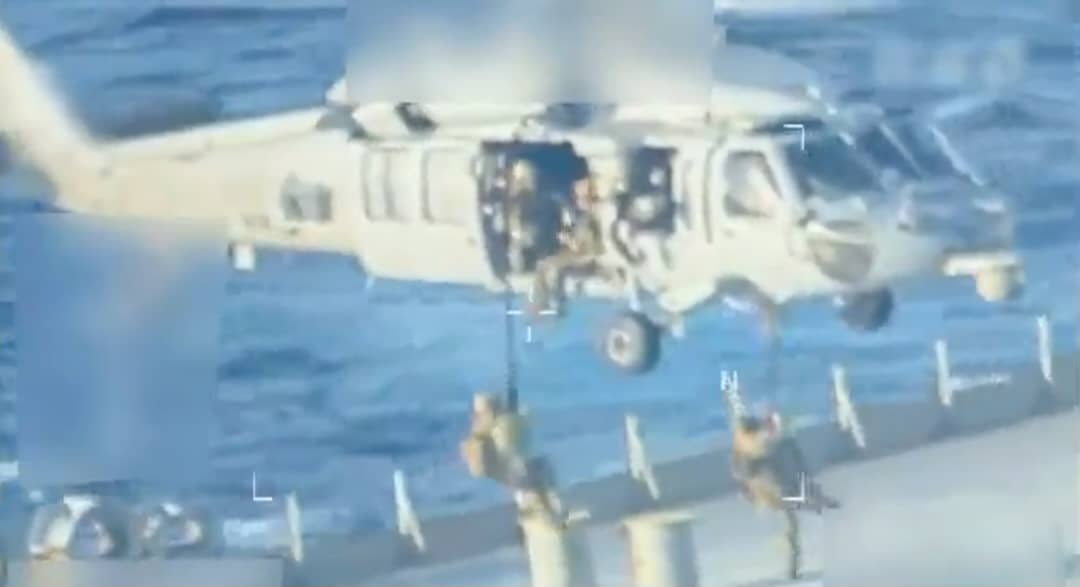
Shortly before dawn, Night Stalker helicopters approached the Marinera through the darkness. SEALs fast-roped onto the deck and within minutes the tanker was under American control. U.S. European Command described the action as a law enforcement operation executed under a federal court warrant for violations of U.S. sanctions law.
Russia’s Transport Ministry confirmed it had lost all contact with the vessel following the boarding, condemning the action as a violation of freedom of navigation. The Russian Foreign Ministry demanded the humane treatment and immediate return of Russian nationals aboard.
U.S. Defence Secretary Pete Hegseth declared: “The blockade of sanctioned and illicit Venezuelan oil remains in FULL EFFECT — anywhere in the world.”
In a striking detail, the Marinera was carrying no oil at all — its holds were entirely empty. Hours after the seizure, U.S. Southern Command announced the simultaneous interception of a second vessel, the M/T Sophia, found in the Caribbean Sea carrying approximately two million barrels of Venezuelan crude.
Aftermath: Scotland, the Crew, and a Captain in Custody
After the seizure, the Marinera was moored on January 13 in the Moray Firth, northeastern Scotland — a port call Scotland’s First Minister said he had received no advance warning of. London explained the stop was for humanitarian purposes: restocking supplies for the crew. Of the 26 crew members aboard, five voluntarily travelled to the United States; the remainder were allowed to return to their home countries. By January 28, Russia confirmed two of its sailors had been released and were en route home following Moscow’s diplomatic intervention.
The ship’s captain — Avtandil Kalandadze, a Georgian national — and his first officer faced a sterner outcome. On January 27, both were transferred to the USCGC Munro and placed in U.S. custody for transport to America to face criminal prosecution. The move immediately triggered a legal challenge: Kalandadze’s wife filed an emergency petition before Edinburgh’s Court of Session, and a Scottish judge issued an interim order prohibiting his removal. The United States proceeded with the transfer regardless — overriding the Scottish court’s ruling, a decision that drew sharp criticism and raised pointed questions about the limits of American unilateral power even within allied jurisdictions.
The Marinera itself was taken to the United States to undergo judicial forfeiture proceedings, through which Washington will seek permanent legal title to the vessel.
Operation Southern Spear: The Bigger Picture
The Marinera seizure formed part of a sweeping campaign called Operation Southern Spear, launched in December 2025 to dismantle Venezuela’s oil export infrastructure. The operation’s most dramatic development came on January 3, 2026, when U.S. forces seized Venezuelan President Nicolás Maduro — a move that sent shockwaves through Latin America and accelerated the flight of tankers from Venezuelan ports. Intelligence sources reported that at least 16 tankers fled Venezuelan waters within 48 hours of Maduro’s capture, many disabling their AIS systems to evade the maritime quarantine.
The scramble proved largely futile. U.S. officials confirmed that 15 of the 16 vessels were already under prior sanctions, and at least six carried a combined estimated cargo of nearly nine million barrels of crude. By March 2026, Venezuela’s crude exports had declined sharply. Secretary of State Marco Rubio described the “tremendous leverage” Washington now held over Venezuela’s oil sector, and the President announced that Caracas had agreed to hand over between 30 and 50 million barrels of sanctioned oil to the U.S. government.
What the Marinera Case Means for Nigeria and West Africa
The Marinera affair carries direct and immediate implications for Nigeria and the broader West African maritime domain.
Nigeria, as Africa’s largest oil producer, operates a significant tanker fleet and has long faced the challenge of distinguishing legitimate commerce from illicit maritime activity in its coastal waters. The U.S. campaign against shadow fleet operators demonstrates that the international community now deploys sophisticated tools — AIS analytics, satellite surveillance, multi-agency intelligence fusion, and cross-border law enforcement coordination — to track and interdict sanctions-evading vessels.
Nigeria’s maritime security authorities — including the Nigerian Maritime Administration and Safety Agency (NIMASA) and the Nigerian Navy — would be well served to study the Marinera case closely and assess how such enforcement architecture could be applied in the Gulf of Guinea, where illicit bunkering, cargo theft, and flag-of-convenience abuse remain persistent threats.
Equally significant are the reputational and legal risks now confronting any Nigerian-linked shipping entity — whether operator, charterer, flag state, or port of call — that facilitates the movement of illicit oil cargoes. As the United States demonstrates its readiness to enforce sanctions far beyond the Western Hemisphere, companies and states that enable shadow fleet operations face the real and growing prospect of secondary sanctions, vessel seizures, and criminal prosecution.
A New Era of High-Seas Enforcement
The seizure of the Marinera marks a genuine turning point in the enforcement of international oil sanctions. For decades, shadow fleet operators exploited the legal complexity of high-seas jurisdiction, the opacity of ship registries, and the reluctance of major powers to conduct overt operations against commercial vessels. The Marinera seizure signals that Washington, under the current administration, is prepared to break those informal conventions — regardless of which flag a vessel is flying or which power is flying it.
An aging, rust-streaked tanker that began its fateful voyage in Iranian waters in early 2025 ended it at the foot of a Navy SEAL fast-rope line in the freezing North Atlantic, watched by submarines, warplanes, and a global audience.
As of March 2026, the Marinera remains in U.S. custody pending judicial forfeiture. Captain Kalandadze and his first officer await trial. Operation Southern Spear continues — more tankers seized, more cargoes confiscated, and Washington showing no signs of easing its maritime pressure.
For Nigeria’s shipping community, the message is clear: the age of consequence-free shadow fleet participation may be coming to an end.
Oghenewoke Osaweren is a Research Reporter for WaterwaysNews.ng. Additional reporting by the WaterwaysNews.ng Investigative Desk.
WaterwaysNews.ng | Nigeria’s Leading Maritime News Platform | March 25, 2026
Nigeria’s $997m Port Overhaul: Apapa, Tin Can Get First Systemic Upgrade in 50 Years
UK-backed modernization deal promises to end decades of delay, corruption, and cargo gridlock at Lagos’s twin maritime gateways
By Raymond Gold | Co-publisher & Research Reporter, Waterways News | Lagos
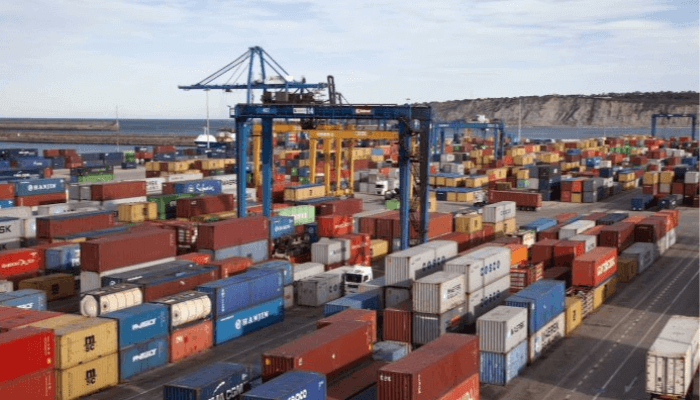
For decades, Nigeria’s two principal maritime gateways — Apapa and Tin Can Island Ports — have functioned less like engines of national growth and more like monuments to bureaucratic stagnation. The air over the Lagos lagoon has long carried the mingled scent of saltwater, diesel, and the quiet frustration of thousands of containers trapped in endless manual clearing loops. A new tide, however, is finally coming in.
The Federal Government has signed a £746 million ($997 million) port modernization agreement with the United Kingdom government, marking the first comprehensive overhaul of these facilities in nearly half a century. Backed by UK Export Finance (UKEF) and coordinated by Citibank, the deal goes far beyond cosmetic improvements. It targets the wholesale replacement of 1970s-era infrastructure with 21st-century automation systems.
Breaking the Bottleneck
At the heart of the agreement is the integration of a National Single Window (NSW) platform and the full digitalisation of cargo tracking — twin mechanisms designed to eliminate what maritime insiders have long called the “invisible taxes” on Nigerian trade: demurrage charges and institutionalized corruption. Together, these hidden costs inflate the price of everything from imported medicine to locally manufactured textiles.
As automation slashes vessel turnaround times from weeks to mere days, the cost of doing business through Nigerian waters will, for the first time, begin to align with global standards. The ripple effects are expected to be felt across the entire economy.
Jobs, Local Capacity, and the Human Capital Dividend
Beyond the docks, the project is being positioned as a major driver of skilled employment. Thousands of jobs in engineering, data management, and port operations are projected to be supported. Critically, the deal ensures that Nigerian firms remain central to delivery: local companies including Hitech Construction and ITB Nigeria are embedded in the project structure, ensuring that while the financing is international, the expertise — and the economic returns — remain domestic.
Reclaiming West Africa’s Maritime Crown
For Nigeria’s maritime sector, the geopolitical stakes are equally significant. For years, shipping traffic has detoured to regional rivals — Cotonou Port in Benin and Lomé Port in Togo — driven away by the notorious delays at Lagos. The new infrastructure efficiency is expected not only to reclaim that lost cargo volume but also to generate a meaningful boost in non-oil customs revenue at a time when diversification of government income remains a national priority.
For a country that has set its sights on a $1 trillion economy, the maritime sector can no longer afford to remain a passive gatekeeper. With the right infrastructure in place, industry analysts believe it holds the potential to rival the oil sector in its GDP contribution.
The Roads and Rails Question
Yet experts caution that a modern port is only as good as the transport corridors feeding into and out of it. The Nigerian Railway Corporation (NRC) and the Federal Ministry of Works face urgent pressure to ensure that cleared cargo can move seamlessly inland without being strangled by the same road congestion that has historically undermined port efficiency. A jet engine, as one industry observer put it, cannot be mounted on a wooden cart.
Similarly, while the current focus centres on the Lagos axis, the standard set by this landmark agreement must eventually extend to the Eastern Ports — Port Harcourt, Warri, and Calabar. Decongesting Lagos demands a national logistics strategy, not merely a city-level intervention.
Policy as the Operating System
Success ultimately hinges on more than hardware. Stakeholders are pointing to the National Policy on Marine and Blue Economy as the critical “software” that must run alongside the new physical infrastructure being installed at Apapa. That means building a culture of transparency in which digital tracking systems are shielded from human interference — where a container can be monitored from the moment it departs a UK port to the moment it arrives at a warehouse in Kano, with no bribe changing hands anywhere along the chain.
When that benchmark is achieved, industry watchers say, the modernization will have truly succeeded.
The Dock We Should Have Built Years Ago
After five decades of near-stagnation, Nigeria’s maritime sector stands at an inflection point. If the government successfully aligns this financial investment with structural integrity and consistent policy enforcement, the nation will not merely be clearing containers — it will be clearing the path to a new era of economic prosperity.
For too long, the country waited for its ship to come in, only to realize it had not built a dock capable of receiving it. That construction, at last, has begun.
Chief Raymond Gold is Co-publisher and Research Reporter for Waterways News. He sent in this piece as a public affairs analyst following the recent news of the Nigeria Government £746 million ($997million) deal with the UK Government to modernize the ports in Lagos.
Blog
SWAAADO Intensifies Waterways Safety Sensitization Campaign to Waterfront Communities in Lagos State.
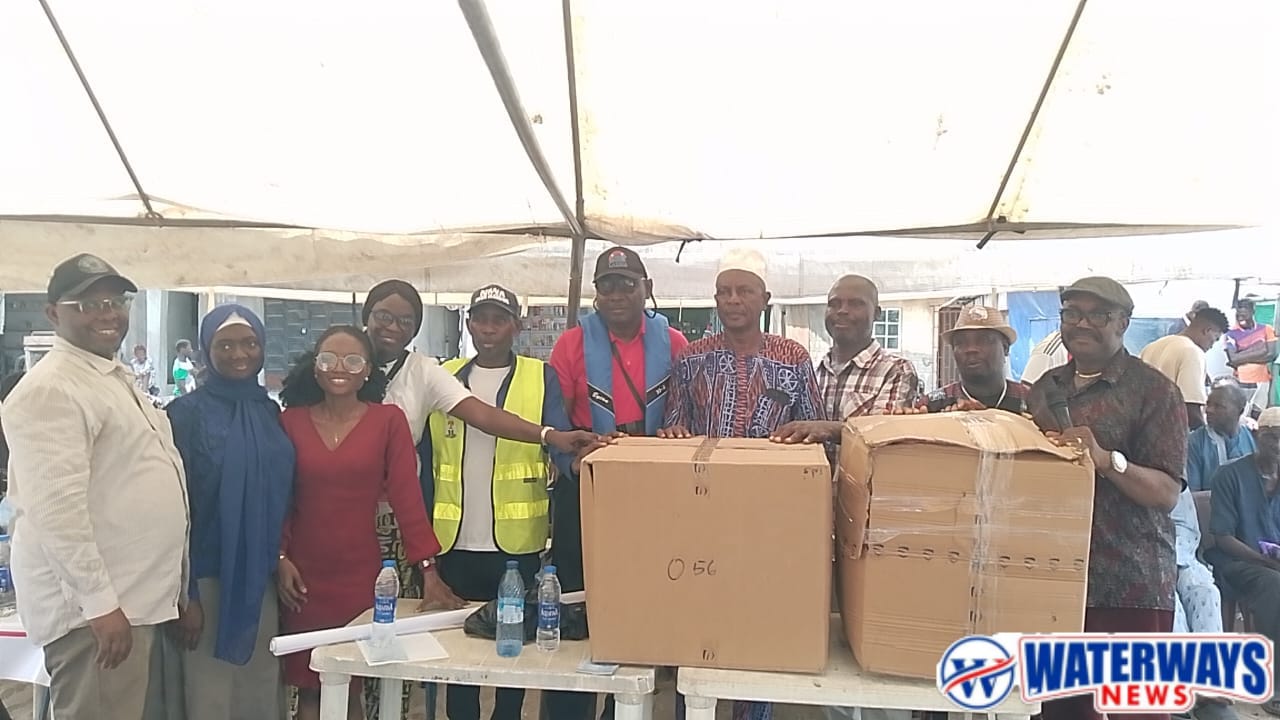
SWAAADO Intensifies Waterways Safety Sensitization Campaign to Waterfront Communities in Lagos State.
130 Persons, Including Boat Drivers, Fishermen, Community Leaders and Everyday Waterway Users, Participate as Organization Plans Free Training and Licensing for Boat Skippers
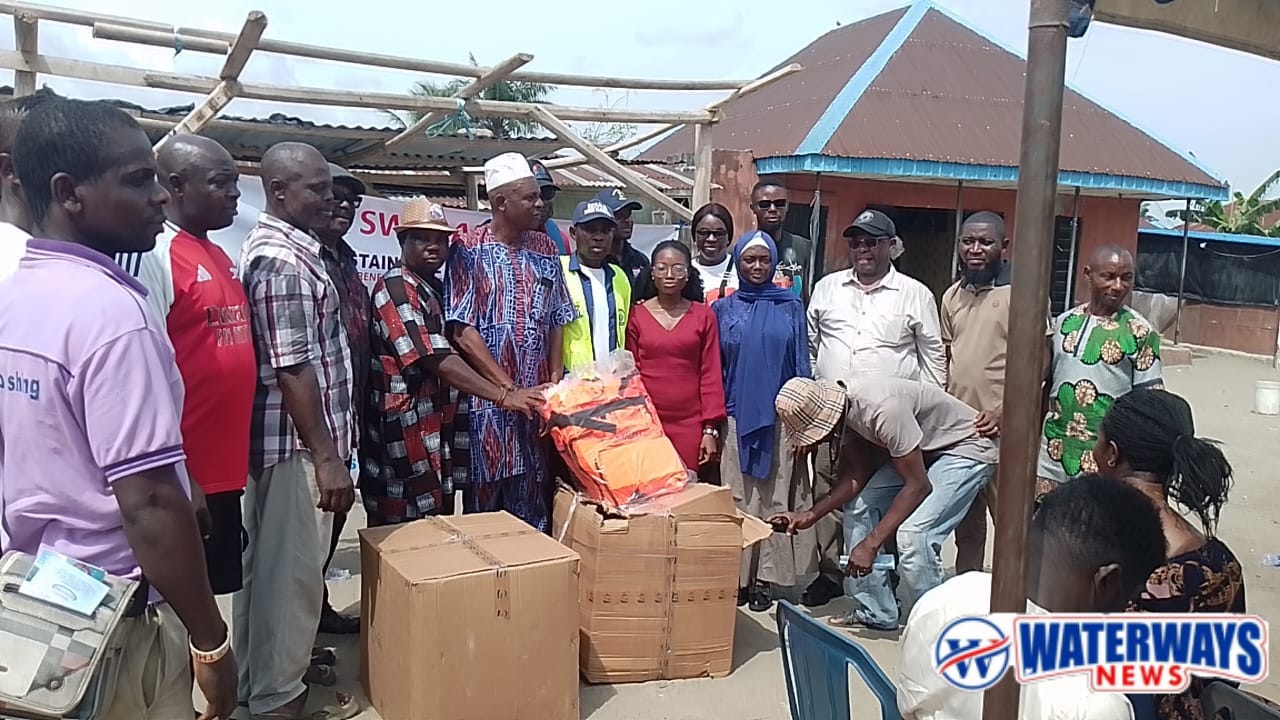
Thursday 12th of February 2026, Amuwo-Odofin, Lagos State
Sustainable Waterways Awareness Advancement and Advocacy Organization (SWAAADO), has expanded its ongoing waterways safety sensitization campaign to three communities on Onisiwo Island in Onisiwo Kingdom, Amuwo-Odofin Local Government Area of Lagos State.
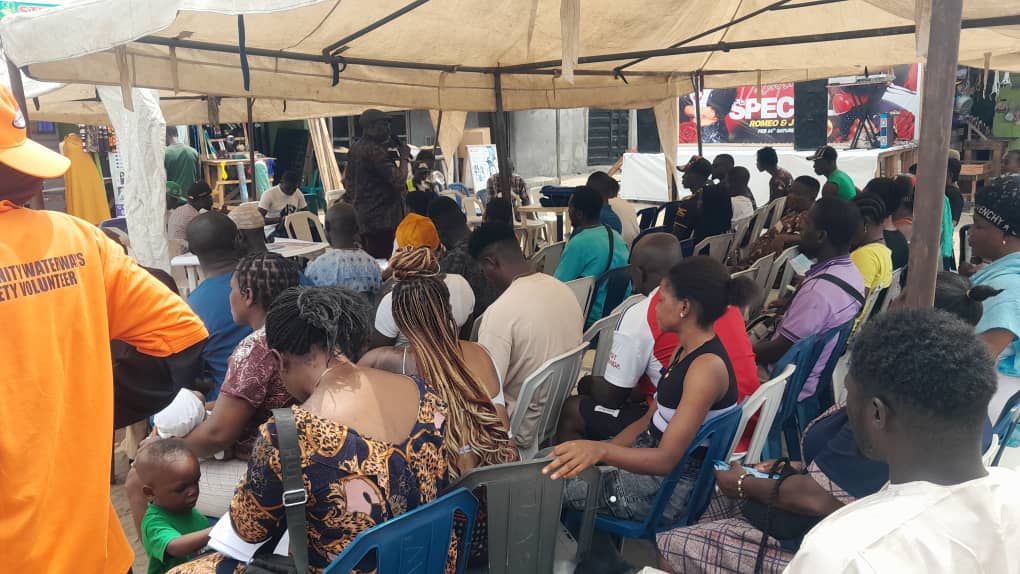
The comprehensive safety awareness program, which covered Ilufemiloye, Irede, and Igbayilola Tie-Gate Communities, attracted 130 participants comprising boat users, fishermen and boat skippers who engaged in robust discussions on waterways safety understanding and knowledge.
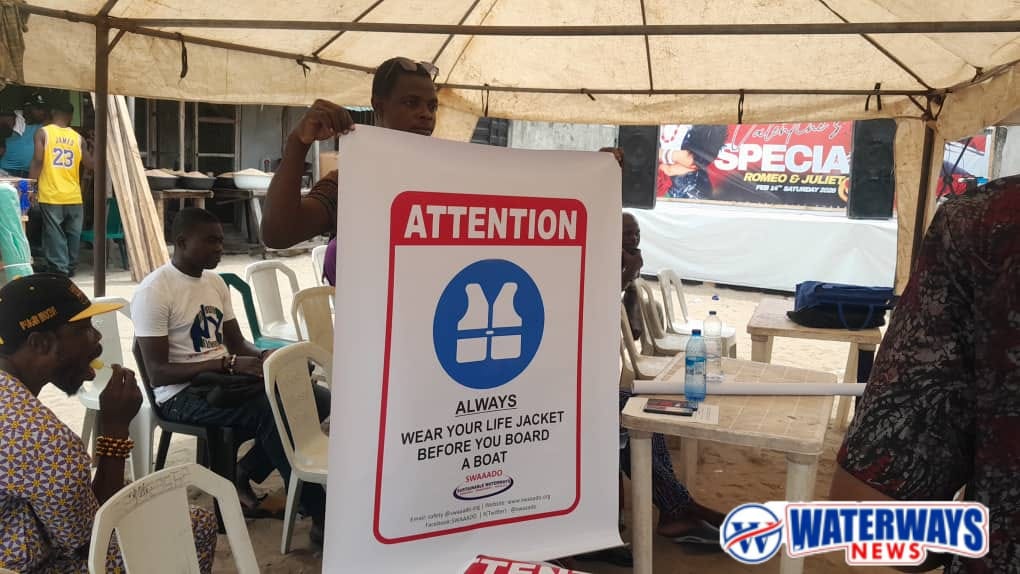
Chief Emmanuel Omotayo, the Baale of Ilufemiloye Community, who attended the occasion, expressed satisfaction with the initiative, noting the visible joy on the faces of community participants. “We need more of this sensitization campaign in our kingdom,” the community leader stated.
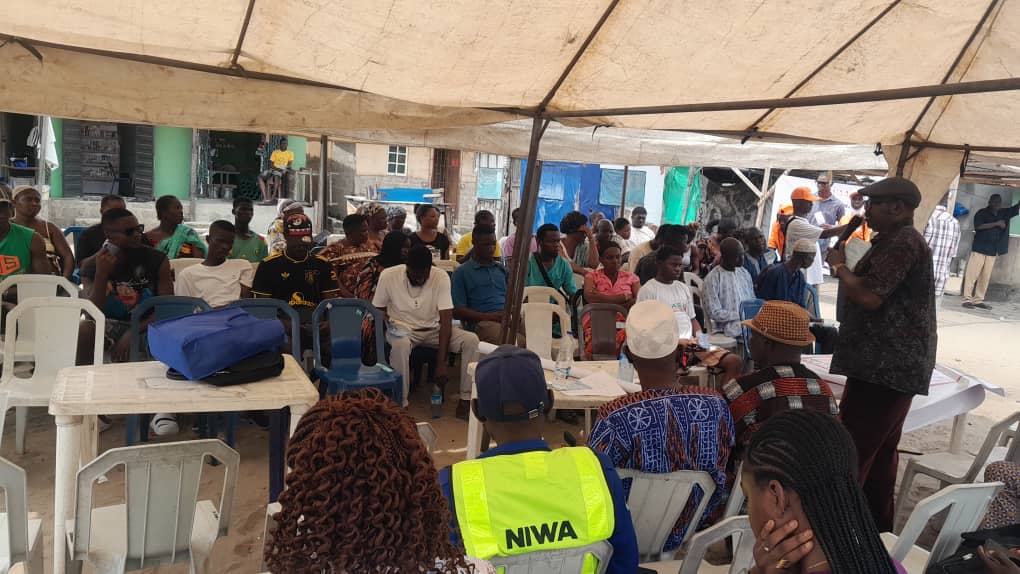
Comprehensive Safety Education
Chief Raymond Gold, SWAAADO’s Head of Desk, Corporate Communication and Strategy, took participants through an extensive waterways safety sensitization program, educating them on critical safety measures required when boarding and disembarking from boats.
Chief Gold unveiled SWAAADO’s ambitious plans for waste management in waterfront communities, emphasizing the detrimental effects that the dumping of household waste on our waterways, could have on aquatic life. He also announced the organization’s groundbreaking initiative to provide free training and licensing for boat skippers while listing them on SWAAADO’s Nigeria Waterways Directory platform – a move designed to bring boat operators into the oversight framework of maritime regulatory agencies.
Partnership for Seamless Training
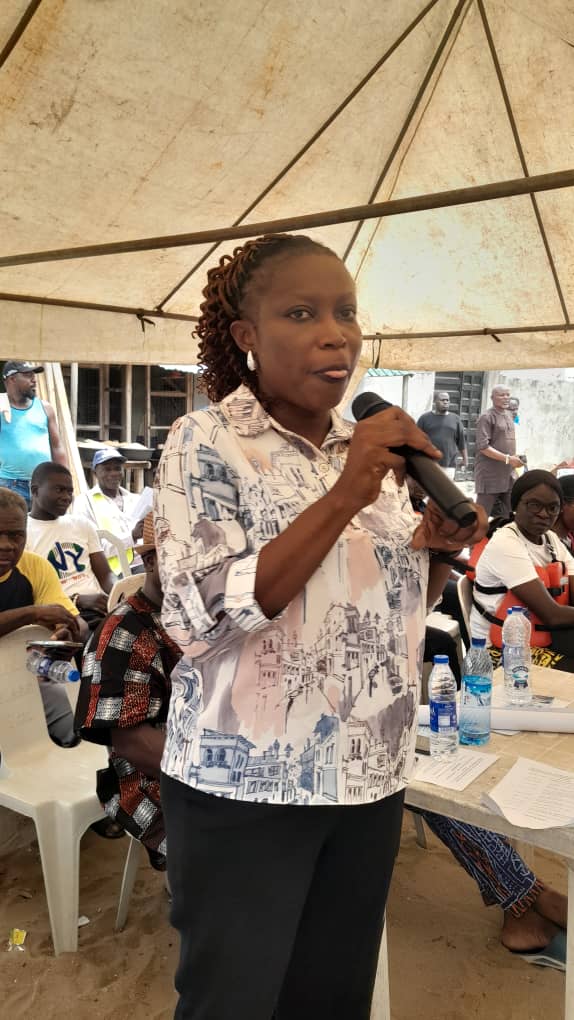
Mrs. Ada Okpanige Agbo, representing SWYRE Marine, a NIMASA-accredited training institution, gave details on the need for every boat skipper to be trained and licensed urging participants to avail themselves of the opportunity that SWAAADO provides. She confirmed that SWYRE Marine has partnered with SWAAADO to ensure seamless training and licensing of boat skippers.
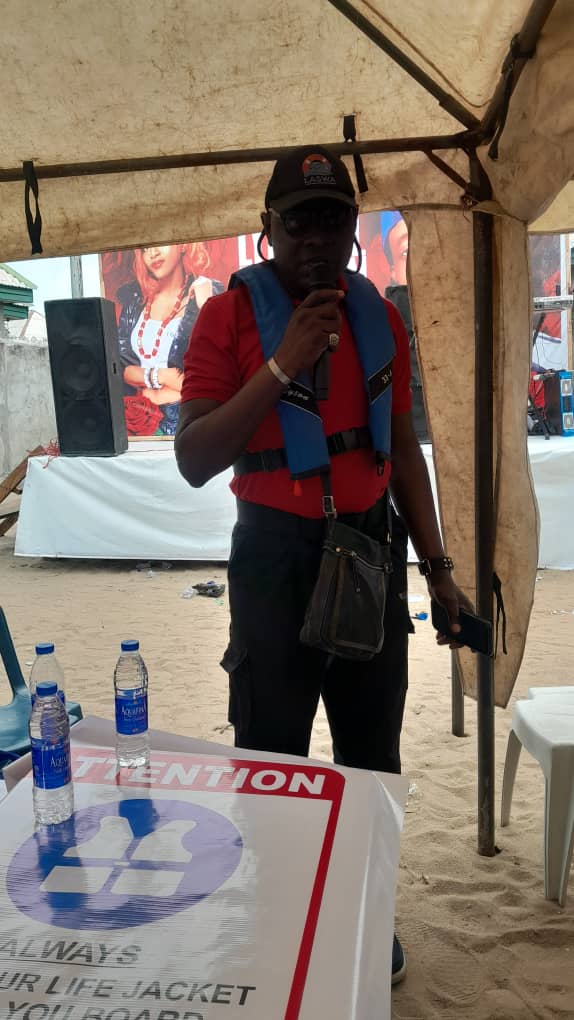
Engr. Shittu Oladimeji of the Lagos State Waterways Authority (LASWA) stressed the importance of constant safety consciousness while highlighting the agency’s ongoing efforts in sensitizing waterways users about safety compliance. He announced LASWA’s readiness to support community waterways safety volunteers and requested the compilation of names for official registration and training in preparation for engagement
Industry Stakeholders Endorse Initiative
Comrade Osaweren O. Larry, representing the Lagos Commercial Private Boat District of the Maritime Workers Union of Nigeria, described the SWAAADO’s Nigeria Waterways Directory concept as “a game changer” in the nation’s waterways industry. He noted that the platform would would instil discipline in the sector by listing all stakeholders with verifiable data and providing mechanisms to blacklist erring participants.
“The burden of safety on our waterways is a shared responsibility,” Larry emphasized, calling on regulatory agencies to partner with SWAAADO in addressing major challenges facing the maritime sector.
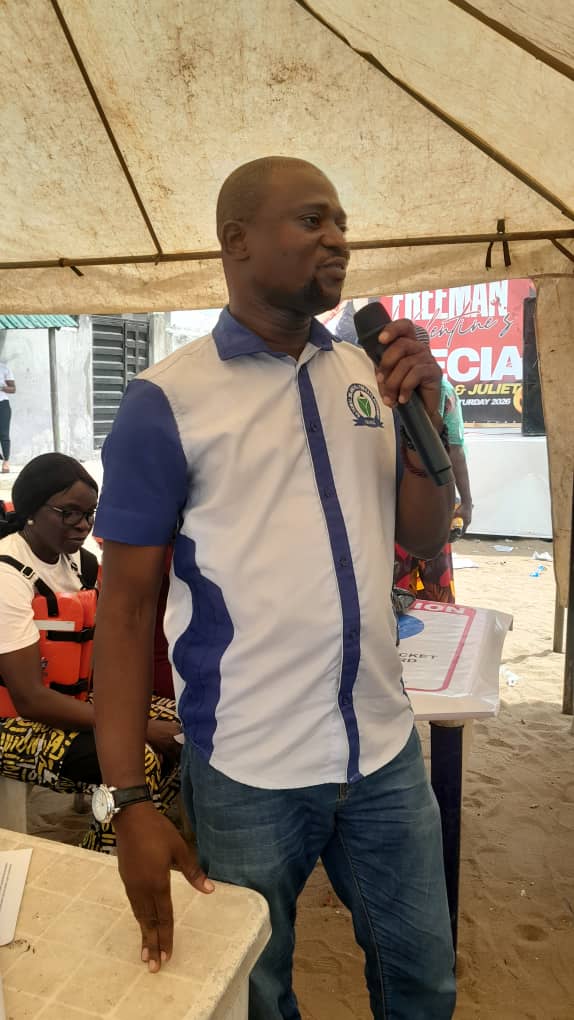
Engr. Gimada of the National Inland Waterways Authority (NIWA) delivered what observers described as a fantastic safety message, further reinforcing the importance of waterways safety education.
Chief Femi Alade, the Baale of Irede Community, also addressing the gathering, advising both passengers and boat skippers to maintain safety consciousness at all times.
Life Vests Distribution
The sensitization campaign ended with the distribution of life vests to the two jetties serving the three communities, providing essential safety equipment to enhance passenger protection on the waterways.
SWAAADO’s waterways safety campaign is supported by Simtop International Limited, Best-Time Global Logistics and Solutions Ltd., Waterways Integrated Synergy Limited, and SWYRE Marine, whose collective commitment continues to drive safety awareness across Lagos State waterfront communities.
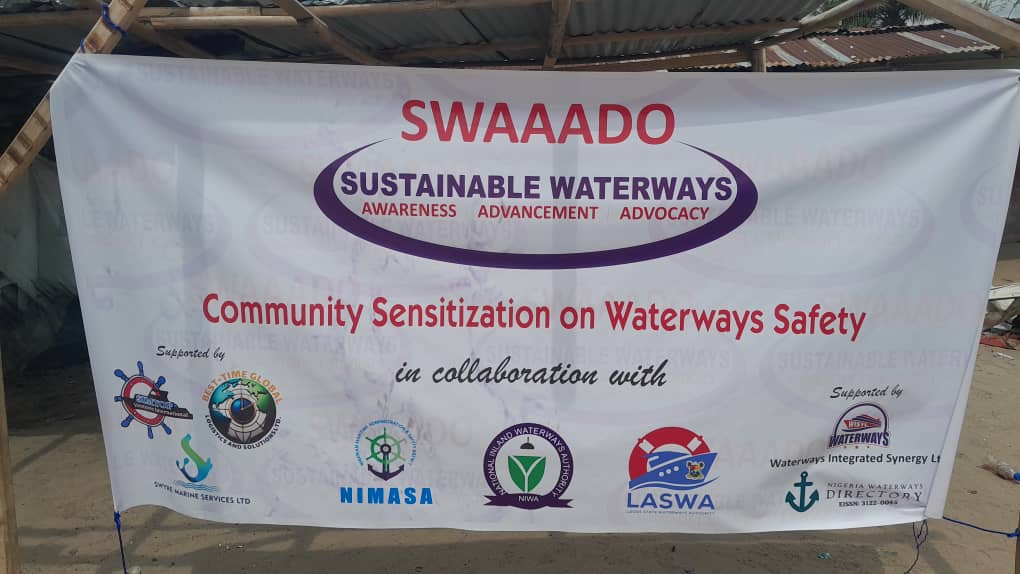
The organization’s multi-faceted approach – combining education, free training, licensing, and regulatory integration – represents a comprehensive strategy to enhance safety standards and formalize operations in Nigeria’s inland waterways sector.
*For more information about SWAAADO’s waterways safety initiatives and upcoming training programs, community members and boat operators are encouraged to contact the organization through its official channels.*
-

 Oil and Gas4 weeks ago
Tantita’s Pipeline Deal: $144m Contract, Rising Output, and the Questions that Deserve Answers
-
 Blue Economy2 months ago
Nigeria’s Coast Guard Bill: A Solution in Search of a Problem?
-
 Business1 month ago
CASABLANCA PORT SHUT DOWN AFTER VESSEL LOSES 85 CONTAINERS — SHIP SERVES NIGERIAN ROUTES