Blog
The Trucks Choke on Nigeria’s Ports: The Case for an Intermodal Transport Revolution

The Trucks Choke on Nigeria’s Ports: The Case for an Inter-modal Transport Revolution
By Raymond Gold Co-publisher and Research Reporter| Waterways News | Lagos
Nigeria is sitting on one of Africa’s most expansive inland waterway networks — yet barges carry barely seven per cent of the cargo moving in and out of its seaports, while trucks haul more than 90 per cent. That glaring imbalance is now costing the country billions of naira annually in congestion losses, road deterioration and eroded trade competitiveness.
The scale of the missed opportunity is thrown into sharp relief by the Nigerian Ports Authority’s 2025 Operational Performance Report, which showed cargo throughput surging by 24.8 per cent last year, with container traffic rising 25.7 per cent to surpass 2.1 million twenty-foot equivalent units (TEUs). The boom in maritime trade has piled even more pressure onto an already overstretched road network — with trucks bearing virtually the entire burden of moving cargo to and from the ports.


A Structurally Broken System
The International Maritime Organisation (IMO) has long advocated seamless integration of inland waterways, rail and road transport as the gold standard for port efficiency and hinterland connectivity. Nigeria’s reality falls far short of that vision.
Industry data compiled by the Sea Empowerment and Research Centre (SEREC) paints a stark picture: between 90 and 95 per cent of port cargo leaves by road, seven per cent via barge, and just five per cent by rail. The result, SEREC warns, is chronic port congestion, inflated logistics costs, rapid road degradation and a steady loss of regional trade competitiveness.
“An efficient intermodal transport system is critical to maritime trade facilitation, economic growth, and regional competitiveness,” said Dr Eugene Nweke, Head of Research at SEREC, in a policy advisory paper titled Reviving Nigeria’s Intermodal Transport System for Efficient Maritime Trade. “In Nigeria, however, the disconnect between seaports and inland logistics networks continues to undermine trade efficiency.”
The problem is structural. Nigeria’s three busiest cargo gateways — Lekki Port (40.6 per cent of national throughput), Apapa Port (26.7 per cent) and Onne Port (19.1 per cent) — have no functional rail connections. Even at Apapa, where a rail line exists, the overwhelming bulk of cargo evacuation still happens by road. Inland waterways, despite Nigeria’s vast potential, remain largely untapped.
The Waterways Opportunity
Nigeria’s waterway network links approximately 22 states — a natural freight corridor that remains almost entirely idle for commercial cargo movement. The Sunday Ademuyiwa, Director of International Trade at the Maritime Researchers and Authors Association of Nigeria (MARASSON), says this is a strategic asset that the country is squandering.
“Given Nigeria’s heavy dependence on maritime imports, improving intermodal connectivity is essential to unlocking economic growth,” Ademuyiwa said. “Inland waterways, which could serve as a viable alternative for cargo movement, remain largely underutilised despite Nigeria’s vast potential. With about 22 states interconnected by waterways, improved investment in water transport could ease pressure on roads and enhance logistics nationwide.”
He warned that persistent port congestion delays shipments, drives up logistics costs and disrupts supply chains — with cascading consequences for businesses and consumers across the country.
The Cost of Inaction
The economic toll is significant. SEREC estimates that high inland transport costs inflate commodity prices, reduce Nigeria’s export competitiveness and are increasingly driving cargo diversion to neighbouring ports with better logistics infrastructure. Nigeria, the research centre warns, is losing billions of naira annually to inefficiencies and delays.
Haruna Omolajomo, Managing Director of HARSECOM Logistics Limited, points out that Apapa and Tincan Island ports together handle over 70 per cent of Nigeria’s imports and exports, generating more than N5 trillion in annual Customs revenue. Yet investment in the infrastructure serving these ports has failed to keep pace.
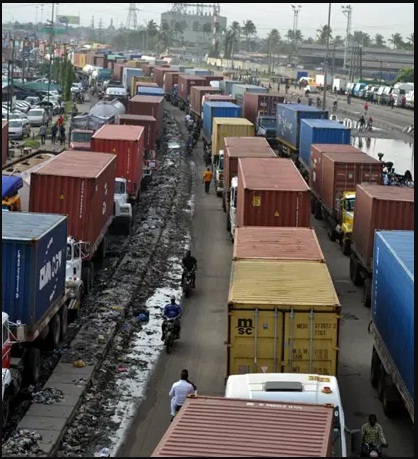

Trucks returning empty containers to the port spillover into the roads in Lagos
“This is very sad,” Omolajomo said. “With these finances, the federal government is still finding it difficult to take even N1 trillion to improve its infrastructure.”
What Must Change
Experts are calling for a phased multimodal reform agenda. SEREC recommends that immediate action — within three years — should include mandatory rail connectivity to all major ports, targeted incentives to grow barge operations on Nigeria’s inland waterways, and the activation and integration of inland dry ports.
Over the medium term (three to seven years), the recommendations include liberalising rail freight, implementing a national single window logistics system, and developing integrated cargo corridors. The long-term goal is a fundamental rebalancing of Nigeria’s freight modal split: 50–60 per cent road, 25–30 per cent rail, and 15–20 per cent waterways.
Crucially, realising the waterways component of that ambition will require urgent action on safety and security. Omolajomo says the National Inland Waterways Authority (NIWA) and the Nigerian Maritime Administration and Safety Agency (NIMASA) must step up patrols and enforce order on Nigeria’s waterways to make barge operations viable for commercial cargo.
“The railway system must be revamped to connect all ports in Nigeria to stimulate a multimodal transport system,” he said. “The same applies to the use of standard barges and tugboats. Security must be provided by NIWA and NIMASA to make our waterways safe and secure. Maritime regulators must do their jobs adequately.”
The Bottom Line
Nigeria cannot afford to keep ignoring its rivers and creeks while trucks gridlock its ports and grind down its roads. With cargo volumes growing year on year and regional competitors investing heavily in multimodal logistics, the window to act is narrowing. The waterways are there — what is missing is the political will and coordinated investment to put them to work.
Raymond Gold is Co-publisher and Research Reporter at Waterways News, Lagos.