Blue Economy
What Is the National Single Window?

Think of the National Single Window (NSW) as the express lane for global trade. Instead of juggling customs, ports, health, agriculture, and standards agencies one by one, traders step into a single digital doorway where everything connects. It’s like turning a maze of paperwork into a streamlined highway.
Around the world, countries are adopting NSWs not just for convenience, but to meet the WTO’s Trade Facilitation Agreement — a push toward transparency, speed, and modern border management. In practice, this means fewer delays, less duplication, and smoother movement of goods across borders.
By Bode Animashaun


Is It Yet Another Bureaucracy?
Far from it. The NSW is designed to eliminate bureaucratic friction, not add to it. Traditional trade systems often involve redundant paperwork, siloed databases, and slow inter-agency coordination. NSWs break down these silos by integrating digital workflows across government bodies.
For example, Singapore’s TradeNet, one of the earliest NSWs, reduced cargo clearance time from days to hours. Similarly, Nigeria’s Trade Modernization Project aims to digitize customs and port operations, with the NSW as its backbone.
Why Should It Be Embraced?
Key Benefits:
- Efficiency: Reduces clearance time and paperwork.
- Transparency: Minimizes corruption and improves accountability.
- Cost Savings: Cuts transaction costs for businesses and governments.
- Competitiveness: Enhances a country’s appeal to global investors and trading partners.
A study by the World Bank found that countries with NSWs experience a 15–25% reduction in trade transaction costs and a 30–50% improvement in clearance times.
Is It Needed at This Time?
Absolutely. In the wake of global supply chain disruptions, inflationary pressures, and the push for economic diversification, the NSW is more relevant than ever. For Nigeria, where port congestion and customs delays are common, the NSW could:
- Unlock export potential for agriculture and manufacturing.
- Support the African Continental Free Trade Area (AfCFTA) goals.
- Attract foreign direct investment through improved ease of doing business.
What Does It Promise for the Future?
The NSW is a cornerstone of smart border management and digital governance. Its future promises include:
- AI-powered risk profiling for faster inspections.
- Blockchain-based document verification to prevent fraud.
- Regional integration with neighboring countries’ NSWs for seamless cross-border trade.
Countries like Rwanda and Kenya are already exploring regional NSW interoperability to boost East African trade corridors.
What Could Disrupt Its Efficiency?
Despite its promise, several challenges could undermine NSW effectiveness:
- Poor digital infrastructure: System outages or slow internet can stall operations.
- Inter-agency resistance: Some bodies may resist data sharing or process harmonization.
- Cybersecurity threats: Centralized systems are attractive targets for hackers.
- Policy inconsistency: Frequent changes in trade regulations can confuse users and disrupt system logic.
Mitigating these risks requires strong leadership, stakeholder buy-in, and continuous system upgrades.

Final Thoughts
The National Single Window is not just a technical upgrade—it’s a strategic enabler of economic transformation. By embracing it, countries like Nigeria can leapfrog legacy systems, boost trade competitiveness, and position themselves as leaders in digital governance.
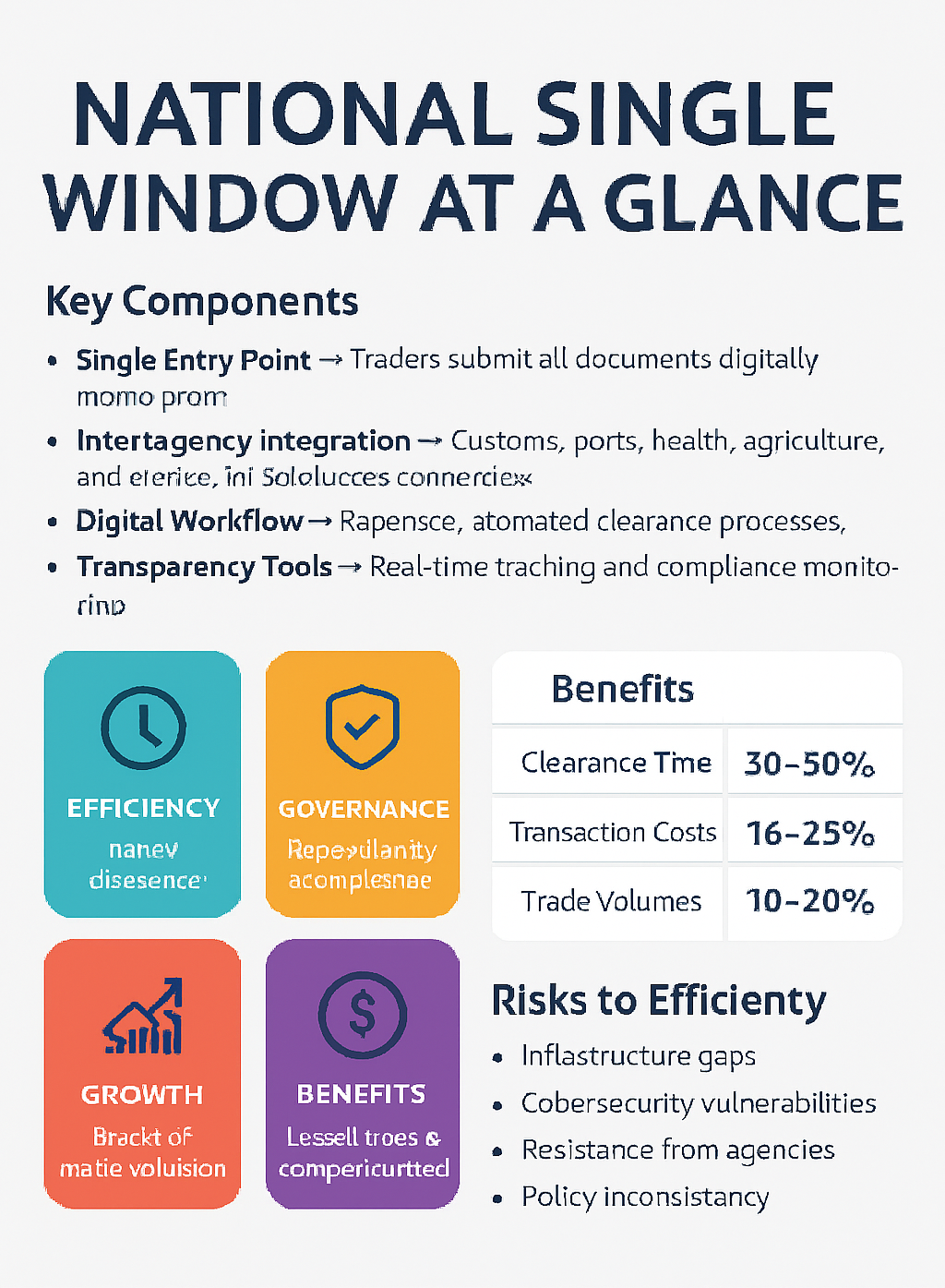
Infographic: National Single Window
Key Components
- Single Entry Point → Traders submit all documents digitally in one place.
- Inter-Agency Integration → Customs, ports, health, agriculture, and standards authorities connected.
- Digital Workflow → Paperless, automated clearance processes.
- Transparency Tools → Real-time tracking and compliance monitoring.
Benefits (Data-Driven)
| Benefit | Impact (Global Averages) |
|---|---|
| Clearance Time | Reduced by 30–50% |
| Transaction Costs | Lowered by 15–25% |
| Trade Volumes | Increased by 10–20% |
| Competitiveness | Improved Ease of Doing Business rankings |
Risks to Efficiency
- Infrastructure gaps (slow internet, outages)
- Cybersecurity vulnerabilities
- Resistance from agencies unwilling to share data
- Policy inconsistency across government departments