News
Ways to Ensure Waterways Safety in Nigeria Inland Waterways

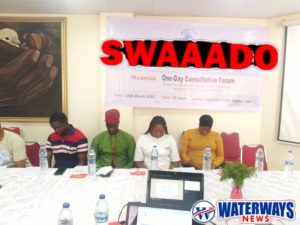
- A PAPER PRESENTED BY CHIEF RAYMOND GOLD, CO-FOUNDER AND CO-EXECUTIVE DIRECTOR OF SUSTAINABLE WATERWAYS AWARENESS, ADVANCEMENT AND ADVOCACY ORGANIZATION IN A STAKEHOLDERS FORUM HELD AT APAPA ON MONDAY THE 10TH OF MARCH 2025, TO SUGGEST IDEAS FOR THE SPECIAL MINISTERIAL COMMITTEE ON BOAT MISHAPS IN NIGERIA, SET UP BY THE FEDERAL MINISTRY OF MARINE AND BLUE ECONOMY, ABUJA.
INTRODUCTION:
In recent times, there has been an increase in the volumes of persons and goods being moved by water across our country Nigeria. One reason behind this increase is the pitiable state of some of our roads. Bad roads increase travel time.

To save time, citizens are gradually embracing water transport as an alternative for both interstates and intrastate travels. Again, within some states, many communities (waterfront communities) are accessible only by water. In such situations the citizens have no other options of travel other than through water.
This increase in water transport patronage, has come with its own challenges including safety challenges. Water transport comes with its own value chain. It include transport, leisure, (tourism) and Fishing (agriculture). Thus any attention paid to fix the challenges of our country’s waterways (including safety challenges), would have a ripple effect on its entire value chain.
The challenges of our waterways include safety, security, poor infrastructure, environmental challenges and more. All these challenges are intertwined and a holistic approach is the best in tackling them.
LOSS OF LIVES AND PROPERTY THROUGH BOAT MISHAPS:
A report published by the Leadership Newspaper sometime in November 2024, put the number of deaths as a result of various boat mishaps on our inland waterways between the year 2000 and 2024, at 1,428. The report also revealed that although, the northern part of our country has low water levels, it recorded the highest volume of casualties.
In the last quarter of 2024, over 200 lives were lost in boat mishaps on the waterways of Kwara and Niger States alone.


As a result of this, SWAAADO worked with WABOTAN, an association of boat owners and drivers, to look into the causes of the boat mishaps. Causative factors as revealed in this collaborative work, include, use of sub-standard boats to travel, poor boat maintenance, night sailing, none use of safety vests (life jackets) and the lack of safety awareness by the the drivers.
For example, findings reveal that out of over 200 passengers involved in the boat mishap that happened on the night of October 1, 2024 in Gbajibo Community, Mokwa Local Government Area of Niger State, over half of the passengers were without life jackets. That boat mishap claimed over a hundred lives.
CAUSES OF BOAT MISHAPS ON OUR INLAND WATERWAYS:
Causes of boat mishaps can be grouped into three, namely: Natural factors, Human factors and
Technical factors.
1. Natural Factors:
These include, strong waves and currents, wrecks and other stumps
on the causeway, piles of sand and silt building up mainly due to indiscriminate
dredging along the waterways that could grind a boat to a sudden halt and cause an
accident, Very bad weather that could affect visibility, and many others. In some
environments, big animals that live in water ( such as crocodiles, alligators, whales,
sharks, hippopotamus, etc, ) could also cause an accident
2. Human Factors:
Human factors includes overloading, night sailing without the necessary navigational equipment on the boats, reckless driving by the boat drivers, nonuse of life jackets or wrong use of same, lack of training and subsequently lack of safety awareness on the part of the captains and the crew, driving with faulty engines, etc. for example, in the accident that happened sometime in August 2024 in Bayelsa state, the engine was running out of fuel and the driver tried to put fuel into the engine without putting off the engine first.
This recklessness on the part of the driver led to a fire outbreak and an explosion that resulted in very severe injuries and loss of lives. Some training in basic safety on the part of the boat driver would have stopped such recklessness.
3. Technical Factors: Technical factors include substandard boats and engines, sudden
failure of engines midway into the journey, inadequate or outright nonexistence of
navigational aids, etc
SUGGESTED WAYS TO REDUCE BOAT MISHAPS ON OUR WATERWAYS:
We suggest the following ways to reduce the incidence of boat mishaps on our waterways.
1. Training and retraining including public sensitization amongst operators and other
stakeholders to build capacity towards safety: Training and retraining of drivers and
their deckhands on basic knowledge of waterways safety such as the type that
SWAAADO does regularly in Lagos in collaboration with WABOTAN, an association of
stakeholders in the water transport sectors.
The curriculum for this training include…rules of the road, basic firefighting techniques, basic first aid procedures such as administering CPR, how to embark and disembark, how to adorn the life jackets properly, etc. SWAAADO in collaboration with WABOTAN, has done this training
consistently in the past seven years.
Many of the operators in the water transport sector (especially out inland waterways) are very informal persons who couldn’t have gone to our maritime academy. This kind of training and workshops would equipped them with the basic knowledge they need to ensure safety in the cause of plying their trade and thus reduce boat mishaps on our waterways.
It also sensitizes the public to appreciate and embrace the use of safety vests such as the life jacket.
2. Regulations and Enforcement:
The regulatory agencies, NIMASA for our coastal waterways and NIWA for our inland waterways should be strengthened to enable them enforce safety regulations on our waterways. Boat drivers should be licensed according to the capacity of the boats they drive….. PDSC certification from NIMASA and the National Boat Drivers’ License from NIWA. Every boat on our waterways should be registered and licensed just as it happens with vehicles on our roads.
Agencies should also sit up to fine/punish offenders to serve as deterrent to others. Such efforts towards regulation and enforcement should be carried out in an inclusive manner involving stakeholders. Both the agencies and stakeholders can co-create a safety culture for our waterways that would in turn reduce boat mishaps and reduce the loss of lives and property that come with such accidents.
3. Government investment in Water Transport Infrastructures and Safety Vests:
The water transport sector is a very huge part of our country’s economy. It is part of a
value chain that boost tourism,(Nautical/Water Tourism) and Agriculture (fishing).
Any investment in this sector is worth it. Governments, both at the federal and state
levels, should invest in this sector through the provision of standard boats for
commercial use, providing standard jetties, etc. Standard life jackets are not cheap.
Some citizens may not be able to afford personal life jackets. Both states and the
federal government should make life jackets available at the jetties where citizens
board boats to travel.
4. MDAs to complement NIWA’s Efforts on our Inland Waterways: State government
should also set up agencies or departments within their various transport ministries
to work with NIWA to ensure safety on the waterways within their states. The job of
ensuring safety on our waterways is enormous and shouldn’t be left to NIWA alone.
Thank you.
Chief Raymond Gold
Tel: 09032140048
Co-founder and Co-Executive Director, SWAAADO