
News
Nigerian-owned Tug Boat Leo sinks off South Africa; Five Crew Members still Missing

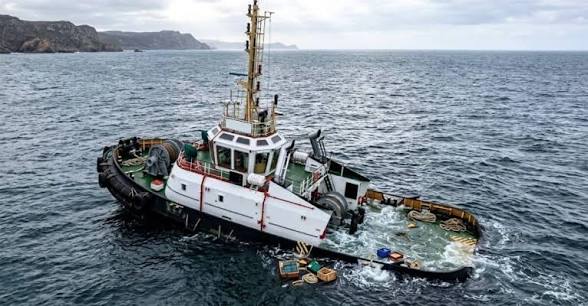

Nigerian-owned Tug Boat Leo sinks off South Africa; Five Crew Members still Missing
By Okeoghene Onoriobe | Waterways News Correspondent | Lagos
A Nigerian-owned tug boat, the Leo, has sunk approximately 80 nautical miles south of Mossel Bay, South Africa, following a distress incident that has left five crew members unaccounted for and one confirmed presumed dead.
The Maritime Rescue Coordination Centre (MRCC) Cape Town activated a search and rescue operation after the vessel transmitted a mayday distress call at 19:02 local time on 28 February 2026, reporting uncontrolled flooding and requesting urgent assistance. Cape Town Radio immediately relayed a mayday broadcast to alert nearby vessels to render assistance.

All 18 crew members aboard abandoned ship into four life-rafts before the tug went under in the early hours of 1 March 2026. To date, 13 of those crew members have been accounted for — 12 survivors and one presumed deceased. The search for the remaining five continues.
Two merchant vessels and a local fishing vessel have remained in the vicinity to assist with recovery efforts, while a helicopter has been deployed to provide aerial support across the search area. Adverse weather conditions have hampered operations, though authorities say all available resources are being utilised to locate the missing crew.
South Africa’s Search and Rescue Organisation (SASAR) has activated an Incident Management System to coordinate the ongoing response, aligning MRCC Cape Town, on-scene vessels, and relevant authorities.
SASAR has extended condolences to the family of the deceased and says further updates will be issued as confirmed information becomes available.
The incident raises fresh concerns about the safety of Nigerian maritime assets operating in international waters and the welfare of Nigerian seafarers serving on vessels far from home.
Waterways News will continue to monitor this developing story.


Peter Obi Open to Cross-Party Alliances, Puts People’s Welfare Above 2027 Politics
Labour Party’s 2023 presidential candidate signals readiness to work with any leader committed to Nigerians’ wellbeing — a posture with implications for maritime sector advocacy
By Ighoyota Onaibre
Peter Obi, the Labour Party’s 2023 presidential candidate, has declared that he is not fixated on the 2027 election cycle, saying his primary concern remains the deteriorating living conditions of ordinary Nigerians — and that he is willing to work with any political actor who shares that commitment.
Speaking in an interview on Noire TV, Obi struck a notably conciliatory tone, signalling a departure from the rigid partisan positioning that has characterised Nigerian opposition politics in recent years.
“I’m not preoccupied about the next election. I’m preoccupied with how the average Nigerian lives today,” Obi said, adding that the country’s persistent insecurity and economic hardship demanded urgent, collective attention beyond party lines.
On the question of political alliances, the former Anambra governor was direct: “I’m prepared to work with anybody who is talking about the care of the people.”
Nigeria Watch
What Obi’s stance means for the maritime and blue economy sector
For maritime stakeholders, port communities, and blue economy advocates, Obi’s remarks carry relevance beyond the electoral calculus.
The Nigerian maritime sector — encompassing ports, inland waterways, shipping, and coastal livelihoods — remains one of the most governance-sensitive segments of the national economy, yet one that routinely falls below the radar of mainstream political discourse.
Nigeria’s ports at Apapa and Tin Can Island continue to struggle with infrastructure decay, port access gridlock, and unresolved concession frameworks, while agencies including NIMASA, the NPA, and the Nigerian Shippers’ Council navigate overlapping mandates and chronic underfunding.
The Federal Ministry of Marine and Blue Economy, established under the current administration, has signalled ambitions for sectoral reform — but sustained political will, and cross-party consensus on maritime development, remains elusive.
Obi’s framing — prioritising people’s welfare over electoral positioning — echoes longstanding calls from maritime industry operators for a depoliticized approach to port governance and blue economy investment. Whether that rhetoric translates into a coherent maritime policy agenda, if and when Obi joins any formal political coalition, remains to be seen.
What is clear is that as Nigeria edges toward 2027, the country’s maritime communities — from fisherfolk in the Niger Delta to freight forwarders at Lekki Deep Sea Port — are watching to see which political voices will take the sector’s structural challenges seriously, and which will treat it as an afterthought.
Maritime Security and Safety
Navy Clamps 13-Hour Waterway Curfew on Calabar-Oron Channel Amid Kidnapping Surge
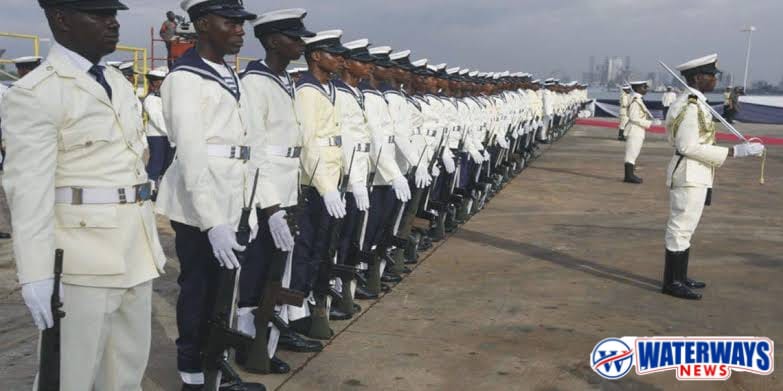
Navy Clamps 13-Hour Waterway Curfew on Calabar-Oron Channel Amid Kidnapping Surge
NNS Victory, FOB Ibaka mount joint raids; militant hideout demolished, suspect in custody
By Okeoghene Onoriobe| Waterways News Correspondent
The Nigerian Navy has imposed a 13-hour daily movement restriction on all maritime traffic along the Calabar waterways, banning vessel operations between 6:00pm and 5:00am, as part of an intensified counter-kidnapping campaign targeting criminal networks operating along the Calabar-Oron channel.
The development was disclosed in an official statement by Lt.-Cdr. Suleiman Bala, Public Affairs Officer of the Nigerian Navy Ship (NNS) Victory, based in Calabar, Cross River State.
According to Bala, the curfew — which permits maritime activity only during daylight hours — is a direct operational response to a recent spike in kidnappings along one of Nigeria’s busiest cross-state waterway corridors. The channel, linking Cross River State to Akwa Ibom, serves as a critical passage for riverine communities, commercial boat operators, and fishing vessels.
New Security Outpost at Peacock Crossing
Beyond the movement restriction, the Navy has established a permanent security outpost at Idung I, commonly known as Peacock Crossing, on the island in Cross River State. Bala said the outpost was strategically sited to enable naval personnel to monitor creek activities in real time and deny militants freedom of movement.
In a series of coordinated operations, NNS Victory and Forward Operating Base (FOB) Ibaka conducted raids on fishing settlements at Dayspring Island. Naval authorities said suspected militant elements fled on sighting troops, prompting a subsequent joint clearance operation involving personnel from the Nigerian Army’s 13 Brigade.
“Troops maintained dominance over the creeks and adjoining waterways,” Bala stated, adding that the sustained military presence led to the discovery of a militant hideout linked to a suspect identified only as “Juju” in the Idung axis.
Upon the approach of naval operatives, the suspect fled, abandoning two engine-fitted boats which were seized. The hideout structure was subsequently demolished.
Informant Arrested, Under Interrogation
In a separate intelligence-driven operation, troops tracked and apprehended one individual identified as an informant embedded within the militant network. The suspect is currently in custody and undergoing interrogation, after which he is to be transferred to a relevant security agency for further investigation and prosecution.
Bala said that prior to the deployment of naval assets, militant groups had operated with near-total impunity in the area, conducting kidnappings and extorting riverine communities. He noted that the presence of troops has substantially degraded their operational capacity, pushing them deeper into the creeks and cutting off their logistics chains.
The Navy’s statement concluded with a firm commitment to sustain what it described as “an aggressive posture” until all undesirable elements within the creeks and communities are neutralised
Nigeria Watch
The curfew on the Calabar-Oron channel underscores a widening maritime security challenge that Nigerian authorities have long struggled to contain in the country’s southern waterways. While most attention on waterway insecurity has focused on the Niger Delta’s oil-producing states, the Calabar-Oron corridor — a vital artery for cross-state trade, passenger movement, and fishing — has increasingly come under pressure from criminal elements exploiting its creek-laced geography.
For the Nigerian maritime sector, the operational implications are significant. A daylight-only movement window of 13 hours effectively compresses the commercial window for boat operators, fishing communities, and inter-state water transport services, adding logistical cost and uncertainty to an already challenging operating environment.
NIMASA, which holds statutory responsibility for maritime safety and security coordination under the Suppression of Piracy and Other Maritime Offences (SPOMO) Act 2019, may need to assess whether the Calabar-Oron flashpoint requires a more structured inter-agency response — one that pairs kinetic naval operations with longer-term community engagement and economic alternatives for vulnerable riverine populations.
The Nigerian Navy’s resolve is evident; sustaining it will require resources, intelligence, and coordination across multiple security and regulatory bodies.
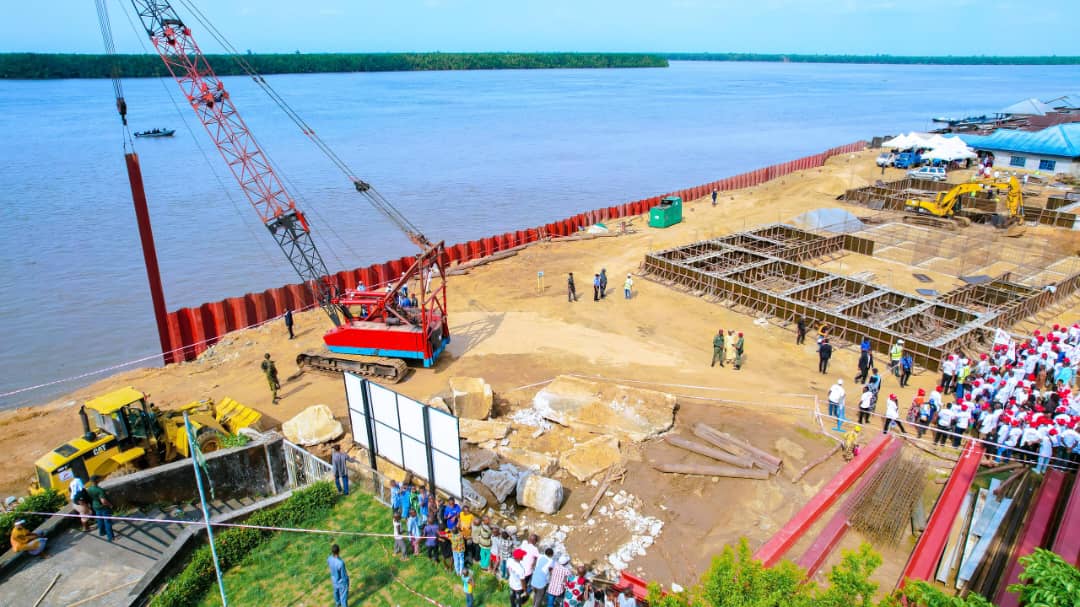
Oron Marine Hub: Akwa Ibom’s Bold Bid to Reclaim Its Waterfront Legacy
By Okeoghene Onoriobe, Waterways News Correspondent
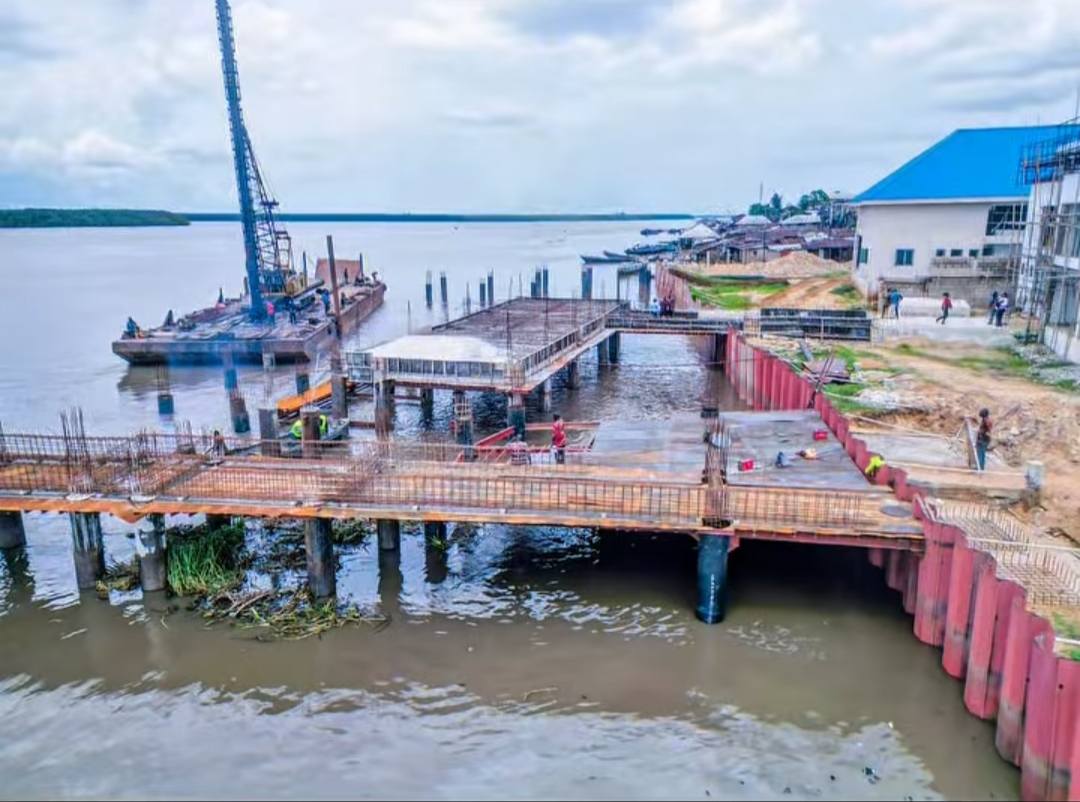
There is a certain quiet confidence building along the waterfront of Oron, the ancient coastal town that sits at the southeastern tip of Akwa Ibom State, where the Cross River empties into the Atlantic and where, for generations, fishermen and traders have made their living from the sea. That confidence has a name: the Oron Marine Hub — a sweeping, multi-component marine development project that, when completed, promises to fundamentally transform not just the physical landscape of Oron, but the economic fortunes of an entire coastal corridor in southern Nigeria.
Ongoing construction at the site signals that this is no pipe dream. For a town whose maritime heritage once made it one of the most strategically important waterfront communities in the Niger Delta region, the hub represents something long overdue: a structured, modern infrastructure investment that takes the sea seriously.
More Than a Jetty
It would be a mistake to describe the Oron Marine Hub simply as a jetty project. The development is taking shape as a fully integrated marine terminal and economic complex — one designed to simultaneously address the needs of passengers, cargo operators, fishermen, security agencies, tourists, and traders.
At its core are four modern jetties, purpose-built to accommodate different categories of vessels. Passenger boats, cargo craft, and security and patrol vessels will each have dedicated berths, ending the chaotic informality that has long plagued waterfront operations across the Niger Delta. Alongside these jetties, a central terminal building is under construction to manage the flow of passengers — providing proper ticketing infrastructure, waiting areas, and the kind of organized movement that modern marine transport demands.
For too long, Nigeria’s inland and coastal waterways have operated as an afterthought to road transport, underfunded and underserved. The Oron Marine Hub is a direct challenge to that status quo.
Logistics, Trade, and the Cold Chain
Perhaps the most commercially significant aspect of the project lies in its cargo and trade infrastructure. A network of warehouses and cargo handling facilities is being integrated into the hub, designed to support marine-based trade and logistics along the Akwa Ibom coastline and beyond.
But it is the inclusion of cold storage systems, dry storage units, and fish processing facilities that may prove most transformative for the local economy. Oron sits in one of Nigeria’s most productive fishing zones, yet for decades, post-harvest losses have eaten deeply into the incomes of artisanal fishermen who lack the infrastructure to properly store or process their catch. With these facilities in place, the hub will create a direct value chain — from catch to processing to market — that could significantly increase revenues across the fishing sector, reduce waste, and open new export possibilities.
For fishing communities in Oron, Ibeno, and the broader coastline, this is not a small detail. It is potentially life-changing.
A Recreational and Tourism Offer
The Oron Marine Hub is also being designed with an eye on tourism — a sector that Nigeria’s coastal states have chronically underinvested in, despite possessing some of West Africa’s most scenic and culturally rich waterscapes.
Plans include a recreational waterfront zone, complete with leisure spaces and floating facilities that will offer residents and visitors an experience currently unavailable anywhere along this stretch of the Akwa Ibom coastline. Waterfronts, when properly developed, become magnets for economic activity — drawing restaurants, hospitality businesses, boat hire services, and cultural tourism.
Oron has history on its side. Home to one of Nigeria’s oldest and most significant traditional museums — the Oron Museum — and with a cultural identity deeply tied to water, the town has the raw ingredients for a compelling tourism offer. The Marine Hub gives it the platform.
Built to Last: Shoreline Protection and Infrastructure
Development along Nigeria’s coastline carries inherent risks. Erosion, tidal surge, and the long-term effects of climate change are real concerns for any coastal infrastructure project. The developers of the Oron Marine Hub appear to have accounted for this, incorporating shoreline protection works into the design — a feature that will be critical to the facility’s long-term viability.
Supporting the terminal operations are internal road networks, dedicated parking areas, and security infrastructure — provisions that speak to the operational complexity of running a busy marine hub and the importance of ensuring safety and order within the facility.
Restoring the Corridors
Beyond its physical footprint, the Oron Marine Hub carries significant strategic weight. Analysts and transport observers have long noted that marine routes connecting communities across the Niger Delta and the Gulf of Guinea coastline remain vastly underutilised, despite offering faster and often cheaper alternatives to road travel.
The hub is strategically positioned to restore key marine transport routes — most notably the Oron–Calabar corridor, a historically important waterway link between Akwa Ibom and Cross River States. Reviving this corridor alone would reduce travel times, ease pressure on road infrastructure, and reconnect communities that share deep commercial and cultural ties.
Wider connectivity to waterway routes in Rivers State and beyond is also within the project’s long-term vision, which could eventually reposition this corner of southern Nigeria as a genuine hub in the regional maritime network.
A Gateway City in the Making
When Nigerian leaders and planners speak of harnessing the country’s 853-kilometre coastline and vast inland waterway network, they are often speaking in abstractions. The Oron Marine Hub is concrete — literally and figuratively. It is bricks, steel, jetties, cold rooms, and warehouses rising from the waterfront of a town that has waited a long time for this moment.
When completed, Oron will not merely be a coastal town tucked into the southeastern corner of Akwa Ibom. It will be a functioning marine gateway — a point of departure and arrival for passengers, goods, and vessels; a processing hub for the fishing industry; a leisure and tourism destination; and a commercial node connecting southern Nigeria’s waterways in ways they have not been connected in a generation.
The sea has always defined Oron. With the Marine Hub, Oron is finally building something worthy of it.
NIGERIA WATCH: Tracking the ministries, departments, and agencies with a stake in this story
The Oron Marine Hub sits at the intersection of several federal mandates, making it one of the most regulatory-dense infrastructure projects currently underway in southern Nigeria. Here are the key government bodies whose oversight, policy direction, and funding priorities are directly relevant to this development:
Federal Ministry of Marine & Blue Economy — As the apex ministry for Nigeria’s maritime sector following its establishment by the Tinubu administration, this ministry holds primary federal interest in a project of this nature. The Oron Marine Hub aligns directly with the Blue Economy agenda, which seeks to monetise Nigeria’s coastal and inland water resources. The ministry’s engagement — or absence — in supporting and coordinating this project will be closely watched.
National Inland Waterways Authority (NIWA) — NIWA holds statutory responsibility for the development, maintenance, and regulation of Nigeria’s inland waterways, including the river and creek routes that connect Oron to Calabar, Warri, and Port Harcourt. The restoration of the Oron–Calabar corridor in particular falls squarely within NIWA’s operational mandate, and the agency’s role in dredging, charting, and regulating traffic on these routes will be essential to the hub’s commercial viability.
Nigerian Ports Authority (NPA) — To the extent that the Oron Marine Hub handles cargo and commercial vessel traffic, it may fall within the NPA’s licensing and regulatory jurisdiction. The NPA’s framework for recognising and regulating smaller regional terminals and marine hubs will determine how smoothly the facility integrates into Nigeria’s broader port ecosystem.
Nigerian Maritime Administration and Safety Agency (NIMASA) — NIMASA’s mandate covers vessel registration, seafarer certification, and maritime safety enforcement. With passenger and cargo vessels set to operate from Oron’s new jetties, NIMASA’s safety standards and enforcement presence will be critical to ensuring that the hub operates to international benchmarks and that lives on the water are protected.
Federal Ministry of Agriculture & Food Security — The hub’s fish processing facilities, cold storage systems, and post-harvest infrastructure connect directly to federal agricultural policy, particularly initiatives targeting aquaculture development and the reduction of post-harvest losses in the fisheries sub-sector. Federal support through this ministry could significantly accelerate the fishing industry components of the project.
Federal Ministry of Tourism — With a dedicated recreational waterfront zone forming part of the hub’s design, the Federal Ministry of Tourism has a clear interest in ensuring that the Oron Marine Hub is incorporated into Nigeria’s national tourism development framework and promotional campaigns.
Nigerian Meteorological Agency (NiMet) & Nigerian Hydrological Services Agency (NIHSA) — For a coastal infrastructure project that incorporates shoreline protection works, accurate weather forecasting and hydrological data are non-negotiable. Both agencies have roles to play in providing the environmental intelligence needed to protect the hub’s long-term structural integrity against tidal and climate risks.
Akwa Ibom State Government — While not a federal body, the state government is the most proximate authority driving and financing this project. Its relationship with federal agencies — particularly NIWA, NIMASA, and the Ministry of Marine & Blue Economy — will largely determine how quickly approvals, corridor licensing, and regulatory clearances are obtained.
Waterways News will continue to monitor federal agency engagement with the Oron Marine Hub project. Relevant ministries and agencies are invited to share updates, policy positions, and timelines with our editorial team.
Send tips and reports to the Waterways News editorial desk at www.waterwaysnews.ng
-

 Oil and Gas2 months ago
Tantita’s Pipeline Deal: $144m Contract, Rising Output, and the Questions that Deserve Answers
-
 Blue Economy2 months ago
Nigeria’s Coast Guard Bill: A Solution in Search of a Problem?
-
 MARITIME TRADE & SHIPPING2 months ago
World’s Largest Container Ship Sets New Maritime Record with 22,233 TEUs on Single Voyage