Editor's Choice
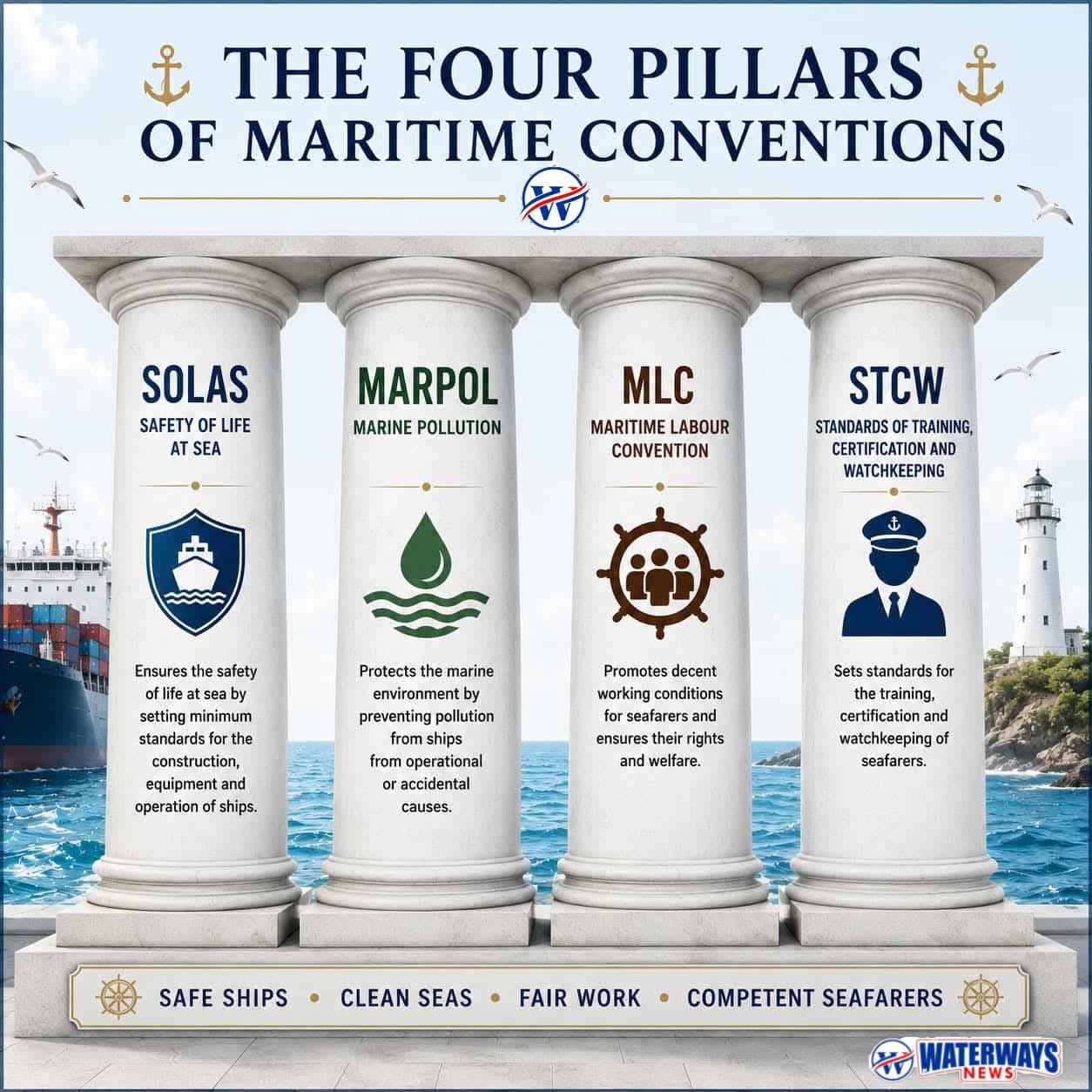
The Four Pillars of Maritime Governance: Understanding the Conventions That Hold Global Shipping Together


The Four Pillars of Maritime Governance: Understanding the Conventions That Hold Global Shipping Together
By Raymond Gold O. | Waterways News Maritime Education Desk
The global maritime industry does not run on goodwill alone. Behind every vessel that departs a port, every seafarer who stands watch through the night, and every cargo consignment that crosses an ocean lies a complex and carefully constructed framework of international regulations.
These rules — forged through decades of maritime disasters, environmental catastrophes, labour abuses, and hard-won diplomatic consensus — exist to ensure that ships are safe, seas are clean, workers are treated with dignity, and the men and women who crew the world’s vessels are professionally competent.
At the centre of this regulatory architecture stand four landmark international conventions, commonly referred to in maritime circles as the four pillars of maritime governance: SOLAS, MARPOL, MLC, and STCW. Individually, each addresses a critical dimension of maritime operations. Collectively, they represent the most comprehensive attempt in human history to bring order, safety, and accountability to one of the world’s oldest and most vital industries.

For Nigerian maritime professionals — from seafarers sailing under foreign flags to port operators managing berths at Apapa and Tin Can Island, from freight forwarders at Lekki Deep Sea Port to marine engineers aboard coastal vessels — a thorough understanding of these conventions is not merely academic. It is a professional and legal obligation.
SOLAS: The Convention Born From Tragedy
The Safety of Life at Sea Convention — known universally as SOLAS — stands as the oldest and arguably the most consequential of the four pillars.
Its origins are rooted in catastrophe. On the night of 14 April 1912, the RMS Titanic struck an iceberg in the North Atlantic and sank, claiming the lives of more than 1,500 people. The disaster exposed glaring inadequacies in the safety standards of the era — insufficient lifeboats, no standardised distress communication protocols, and no international framework compelling shipowners to prioritise passenger safety.
The first SOLAS convention was adopted in 1914, directly in response to the Titanic disaster. The current version, adopted in 1974 under the International Maritime Organization (IMO) and significantly amended over subsequent decades, remains the primary treaty governing ship safety worldwide.
SOLAS establishes minimum standards for the construction, equipment, and operation of merchant ships. Its chapters cover an extraordinarily wide range of subject matter: the structural integrity of hulls, the reliability of fire detection and suppression systems, the standards and quantity of lifesaving appliances (lifeboats, life rafts, immersion suits, and emergency position-indicating radio beacons), navigation equipment requirements, radio communications systems, and the management of cargo — including dangerous goods.
One of SOLAS’s most significant modern contributions is the International Safety Management (ISM) Code, which requires shipping companies to implement documented safety management systems onboard every vessel. Under the ISM Code, companies must identify risks, establish procedures for emergencies, conduct regular drills, and maintain records that demonstrate compliance.
For Nigerian shipping companies operating internationally, ISM certification is not optional — it is a prerequisite for trading.
SOLAS also incorporates the International Ship and Port Facility Security (ISPS) Code, introduced after the September 2001 terrorist attacks in the United States. The ISPS Code mandates security assessments, security plans, and the designation of security officers at both ship and port facility levels — a framework that directly affects all terminals and port facilities operating under the Nigeria Ports Authority (NPA).
For Nigerian seafarers, compliance with SOLAS is a daily reality. Every fire drill, every muster at lifeboat stations, every inspection of firefighting equipment, every voyage data recorder check — these are the tangible expressions of a convention that has, over more than a century, driven a profound transformation in maritime safety culture.
MARPOL: Defending the Oceans From the Ships That Use Them
The International Convention for the Prevention of Pollution from Ships — MARPOL — addresses one of the most pressing environmental challenges of the modern age: the damage that shipping can inflict on the world’s oceans.
MARPOL was born from a dual catastrophe. The first MARPOL convention was adopted in 1973, and was subsequently modified by a Protocol adopted in 1978 following a series of devastating tanker accidents. Today, the combined instrument — formally known as MARPOL 73/78 — is administered by the IMO and is structured around six technical Annexes, each targeting a different category of ship-generated pollution.
Annex I regulates the discharge of oil and oily mixtures. Every maritime professional familiar with the sight of oil slicks in Lagos Harbour or around Apapa anchorage understands the destructive power of petroleum contamination on marine ecosystems, fisheries, and coastal livelihoods. Annex I requires ships to maintain Oil Record Books, mandates the use of Oil Water Separators for bilge water, and establishes strict discharge limits — with outright prohibitions in designated Special Areas and Emission Control Areas.
Annex II addresses noxious liquid substances carried in bulk — the hazardous chemicals transported by tankers that, if discharged at sea, can cause severe ecological damage.
Annex III covers harmful substances in packaged form, governing the labelling, documentation, and stowage of hazardous cargoes.
Annex IV regulates sewage discharge from ships, prohibiting the release of untreated sewage within specified distances from land — a provision of direct relevance to the passenger ferries, water taxis, and ro-ro vessels operating on Lagos waterways.
Annex V governs garbage management. It prohibits the disposal of plastics into the sea entirely, and imposes strict controls on the dumping of other waste materials. Ships are required to maintain Garbage Management Plans and Garbage Record Books. Given Nigeria’s ongoing challenges with plastic pollution in coastal and riverine environments, the principles embedded in
Annex V have particular resonance for inland waterway operators.
Annex VI, arguably the most consequential annex for the current era of shipping, regulates air pollution from ships — specifically sulphur oxide emissions, nitrogen oxide emissions, and the use of ozone-depleting substances. The 2020 global sulphur cap — which reduced the permitted sulphur content in marine fuel from 3.5% to 0.5% — sent shockwaves through the global bunkering industry and accelerated the adoption of scrubber technology and alternative fuels such as LNG.
For Nigeria, with its major bunkering operations and the enormous implications of the Dangote Refinery for marine fuel supply, the requirements of MARPOL Annex VI are of direct commercial and strategic significance.
MLC: The Seafarers’ Bill of Rights
If SOLAS protects ships and MARPOL protects oceans, the Maritime Labour Convention — MLC 2006 — exists to protect the human beings who make global shipping possible.
Adopted by the International Labour Organization (ILO) in Geneva in February 2006 and entering into force in August 2013, the MLC is the most comprehensive international treaty ever developed for the welfare of workers in any industry. It consolidates more than 65 pre-existing ILO instruments on maritime labour into a single, enforceable framework. Informally but fittingly, it is known as the Seafarers’ Bill of Rights.
The MLC is structured around five Titles, each addressing a fundamental aspect of seafarer welfare:
Title 1 covers minimum requirements to work on a ship — including minimum age (no seafarer below 16 years of age), medical fitness requirements, and the mandatory provision of seafarer employment agreements (SEAs).
Title 2 addresses conditions of employment — including wages, working hours and rest periods, paid annual leave, repatriation rights, and compensation in the event of a ship’s loss or foundering. The MLC mandates that seafarers receive a minimum wage established periodically by the ILO’s Joint Maritime Commission, and that wage payments are made regularly and documented.
Title 3 sets standards for accommodation, recreational facilities, food, and catering. It establishes minimum cabin sizes, noise and vibration limits, air conditioning requirements, and standards for the quality and nutritional value of food provided to crew.
Title 4 addresses health protection, medical care, and social security. Every vessel subject to the MLC must carry a medicine chest, have access to medical advice by radio, and maintain arrangements for the medical evacuation of seriously ill seafarers. Flag states and port states are jointly responsible for ensuring that injured or sick seafarers receive prompt medical treatment ashore where necessary.
Title 5 provides the enforcement architecture — establishing the inspection and certification regime through which flag states and port state control authorities (such as NIMASA, in the Nigerian context) verify compliance.
For Nigerian seafarers — who number in the tens of thousands, with many serving on foreign-flagged vessels in international trade — the MLC provides a floor of rights that cannot be bargained away. Abusive employment practices, the withholding of wages, inadequate living conditions, and the refusal to repatriate stranded crew members are not merely ethical failures; they are violations of a binding international legal instrument that port state control officers are empowered to enforce.
The MLC also has direct implications for Nigerian shipping companies seeking to operate internationally and for the ongoing work of the Maritime Workers’ Union of Nigeria (MWUN) in advocating for the welfare of its members.
STCW: Building Competent Seafarers for a Complex Industry
The International Convention on Standards of Training, Certification and Watchkeeping for Seafarers — STCW — is the convention that answers a deceptively simple question: how do we know that the people operating ships are actually qualified to do so?
Adopted in 1978 and significantly revised by the Manila Amendments of 2010, STCW establishes the global minimum standards for the training, certification, and watchkeeping of officers and ratings aboard seagoing ships. It applies to seafarers serving on ships engaged in international voyages and sets out the competencies that must be demonstrated before a seafarer can be certified at any level — from Able Seaman to Master Mariner or Chief Engineer.
The STCW Convention is complemented by the STCW Code, which contains the mandatory and recommended standards of competence in detail. Seafarers and maritime training institutions alike are required to align their programmes and assessments with the competency frameworks established in the Code.
Among the most widely recognised STCW certifications are those covering:
Basic Safety Training (BST): Personal survival techniques, firefighting and fire prevention, elementary first aid, and personal safety and social responsibilities — the foundation upon which every seafarer’s career is built.
Proficiency in Survival Craft and Rescue Boats (PSCRB): Advanced training in the operation of lifeboats and rescue boats.
Advanced Firefighting: For officers and others with responsibility for fire-fighting operations.
Medical Care and Medical First Aid: For those designated to provide medical assistance onboard.
Bridge Resource Management (BRM) and Engine Room Resource Management (ERM): Competencies in team coordination, situational awareness, and decision-making under pressure.
GMDSS (Global Maritime Distress and Safety System): Certification for radio operators managing ship-to-shore and ship-to-ship communications in emergencies.
The Manila Amendments of 2010 introduced important additions, including requirements for training in security awareness, leadership and teamwork, and updated standards for electro-technical officers — reflecting the increasing complexity of modern ship systems.
In Nigeria, STCW certification is administered through the Nigerian Maritime Administration and Safety Agency (NIMASA), which accredits maritime training institutions and issues Certificates of Competency. Institutions such as the Nigerian Merchant Navy Officer Cadet Training Scheme and various maritime academies across the country provide STCW-aligned programmes. However, concerns about the quality and currency of training provision, alignment with the Manila Amendments, and the international recognition of Nigerian seafarer certificates have been persistent topics of debate within the industry — debates that go directly to the heart of Nigeria’s ambitions to expand its pool of internationally certified maritime professionals.
The Four Pillars as a Unified System
It is important to understand that SOLAS, MARPOL, MLC, and STCW do not operate in isolation. They are interrelated and mutually reinforcing. A vessel that complies with SOLAS safety standards but whose crew is inadequately trained — in violation of STCW — is still an unsafe vessel. A ship whose engineers are brilliant but who are denied rest hours — in violation of MLC — creates the conditions for fatigue-induced accidents that SOLAS exists to prevent. A vessel that meets every environmental standard under MARPOL but lacks certified personnel to manage its oil water separators correctly is a vessel awaiting an environmental incident.
Port state control regimes — including the Tokyo MOU, Paris MOU, and the Abuja MOU, which covers the West and Central African region — inspect vessels against the requirements of all four conventions simultaneously. A deficiency in any pillar can result in detention.
For Nigerian port state control officers operating under the Abuja MOU framework and supervised by NIMASA, these four conventions constitute the primary inspection checklist against which every foreign vessel calling at Nigerian ports is measured.
Nigeria Watch: Why This Matters for Nigeria
Nigeria’s maritime industry is at a critical juncture. The country possesses one of the largest exclusive economic zones in Africa, a vast network of inland waterways, significant offshore oil and gas operations, and increasingly busy commercial ports at Apapa, Tin Can Island, Onne, Calabar, and the Lekki Deep Sea Port. The Federal Ministry of Marine and Blue Economy has articulated ambitious development goals, and the Nigerian content agenda continues to push for greater participation of Nigerian seafarers, vessels, and companies in the country’s maritime trade.
In that context, the four pillars of maritime governance are not abstract international obligations. They are the terms and conditions upon which Nigeria participates in global shipping — and the standards against which the competence and professionalism of Nigerian maritime actors will be judged by the international community.
Every maritime professional in Nigeria — whether studying at a maritime academy, working on an offshore support vessel, operating a passenger ferry on the Lagos waterways, managing a freight forwarding business, or sitting in a regulatory office at NIMASA or the NPA — has both a stake in these conventions and a responsibility to understand and uphold them.
The sea does not forgive ignorance. Neither, ultimately, does the international regulatory framework that governs it.
Waterways News is Nigeria’s foremost maritime, shipping, ports, and blue economy publication, dedicated to informing and educating maritime industry stakeholders across Nigeria and the wider Gulf of Guinea region.
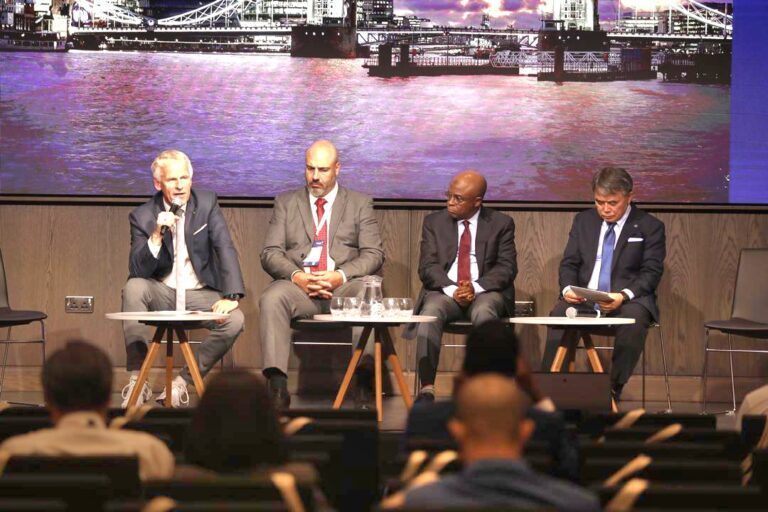
Nigeria’s Port Boom Is Outpacing Its Capacity, Dantsoho Tells World Ports Conference
Dantsoho Pitches Nigeria’s Ports to Global Investors in London, Says Lekki’s Capacity Is Exhausted
By Emamuzou Akatugba | Waterways News | London
The Managing Director of the Nigerian Ports Authority (NPA), Dr Abubakar Dantsoho, has told global port investors that Nigeria’s fast-growing cargo volumes make the country’s ports one of Africa’s most compelling investment opportunities. He said the Tinubu administration has put investor-friendly policies in place.
Dantsoho spoke on Tuesday at the IAPH World Ports Conference in London, which runs from November 3 to 6 at Olympia. He addressed a select group of maritime investors. He is Vice-President of the International Association of Ports and Harbors (IAPH) and Chairman of the Port Management Association of West and Central Africa (PMAWCA).
He said Nigeria’s population, rapid urbanisation and infrastructure gaps are what make the opportunity attractive. He argued that governments across Africa cannot alone fund bigger and deeper seaports, so private investment must move in quickly.
“The investment needed in ports to meet this expansion and growth can only happen if the requisite private investment is attracted and retained,” he said. He added that President Tinubu “has created the enabling atmosphere” for this
Dantsoho said Nigeria’s population has grown from about 45 million at independence in 1960 to over 260 million. In his words, the country needs capacity to receive bigger import vessels and to move higher export volumes.
His strongest example was the Lekki Deep Sea Port. It was funded with Chinese backing and built by China Harbour at a cost of $1.6 billion. He said it was commissioned only about three years ago, yet its capacity “has been exhausted”.
“Clearly, we need more capacity to be able to contain the volumes,” he said. He added that the NPA is pleased to be capturing more cargo, since rising volumes are what lift port revenue.
He also said most cargo arriving in West Africa, largely from China, ends up in the Nigerian market. He compared Nigeria’s population with Ghana (34 million), Côte d’Ivoire (32 million), Benin Republic (14 million) and Togo (9 million).
Other reports from the conference quote Dantsoho saying federal reforms have lifted Nigeria’s exports by about 25 per cent in two years, across oil and non-oil goods. He reportedly also cited two Nigerian ports in the World Bank’s top 20 global rankings, and a Single Window system the NPA developed in 2025 with a Singaporean firm.
NIGERIA WATCH
Capacity is now the story. A $1.6bn flagship port that is already full is the clearest sign yet that Nigeria’s problem has moved from attracting ships to handling them. It strengthens the case for the new deep seaport approvals (Badagry, Olokola, Ibom, Bakassi and Bonny) that have so far been announced faster than they have been built. Investors in London will want timelines, not just approvals.
Retaining investors is harder than attracting them. Dantsoho himself used the phrase “attracted and retained”. Concession renewal anxieties, regulatory overlap among agencies, and the Strait of Hormuz crisis’s effect on freight rates and war-risk insurance all weigh on retention. These are the questions investors will ask after the speech.
Where do the small operators fit? The pitch is about big terminals and big capital. Informal inland waterway operators, represented by WABOTAN and ATBOWATON, remain absent from the conversation.
Waterways News will keep asking how port-led growth and the NPA’s assessment of inland dry ports will translate into jetties, safety and livelihoods for the informal inland waterway operators.
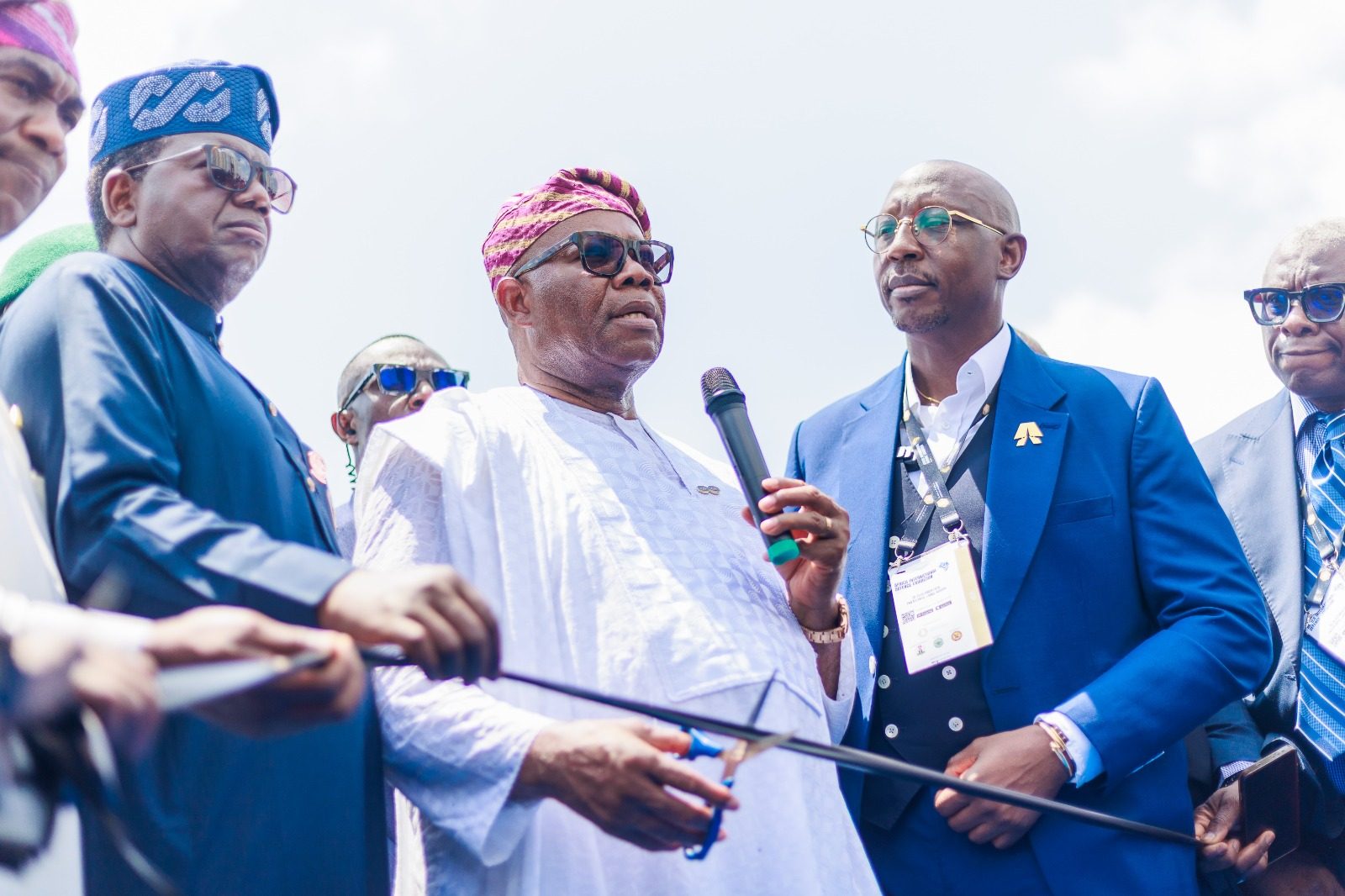
Nigeria Unveils Home-Built ADX-Barra 200 Autonomous Vessel at AFRIDEX 2026
Arridex, DICON joint venture Helagon delivers country’s first indigenously developed unmanned surface vessels%
By Ighoyota Onaibre | Waterways News
Nigeria has unveiled its first indigenously developed autonomous surface vessel, the ADX-Barra 200. Arridex Group, formerly RusselSmith Group, built it through Helagon, its defence joint venture with the Defence Industries Corporation of Nigeria (DICON).
The vessel was unveiled on 26 October at the inaugural Africa International Defence Exhibition (AFRIDEX 2026) at Eko Atlantic, Lagos. The exhibition ran from 26 to 29 October.
President Bola Ahmed Tinubu was represented by Senate President Godswill Akpabio. He said the administration prioritises defence industry growth because a nation is more secure when it can build and maintain its own capability. He described the vessel as that capability taking shape, designed and built by local engineers in partnership with DICON, and said it deserves government support and the confidence of the armed forces.
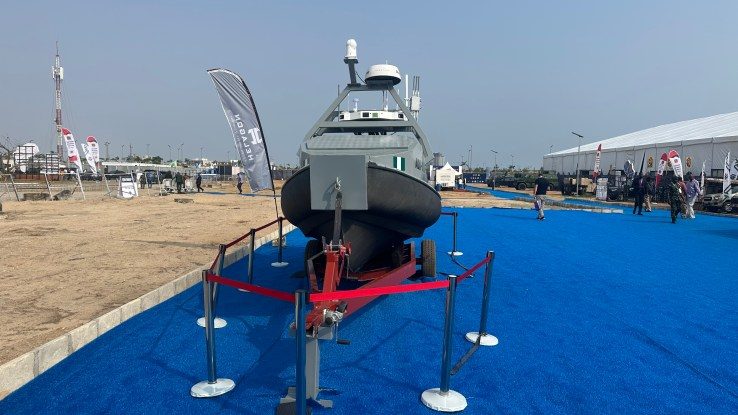
ADX-Barra 200
Arridex Group CEO Kayode Adeleke presented the vessel. He said Helagon was set up to design autonomous systems and that the ADX-Barra 200 is the result. For the forces that will use it, he called it a force multiplier.
The ADX-Barra 200 is one of two platforms in the ADX-Barra series launched at the exhibition. The other is the ADX-Barra 100. Arridex says both were designed, built and integrated in Nigeria by its engineers.
Adeleke tied the platforms to Gulf of Guinea security. He said the region’s waters carry its trade, support its coastal communities and hold much of its energy wealth, and that protecting them calls for capability the region can build, sustain and improve itself. He invited the armed services and other stakeholders to arrange demonstrations and to help shape later generations of the vessels.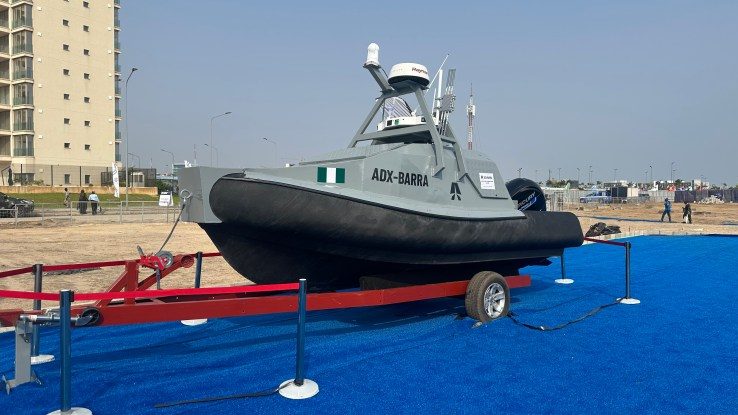
Others at the unveiling included Lagos State Deputy Governor Dr Obafemi Hamzat and the Minister of State for Defence, Dr Bello Matawalle. DICON Director-General Major General Babatunde Ibrahim Alaya, Helagon Chief Operating Officer Engr. Precious Omo-Agege and Arridex senior management were also present.
Arridex has not published the vessel’s technical specifications, including its length, endurance, payload and sensors. Both vessels remained on display at the exhibition.
NIGERIA WATCH
A home-built answer to a long-standing maritime problem: Nigeria’s waters have long needed more patrol capacity than its platforms and budgets can supply. A locally designed vessel that “can be supported, adapted and improved by the team that made it,” as Arridex puts it, addresses one persistent weakness. Imported hulls and systems often sit idle for want of spares, support and trained hands.
The questions that matter next: Unveilings are not deployments. The Navy, NIMASA’s Deep Blue Project and other agencies will want to know the vessel’s range, endurance, sensors and sea-state limits. They will also want to know whether it can work in the Gulf of Guinea. Until Arridex publishes specifications and arranges trials, the “game-changing” claim remains the company’s own.
Beyond defence: Waterways News readers should watch whether this technology filters into civil uses such as inland waterway surveillance, anti-vandalism patrols and search and rescue. The country’s inland operators, including those represented by WABOTAN and ATBOWATON, face insecurity and safety gaps that policy announcements have not closed. Local manufacturing capacity matters to them only if it eventually reaches the waterways where they work.
The accountability test: The industrial-policy argument is sound. It is build locally and maintain locally. It will be judged by procurement, deployment and sustained operation, not by launch-day speeches.
Editor's Choice
Australia Bars Repeat-Offender Bulk Carrier for 90 Days Over Falsified Crew Rest Records
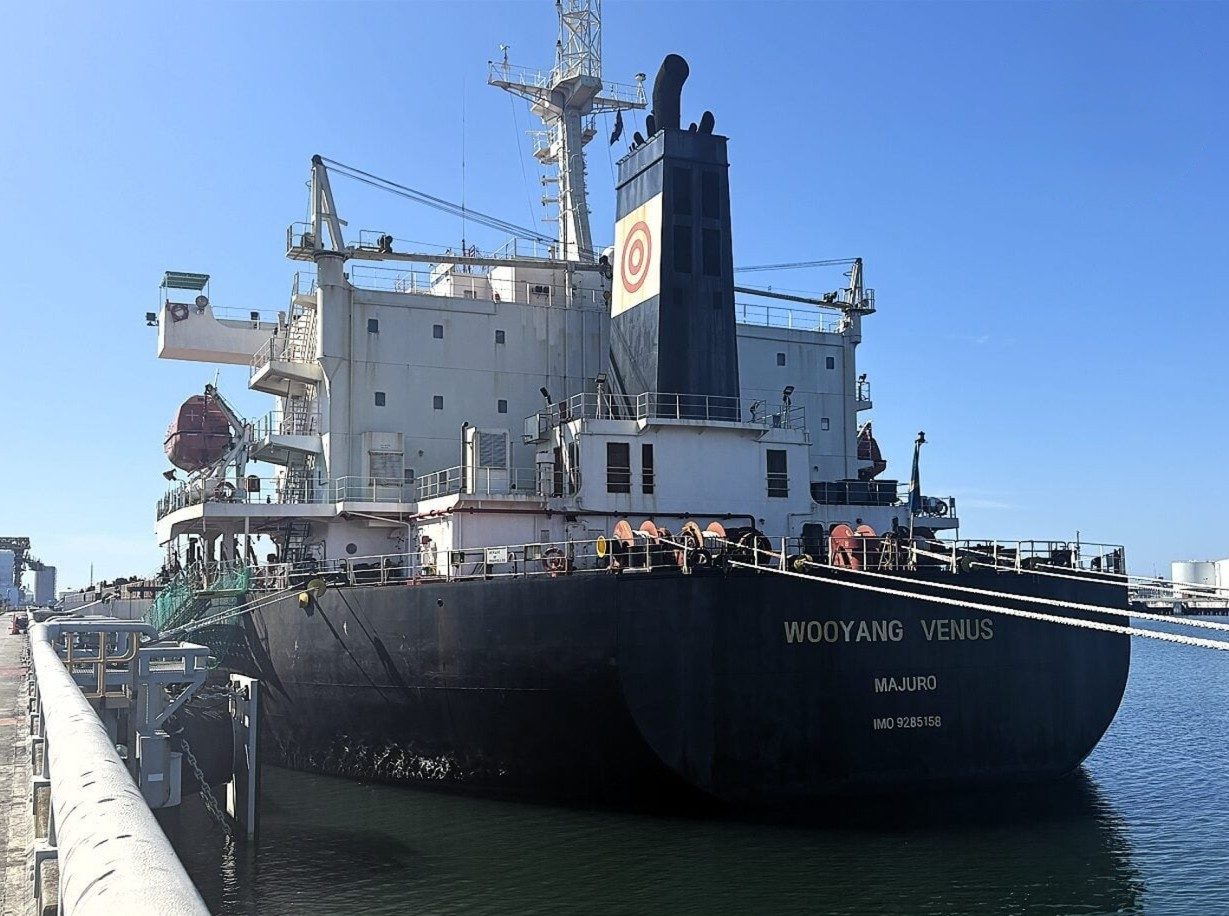
Australia Bars Repeat-Offender Bulk Carrier for 90 Days Over Falsified Crew Rest Records
By Okeoghene Onoriobe | Waterways News
Australian maritime authorities have banned the Marshall Islands-flagged bulk carrier Wooyang Venus from its ports and waters for 90 days. Inspectors found that the ship’s crew work and rest-hour records had been deliberately falsified to hide excessive working hours.
The Australian Maritime Safety Authority (AMSA) boarded the vessel at the Port of Newcastle on 29 October after a complaint under the Maritime Labour Convention (MLC). Its port state control inspection found that the records did not match the hours the crew actually worked. The ship left Newcastle on 31 October for Korea, and the ban took effect afterwards.
This is the vessel’s third brush with Australian enforcement in under three years. AMSA detained it in August 2026 when crew hours were neither properly recorded nor monitored. It was first detained in December 2023, after a complaint from the International Transport Workers’ Federation (ITF).
That inspection found falsified hours records, poor food provisions and an allegation that the master had assaulted a crew member. AMSA’s annual MLC report says the operator then submitted a corrective action plan covering repatriation, better provisions and training on rest-hour compliance. The latest findings suggest those measures did not take hold.
AMSA Executive Director for Maritime Safety and Environmental Compliance, Greg Witherall, said falsifying records meant to protect seafarers undermines both crew welfare and ship safety. He warned that fatigue dulls judgement and slows reaction times, raising the risk of collisions, groundings and injuries, particularly during navigation and watchkeeping.
The ban was imposed under Section 246 of Australia’s Navigation Act 2012. AMSA cited the deliberate falsification, the repeated breaches and doubts over the effectiveness of the owner’s and operator’s safety management systems.
Nigeria Watch
The case matters for Nigeria for three reasons:
Records are the enforcement tool. Fatigue rules only work if rest-hour logs can be trusted. Australia treated falsification as a safety-system failure, not a paperwork lapse, and banned the ship rather than detaining it again.
Repeat offenders need escalating penalties. Two detentions and a corrective plan did not change this operator’s behaviour. Nigerian port state control should ask whether its own follow-up on repeat deficiencies has real consequences.
Seafarer welfare is a Nigerian issue. Nigerian seafarers serve on foreign-flagged ships, and those working boats and ferries on domestic waters face fatigue and welfare gaps too, often with no records at all.
The MLC regime Australia is enforcing shows what accountability looks like. It is the benchmark NIMASA and the inland regulators should be measured against, and one this publication will keep pressing.

 Oil and Gas8 months ago
Tantita’s Pipeline Deal: $144m Contract, Rising Output, and the Questions that Deserve Answers
 MARITIME TRADE & SHIPPING8 months ago
World’s Largest Container Ship Sets New Maritime Record with 22,233 TEUs on Single Voyage
 Blue Economy9 months ago
Nigeria’s Coast Guard Bill: A Solution in Search of a Problem?