Editor's Choice
The Four Pillars of Maritime Governance: Understanding the Conventions That Hold Global Shipping Together


The Four Pillars of Maritime Governance: Understanding the Conventions That Hold Global Shipping Together
By Raymond Gold O. | Waterways News Maritime Education Desk
The global maritime industry does not run on goodwill alone. Behind every vessel that departs a port, every seafarer who stands watch through the night, and every cargo consignment that crosses an ocean lies a complex and carefully constructed framework of international regulations.
These rules — forged through decades of maritime disasters, environmental catastrophes, labour abuses, and hard-won diplomatic consensus — exist to ensure that ships are safe, seas are clean, workers are treated with dignity, and the men and women who crew the world’s vessels are professionally competent.
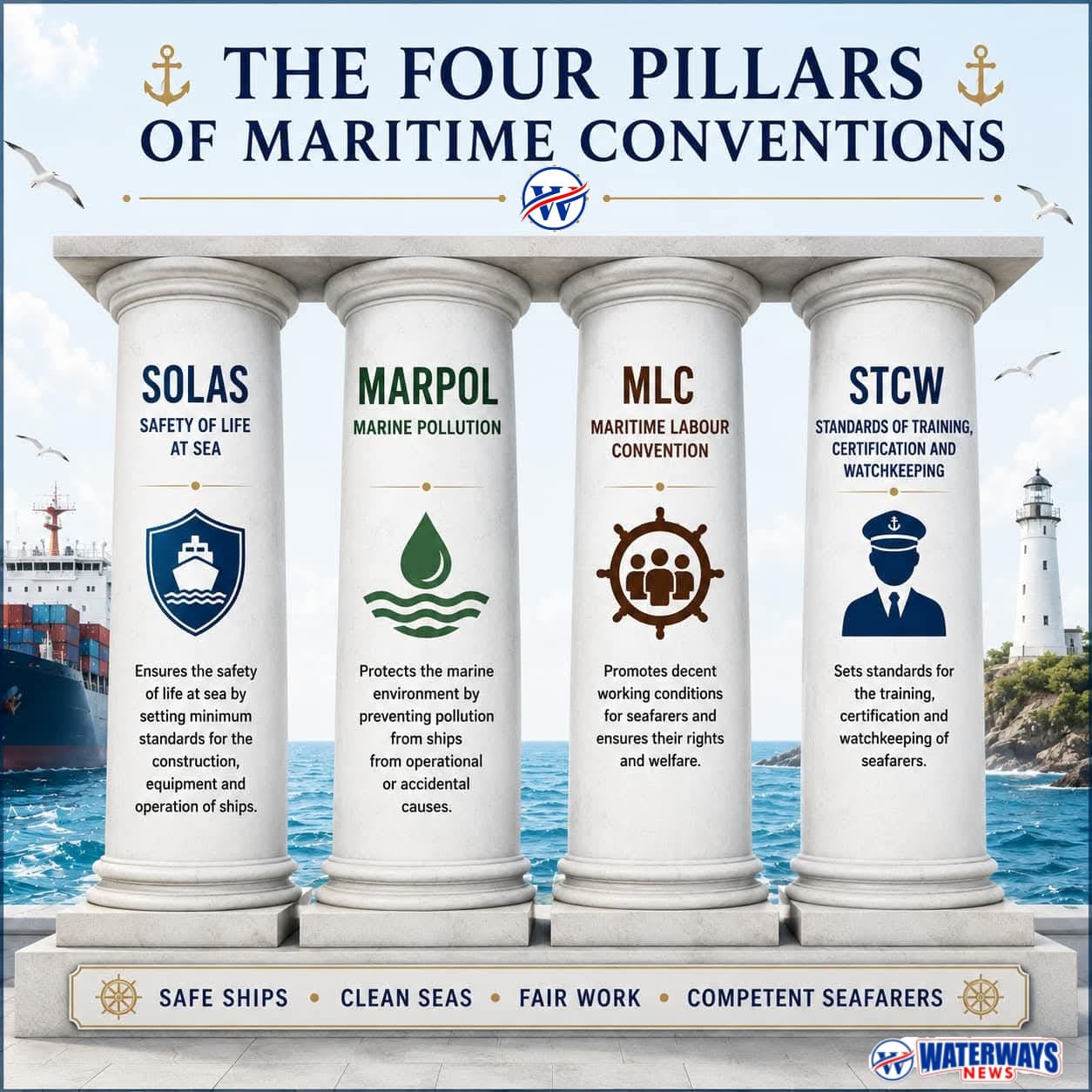
At the centre of this regulatory architecture stand four landmark international conventions, commonly referred to in maritime circles as the four pillars of maritime governance: SOLAS, MARPOL, MLC, and STCW. Individually, each addresses a critical dimension of maritime operations. Collectively, they represent the most comprehensive attempt in human history to bring order, safety, and accountability to one of the world’s oldest and most vital industries.

For Nigerian maritime professionals — from seafarers sailing under foreign flags to port operators managing berths at Apapa and Tin Can Island, from freight forwarders at Lekki Deep Sea Port to marine engineers aboard coastal vessels — a thorough understanding of these conventions is not merely academic. It is a professional and legal obligation.
SOLAS: The Convention Born From Tragedy
The Safety of Life at Sea Convention — known universally as SOLAS — stands as the oldest and arguably the most consequential of the four pillars.
Its origins are rooted in catastrophe. On the night of 14 April 1912, the RMS Titanic struck an iceberg in the North Atlantic and sank, claiming the lives of more than 1,500 people. The disaster exposed glaring inadequacies in the safety standards of the era — insufficient lifeboats, no standardised distress communication protocols, and no international framework compelling shipowners to prioritise passenger safety.
The first SOLAS convention was adopted in 1914, directly in response to the Titanic disaster. The current version, adopted in 1974 under the International Maritime Organization (IMO) and significantly amended over subsequent decades, remains the primary treaty governing ship safety worldwide.
SOLAS establishes minimum standards for the construction, equipment, and operation of merchant ships. Its chapters cover an extraordinarily wide range of subject matter: the structural integrity of hulls, the reliability of fire detection and suppression systems, the standards and quantity of lifesaving appliances (lifeboats, life rafts, immersion suits, and emergency position-indicating radio beacons), navigation equipment requirements, radio communications systems, and the management of cargo — including dangerous goods.
One of SOLAS’s most significant modern contributions is the International Safety Management (ISM) Code, which requires shipping companies to implement documented safety management systems onboard every vessel. Under the ISM Code, companies must identify risks, establish procedures for emergencies, conduct regular drills, and maintain records that demonstrate compliance.
For Nigerian shipping companies operating internationally, ISM certification is not optional — it is a prerequisite for trading.
SOLAS also incorporates the International Ship and Port Facility Security (ISPS) Code, introduced after the September 2001 terrorist attacks in the United States. The ISPS Code mandates security assessments, security plans, and the designation of security officers at both ship and port facility levels — a framework that directly affects all terminals and port facilities operating under the Nigeria Ports Authority (NPA).
For Nigerian seafarers, compliance with SOLAS is a daily reality. Every fire drill, every muster at lifeboat stations, every inspection of firefighting equipment, every voyage data recorder check — these are the tangible expressions of a convention that has, over more than a century, driven a profound transformation in maritime safety culture.
MARPOL: Defending the Oceans From the Ships That Use Them
The International Convention for the Prevention of Pollution from Ships — MARPOL — addresses one of the most pressing environmental challenges of the modern age: the damage that shipping can inflict on the world’s oceans.
MARPOL was born from a dual catastrophe. The first MARPOL convention was adopted in 1973, and was subsequently modified by a Protocol adopted in 1978 following a series of devastating tanker accidents. Today, the combined instrument — formally known as MARPOL 73/78 — is administered by the IMO and is structured around six technical Annexes, each targeting a different category of ship-generated pollution.
Annex I regulates the discharge of oil and oily mixtures. Every maritime professional familiar with the sight of oil slicks in Lagos Harbour or around Apapa anchorage understands the destructive power of petroleum contamination on marine ecosystems, fisheries, and coastal livelihoods. Annex I requires ships to maintain Oil Record Books, mandates the use of Oil Water Separators for bilge water, and establishes strict discharge limits — with outright prohibitions in designated Special Areas and Emission Control Areas.
Annex II addresses noxious liquid substances carried in bulk — the hazardous chemicals transported by tankers that, if discharged at sea, can cause severe ecological damage.
Annex III covers harmful substances in packaged form, governing the labelling, documentation, and stowage of hazardous cargoes.
Annex IV regulates sewage discharge from ships, prohibiting the release of untreated sewage within specified distances from land — a provision of direct relevance to the passenger ferries, water taxis, and ro-ro vessels operating on Lagos waterways.
Annex V governs garbage management. It prohibits the disposal of plastics into the sea entirely, and imposes strict controls on the dumping of other waste materials. Ships are required to maintain Garbage Management Plans and Garbage Record Books. Given Nigeria’s ongoing challenges with plastic pollution in coastal and riverine environments, the principles embedded in
Annex V have particular resonance for inland waterway operators.
Annex VI, arguably the most consequential annex for the current era of shipping, regulates air pollution from ships — specifically sulphur oxide emissions, nitrogen oxide emissions, and the use of ozone-depleting substances. The 2020 global sulphur cap — which reduced the permitted sulphur content in marine fuel from 3.5% to 0.5% — sent shockwaves through the global bunkering industry and accelerated the adoption of scrubber technology and alternative fuels such as LNG.
For Nigeria, with its major bunkering operations and the enormous implications of the Dangote Refinery for marine fuel supply, the requirements of MARPOL Annex VI are of direct commercial and strategic significance.
MLC: The Seafarers’ Bill of Rights
If SOLAS protects ships and MARPOL protects oceans, the Maritime Labour Convention — MLC 2006 — exists to protect the human beings who make global shipping possible.
Adopted by the International Labour Organization (ILO) in Geneva in February 2006 and entering into force in August 2013, the MLC is the most comprehensive international treaty ever developed for the welfare of workers in any industry. It consolidates more than 65 pre-existing ILO instruments on maritime labour into a single, enforceable framework. Informally but fittingly, it is known as the Seafarers’ Bill of Rights.
The MLC is structured around five Titles, each addressing a fundamental aspect of seafarer welfare:
Title 1 covers minimum requirements to work on a ship — including minimum age (no seafarer below 16 years of age), medical fitness requirements, and the mandatory provision of seafarer employment agreements (SEAs).
Title 2 addresses conditions of employment — including wages, working hours and rest periods, paid annual leave, repatriation rights, and compensation in the event of a ship’s loss or foundering. The MLC mandates that seafarers receive a minimum wage established periodically by the ILO’s Joint Maritime Commission, and that wage payments are made regularly and documented.
Title 3 sets standards for accommodation, recreational facilities, food, and catering. It establishes minimum cabin sizes, noise and vibration limits, air conditioning requirements, and standards for the quality and nutritional value of food provided to crew.
Title 4 addresses health protection, medical care, and social security. Every vessel subject to the MLC must carry a medicine chest, have access to medical advice by radio, and maintain arrangements for the medical evacuation of seriously ill seafarers. Flag states and port states are jointly responsible for ensuring that injured or sick seafarers receive prompt medical treatment ashore where necessary.
Title 5 provides the enforcement architecture — establishing the inspection and certification regime through which flag states and port state control authorities (such as NIMASA, in the Nigerian context) verify compliance.
For Nigerian seafarers — who number in the tens of thousands, with many serving on foreign-flagged vessels in international trade — the MLC provides a floor of rights that cannot be bargained away. Abusive employment practices, the withholding of wages, inadequate living conditions, and the refusal to repatriate stranded crew members are not merely ethical failures; they are violations of a binding international legal instrument that port state control officers are empowered to enforce.
The MLC also has direct implications for Nigerian shipping companies seeking to operate internationally and for the ongoing work of the Maritime Workers’ Union of Nigeria (MWUN) in advocating for the welfare of its members.
STCW: Building Competent Seafarers for a Complex Industry
The International Convention on Standards of Training, Certification and Watchkeeping for Seafarers — STCW — is the convention that answers a deceptively simple question: how do we know that the people operating ships are actually qualified to do so?
Adopted in 1978 and significantly revised by the Manila Amendments of 2010, STCW establishes the global minimum standards for the training, certification, and watchkeeping of officers and ratings aboard seagoing ships. It applies to seafarers serving on ships engaged in international voyages and sets out the competencies that must be demonstrated before a seafarer can be certified at any level — from Able Seaman to Master Mariner or Chief Engineer.
The STCW Convention is complemented by the STCW Code, which contains the mandatory and recommended standards of competence in detail. Seafarers and maritime training institutions alike are required to align their programmes and assessments with the competency frameworks established in the Code.
Among the most widely recognised STCW certifications are those covering:
Basic Safety Training (BST): Personal survival techniques, firefighting and fire prevention, elementary first aid, and personal safety and social responsibilities — the foundation upon which every seafarer’s career is built.
Proficiency in Survival Craft and Rescue Boats (PSCRB): Advanced training in the operation of lifeboats and rescue boats.
Advanced Firefighting: For officers and others with responsibility for fire-fighting operations.
Medical Care and Medical First Aid: For those designated to provide medical assistance onboard.
Bridge Resource Management (BRM) and Engine Room Resource Management (ERM): Competencies in team coordination, situational awareness, and decision-making under pressure.
GMDSS (Global Maritime Distress and Safety System): Certification for radio operators managing ship-to-shore and ship-to-ship communications in emergencies.
The Manila Amendments of 2010 introduced important additions, including requirements for training in security awareness, leadership and teamwork, and updated standards for electro-technical officers — reflecting the increasing complexity of modern ship systems.
In Nigeria, STCW certification is administered through the Nigerian Maritime Administration and Safety Agency (NIMASA), which accredits maritime training institutions and issues Certificates of Competency. Institutions such as the Nigerian Merchant Navy Officer Cadet Training Scheme and various maritime academies across the country provide STCW-aligned programmes. However, concerns about the quality and currency of training provision, alignment with the Manila Amendments, and the international recognition of Nigerian seafarer certificates have been persistent topics of debate within the industry — debates that go directly to the heart of Nigeria’s ambitions to expand its pool of internationally certified maritime professionals.
The Four Pillars as a Unified System
It is important to understand that SOLAS, MARPOL, MLC, and STCW do not operate in isolation. They are interrelated and mutually reinforcing. A vessel that complies with SOLAS safety standards but whose crew is inadequately trained — in violation of STCW — is still an unsafe vessel. A ship whose engineers are brilliant but who are denied rest hours — in violation of MLC — creates the conditions for fatigue-induced accidents that SOLAS exists to prevent. A vessel that meets every environmental standard under MARPOL but lacks certified personnel to manage its oil water separators correctly is a vessel awaiting an environmental incident.
Port state control regimes — including the Tokyo MOU, Paris MOU, and the Abuja MOU, which covers the West and Central African region — inspect vessels against the requirements of all four conventions simultaneously. A deficiency in any pillar can result in detention.
For Nigerian port state control officers operating under the Abuja MOU framework and supervised by NIMASA, these four conventions constitute the primary inspection checklist against which every foreign vessel calling at Nigerian ports is measured.
Nigeria Watch: Why This Matters for Nigeria
Nigeria’s maritime industry is at a critical juncture. The country possesses one of the largest exclusive economic zones in Africa, a vast network of inland waterways, significant offshore oil and gas operations, and increasingly busy commercial ports at Apapa, Tin Can Island, Onne, Calabar, and the Lekki Deep Sea Port. The Federal Ministry of Marine and Blue Economy has articulated ambitious development goals, and the Nigerian content agenda continues to push for greater participation of Nigerian seafarers, vessels, and companies in the country’s maritime trade.
In that context, the four pillars of maritime governance are not abstract international obligations. They are the terms and conditions upon which Nigeria participates in global shipping — and the standards against which the competence and professionalism of Nigerian maritime actors will be judged by the international community.
Every maritime professional in Nigeria — whether studying at a maritime academy, working on an offshore support vessel, operating a passenger ferry on the Lagos waterways, managing a freight forwarding business, or sitting in a regulatory office at NIMASA or the NPA — has both a stake in these conventions and a responsibility to understand and uphold them.
The sea does not forgive ignorance. Neither, ultimately, does the international regulatory framework that governs it.
Waterways News is Nigeria’s foremost maritime, shipping, ports, and blue economy publication, dedicated to informing and educating maritime industry stakeholders across Nigeria and the wider Gulf of Guinea region.
Two More Tankers Struck in Strait of Hormuz as Attack Count Hits Five in a Week
By Okeoghene Onoriobe | Waterways News
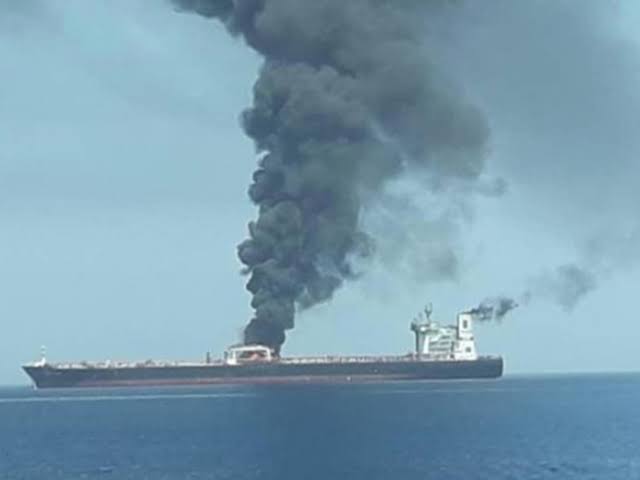
Two more tankers have been hit while transiting the Strait of Hormuz, leaving two seafarers with minor injuries and pushing the number of reported attacks or security incidents against commercial vessels in the waterway to at least five since 16 September.
The UK Maritime Trade Operations (UKMTO) centre said an inbound tanker was struck by an unidentified projectile on Monday. Two crew members sustained minor injuries, but the vessel stayed under its own power and continued to its next port, with no environmental impact reported.
Hours later, UKMTO issued a second alert after an outbound LPG tanker reported being struck by debris from unknown projectiles. All crew were reported safe and the vessel also continued its voyage. Authorities are investigating both incidents, and UKMTO has not attributed either attack to a specific actor.
The two strikes build on a Joint Maritime Information Center (JMIC) advisory covering three earlier attacks between 16 and 18 September, one of which saw a tanker’s hull breached by a projectile, sparking a fire. JMIC continues to rate the threat level in the strait as “severe,” citing a high likelihood of deliberate hostile action and pointing to a pattern of harassment by Iran’s Islamic Revolutionary Guard Corps — drone overflights, surveillance of merchant vessels and VHF hailing, alongside the direct attacks.
Traffic through the chokepoint remains sharply depressed. Only 17 commodity vessels were visibly transiting over the weekend, down from 37 the week before and against a pre-war daily average of roughly 125. That figure excludes vessels sailing with their AIS transponders switched off, and JMIC notes a persistent gap between visible and actual traffic.
Nigeria Watch
For Nigerian maritime stakeholders, the Hormuz crisis is no longer a distant Gulf story. It is a cost line. Every fresh escalation feeds directly into the war-risk insurance premiums and freight rates that Nigerian importers, refiners and shipping agents ultimately absorb, since global tanker and container capacity pulled off the Hormuz route tightens supply elsewhere and pushes rates up across long-haul trades, including those serving West African ports.
The renewed attacks also sharpen the stakes around Nigeria’s push for a stronger voice at the IMO Council table and its broader blue-economy diplomacy under Minister Adegboyega Oyetola. A sustained Gulf disruption is exactly the kind of systemic shock that tests whether Nigeria’s seat translates into influence over how global shipping risk, insurance and rerouting decisions are made, rather than Nigeria simply absorbing the downstream cost.
Locally, the episode is a reminder of the layered nature of “maritime security” as a policy word: the Deep Blue Project and Gulf of Guinea security architecture address piracy and armed robbery close to home, but Nigeria’s ports and shippers remain exposed to security failures thousands of kilometres away in the Gulf.
Waterways News will continue tracking how the Hormuz situation feeds into freight cost pressure at Nigerian ports and NIMASA’s public messaging on the issue.
Blue Economy
Oyetola Confirms 7,059 Nigerian Seafarers Placed Onboard Vessels, Orders NIMASA to Fast-Track CVFF Disbursement
Oyetola Confirms 7,059 Nigerian Seafarers Placed Onboard Vessels, Orders NIMASA to Fast-Track CVFF Disbursement
By Ighoyota Onaibre | Waterways News
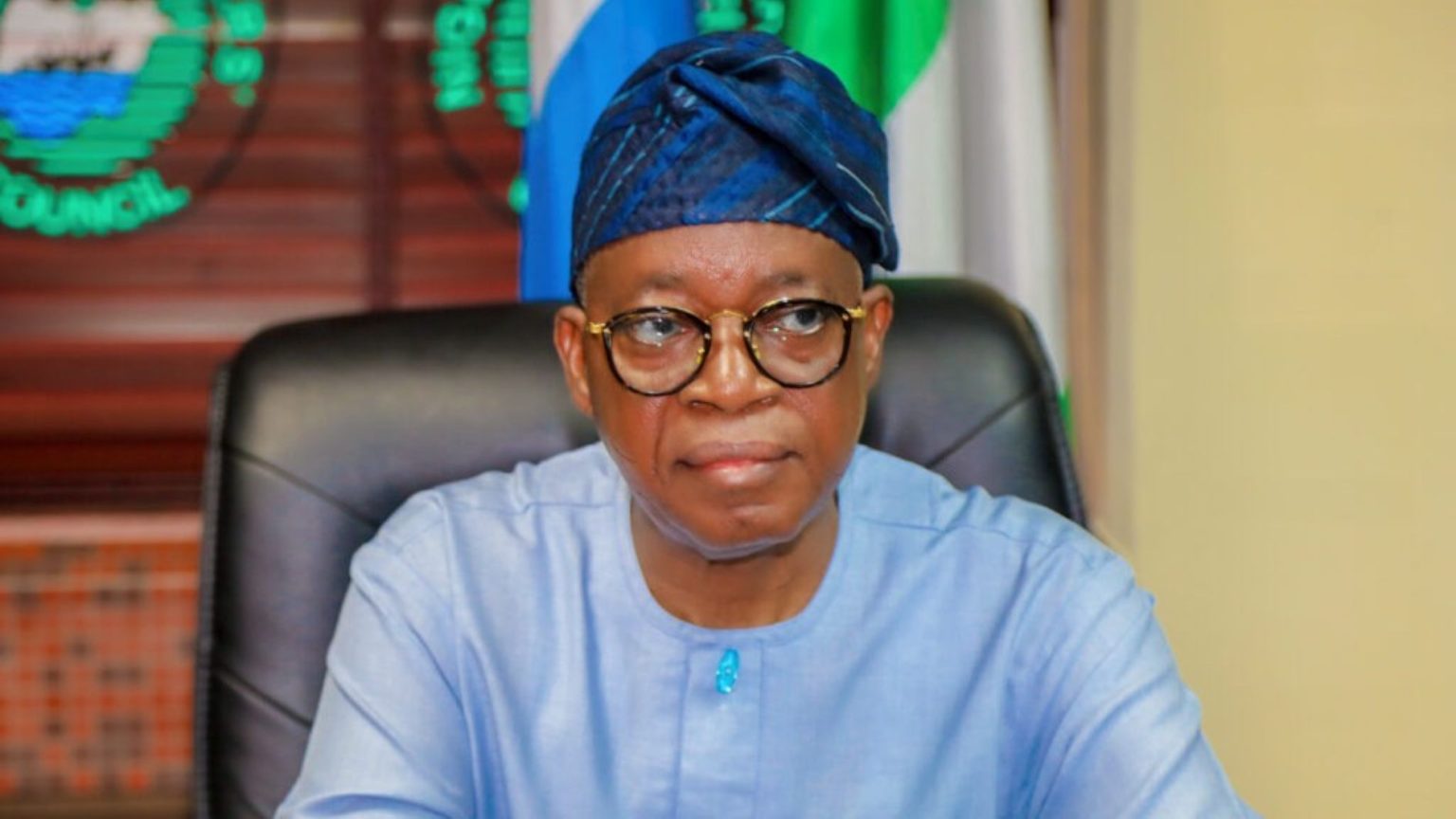
The Minister of Marine and Blue Economy, Dr Adegboyega Oyetola, says 7,059 Nigerian seafarers have so far been placed onboard vessels to acquire seatime experience, part of what he described as the Federal Government’s broader push to build a competitive indigenous maritime workforce.
The Minister, in a statement issued through his Special Adviser, Dr Bolaji Akinola, at the weekend, also directed the Nigerian Maritime Administration and Safety Agency (NIMASA) to work more closely with the 12 approved Primary Lending Institutions (PLIs) to accelerate disbursement of the Cabotage Vessel Financing Fund (CVFF) to qualified Nigerian shipowners.
According to the statement, NIMASA has so far received 92 applications under the CVFF framework, of which 20 have been forwarded to the PLIs and one has been reviewed and cleared for approval. Oyetola said the ship acquisition initiative could generate more than 30,000 direct and indirect jobs across shipyards, marine engineering firms and maritime logistics companies, while deepening Nigeria’s domestic ship-owning and shipbuilding base.
The Minister linked the disbursement push to President Bola Tinubu’s authorisation to unlock financing long owed to domestic maritime operators, framing it as central to realising the economic potential of Nigeria’s blue economy.
On manpower development, Oyetola disclosed that 222 seafarers had been trained free of charge in basic and advanced professional courses, while 333 cadets completed academic training and were awarded degrees. Under the Nigerian Seafarers Development Programme (NSDP), 135 cadets have completed the programme and obtained their Certificates of Competency (CoC).
He said the interventions reflect government’s commitment to strengthening indigenous maritime capacity so that Nigerians can benefit directly from opportunities created by the blue economy.
Nigeria Watch
The seafarer numbers are worth celebrating, but the more consequential line in Oyetola’s statement is the one about CVFF: 92 applications received, 20 forwarded to PLIs, and just one, only one is reviewed and cleared for approval. That ratio is the real story.
Waterways News has tracked the CVFF disbursement saga for years, and the pattern here is familiar: an announcement of “significant progress” that, on closer reading, describes a process still largely stuck at the application stage. Nigerian shipowners have waited over two decades for meaningful access to this fund, first established in 2003. A single approved application, even framed as forward momentum, does not yet amount to disbursement, and it is disbursement, not directives to NIMASA and the PLIs, that shipowners can take to the bank.
The seafarer placement and training figures are a genuine bright spot and speak to real capacity-building through NIMASA’s cadetship and NSDP schemes. But they sit somewhat apart from the CVFF question.
Training seafarers builds the workforce; it does not put Nigerian-owned vessels on the water for that workforce to crew. Until the CVFF pipeline moves from “20 applications forwarded” to actual funds reaching qualified shipowners, Nigeria’s ambition to grow an indigenous shipowning fleet — the same ambition the Minister invoked in citing 30,000 potential jobs — remains aspirational.
Waterways News will continue to press for concrete disbursement timelines and named beneficiaries under the CVFF, rather than accept process updates as a substitute for delivery.
Blue Economy
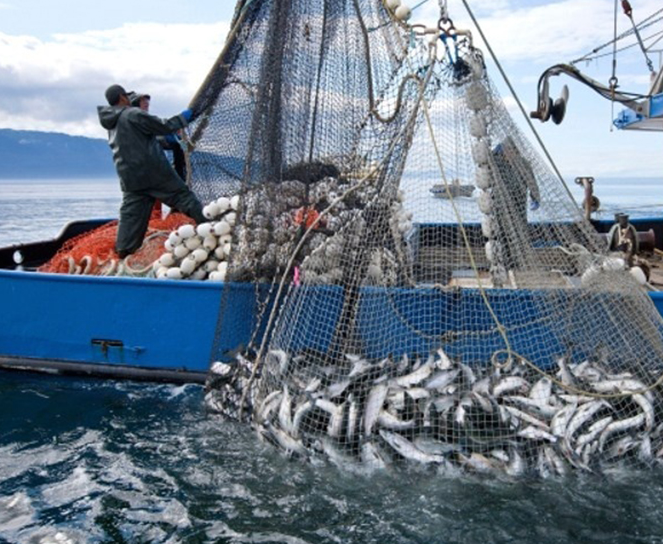
Navy, Fisheries Department Arrest 34 Suspects, Seize Three Vessels in Renewed War on Illegal Fishing
Navy, Fisheries Department Arrest 34 Suspects, Seize Three Vessels in Renewed War on Illegal Fishing
By Raymond Gold | Waterways News
The Federal Department of Fisheries and Aquaculture and the Nigerian Navy have struck a fresh blow against illegal fishing in Nigerian waters, seizing three vessels and arresting 34 suspects in a coordinated three-day sweep.
The operation, codenamed Operation Abo Eja 2026, was designed to tighten surveillance and enforcement against illegal, unreported and unregulated (IUU) fishing, one of the most persistent threats to Nigeria’s marine resources and the livelihoods that depend on them.
Among those arrested were 24 Nigerians, three Ghanaians and three Chinese nationals, underlining the increasingly foreign and cross-border character of the illegal trawling networks operating off the country’s coast.
The Western Naval Command led the offshore muscle of the operation, deploying a naval ship, a helicopter and Special Boat Service personnel, while the Department of Fisheries and Aquaculture supplied technical and regulatory backing to ensure the arrests translate into prosecutable enforcement action.
Deputy Director at the Department of Fisheries and Aquaculture, Adeleke Adegoke, said the operation underscored the need for sharper intelligence gathering and better information sharing between agencies to make future raids more targeted and effective.
Flag Officer Commanding the Western Naval Command, Rear Admiral Abdullahi Mustapha, described the exercise as proof of effective inter-agency coordination, adding that it would strengthen ongoing efforts to safeguard Nigeria’s marine resources.
Nigeria Watch
Operation Abo Eja 2026 lands squarely inside a theme this desk has tracked for months: the steady erosion of Nigerian control over its own coastal waters. Illegal, unreported and unregulated fishing is not a fringe nuisance — it is a direct assault on artisanal fishing communities and the small-scale operators who make up the bulk of Nigeria’s blue economy workforce, even as foreign trawlers, often flagged or crewed out of Asia, continue to test the limits of enforcement.
The presence of Chinese nationals among those arrested will not surprise close observers of Nigeria’s fisheries sector, where foreign-linked trawling operations have long been accused of over-exploiting stocks with little regard for licensing or seasonal restrictions. It also reinforces a broader pattern this publication has flagged repeatedly: foreign dominance of Nigerian coastal waters remains an unresolved policy failure, one that recurs regardless of which agency is nominally in charge.
The joint Navy-fisheries model deployed here — naval assets providing muscle, the fisheries department providing regulatory teeth — is also the same architecture underpinning the Deep Blue Project and broader Gulf of Guinea security efforts championed by the Federal Ministry of Marine and Blue Economy under Minister Adegboyega Oyetola. Deputy Director Adegoke’s call for better intelligence sharing is a familiar refrain in Nigerian maritime enforcement: the hardware and manpower for these operations increasingly exist, but the surveillance and prosecutorial follow-through that would deter repeat offenders has historically lagged.
For the informal and small-scale operators this desk covers closely, the real test will not be the headline arrest numbers but what happens next — whether the 34 suspects face meaningful prosecution, whether the three seized vessels are forfeited rather than quietly released, and whether Operation Abo Eja 2026 becomes a sustained enforcement posture rather than another one-off show of force.

 Oil and Gas7 months ago
Tantita’s Pipeline Deal: $144m Contract, Rising Output, and the Questions that Deserve Answers
- MARITIME TRADE & SHIPPING7 months ago
World’s Largest Container Ship Sets New Maritime Record with 22,233 TEUs on Single Voyage
- Blue Economy7 months ago
Nigeria’s Coast Guard Bill: A Solution in Search of a Problem?