
Connect with us

Security & Safety

Clarion Shipping Launches Nigeria’s First Indigenous Container Vessel, Strengthens Regional Trade Links

Published

on

Stay connected via Google News
Follow us for latest news and information on Nigeria water ways.
Add as preferred source on Google

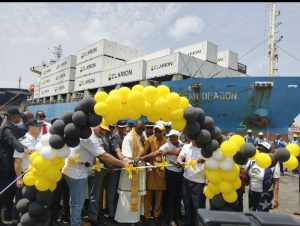
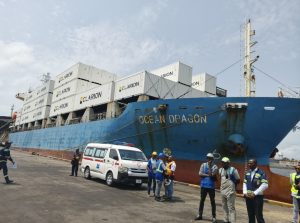
In a groundbreaking move for Nigeria’s maritime sector, Clarion Shipping West Africa Limited has unveiled MV Clarion Ocean Dragon, the country’s first fully indigenous container vessel, marking a major stride in domestic shipping and regional trade integration.

Unveiled at the Five Star Logistics Terminal, Tin Can Island Port in Lagos, the 349-TEU capacity vessel is expected to revolutionize port-to-port cargo movement within Nigeria and across West Africa, offering a safer and more efficient alternative to road transport.

Clarion Shipping, which currently operates a fleet of two ocean-going and five coastal barges, described the newly acquired vessel as a game-changer for volume, speed, and safety in cargo delivery. The company projects a return on its investment within two years—pending favorable government support and policy implementation.

Speaking at the ceremony, Vice President of Clarion Shipping, Mrs. Bernadine Eloka, noted that the MV Ocean Dragon—crewed by over 70% Nigerians and captained by Indonesian Captain Deddy Febinyanto—was built in China and funded through Nigerian financial institutions despite the high cost of capital.

“Raising capital for a vessel in Nigeria is no joke,” Eloka remarked. “We didn’t get single-digit loans. But the banks saw the vision and supported us.”

Advertisement

Designed to serve both domestic and international trade corridors, the vessel will facilitate container shipping between major Nigerian ports and key destinations such as Ghana, Côte d’Ivoire, Sierra Leone, Egypt, and South Africa. Bookings have already been confirmed for routes including Ghana, Algeria, and Lome.

To further consolidate its shipping capacity, Eloka announced the acquisition of a second, larger vessel—NB-778—co-owned with a Chinese partner, scheduled to depart Chengdao Port in China for Nigeria on July 27.

She emphasized that the initiative aligns with the Nigerian Coastal and Inland Shipping (Cabotage) Act, with the vessel fully Nigerian-flagged and operated. “We’ve fulfilled all requirements from NIMASA, NPA, NIWA, and Customs. What we now need is enforcement—Nigerian ships should carry Nigerian cargo,” she stated, calling on the government to reserve domestic container shipping for local operators.

Also speaking, Mr. Mustafa Muhammed, Managing Director of Clarion’s sister company, Suncity Terminal Logistics, highlighted the company’s end-to-end logistics network that bridges the gap between northern exporters and the ports. Through a combination of road and rail, Clarion has mobilized over 1,300 export containers, with 800 branded containers distributed across cities like Kano, Kaduna, Zaria, Yola, and Bauchi.

Advertisement

“Our model saves exporters millions. We provide the empty containers up north, get them filled there, and bring them down for export—cutting costs and reducing product spoilage,” Muhammed said.

He added that Clarion’s status as a government-recognized processing terminal allows for seamless movement of sealed containers directly from its depots to the port, bypassing bureaucratic delays. The company also operates warehouses with a combined storage capacity of 4,500 metric tons.

Looking ahead, Muhammed disclosed plans for the deployment of a higher-capacity feeder vessel capable of carrying up to 1,700 TEUs. The ship will ply regional shipping corridors between Lome, Abidjan, Accra, and Lagos, enhancing Clarion’s position in the West African trade ecosystem.

In an emotional moment, Ms. Ada Eloka, the recently appointed Managing Director of Clarion Shipping, recounted the challenges and triumphs that shaped the journey of the MV Ocean Dragon from China to Nigeria. Having taken office in January 2025, managing the acquisition and delivery of the vessel was her first major assignment.

Advertisement

“The ship departed China on April 17 and arrived on July 1. Seeing the video of its arrival brought me to tears—it was a culmination of countless challenges and unwavering determination,” she said.

She recalled major hurdles, including communication barriers between Nigerian and Chinese teams and a mid-voyage engine fault that forced the crew to return to Malaysia. “Despite the setbacks, we pressed on. Today is proof that the journey was worth it,” Eloka concluded.

Facebook Comments Box
Stay connected via Google News
Follow us for latest news and information on Nigeria water ways.
Add as preferred source on Google
Continue Reading
Advertisement
Click to comment

Leave a Reply

Your email address will not be published. Required fields are marked *

Security & Safety

BOAT OPERATORS ARE THE FIRST RESPONDERS ON THE LAGOON

Published

on

Stay connected via Google News
Follow us for latest news and information on Nigeria water ways.
Add as preferred source on Google

BOAT OPERATORS ARE THE FIRST RESPONDERS ON THE LAGOON

.…..Carter bridge rescue exposes gap

By Oghenewoke Osaweren | Waterways News

Lagos, Nigeria. For the second time in just over a year, informal boat operators, not any designated emergency service, were the ones who pulled a woman alive from the Lagos Lagoon after she jumped from Carter Bridge, raising fresh questions about who is actually responsible for water rescue on one of Africa’s busiest urban waterways.

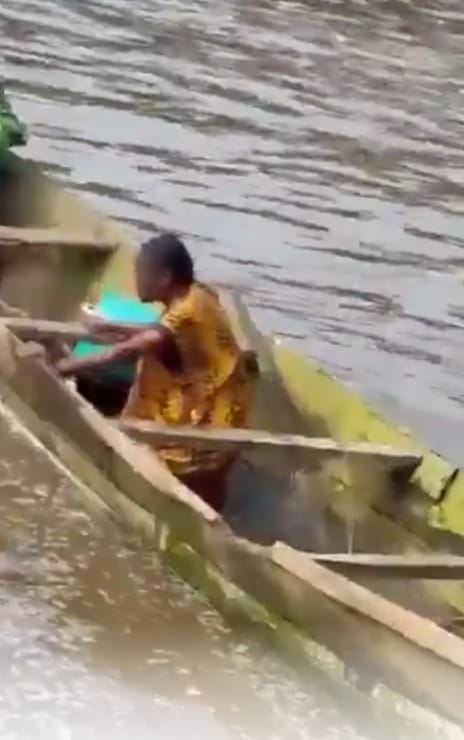
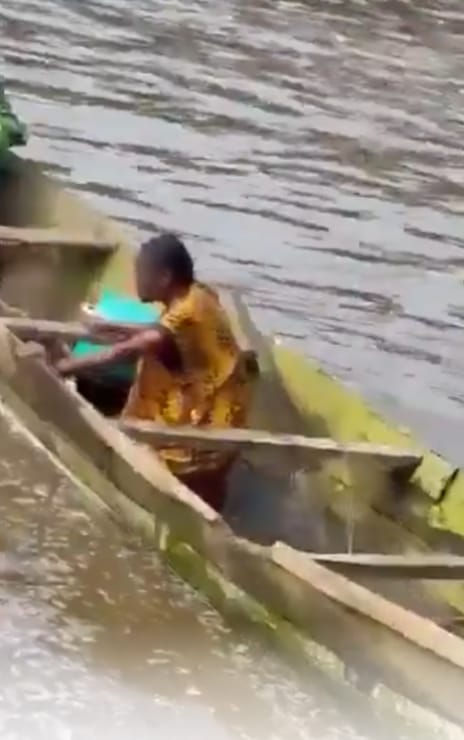
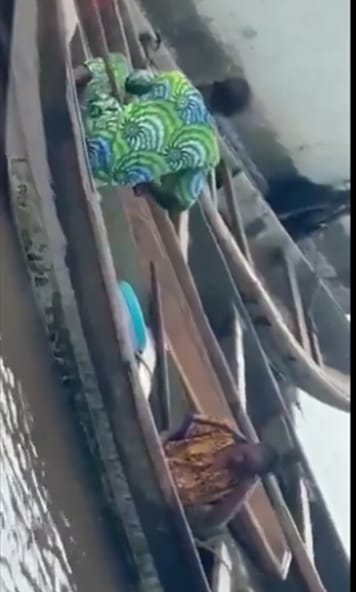
The unidentified woman jumped from the Idumota end of the bridge on the afternoon of Tuesday, August 4. Eyewitnesses said local boat operators working within the area reacted within moments, pulling her from the water before she could be swept further into the lagoon’s currents. Video circulating on social media shows her seated inside a wooden canoe, visibly disoriented, as bystanders on the bridge above shouted down, some pleading with the operators not to hand her over to the police, others audibly distressed and asking what could have driven her to the water’s edge.
Advertisement

A PATTERN AT THE SAME BRIDGE

This is not an isolated site incident. In July 2025, a separate woman was intercepted at the same Carter Bridge location, that time by police Rapid Response Squad officers on routine patrol, before she entered the water. Tuesday’s case had no such patrol presence. The outcome depended entirely on boat operators who happened to be working nearby.

Carter Bridge, opened in 1901, is one of only three crossings linking Lagos Island to the mainland, alongside Eko and Third Mainland bridges, and sits directly over lagoon waters used daily by commercial boat traffic, artisanal fishermen and ferry operators. That density of water traffic is precisely why informal operators keep ending up as the default emergency responders, they are simply the ones already on the water when someone goes in.

NO FORMAL WATER RESCUE MANDATE

Neither the Lagos State Waterways Authority (LASWA) nor the National Inland Waterways Authority (NIWA) operates a dedicated, publicised rapid-response rescue protocol for bridge-jump incidents on Lagos waterways, despite the lagoon’s role as a primary transport corridor for hundreds of thousands of commuters. Search-and-rescue capacity for road-based emergencies sits with the police and, in some cases, the Lagos State Emergency Management Agency (LASEMA) but water incidents routinely fall to whichever boat happens to be nearest, with no formal reporting chain back to state authorities on outcomes, casualty data or referral to mental health support afterward.

Advertisement

That gap matters beyond this single case. Nigeria records among the highest estimated suicide rates in West Africa according to World Health Organization modelling, yet has no national suicide prevention strategy comparable to those adopted elsewhere on the continent, and Lagos, a lagoon city where bridges double as the tallest accessible points over open water, has no publicly documented protocol connecting bridge surveillance, water rescue and post-rescue mental health referral into a single chain of response.
WHAT HAPPENED AFTER THE RESCUE

As of the time of filing, the woman’s identity, condition and the circumstances that led to the incident remain undisclosed. It is not yet known whether she was handed to police, taken to a hospital, or released, despite the pleas heard on video against police involvement, a detail that itself reflects a wider public wariness in Lagos toward treating suicide attempts as a criminal matter rather than a medical one. The Lagos State government had not issued a statement at the time of this report.

This story concerns a suicide attempt. If you or someone you know is struggling, please reach out to a trusted person, a doctor, or a crisis line for support.
Facebook Comments Box
Stay connected via Google News
Follow us for latest news and information on Nigeria water ways.
Add as preferred source on Google
Continue Reading

News

Fire Breaks Out at Bono Tank Farm in Olodi-Apapa, Cause Yet Unknown

Published

on

Stay connected via Google News
Follow us for latest news and information on Nigeria water ways.
Add as preferred source on Google

Fire Breaks Out at Bono Tank Farm in Olodi-Apapa, Cause Yet Unknown

By Oghenewoke Osaweren | Waterways News

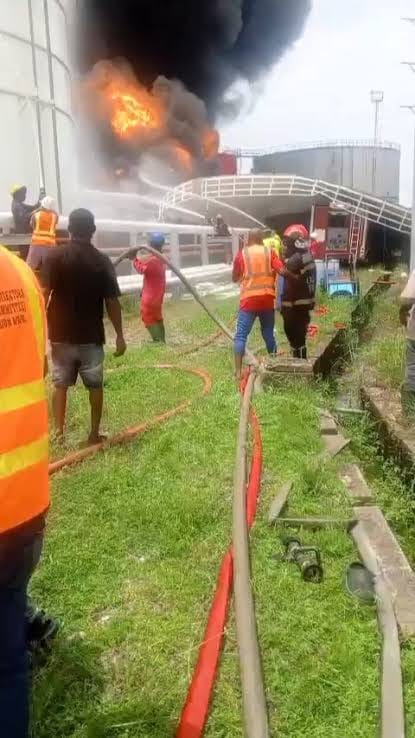
Firefighters were on Friday battling a blaze at Bono Tank Farm in the Coconut area of Olodi-Apapa, Lagos, one of several petroleum storage facilities lining the busy Apapa-Oworonshoki Expressway corridor.
The Lagos State Fire and Rescue Service confirmed the incident, with its spokesperson, Shakiru Amodu, stating that crews had been deployed to the scene to contain the fire and prevent it from spreading to adjoining tank farms and energy installations in the densely industrialised zone.

As at press time, the cause of the fire remained unconfirmed, and there was no official word on casualties or the scale of damage to the facility. Authorities said updates on the investigation and the outcome of firefighting efforts would follow as operations continued.

Nigeria Watch: The blaze once again puts a spotlight on the fire safety architecture around Apapa’s tank farm cluster, an area with concentrations of petroleum storage in the country. Recurring incidents of this kind raise familiar questions for regulators, terminal operators, and depot owners alike: are inspection regimes, firefighting readiness, and emergency evacuation protocols keeping pace with the volume and proximity of fuel storage in the corridor?

Advertisement

With Nigeria’s downstream sector expanding rapidly on the back of Dangote Refinery output and rising import substitution, incidents like this one underline why depot safety compliance deserves the same regulatory urgency being applied to port and vessel safety elsewhere in the sector.

Facebook Comments Box
Stay connected via Google News
Follow us for latest news and information on Nigeria water ways.
Add as preferred source on Google
Continue Reading

Security & Safety

Marine Litter Crisis Threatens Nigeria’s Blue Economy Ambitions as Waterways Choke on Plastic Waste

Published

on

Stay connected via Google News
Follow us for latest news and information on Nigeria water ways.
Add as preferred source on Google

Marine Litter Crisis Threatens Nigeria’s Blue Economy Ambitions as Waterways Choke on Plastic Waste

From Ikoyi waterfront to the Bonny-Port Harcourt corridor, plastic debris, abandoned fishing nets and industrial refuse are clogging Nigeria’s inland and coastal waterways — damaging vessels, imperilling livelihoods and undermining the nation’s maritime growth agenda.

By Okeoghene Onoriobe | Lagos Correspondent

Nigeria’s ambition to unlock the full economic potential of its blue economy is facing a stubborn and worsening adversary — marine litter. Across the country’s 853-kilometre coastline, and deep into its network of rivers, creeks, lagoons and inland waterways, plastic waste, styrofoam, discarded fishing gear and household refuse are accumulating at a rate that threatens to undermine the shipping, fisheries, tourism and inland transport sectors simultaneously.

The alarm has grown sharper in the days surrounding World Ocean Day, observed globally on June 8, which this year placed particular emphasis on the marine litter crisis and its direct threat to sustainable blue economy development — a framework central to the mandate of Nigeria’s Federal Ministry of Marine and Blue Economy.

Advertisement

Nigeria Among the World’s Top Plastic Waste Generators
The scale of the problem is stark. According to World Bank data, Nigeria generates an estimated 2.5 million tonnes of plastic waste annually, with only a fraction entering any form of recycling process. The overwhelming majority ends up in open dumpsites, drainage channels and, ultimately, waterways — driven by inadequate waste collection infrastructure, rapid urbanisation and poor environmental compliance culture.

The global picture is no less alarming. The United Nations warns that 14 million tonnes of plastic enter the world’s oceans every year — a figure projected to nearly double to 27 million tonnes by 2040 if current trajectories are not reversed. The economic cost, according to the UN, stands at approximately $13 billion annually, with over 817 marine species threatened. The United Nations Environment Programme (UNEP) has further estimated that plastic accounts for at least 85 per cent of all marine waste.
For Nigeria’s maritime sector specifically, the Regional Coordinator for Africa at Prevention of Marine Litter in the Gulf of Guinea (PROTEGO), Clem Ugorji, has put the country’s direct financial losses from poor waste management and marine litter at $1 billion per year — a figure that demands the attention of port operators, shipping companies, waterways transport concessionaires and maritime regulators alike.

Operational Hazards for Vessels and Waterway Operators
The consequences extend well beyond environmental degradation. For Nigeria’s inland waterways transport (IWT) sector — already strained by underinvestment, ageing fleets and safety concerns — marine litter represents a direct operational and safety hazard.

The Lagos Area Manager of the National Inland Waterways Authority (NIWA), Sarat Braimah, has raised the alarm in clear terms. Floating debris, she warned, is routinely sucked into vessel water intakes, wrapping around propeller shafts and clogging engine cooling systems. The result is sudden engine failure mid-journey — leaving passenger ferries, water taxis and speedboats dangerously exposed to capsizing or collision with larger commercial vessels navigating shared waterways.

Advertisement

Braimah noted that once plastics, cans and nylon bags enter water bodies rather than shore-based waste receptacles, the damage is immediate: marine life is choked, water quality degrades, and toxins enter the aquatic food chain that coastal communities depend on for sustenance and income.

The situation deteriorates markedly during the annual rainy season, when residents dump refuse into drainage channels already clogged with accumulated waste, and floodwaters carry massive volumes of debris directly into creeks, lagoons and offshore waters — compounding a maritime environmental emergency that recurs year after year.

Fisheries, Coastal Communities and the Hidden Human Cost
Beyond vessel operations, the impact on Nigeria’s artisanal fishing communities is severe. Fishermen across coastal and riverine states report persistently damaged gear, declining catches and increasingly contaminated fishing grounds. Scientists have raised growing concerns about microplastics — particles formed as larger plastic items break down — which now enter marine food chains and, through seafood consumption, ultimately reach the human population. UNEP has warned that plastic pollution now constitutes a direct threat to food security and public health at a global scale.

Coastal communities in Rivers, Bayelsa, Delta, Lagos and other littoral states, many of which depend almost exclusively on fishing and waterway-based trade, bear the sharpest end of this crisis — absorbing health risks, economic losses and environmental degradation simultaneously.

Advertisement

Private Sector Steps Up: NSML’s Clean Waterways Initiative
In the absence of a fully integrated national marine litter strategy, it is increasingly the private maritime sector that has moved to fill the gap. One notable actor is NLNG Shipping and Marine Services Limited (NSML), which has expanded its Clean Waterways Initiative (CWI) — a corporate social responsibility programme targeting the waterway corridor between the NLNG Jetty in Port Harcourt and the operating terminal on Bonny Island in Rivers State.

Operating through a “Triple A” framework of Awareness, Advocacy and Action, NSML engages riverine communities on the health and economic dangers of plastic pollution, partners with local governments to improve waste disposal and recycling infrastructure, and conducts quarterly large-scale clean-up exercises to physically remove debris from affected water bodies. The company has recently expanded these activities to include the Bonny Island waterfronts on a regular basis.

NSML Chief Executive Abdulkadir Ahmed described the initiative as a direct response to the growing volume of plastic waste and debris entering rivers, creeks and coastal waters — and stressed that lasting progress requires both regulatory backing and individual behavioural change.

“Advocacy is about engaging government agencies and regulatory bodies so that we can have the necessary backing to take action,” Ahmed said. “We are beginning to see some positive impact from these efforts, and we are not alone in this fight because plastic pollution is a global issue.”
Ahmed was forthright that clean-up exercises, though essential, are insufficient on their own. What is needed, he argued, is consistent individual action and a fundamental reduction in dependence on single-use plastics — combined with the enforcement frameworks and industry accountability that only government can provide.

Advertisement

IMO Sets 2030 Zero-Discharge Target
At the global regulatory level, the International Maritime Organisation (IMO) has sharpened its response. Secretary-General Arsenio Dominguez, in his World Oceans Day statement, announced the adoption of the IMO’s 2026 Strategy and Action Plan aimed at eliminating plastic waste discharges from shipping, with a headline target of zero plastic discharge to sea from ships by 2030.

Dominguez acknowledged that progress is being recorded on pollution control, biodiversity protection and climate action within the global shipping industry, but stressed that considerably more coordinated international effort is required. He called specifically for stronger regulatory frameworks to curb plastic pollution, address underwater radiated noise, and manage the spread of transboundary marine species — and urged a fundamental rethinking of humanity’s relationship with the ocean.

Nigeria Watch: What This Means for the Maritime Sector
For Nigeria’s maritime and blue economy stakeholders, the convergence of World Ocean Day, the IMO’s 2030 commitment and NSML’s expanded private-sector initiative carries a pointed message: the window to get ahead of the marine litter crisis is narrowing.

Nigeria still lacks the fully integrated national marine litter strategy that the scale of its waterways challenge demands — one that combines waste management reform, robust recycling infrastructure, regulatory enforcement, public education and industry-wide accountability. The Federal Ministry of Marine and Blue Economy, NIMASA, NIWA, LASWA and the Nigerian Ports Authority each have roles to play, but coordination between them on environmental governance remains limited.

Advertisement

The stakes for the maritime sector are concrete. Navigational hazards from floating debris inflate vessel maintenance costs, increase accident risk on passenger ferry routes, and degrade the operating environment for port authorities, shipping companies and terminal concessionaires. Every kilometre of waterway choked with litter is a direct tax on trade competitiveness and investor confidence in Nigeria’s blue economy promise.

With the IMO’s 2030 zero-discharge target now formally on the table, Nigeria’s maritime operators — and the regulators that oversee them — face a tightening timeline to demonstrate that the country’s waterways can meet international environmental governance standards. The infrastructure investment, policy coherence and enforcement will required to do so is not trivial. But the cost of inaction, measured in vessel damage, lost catches, degraded coastlines and stunted blue economy growth, will ultimately prove far higher.

Waterways News | waterwaysnews.ng

Advertisement
Facebook Comments Box
Stay connected via Google News
Follow us for latest news and information on Nigeria water ways.
Add as preferred source on Google
Continue Reading

Trending