Blue Economy
HORMUZ CRISIS: TRUMP ORDERS US NAVY TO ESCORT OIL TANKERS AS 3,200 VESSELS TRAPPED IN GULF

HORMUZ CRISIS: TRUMP ORDERS US NAVY TO ESCORT OIL TANKERS AS 3,200 VESSELS TRAPPED IN GULF

Iranian threats to burn passing ships spark global shipping paralysis; freight rates and insurance costs soar
By Okeoghene Onoriobe | Waterways News Correspondent | Lagos
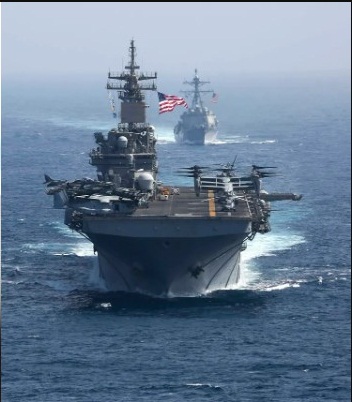
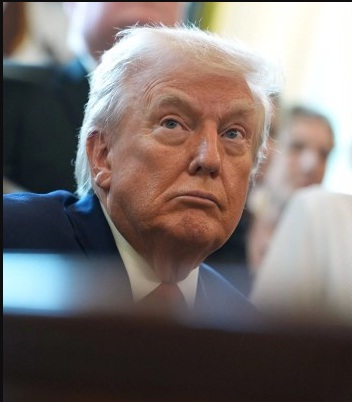
United States President Donald Trump has ordered the US Navy to begin escorting oil tankers through the strategically vital Strait of Hormuz, as a military conflict between the US-Israel coalition and Iran plunges global shipping into crisis and threatens energy flows to markets worldwide — including Nigeria and the wider African continent.
In a post on his Truth Social platform on Tuesday, Trump declared: “If necessary, the United States Navy will begin escorting tankers through the Strait of Hormuz, as soon as possible,” adding that the US would “ensure the FREE FLOW of ENERGY to the WORLD.” He also directed the US International Development Finance Corporation (DFC) to provide risk insurance and guarantees for all maritime trade in the region, a measure covering all shipping companies, not just energy vessels.

3,200 Vessels Stranded as Iran Closes the Strait
The crisis escalated dramatically after Iranian commanders declared the Strait of Hormuz closed and issued stark warnings that the Revolutionary Guards and the regular navy would “set those ships ablaze” if vessels attempted to transit. As of the latest count, some 3,200 ships remain trapped inside the Persian Gulf, representing roughly four per cent of global shipping tonnage. The figure includes 112 crude tankers, 114 containerships, and approximately 500 vessels waiting off the coasts of the UAE and Oman.
“If necessary, the United States Navy will begin escorting tankers through the Strait of Hormuz, as soon as possible” POTUS Donal Trump
The strait, which sits between Iran and Oman, is the only maritime outlet from the Gulf to the open oceans and is the artery through which the oil output of Iran, Saudi Arabia, Iraq, Kuwait, Qatar, Bahrain and the United Arab Emirates reaches world markets. Market analysts at Kpler described the situation not as a formal blockade but as “risk-driven paralysis,” noting that the strait normally handles 80 to 100 ship transits per day and carries roughly a fifth of global oil consumption. Bypass pipelines, they warned, lack the capacity to offset a sustained outage.
Freight Rates and Insurance Costs Surge
The market reaction has been severe. Very Large Crude Carrier (VLCC) freight rates shot to extraordinary levels on Monday, with the benchmark TD3C route from the Middle East to China quoted at $423,700 per day — an increase of over $205,000 from the previous day. Brokers cautioned, however, that confirmed fixtures at such levels were scarce.
War risk insurance has also become a critical concern. More than half of the world’s largest Protection and Indemnity (P&I) clubs have announced they will cease war risk cover for ships entering the Persian Gulf from 5 March, with automatic termination of protection for vessels transiting specified adjacent waters. The move is expected to sharply raise voyage costs and push shipowners to divert around the Cape of Good Hope, adding considerable time and expense to voyages.
Ships Damaged; Ports and Energy Infrastructure Struck
Iranian attacks have already inflicted real damage on the maritime and energy sectors. Clarksons Research reported at least six vessels damaged, including the Stena Imperative, Sea La Donna, Hercules Star, Ocean Electra, Skylight and MKD Vyom, alongside multiple strikes on ports and energy facilities. A strike on a Bahrain port on Monday killed one shipyard worker, injured two others and damaged a US-flagged tanker. US Secretary of State Marco Rubio has warned that the “hardest hits” on Iran are “yet to come,” with no indication of how long the military campaign will last.
LNG, LPG, Containers and Dry Bulk: A Sector-by-Sector Impact
Beyond crude oil, the crisis is destabilising multiple shipping segments. The Ras Laffan LNG terminal has gone offline, sending regional gas prices sharply higher and pushing short-term LNG carrier rates up by more than 20 per cent. LPG flows — about 30 per cent of which pass through Hormuz — face similar disruptions to both supply and freight.
Container shipping faces limited direct exposure through Hormuz, with only about two per cent of box trade transiting the strait. Nonetheless, the indirect impact is material: major lines including MSC have suspended all bookings to the Middle East until further notice. Rerouting around the Cape of Good Hope is expected to intensify port congestion in both Europe and Asia. Dry bulk shipping faces the least direct exposure, though secondary delays and congestion are anticipated.
What This Means for Nigeria and Africa
For Nigeria and other African oil importers, the Hormuz crisis carries significant implications. Oil and gas prices have already risen sharply in response to the conflict, and any prolonged disruption to Gulf supply would further tighten global energy markets and raise import costs. Nigerian refineries and power sector operators that depend on imported petroleum products could face higher procurement costs, while the prospect of global tanker diversion to the Cape route could affect vessel availability and freight rates on West African trade lanes.
Waterways News will continue to monitor developments in the Strait of Hormuz and their implications for Nigerian and West African maritime trade.


Blue Economy
NSC BOSS WARNS SHIPPING FIRMS, FREIGHT FORWARDERS: RETURN TO THE TABLE OR FACE FEDERAL ESCALATION
NSC BOSS WARNS SHIPPING FIRMS, FREIGHT FORWARDERS: RETURN TO THE TABLE OR FACE FEDERAL ESCALATION
By Okeoghene Onoriobe | Waterways News Correspondent, Lagos
The Nigerian Shippers’ Council (NSC) has issued a firm warning to foreign shipping companies and clearing agents locked in a bitter standoff over recently approved port tariff increases — resolve your differences or face intervention at the highest levels of government.
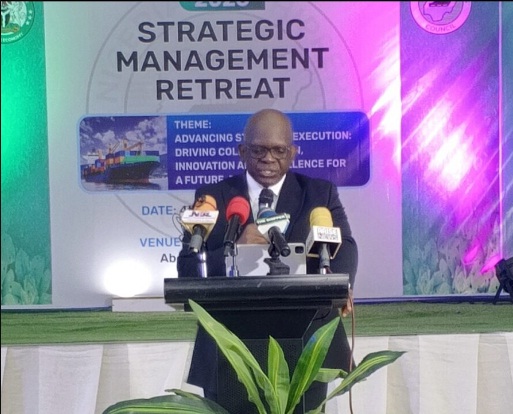
Dr. Pius Akutah, Executive Secretary of the NSC, delivered the stark message while speaking to journalists on the sidelines of the Council’s management retreat in Abeokuta, making clear that the regulator will not stand idle as the dispute threatens to destabilise operations at Nigeria’s seaports.
Akutah revealed that the Council had twice declined requests from shipping companies to raise charges before approving the current tariff hike — a decision he said was driven not by profit motives, but by the need to address mounting operational costs facing maritime operators.
“I think that they need to work together more harmoniously to resolve these issues. We, as a regulator have given the approval. It is left for the shipping companies and the freight forwarders to come to a harmonious stand where they can implement this,” Akutah said.
The NSC boss, however, stressed that any resolution must involve genuine compromise from both sides, cautioning that a deadlock serves no one.
“There must be a reason for people to move and shift ground. It should be a give-and-take relationship. Whenever there is a standstill and nobody is moving, then there is a problem,” he warned.
Akutah disclosed that the Council had already attempted to broker peace between the warring parties, but the dispute had dragged on — prompting the renewed public call for both sides to get back to the negotiating table.
“Recently, we tried to see how we can wade into this to see how they can resolve this, but this has kept going on. We are calling on both sides to go back to the table and see how they can resolve this issue and move on,” he said.
With patience wearing thin, Akutah put both camps on notice that federal involvement was now on the cards if the impasse continues.
“We cannot sit and watch this without taking steps. It will get to a point where we can escalate this to the level of the minister, if they fail to resolve it,” he stated.
The NSC chief rounded off with a broader warning to all maritime stakeholders, cautioning that the sustainability of Nigeria’s entire shipping sector depends on a spirit of cooperation.
“If they say there won’t be any hike in charges and at the end of the day the cost of operation has hindered them from carrying out their functions, then we will not have a maritime sector,” he said.
Blue Economy
$10BN Cargo Crises: Over 270,000 TEUs Stranded as Global Shipping Giant Halt Gulf Bookings — Nigeria’s Trade Lanes at Risk
$10BN Cargo Crises: Over 270,000 TEUs Stranded as Global Shipping Giant Halt Gulf Bookings — Nigeria’s Trade Lanes at Risk
By Okeoghene Onoriobe | Waterways News Correspondent | Lagos
The global shipping industry is facing one of its most severe disruptions in recent memory, as leading container carriers suspend cargo bookings across the Arabian Gulf amid intensifying Middle East tensions — a crisis that threatens to ripple through Nigeria’s import-dependent economy and raise costs at the ports of Lagos, Apapa, and Tin Can Island.
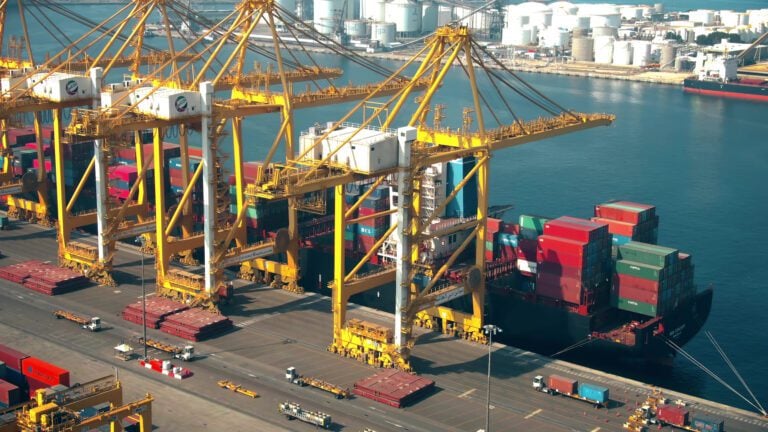
Industry data now confirms that more than 270,000 twenty-foot equivalent units (TEUs) — valued at an estimated $10 billion — are stranded at Gulf ports or adrift in surrounding waters, with no clear timeline for resolution.
Ben Tracy, Vice President of Strategic Business Development at shipping intelligence firm Vizion, described the scale of the paralysis as staggering. “You are looking at about $10 billion worth of cargo stranded at ports or in the Arabian Gulf. That’s over 270,000 TEUs,” Tracy stated.
Global shipping giant A.P. Moller–Maersk, which operates several key routes serving West Africa including Nigeria, has suspended all cargo booking acceptance for shipments to and from ports in the United Arab Emirates, Iraq, Kuwait, Qatar, Bahrain, Saudi Arabia, and most Omani ports, with the exception of Salalah. The Danish carrier currently has approximately 14 vessels with a combined capacity of roughly 70,000 TEUs either trapped or operating in the affected zone.
French carrier CMA CGM, another major player on Nigeria-bound trade lanes, has halted hazardous cargo bookings to multiple Middle Eastern destinations and suspended Suez Canal transits entirely. Between 14 and 17 of its vessels — representing close to 70,000 TEUs — are reported to be sheltering or stranded in the region.
German liner Hapag-Lloyd has gone further, implementing an immediate and comprehensive booking suspension covering all cargo types to and from Gulf ports, including those in the UAE, Iraq, Kuwait, Qatar, Bahrain, Oman’s Sohar terminal, and Saudi Arabia’s Dammam and Jubail ports. Hapag-Lloyd’s Chief Executive Officer, Rolf Jansen, confirmed that approximately 50,000 TEUs belonging to the carrier have been caught in the conflict zone.
Ocean Network Express (ONE) and COSCO Shipping Lines have also announced temporary booking suspensions on critical Gulf routes. ONE’s CEO, Jeremy Nixon, noted that around 100 container vessels are among approximately 750 ships currently navigating the Strait of Hormuz — a choke point through which a significant portion of global energy and trade cargo passes. COSCO, meanwhile, has issued a navigation advisory ordering vessels to prioritise crew safety by reducing speed, anchoring, or relocating to safer anchorages, with logistics sources estimating that six of its ships are directly affected. Shipping data firm Kpler adds that MSC has between 15 and 16 vessels either trapped or sheltering in the Gulf.
The disruption, experts warn, is not confined to vessels already at sea. Cargo waiting at origin ports worldwide — including goods destined for Nigeria from Asian and European manufacturers — is equally frozen. “Containers destined to the region are waiting in their origin ports. These containers have nowhere to go,” Tracy said.
For Nigerian importers and manufacturers who depend heavily on goods transiting through Gulf hubs, the consequences could prove severe. Logistics firms have warned that carriers are now invoking emergency clauses written into Bills of Lading, which allow them to divert vessels to alternative ports or terminate voyages ahead of schedule. SEKO Logistics, in a notice to clients, cautioned that shippers could face a cascade of additional charges — including container handling fees, storage costs, diversion surcharges, and onward transportation expenses.
MSC has already moved to monetise the disruption, reportedly imposing an $850 charge per container for diverted cargo — a levy that, applied across all affected shipments, could yield approximately $158 million in fees for the carrier alone.
The unfolding crisis at the Strait of Hormuz adds fresh urgency to longstanding calls within Nigeria’s maritime sector for supply chain diversification, stronger bilateral shipping agreements, and accelerated development of domestic port infrastructure capable of absorbing such global shocks. For now, Nigerian traders, port operators, and logistics managers will be watching developments in the Gulf closely — knowing that what happens in the Hormuz could very quickly be felt on the Lagos shoreline.
Blue Economy
Coastal Communities Key to Blue Economy Success, Says GMA Founder Onakughotor at Ondo Summit

Coastal Communities Key to Blue Economy Success, Says GMA Founder Onakughotor at Ondo Summit
By Okeoghene Onoriobe | Waterways News Correspondent
The President and Founder of the Global Maritime Academy (GMA), Mr. Ejiro Dennis Onakughotor, has declared that Nigeria’s Blue Economy ambitions can only succeed if coastal communities are placed at the heart of its implementation — and not treated as afterthoughts.
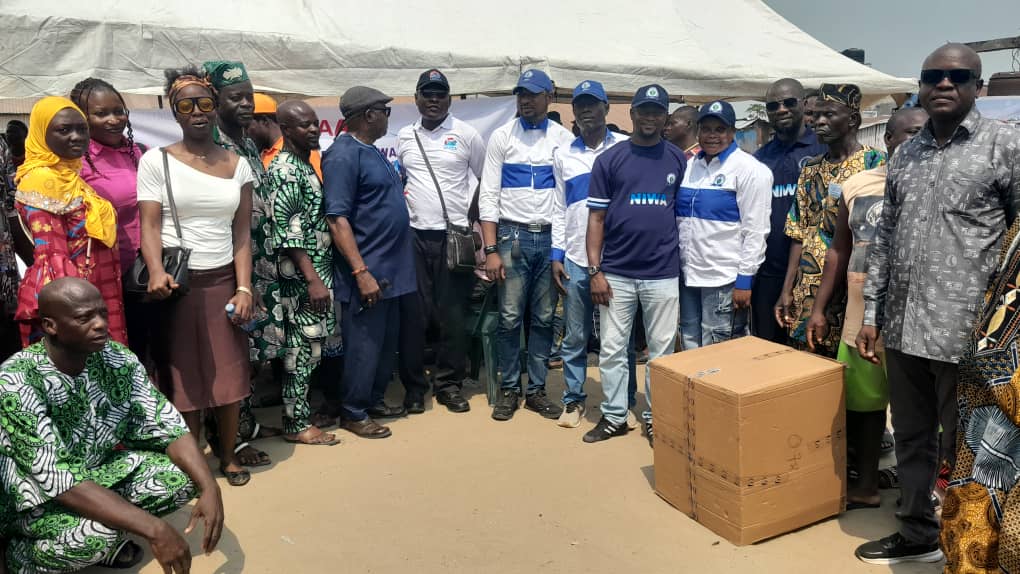
Onakughotor made this assertion at the maiden Maritime Summit on Marine and Blue Economy held in Igboegunrin Kingdom, Ondo State, where traditional rulers, maritime experts, and key government stakeholders gathered to chart a new course for Nigeria’s ocean-based economic future.
Themed “The Marine and Blue Economy Policy and Its Implementation: The Game Changer to the Nigerian Economy,” the summit drew overwhelming support from participants who expressed readiness to help Nigeria harness its vast marine and coastal resources for sustainable national growth.
Grassroots-Driven Development
Describing coastal communities as “the heartbeat of Nigeria’s emerging ocean economy,” Onakughotor argued that investment in the Blue Economy must flow from the ground up. He stressed that the full implementation of Nigeria’s marine and ocean-based development policies must be community-driven to achieve genuine national economic transformation.”This gathering is more than a conference — it is a turning point for coastal development, economic diversification, and inclusive growth,” he said.
“This gathering is more than a conference — it is a turning point for coastal development, economic diversification, and inclusive growth”
He noted that the establishment of the Federal Ministry of Marine and Blue Economy marked a deliberate pivot away from Nigeria’s longstanding oil dependence, aligning the country with a global ocean economy valued at over $1.5 trillion.
Jobs, Infrastructure and Opportunity
Onakughotor cited Federal Government projections of creating three million jobs within four years across fisheries, aquaculture, shipping services, coastal tourism, and maritime security — sectors in which riverine and coastal communities like Igboegunrin stand to benefit most.
He also highlighted planned government investments in smart ports and the dredging of more than 2,000 kilometres of inland waterways, positioning host communities along Nigeria’s water corridors as emerging hubs for maritime transport and logistics.
Onakughotor urged youths in Igboegunrin Kingdom and other coastal areas to proactively acquire relevant skills and position themselves to take advantage of the opportunities ahead.
GMA’s Community-Driven Agenda
As a practical step toward capacity building, the Global Maritime Academy president unveiled a community-driven initiative that includes:
Vocational training for local cadets and youths in marine engineering, shipping management, logistics, and maritime security
Upskilling for artisanal fishers in modern aquaculture practices, sustainable fishing methods, and improved post-harvest handling
Coastal safety and surveillance training to strengthen waterway security for trade, tourism, and community wellbeing
Scholarships for deserving students from Igboegunrin Kingdom to access maritime education and vocational training
Onakughotor also made a passionate appeal to indigenes of Igboegunrin Kingdom — at home and in the diaspora — to support the establishment of a GMA Vocational Centre in the community, describing it as a future hub for skills acquisition, youth empowerment, and long-term economic transformation.
Sustainable Roadmap
The summit outlined a broader development roadmap anchored on integrated coastal management, digital inclusion through port automation and marine technologies, and community-owned eco-tourism designed to preserve local culture while generating income for households.
Closing his remarks, Onakughotor reminded participants that the Blue Economy is ultimately a people-centred agenda — one that directly affects fishermen, students, and local entrepreneurs. He called on all stakeholders to move beyond dialogue and take decisive action in unlocking shared prosperity along Nigeria’s coastlines.
Dignitaries
Prominent figures at the event included the Ondo State Governor, represented by his Senior Special Assistant on Marine and Blue Economy, Hon. Olugbemiro Aladenusi; the Chief of Staff to the Governor, Hon. Oluwasegun Omojuwa; and the royal host, Phillip Olatunji Kalejaye, the traditional ruler of Igboegunrin Kingdom.
Waterways News | Covering Nigeria’s Maritime and Inland Waterways Sector