

Maritime Security and Safety
IMO Boss Demands Crackdown on False Flags, Substandard Ships as Hormuz Seafarer Death Toll Hits 25

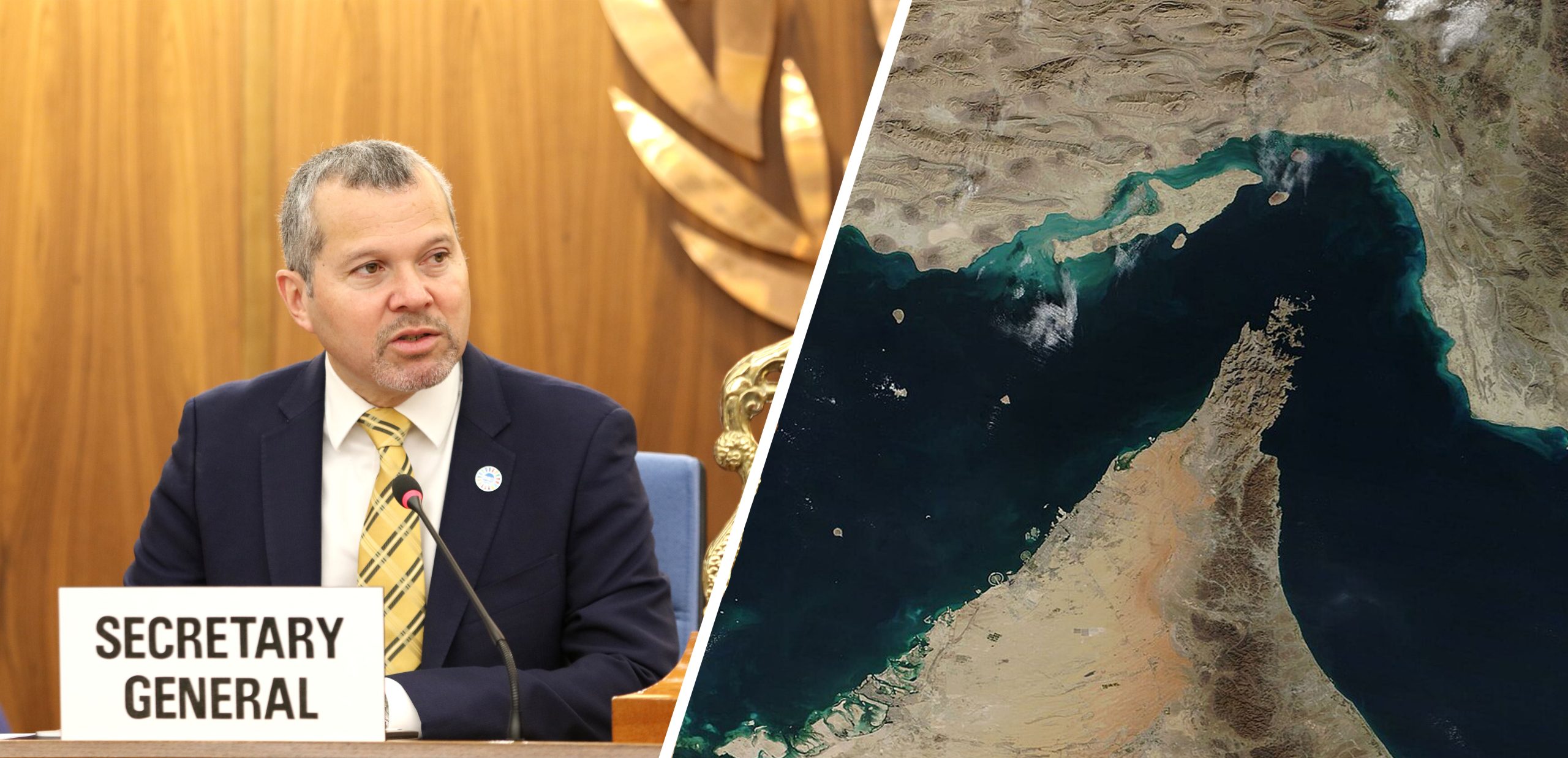

IMO Boss Demands Crackdown on False Flags, Substandard Ships as Hormuz Seafarer Death Toll Hits 25
Arsenio Dominguez Tells Governments to Enforce Safety Rules as Rogue Vessels Add to Seafarers’ Peril
By Okeoghene Onoriobe | Waterways News
The Secretary-General of the International Maritime Organization (IMO), Arsenio Dominguez, has called on governments to enforce international shipping regulations more strictly in the Strait of Hormuz. He warned that unsafe operating practices are adding to the dangers already facing seafarers in the conflict zone.
In a statement on Wednesday, Dominguez said some vessels are transiting the waterway without meeting basic safety requirements, including those under the International Convention for the Safety of Life at Sea (SOLAS).

The IMO has verified 133 incidents involving merchant ships since the conflict began on 28 February. As of 10 November, these incidents had killed 25 seafarers, with others injured or missing. The latest death followed an attack on the tanker M/T VELOS SAPPHIRE in the Strait on 5 November.
Dominguez singled out four practices: the use of substandard vessels, the concealment of IMO identification numbers, fraudulent ship registrations and false flags. He said they weaken maritime safety and make it harder to protect lives at sea.
“IMO’s technical and operational regulations are there to protect seafarers, ships and the marine environment,” he said. “They must be respected and enforced effectively.”
He urged flag, port and coastal states to act against violations within their jurisdictions, in line with international law. He also asked shipowners and operators to avoid commercial activity that exposes crews to unacceptable risk.
The statement follows the IMO Council session in London from 2 to 6 November. There, member states condemned attacks on merchant shipping and called for stronger protection of seafarers and for safe, uninterrupted navigation through vital international waterways. The IMO has also flagged a rise in piracy and armed robbery in the Western Indian Ocean and Gulf of Aden, with 17 attempted or actual incidents recorded since the start of 2026.
Dominguez renewed calls for a political resolution and for restoring a safe, internationally recognised framework for navigation through the Strait. He warned that the effects reach beyond shipping, threatening global trade and raising living costs for millions. “It is imperative for Governments to tackle the root causes of this conflict,” he said.
NIGERIA WATCH
Why this matters at home. Dominguez’s call to flag, port and coastal states lands squarely on Nigeria. It is an IMO Council member and a coastal state with its own flag, registry and port state control obligations. The concealed IMO numbers and false flags he described are the same grey-market tactics that make weak enforcement dangerous everywhere, including in Gulf of Guinea waters.
Council credibility is tested. Nigeria used the 138th Council session to press seafarer welfare and maritime security. A statement from the IMO’s own chief now puts the question of enforcement, not just advocacy, in front of every Council member.
Stakeholders should expect pressure on regulators like NIMASA to show that port state control inspections, ship registration vetting and flag state oversight are tight.
The cost reaches Nigerian shippers. The Hormuz crisis keeps driving up war-risk insurance, freight rates and cargo uncertainty. Importers and shippers already carrying those costs deserve clarity from NIMASA, the Nigerian Ports Economic Regulatory Authority and the Ministry of Marine and Blue Economy on what is being done to cushion them.
Nigerian seafarers are exposed too. Nigerians crew foreign-flagged vessels, and the question of who protects them when ships operate outside the rules cannot be left to shipowners alone.
The accountability question. Nigeria’s maritime leadership has been vocal at global forums. The test is whether that voice is matched by visible enforcement on Nigerian waters, where the same loopholes the IMO describes can be exploited.
Waterways News will keep tracking whether talk at the IMO becomes action at home.
Maritime Security and Safety
Russian Navy Training Ship Perekop Calls at Lagos, Drills with Nigerian Navy as Moscow–Abuja Maritime Ties Deepen
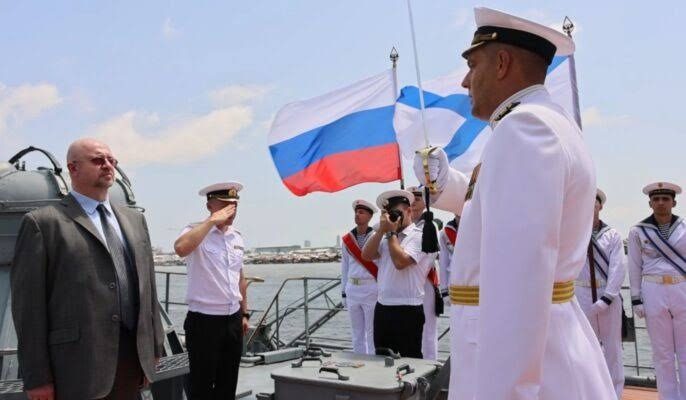
Russian Navy Training Ship Perekop Calls at Lagos, Drills with Nigerian Navy as Moscow–Abuja Maritime Ties Deepen
Russia’s Baltic Fleet Trainer Joins Nigerian Navy at Sea
By Okeoghene Onoriobe | Waterways News | Lagos
A Russian Navy training ship, Perekop, spent three days in Lagos this month. Her visit included joint exercises with the Nigerian Navy and is the latest sign of growing defence and maritime engagement between Moscow and Abuja.
The vessel belongs to Russia’s Baltic Fleet. According to a statement from the Russian Embassy in Nigeria, she arrived on 6 November and departed on 8 November 2026. Russian diplomats and Nigerian Navy officers received her crew. The programme included official engagements, exhibitions and joint manoeuvres between Perekop and a Nigerian Navy patrol vessel, giving personnel of both navies a chance to exchange professional knowledge and strengthen operational ties.
According to details of the at-sea phase that came from the Baltic Fleet’s press service, after leaving Lagos, Perekop’s crew conducted joint maneuvers with the Nigerian Navy before docking at Cotonou, Benin. The exercise involved the Nigerian Navy patrol vessel Deep Blue Abuja and a Nigerian Navy AW-139 shipborne helicopter, with sailors sharing experience on navigation safety and coordinated action.
The Lagos call is one leg of a much longer deployment. Perekop’s long-distance voyage began in early July and runs until mid-December, covering roughly 30,000 nautical miles. Earlier on the same voyage, in Pointe-Noire, Republic of the Congo, twelve Congolese cadets boarded for practical training.
Nigeria Watch
The significance lies less in the ship than in the pattern. Nigeria and Russia signed a military-technical cooperation agreement in 2021. It provides a legal framework for equipment supply and servicing, personnel training and technology transfer. In February 2026, Russia’s ambassador in Abuja said some projects under those agreements had already started. A port call with joint drills is the visible, low-cost end of that relationship.
Three questions are worth following for Nigeria’s maritime stakeholders:
Deep Blue Project: The Nigerian Navy chose Deep Blue Abuja, an asset of the Deep Blue Project, for the drill. The exercise tests whether those platforms are being integrated into real operational training, beyond showcase events.
Gulf of Guinea security: Perekop is moving along the regional coast, with calls in Congo, Nigeria and Benin. Coastal states are being courted by several foreign navies, and Nigeria’s Navy must keep a clear line between training exchange and strategic dependence.
Delivery over diplomacy: Waterways News has consistently tracked the gap between maritime announcements and outcomes. Port calls and exhibitions do not secure Nigerian waters. The test is whether this cooperation produces trained personnel, serviceable equipment and measurable gains in patrol capacity, including for the inland and coastal waterways where small operators face daily insecurity.
The Nigerian Navy is yet to publish its own account of the visit. Waterways News will continue to track this development and keep our readers informed. We also encourage Nigerian stakeholders to ask what the exercise was meant to achieve.
Maritime Security and Safety
NIMASA, China Sign Six-Pillar Maritime Pact in Shanghai, Pledging Seafarer Training and Safety Cooperation
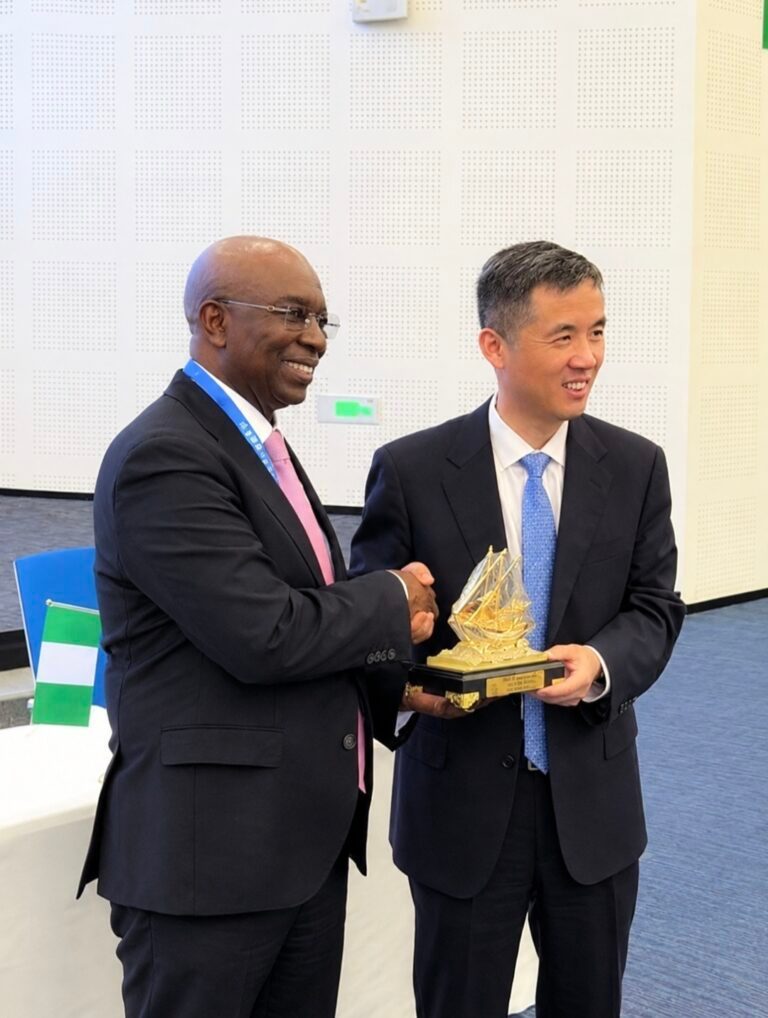
NIMASA, China Sign Six-Pillar Maritime Pact in Shanghai, Pledging Seafarer Training and Safety Cooperation
Mobereola: MoU must deliver “tangible outcomes”, not just ceremony
By Raymond Gold | Waterways News
The Nigerian Maritime Administration and Safety Agency (NIMASA) has signed a Memorandum of Understanding (MoU) on Maritime Cooperation with the China Maritime Safety Administration (China MSA) in Shanghai, the People’s Republic of China.
The agreement sets out a framework for cooperation in six areas:
Maritime safety and navigation
Marine environmental protection
Seafarer training, certification and rights protection
Marine casualty and incident investigation
Maritime transportation facilitation
Maritime security
The signing took place at the Shanghai Seafarers Assessment Model Centre. NIMASA’s Director-General, Dr. Dayo Mobereola, called the pact a historic milestone in Nigeria-China relations and said it must be turned into practical programmes with real benefits for both countries’ maritime sectors.
“This partnership must deliver tangible outcomes for our maritime industries,” Mobereola said, describing the MoU as more than a formal agreement.
He added that President Bola Ahmed Tinubu values Nigeria’s long relationship with China and is committed to deepening cooperation in the maritime sector. He said this aligns with the Renewed Hope Agenda and the mandate of the Federal Ministry of Marine and Blue Economy under Minister Adegboyega Oyetola.
The China MSA Director-General, Mr. Xu Wei, reaffirmed Beijing’s commitment to closer maritime ties with Nigeria. He noted China’s interest in Nigeria’s maritime development and the progress it has made, and pledged continued support for sustainable growth in both countries’ maritime industries.
The agreement is expected to enable technical cooperation, knowledge-sharing, capacity development and the exchange of best practices, while strengthening institutional links between the two agencies. Mobereola presented a plaque to Xu Wei at the ceremony.
NIGERIA WATCH
Strong on paper; the test is delivery. The MoU’s six areas cover real needs for Nigeria, especially seafarer training and certification and casualty investigation. But NIMASA has signed many MoUs recently, including with the Nigerian Navy, the World Maritime University, the ITC-ILO and the Tanzania Shipping Agencies Cooperation (TASAC). The sector’s question is which of them have produced measurable results, such as cadets trained, certificates recognised or investigations completed. Mobereola himself has set “tangible outcomes” as the yardstick.
Where are the timelines? The reports on the signing mention no implementation schedule, budget, training quotas or review mechanism. Stakeholders should press NIMASA to publish these, along with how Nigerian seafarers will access the Chinese training facilities.
Seafarer welfare. The “rights protection” element matters to Nigerian seafarers working on foreign-flagged vessels. It should be tested against a record of crew welfare problems, and it comes as the IMO Council has pressed for stronger protection of seafarers in conflict zones.
Small operators left out? As is usual with NIMASA’s international agreements, nothing in the MoU speaks to the informal inland waterway operators represented by WABOTAN and ATBOWATON. Safety training, life-saving equipment and navigation standards from the Shanghai partnership should reach them too, not only the deep-sea sector.
Balanced partnerships. Nigeria’s maritime diplomacy now includes its IMO Council seat and ties with several partners. China’s backing for that seat was reported earlier, so the Shanghai pact should be read as part of that wider strategy, and Nigeria should insist on genuine skills and technology transfer.
Waterways News will track implementation of the MoU and follow up with NIMASA.
Maritime Security and Safety
IMO Council Mourns Slain Seafarers, Demands Stronger Protection as Maritime Conflicts Deepen
IMO Council Mourns Slain Seafarers, Demands Stronger Protection as Maritime Conflicts Deepen
Dominguez warns merchant ships remain exposed from Hormuz to the Black Sea as 138th Council session ends in London
By Okeoghene Onoriobe | Waterways News
Member states at the International Maritime Organization (IMO) used the opening of the Council’s 138th session to mourn seafarers killed in recent attacks and to demand firmer protection for civilian mariners.
Council met in London from 2 to 6 November, with Russia and Iran putting security in the Black Sea and the Strait of Hormuz at the centre of discussions. On 2 November, Secretary-General Arsenio Dominguez said commercial shipping remained exposed to attack in the Strait of Hormuz, the Red Sea, Bab el-Mandeb, the Eastern Mediterranean, the Black Sea and the Sea of Azov.
The mourning was driven by a run of deaths this year. Five seafarers reportedly died on 29 September during the rescue of the hijacked HONOUR 25 in Somali waters, and several others were seriously injured. In all, 44 seafarers were freed from three vessels. Dominguez noted that 22 seafarers remain captive aboard the ASANA, which was seized earlier this year, and urged continued effort to secure their release.
The Strait of Hormuz remains the deadliest flashpoint. The IMO had verified at least 70 attacks on international shipping there, with 19 seafarers killed, by its late-August assessment. A tally reported by gCaptain put the seafarer death toll at 24 as of 5 November.
Dominguez has repeatedly insisted that seafarers are civilians doing their jobs. He has said they should never become casualties of conflicts to which they are not a party.
Member states echoed the call. Liberia renewed its appeal for seafarer protection and freedom of navigation, and Indonesia said seafarer protection and safety of navigation must be a shared priority.
The session also dealt with leadership. Council backed a second four-year term for Dominguez, subject to approval by the IMO Assembly in 2027. The term would run from 1 January 2028 to 31 December 2031.
Nigeria Watch
Nigeria has more at stake than a distant diplomatic debate. Hormuz disruption has fed through to freight rates, war-risk insurance and port costs for Nigerian importers and shippers. Piracy off Somalia and the Gulf of Aden is a reminder that the Gulf of Guinea’s own security gains, including the Deep Blue Project, cannot be taken for granted.
The Council session also bears on Nigeria’s IMO seat. Abuja has pushed seafarer welfare and maritime security as part of its diplomacy, and the Council’s message gives that agenda more weight. The test is whether Nigeria backs its advocacy abroad with welfare protections, training and safety enforcement for its own mariners and for the informal waterway operators represented by WABOTAN and ATBOWATON.
For those operators, the lesson from London is that protection is a shared responsibility, and it has to reach the people who work on the inland water, not just those on ocean-going ships.

 Oil and Gas8 months ago
Tantita’s Pipeline Deal: $144m Contract, Rising Output, and the Questions that Deserve Answers
 MARITIME TRADE & SHIPPING8 months ago
World’s Largest Container Ship Sets New Maritime Record with 22,233 TEUs on Single Voyage
 Blue Economy9 months ago
Nigeria’s Coast Guard Bill: A Solution in Search of a Problem?