
Editor's Choice
LASWA, Interferry Launch Africa’s First Ferry Safety Mentorship Programme

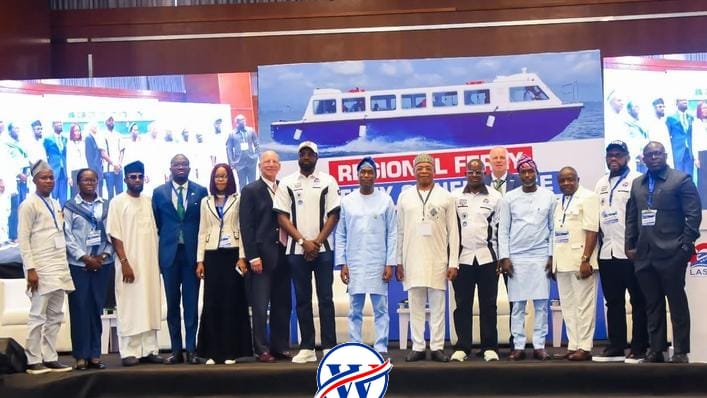

LASWA, Interferry Launch Africa’s First Ferry Safety Mentorship Programme
18-month hybrid initiative targets 50 operators across captain, engineering and safety officer cadres
By Okeoghene Onoriobe | Waterways News Correspondent
The Lagos State Waterways Authority (LASWA) has partnered with global ferry industry body Interferry to launch what has been described as Africa’s first Ferry Safety Development and Mentoring Programme — a landmark initiative aimed at raising professional standards, improving operational efficiency, and strengthening safety culture across Lagos’s inland waterway transport network.

The Special Adviser to the Governor on Blue Economy, Mr Oluwadamilola Emmanuel, disclosed the development in a statement on Monday, describing the programme as a transformative step that will “revolutionise ferry safety practices” and elevate the competitiveness of Nigeria’s ferry transport sector on the global stage.
Fifty participants — drawn from the ranks of captains, engineers and safety officers — have already been selected following a verification exercise conducted on 18 March, with the programme scheduled to commence this month, May 2026.
The 18-month programme will operate on a hybrid model, combining online learning modules, virtual mentoring sessions, and monthly hands-on practical training. Mentors will be drawn from Interferry experts as well as facilitators from maritime institutions, companies and regulatory agencies across Nigeria.
Core curriculum modules are to cover ferry design and construction, safety management systems, maritime regulatory frameworks, and both preventive and predictive maintenance techniques — competencies widely regarded as foundational to reducing the frequency of accidents and operational failures on Lagos waterways.
Nigeria Watch
The LASWA-Interferry programme arrives at a critical moment for Nigeria’s waterway transportation sector. Lagos’s ferry network — one of the busiest in sub-Saharan Africa — has long grappled with safety deficits rooted in inadequate training, ageing vessels, and inconsistent regulatory enforcement. High-profile accidents on the Lagos lagoon in recent years have intensified calls for systemic capacity building rather than reactive enforcement.
By anchoring this initiative to a structured, internationally validated mentoring framework, LASWA is signalling a shift from compliance-driven regulation toward competency-led governance — a model consistent with the International Maritime Organization’s (IMO) Standards of Training, Certification and Watchkeeping (STCW) principles adapted for inland and ferry operations.
For the Federal Ministry of Marine and Blue Economy and agencies such as NIMASA, the Lagos initiative also offers a replicable template: if the programme delivers measurable safety outcomes over its 18-month cycle, it could inform a national framework for ferry operator certification — a gap that has persisted in Nigeria’s inland waterways governance architecture. NIWA and state waterway authorities in Rivers, Delta, and Cross River states would be natural candidates for replication.
The selection of 50 participants as an inaugural cohort is modest but deliberate. A targeted, verifiable cohort allows programme outcomes to be tracked and documented — building the evidence base needed to scale the model across other Nigerian waterway corridors.
Waterways News | Maritime | Ports | Blue Economy

High Freight Charges: Importers Save Up to N4m Per Box Routing Cargo Through Cotonou
By Okeoghene Onoriobe | Waterways News
As freight surcharges bite, IMAN raises alarm over accelerating diversion of Nigerian trade traffic to Benin Republic
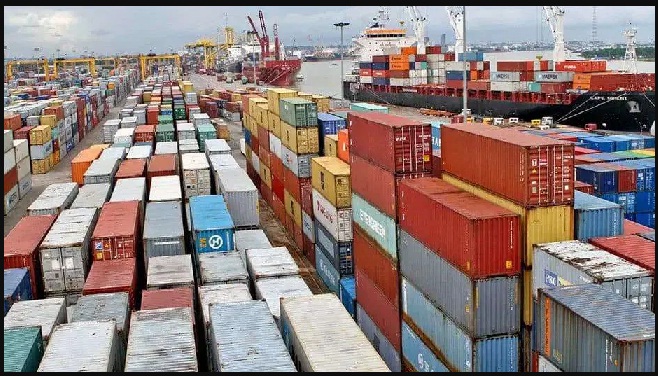
Nigerian importers are routing consignments away from Apapa and other Lagos ports to the Port of Cotonou in the Republic of Benin, with cost differentials of between N3 million and N4 million per container now driving what stakeholders warn is a structural shift in regional cargo flows.
The Importers Association of Nigeria (IMAN), South West Zone, raised the alarm over the weekend, accusing shipping lines of imposing successive freight rate increases that have rendered cargo clearance through Apapa prohibitively expensive relative to neighbouring port corridors. Acting Chairman of the association, Chief Joseph Ajoku, confirmed the trend, stating that the cost disparity had become too significant for importers to ignore.
“Most times, the cost of clearing in Apapa is so high that we decide to move our cargo to Cotonou. When we compare, we see a difference of about N3 million to N4 million on a single container,” he said.
Ajoku noted that despite repeated engagement with shipping lines, no concession had been reached. Operators, he said, acknowledge stakeholder concerns in meetings but proceed regardless to announce new increments.
“We have attended several meetings. They explain their challenges, but at the end, they still go ahead to announce the increment,” he told newsmen.
The IMAN chairman also raised transparency concerns, alleging that neither shipping companies nor freight forwarders had provided cost templates to justify the price hikes. Importers, he stressed, absorb the cumulative burden of charges imposed across the logistics chain. “All the burden is on the importers. We are the ones at the receiving end,” he said.
Ajoku warned that the sustained diversion of cargo, if left unaddressed, would translate to measurable revenue losses for Nigeria and a further erosion of port competitiveness — a particularly sensitive concern at a time when Lekki Deep Sea Port is still in the early stages of building its cargo base.
Nigeria Watch
The IMAN disclosure crystallises a challenge that Nigerian port authorities and regulators have grappled with for years but have yet to resolve decisively: the cost of doing business through Lagos ports remains structurally higher than competing West African corridors, and freight rate volatility — driven partly by global factors including the Red Sea disruptions and demand shifts on the Asia–West Africa trade lane — is now amplifying that gap in ways that directly influence importer behaviour.
For the Nigerian Shippers’ Council (NSC), whose mandate includes protecting cargo interests and moderating shipping line charges, this is a direct stress test of its regulatory effectiveness. The Council has in recent months taken steps to scrutinise surcharge applications, but the persistence of diversion trends suggests enforcement gaps remain.
The NPA and the Federal Ministry of Marine and Blue Economy will be equally concerned. Every container that transits through Cotonou rather than Apapa or Tin Can Island represents lost terminal revenue, reduced Customs receipts, and diminished throughput statistics — metrics that bear directly on the government’s port reform and concession renewal narrative.
With the Nigeria National Single Window now live and port digitization ongoing, the process argument for Nigerian ports is strengthening. But process improvements mean little if the cost arithmetic continues to favour Cotonou. Addressing the freight rate and port charges question — through stronger NSC intervention, transparent surcharge templates, and dialogue that produces outcomes rather than deferrals — must now be treated as a matter of urgent commercial policy.
Waterways News | Maritime & Blue Economy Reports
Oron Marine Hub: Akwa Ibom’s Bold Bid to Reclaim Its Waterfront Legacy
By Okeoghene Onoriobe, Waterways News Correspondent
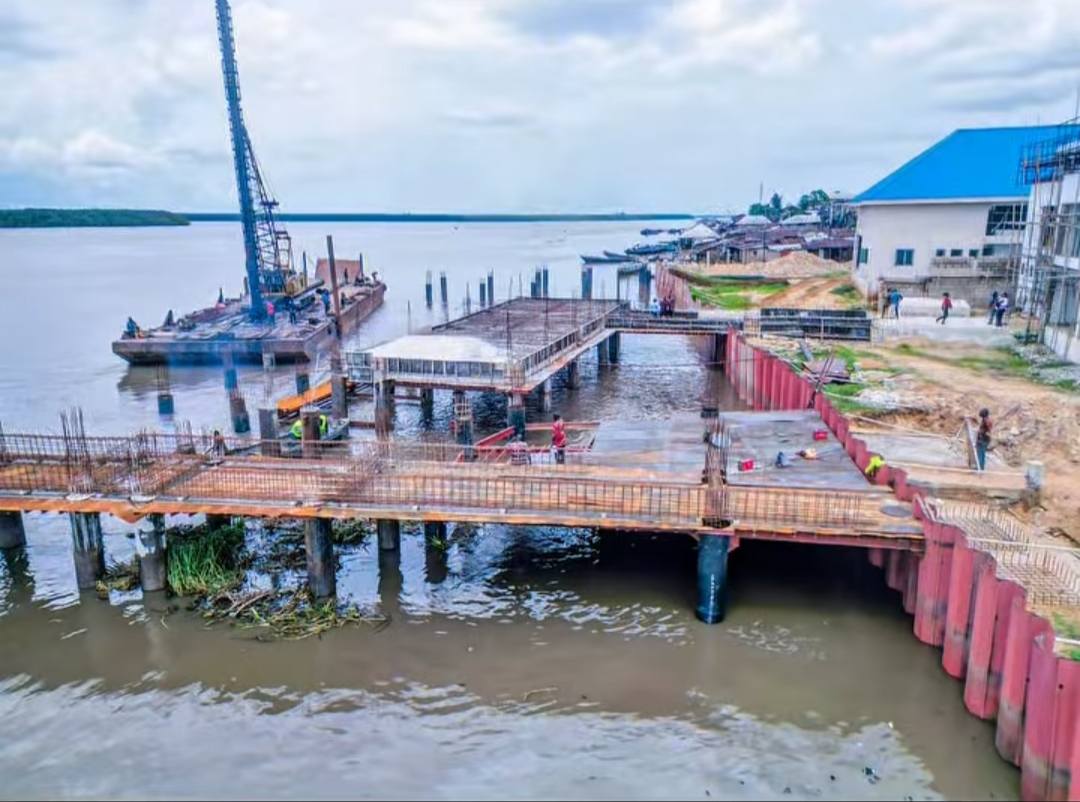
There is a certain quiet confidence building along the waterfront of Oron, the ancient coastal town that sits at the southeastern tip of Akwa Ibom State, where the Cross River empties into the Atlantic and where, for generations, fishermen and traders have made their living from the sea. That confidence has a name: the Oron Marine Hub — a sweeping, multi-component marine development project that, when completed, promises to fundamentally transform not just the physical landscape of Oron, but the economic fortunes of an entire coastal corridor in southern Nigeria.
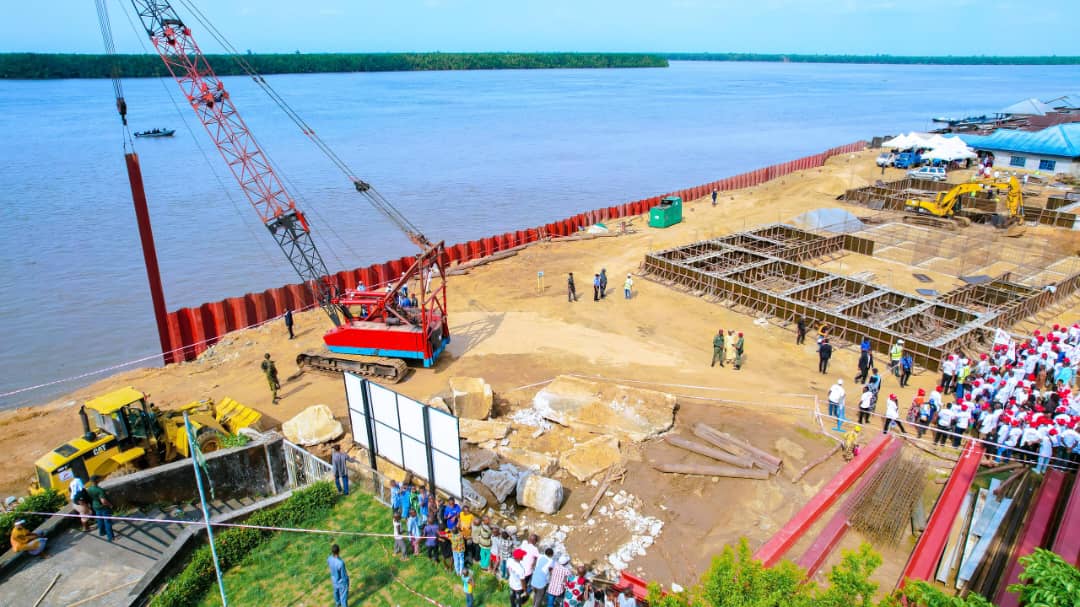
Ongoing construction at the site signals that this is no pipe dream. For a town whose maritime heritage once made it one of the most strategically important waterfront communities in the Niger Delta region, the hub represents something long overdue: a structured, modern infrastructure investment that takes the sea seriously.
More Than a Jetty
It would be a mistake to describe the Oron Marine Hub simply as a jetty project. The development is taking shape as a fully integrated marine terminal and economic complex — one designed to simultaneously address the needs of passengers, cargo operators, fishermen, security agencies, tourists, and traders.
At its core are four modern jetties, purpose-built to accommodate different categories of vessels. Passenger boats, cargo craft, and security and patrol vessels will each have dedicated berths, ending the chaotic informality that has long plagued waterfront operations across the Niger Delta. Alongside these jetties, a central terminal building is under construction to manage the flow of passengers — providing proper ticketing infrastructure, waiting areas, and the kind of organized movement that modern marine transport demands.
For too long, Nigeria’s inland and coastal waterways have operated as an afterthought to road transport, underfunded and underserved. The Oron Marine Hub is a direct challenge to that status quo.
Logistics, Trade, and the Cold Chain
Perhaps the most commercially significant aspect of the project lies in its cargo and trade infrastructure. A network of warehouses and cargo handling facilities is being integrated into the hub, designed to support marine-based trade and logistics along the Akwa Ibom coastline and beyond.
But it is the inclusion of cold storage systems, dry storage units, and fish processing facilities that may prove most transformative for the local economy. Oron sits in one of Nigeria’s most productive fishing zones, yet for decades, post-harvest losses have eaten deeply into the incomes of artisanal fishermen who lack the infrastructure to properly store or process their catch. With these facilities in place, the hub will create a direct value chain — from catch to processing to market — that could significantly increase revenues across the fishing sector, reduce waste, and open new export possibilities.
For fishing communities in Oron, Ibeno, and the broader coastline, this is not a small detail. It is potentially life-changing.
A Recreational and Tourism Offer
The Oron Marine Hub is also being designed with an eye on tourism — a sector that Nigeria’s coastal states have chronically underinvested in, despite possessing some of West Africa’s most scenic and culturally rich waterscapes.
Plans include a recreational waterfront zone, complete with leisure spaces and floating facilities that will offer residents and visitors an experience currently unavailable anywhere along this stretch of the Akwa Ibom coastline. Waterfronts, when properly developed, become magnets for economic activity — drawing restaurants, hospitality businesses, boat hire services, and cultural tourism.
Oron has history on its side. Home to one of Nigeria’s oldest and most significant traditional museums — the Oron Museum — and with a cultural identity deeply tied to water, the town has the raw ingredients for a compelling tourism offer. The Marine Hub gives it the platform.
Built to Last: Shoreline Protection and Infrastructure
Development along Nigeria’s coastline carries inherent risks. Erosion, tidal surge, and the long-term effects of climate change are real concerns for any coastal infrastructure project. The developers of the Oron Marine Hub appear to have accounted for this, incorporating shoreline protection works into the design — a feature that will be critical to the facility’s long-term viability.
Supporting the terminal operations are internal road networks, dedicated parking areas, and security infrastructure — provisions that speak to the operational complexity of running a busy marine hub and the importance of ensuring safety and order within the facility.
Restoring the Corridors
Beyond its physical footprint, the Oron Marine Hub carries significant strategic weight. Analysts and transport observers have long noted that marine routes connecting communities across the Niger Delta and the Gulf of Guinea coastline remain vastly underutilised, despite offering faster and often cheaper alternatives to road travel.
The hub is strategically positioned to restore key marine transport routes — most notably the Oron–Calabar corridor, a historically important waterway link between Akwa Ibom and Cross River States. Reviving this corridor alone would reduce travel times, ease pressure on road infrastructure, and reconnect communities that share deep commercial and cultural ties.
Wider connectivity to waterway routes in Rivers State and beyond is also within the project’s long-term vision, which could eventually reposition this corner of southern Nigeria as a genuine hub in the regional maritime network.
A Gateway City in the Making
When Nigerian leaders and planners speak of harnessing the country’s 853-kilometre coastline and vast inland waterway network, they are often speaking in abstractions. The Oron Marine Hub is concrete — literally and figuratively. It is bricks, steel, jetties, cold rooms, and warehouses rising from the waterfront of a town that has waited a long time for this moment.
When completed, Oron will not merely be a coastal town tucked into the southeastern corner of Akwa Ibom. It will be a functioning marine gateway — a point of departure and arrival for passengers, goods, and vessels; a processing hub for the fishing industry; a leisure and tourism destination; and a commercial node connecting southern Nigeria’s waterways in ways they have not been connected in a generation.
The sea has always defined Oron. With the Marine Hub, Oron is finally building something worthy of it.
NIGERIA WATCH: Tracking the ministries, departments, and agencies with a stake in this story
The Oron Marine Hub sits at the intersection of several federal mandates, making it one of the most regulatory-dense infrastructure projects currently underway in southern Nigeria. Here are the key government bodies whose oversight, policy direction, and funding priorities are directly relevant to this development:
Federal Ministry of Marine & Blue Economy — As the apex ministry for Nigeria’s maritime sector following its establishment by the Tinubu administration, this ministry holds primary federal interest in a project of this nature. The Oron Marine Hub aligns directly with the Blue Economy agenda, which seeks to monetise Nigeria’s coastal and inland water resources. The ministry’s engagement — or absence — in supporting and coordinating this project will be closely watched.
National Inland Waterways Authority (NIWA) — NIWA holds statutory responsibility for the development, maintenance, and regulation of Nigeria’s inland waterways, including the river and creek routes that connect Oron to Calabar, Warri, and Port Harcourt. The restoration of the Oron–Calabar corridor in particular falls squarely within NIWA’s operational mandate, and the agency’s role in dredging, charting, and regulating traffic on these routes will be essential to the hub’s commercial viability.
Nigerian Ports Authority (NPA) — To the extent that the Oron Marine Hub handles cargo and commercial vessel traffic, it may fall within the NPA’s licensing and regulatory jurisdiction. The NPA’s framework for recognising and regulating smaller regional terminals and marine hubs will determine how smoothly the facility integrates into Nigeria’s broader port ecosystem.
Nigerian Maritime Administration and Safety Agency (NIMASA) — NIMASA’s mandate covers vessel registration, seafarer certification, and maritime safety enforcement. With passenger and cargo vessels set to operate from Oron’s new jetties, NIMASA’s safety standards and enforcement presence will be critical to ensuring that the hub operates to international benchmarks and that lives on the water are protected.
Federal Ministry of Agriculture & Food Security — The hub’s fish processing facilities, cold storage systems, and post-harvest infrastructure connect directly to federal agricultural policy, particularly initiatives targeting aquaculture development and the reduction of post-harvest losses in the fisheries sub-sector. Federal support through this ministry could significantly accelerate the fishing industry components of the project.
Federal Ministry of Tourism — With a dedicated recreational waterfront zone forming part of the hub’s design, the Federal Ministry of Tourism has a clear interest in ensuring that the Oron Marine Hub is incorporated into Nigeria’s national tourism development framework and promotional campaigns.
Nigerian Meteorological Agency (NiMet) & Nigerian Hydrological Services Agency (NIHSA) — For a coastal infrastructure project that incorporates shoreline protection works, accurate weather forecasting and hydrological data are non-negotiable. Both agencies have roles to play in providing the environmental intelligence needed to protect the hub’s long-term structural integrity against tidal and climate risks.
Akwa Ibom State Government — While not a federal body, the state government is the most proximate authority driving and financing this project. Its relationship with federal agencies — particularly NIWA, NIMASA, and the Ministry of Marine & Blue Economy — will largely determine how quickly approvals, corridor licensing, and regulatory clearances are obtained.
Waterways News will continue to monitor federal agency engagement with the Oron Marine Hub project. Relevant ministries and agencies are invited to share updates, policy positions, and timelines with our editorial team.
Send tips and reports to the Waterways News editorial desk at www.waterwaysnews.ng
Editor's Choice
WORKERS’ DAY SPECIAL REPORT: Between the Tide and the Struggle — The State of Nigeria’s Maritime Workers in 2026
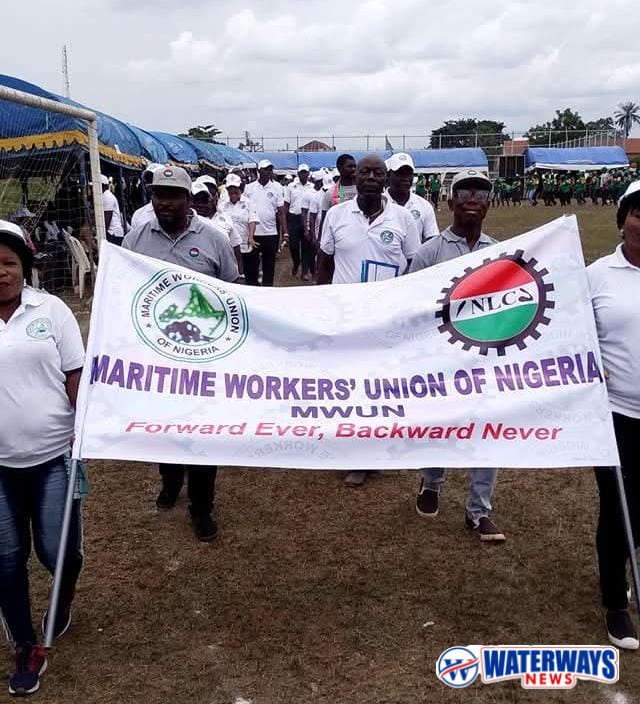
WORKERS’ DAY SPECIAL REPORT: Between the Tide and the Struggle — The State of Nigeria’s Maritime Workers in 2026
A Waterways News Special Investigation | May 1, 2026
By Larry Osaweren | Waterways News
As the world marks International Workers’ Day, the men and women who keep Nigeria’s ports, terminals, and waterways moving remain among the most underserved labour forces on the continent. From the creeks of the Niger Delta to the crowded jetties of Apapa, their stories are ones of grit against institutional neglect, unpaid wages, and structural abandonment — set in sharp relief against a global maritime labour framework that Nigeria has ratified but struggles to enforce.
The Wage Gap That Indicts a System
Begin with the most basic measure of worker dignity: pay.
In April 2025, the International Labour Organization concluded minimum wage negotiations in Geneva, setting the global maritime floor at USD $690 per month for an able seafarer — effective January 2026, rising to $704 in 2027 and $715 in 2028. That figure, the product of decades of collective bargaining between the International Chamber of Shipping and the International Transport Workers’ Federation, represents the baseline below which no seafarer anywhere in the world should legally fall.
Nigerian seafarers fall below it routinely.
Testimonies gathered by industry investigators indicate that Nigerian seafarers earn five to seven times less than their international counterparts in comparable roles. One seafarer, speaking anonymously, confirmed that the minimum wage document — a tripartite instrument midwifed by the Nigerian Maritime Administration and Safety Agency (NIMASA) and the National Joint Industrial Council of the Federal Ministry of Labour — is routinely disregarded, with shipping companies paying figures well below what is stipulated. Calls for Nigerian seafarers to be paid in US dollars, in line with the global nature of the profession, have gone largely unanswered.
On land, Nigeria’s national minimum wage stands at ₦70,000 per month — roughly USD $45 — signed into law by President Bola Tinubu in July 2024. The average monthly salary across all sectors hovers around ₦339,000 (approximately $220). Against this already-depressed baseline, maritime workers on the waterways — canoe pilots, boat skippers, and jetty workers who move millions of Nigerians daily — frequently earn below even these modest benchmarks.
The Stranded Cadet Crisis
Nigeria’s maritime workforce challenge is not simply about low wages. At its core, it is a crisis of structural abandonment — one that wastes billions of naira in training investments and condemns thousands of qualified young Nigerians to idleness.
Across the country’s maritime training institutions — from the Maritime Academy of Nigeria (MAN) in Oron to private offshore training centres — hundreds of cadets graduate every year. They emerge certified, ambitious, and trapped. The bottleneck is sea-time: to become a licensed international seafarer, a cadet must complete mandatory onboard training. That requires vessels. And Nigeria, bluntly, lacks a meaningful national fleet.
The Cabotage Vessel Financing Fund (CVFF), established under the Cabotage Act of 2003 to help indigenous shipowners acquire vessels, sat largely un-operationalised for over two decades despite billions of naira in accumulated contributions — a damning verdict on successive administrations. NIMASA under Director-General Dr. Dayo Mobereola has taken visible steps to revive the CVFF, launching an application portal in January 2025, with meaningful disbursements to indigenous operators anticipated through 2026.
But the human cost of the delay is already tallied: over 4,000 trained Nigerian seafarers — deckhands, officers, cadets, and marine engineers — are currently adrift in the job market, qualified but largely idle. Meanwhile, industry insiders report that over 80 per cent of vessels flying the Nigerian flag or trading in Nigerian waters no longer carry Nigerian cadets. The roles are going to foreign nationals while Nigerian-trained talent withers on the vine.
The comparison is instructive. The Philippines exports over 400,000 seafarers globally and earns an estimated $6 to $7 billion yearly in remittances. Nigeria’s seafarers, with the country’s enormous coastline, river systems, and maritime heritage, represent one of the nation’s most squandered economic assets.
The Certificate Recognition Problem
A further dimension of the crisis is the global non-recognition of Nigerian maritime credentials. Certificates of Competency (CoC) issued by NIMASA are not widely accepted aboard international vessels, dramatically curtailing the professional reach of Nigerian seafarers compared to peers from India, Greece, or the Philippines.
Captain (Dr.) Abdulrasheed Onakoya, a researcher and member of the Nigerian Association of Master Mariners, has publicly highlighted that Nigeria’s maritime training institutions suffer from inadequate funding, outdated equipment, and limited access to sea-time — a combination that makes it difficult to meet standards set by the International Maritime Organization (IMO). Shipowners, aware of this gap, use it as justification to underpay or refuse to employ Nigerian seafarers altogether.
NIMASA has responded: the agency has dispatched over 235 cadets to premier institutions in India and Greece, and has integrated technology for verifying Certificates of Competency. These are the right moves. But they must be accelerated and matched with domestic sea-time opportunities at home.
MWUN: Progress, but Not Enough
The Maritime Workers Union of Nigeria (MWUN) has recorded genuine milestones. Under President-General Comrade Francis Bunu, the union secured a landmark Collective Bargaining Agreement with shipping companies in August 2024 — the first meaningful minimum conditions framework in twenty years of failed negotiations with the Shipping Agencies, Clearing and Forwarding Employers Association. The agreement, brokered with the involvement of NIMASA and the Nigerian Shippers’ Council, established minimum standards covering wages, working hours, and health and safety.
In July 2025, MWUN also concluded a peace accord with Melsmore Marine Nigeria Limited following a protracted dispute over workers’ welfare and pension remittances, with Bunu declaring a “new dawn for Nigerian seafarers” and announcing full unionisation of Melsmore’s workforce.
These are genuine victories. But they remain islands of progress in a sea of structural deficit. Union penetration remains incomplete. Pension remittances by shipping companies to workers’ retirement savings accounts continue to be a site of dispute. And the broader Nigerian labour landscape — with over 75 million informal sector workers excluded from the Contributory Pension Scheme — means maritime workers outside the formal MWUN structure are particularly exposed.
The Inland Waterways: Nigeria’s Forgotten Workforce
Beyond the seafarers, there is a second maritime labour force even more invisible to policy: the operators of Nigeria’s inland waterways — the boat skippers, canoe pilots, and jetty workers who carry millions of Nigerians across rivers, creeks, and lagoons every day.
Nigeria’s approximately 10,000 kilometres of navigable waterways connect 28 of its 36 states and link to five neighbouring countries. This is an extraordinary geographic asset — one that remains criminally underutilised, and whose workers remain almost entirely unprotected.
The National Inland Waterways Authority (NIWA) has intensified training efforts, completing a three-day Boat Navigation and Safety Training for 75 operators from Lagos, Ogun, and Ondo states in December 2025, and distributing 42,000 life jackets across 12 riverine states. These are commendable steps. But NIWA remains overwhelmingly dependent on government grants and generates barely 20 per cent of its required funding — a structural fragility that constrains both infrastructure development and worker welfare.
Boat operators themselves have historically borne multiple, overlapping levies from competing agencies — a burden so contentious it required a Supreme Court judgment in January 2024 to settle the jurisdictional boundary between NIWA and the Lagos State Waterways Authority (LASWA).
Nigeria Watch: What Must Change
This Workers’ Day, Nigerian maritime labour stands at a crossroads. The legal architecture exists — Nigeria has ratified the Maritime Labour Convention (MLC) 2006 — but enforcement remains uneven and frequently dependent on the goodwill of individual shipping companies rather than institutional compulsion.
The path forward is clear, even if the political will to walk it is not yet assured. NIMASA must convert CVFF momentum into actual vessel acquisitions that create the sea-time berths stranded cadets desperately need. Training reform must be matched by domestic opportunity. MWUN must extend its reach to the informal and inland waterway operators who remain outside its protection. And the Federal Ministry of Marine and Blue Economy must treat maritime labour not as a residual concern, but as a strategic pillar of the blue economy agenda it has championed.
Nigeria’s waterway workers have kept the nation moving — through floods, fuel crises, and fiscal austerity. On this Workers’ Day, the question is not whether they deserve better. It is whether the institutions charged with their welfare will finally deliver it.
Waterways News | waterwaysnews.ng
-

 Oil and Gas2 months ago
Tantita’s Pipeline Deal: $144m Contract, Rising Output, and the Questions that Deserve Answers
-
 Blue Economy3 months ago
Nigeria’s Coast Guard Bill: A Solution in Search of a Problem?
-
 MARITIME TRADE & SHIPPING2 months ago
World’s Largest Container Ship Sets New Maritime Record with 22,233 TEUs on Single Voyage