

Maritime Security and Safety
RED SEA BLOODBATH FOR SHIPPING CONTINUES AS INDIAN VESSEL SINKS OFF YEMEN, AFRICA’S TRADE ROUTES PAY THE PRICE

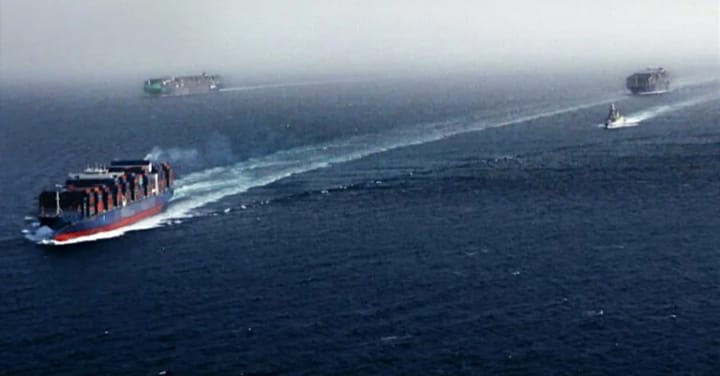

RED SEA BLOODBATH FOR SHIPPING CONTINUES AS INDIAN VESSEL SINKS OFF YEMEN, AFRICA’S TRADE ROUTES PAY THE PRICE
By Oghenewoke Osaweren | Waterways News
An Indian-flagged cargo vessel, MSV Faize Noore Oliya, sank in the Red Sea on August 4 after being struck by what maritime intelligence firm Windward described as an explosives-laden boat roughly 13 nautical miles south of Hodeidah. All 14 crew members, 13 Indian nationals and one Yemeni, were rescued by Yemeni National Resistance Forces and taken to the Port of Mokha, with no casualties reported.
While New Delhi and international wire services have framed this strictly as an Indo-Yemeni maritime security story, the sinking deserves a harder look from an African vantage point because it is African ports, African economies, and African seafarers who are quietly absorbing the fallout of a crisis that keeps getting reported as someone else’s war.
THE STORY THE WIRE SERVICES ARE MISSING

Every major attack on Red Sea shipping since the Houthi campaign escalated has triggered the same reflex: rerouting around the Cape of Good Hope. That single word, “reroute”, is doing a lot of quiet, unexamined work in global coverage. For African port authorities, from Cape Town to Lagos to Mombasa, “reroute” means a measurable spike in vessel traffic, bunkering demand, and transit revenue potential that the continent has been slow to capitalise on.
Waterways News has previously tracked how Saudi-flagged tankers, spooked by Houthi threats, have opted for the longer Cape route rather than risk the Bab el-Mandeb corridor. The sinking of Faize Noore Oliya, the latest confirmed loss, not merely a near-miss, will almost certainly accelerate that trend. Yet Nigerian and wider West African maritime authorities have offered no coordinated public strategy to position local ports as beneficiaries of this shift, even as NIMASA and NPA officials privately acknowledge the opportunity.
A CREW LIST THAT EXPOSES A GAP IN AFRICAN LABOUR PROTECTION
One detail largely buried in Indian coverage matters enormously here: the 14-member crew was not entirely Indian. One Yemeni national was aboard and rescued alongside the 13 Indians. Indian authorities, through Minister Sarbananda Sonowal and the Ministry of External Affairs, moved swiftly to claim ownership of the welfare response, directing the Director General of Shipping to coordinate assistance for “Indian seafarers.”
No African maritime labour body has issued a comparable statement, despite the fact that thousands of African seafarers, Nigerians, Ghanaians, Filipinos crewing African-flagged and African-chartered vessels included in wider MWUN affiliate networks, transit these same waters daily on comparable mechanised and coastal vessels. When an Indian ship goes down, India activates its diplomatic and welfare machinery within hours. When African crew are exposed to identical risk on comparable routes, there is no equivalent institutional reflex. That asymmetry is the real story for our readership, not the diplomatic language of “unprovoked attacks” that Colombo, New Delhi and London wire desks recycle.
THE ATTRIBUTION PROBLEM AFRICAN EDITORS SHOULD INTERROGATE
Windward’s assessment that the location and method are “consistent with previous Houthi operations” while stopping short of confirmed attribution, deserves more scrutiny than it has received. Yemen’s National Resistance Forces have directly blamed the Houthis; the Houthis themselves have not claimed the strike, unlike their explicit claim last week over the NCC GHAZAL attack on a Saudi tanker. That inconsistency, claimed responsibility for a missile strike on a Saudi tanker days earlier, but silence on a fatal-risk strike against a vessel carrying mostly Indian crew, is worth African maritime analysts tracking closely, given how often blockade rhetoric aimed at Gulf shipping spills into unclaimed, ambiguous strikes on vessels with no direct Gulf ownership link.
WHAT THIS MEANS FOR LAGOS AND WEST AFRICAN MARITIME POLICY
For the wider Nigerian maritime labour community, the practical takeaway is this: the Red Sea crisis is not a distant geopolitical drama. It is actively reshaping global shipping economics in ways that touch bunkering demand, crew deployment risk assessments, and insurance premiums for any Nigerian-linked vessel or seafarer operating on routes that intersect the Gulf of Aden, Bab el-Mandeb, or the wider western Indian Ocean. Nigerian union and regulatory bodies should be pressing NIMASA and NIWA for updated advisories, comparable to the DGMA’s Strait of Hormuz caution issued to Indian shipping companies last month rather than leaving Nigerian crew and shipowners to absorb the risk unbriefed.
BACKGROUND
The sinking follows a documented pattern: the Houthis claimed responsibility for striking the Saudi-flagged tanker NCC GHAZAL last week over alleged violation of their declared blockade of Saudi ports, reportedly using anti-ship missiles that forced the vessel to turn back. India’s Ministry of External Affairs has called for “free and unimpeded navigation” to be restored “in keeping with international law” is a language that, notably, mirrors African Union statements on freedom of navigation issued after earlier Red Sea incidents, statements that received far less international pickup than New Delhi’s.

Maritime Security and Safety
IMO Council Mourns Slain Seafarers, Demands Stronger Protection as Maritime Conflicts Deepen
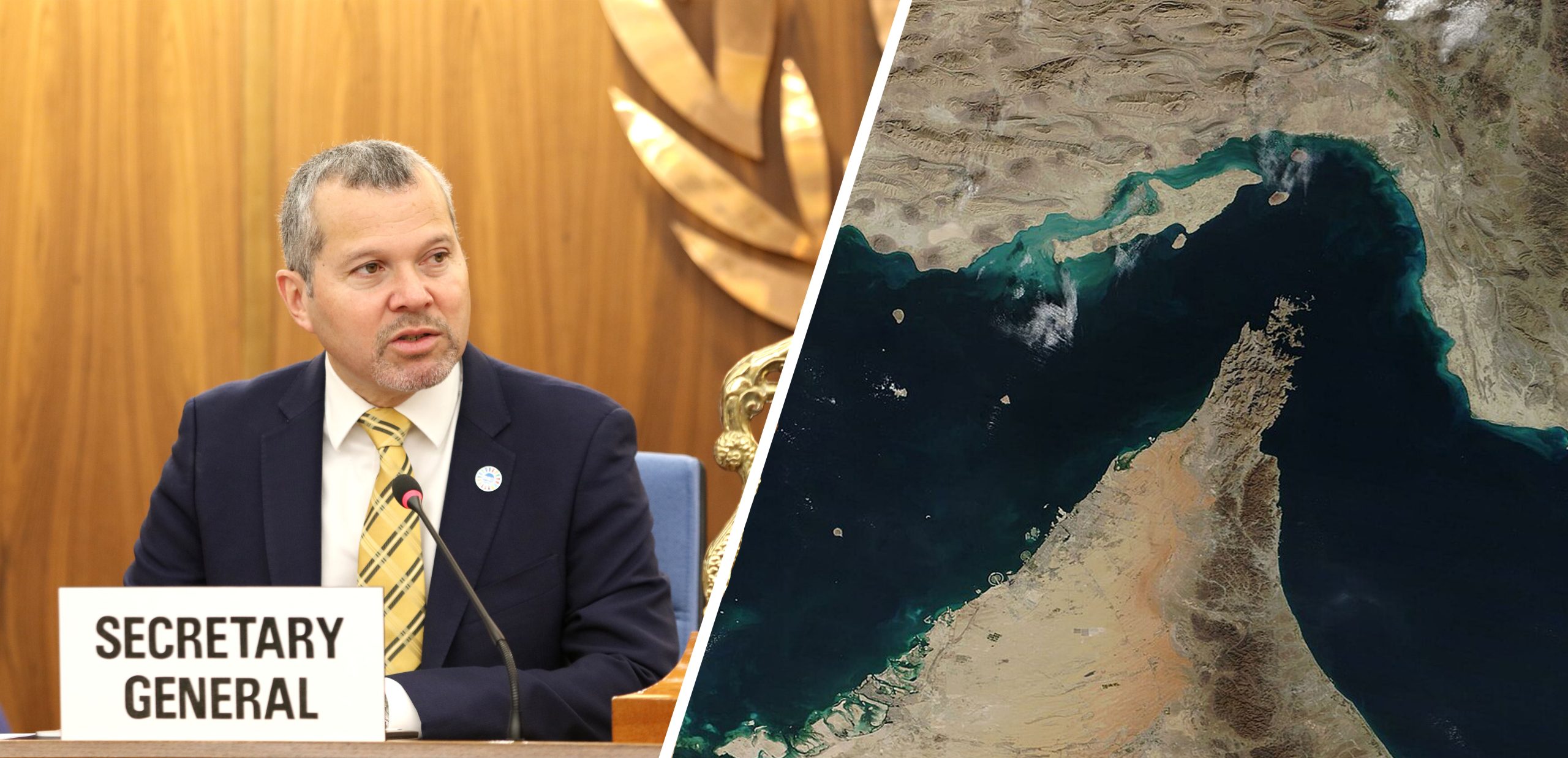
IMO Council Mourns Slain Seafarers, Demands Stronger Protection as Maritime Conflicts Deepen
Dominguez warns merchant ships remain exposed from Hormuz to the Black Sea as 138th Council session ends in London
By Okeoghene Onoriobe | Waterways News
Member states at the International Maritime Organization (IMO) used the opening of the Council’s 138th session to mourn seafarers killed in recent attacks and to demand firmer protection for civilian mariners.
Council met in London from 2 to 6 November, with Russia and Iran putting security in the Black Sea and the Strait of Hormuz at the centre of discussions. On 2 November, Secretary-General Arsenio Dominguez said commercial shipping remained exposed to attack in the Strait of Hormuz, the Red Sea, Bab el-Mandeb, the Eastern Mediterranean, the Black Sea and the Sea of Azov.
The mourning was driven by a run of deaths this year. Five seafarers reportedly died on 29 September during the rescue of the hijacked HONOUR 25 in Somali waters, and several others were seriously injured. In all, 44 seafarers were freed from three vessels. Dominguez noted that 22 seafarers remain captive aboard the ASANA, which was seized earlier this year, and urged continued effort to secure their release.
The Strait of Hormuz remains the deadliest flashpoint. The IMO had verified at least 70 attacks on international shipping there, with 19 seafarers killed, by its late-August assessment. A tally reported by gCaptain put the seafarer death toll at 24 as of 5 November.
Dominguez has repeatedly insisted that seafarers are civilians doing their jobs. He has said they should never become casualties of conflicts to which they are not a party.
Member states echoed the call. Liberia renewed its appeal for seafarer protection and freedom of navigation, and Indonesia said seafarer protection and safety of navigation must be a shared priority.
The session also dealt with leadership. Council backed a second four-year term for Dominguez, subject to approval by the IMO Assembly in 2027. The term would run from 1 January 2028 to 31 December 2031.
Nigeria Watch
Nigeria has more at stake than a distant diplomatic debate. Hormuz disruption has fed through to freight rates, war-risk insurance and port costs for Nigerian importers and shippers. Piracy off Somalia and the Gulf of Aden is a reminder that the Gulf of Guinea’s own security gains, including the Deep Blue Project, cannot be taken for granted.
The Council session also bears on Nigeria’s IMO seat. Abuja has pushed seafarer welfare and maritime security as part of its diplomacy, and the Council’s message gives that agenda more weight. The test is whether Nigeria backs its advocacy abroad with welfare protections, training and safety enforcement for its own mariners and for the informal waterway operators represented by WABOTAN and ATBOWATON.
For those operators, the lesson from London is that protection is a shared responsibility, and it has to reach the people who work on the inland water, not just those on ocean-going ships.
Nigeria Unveils Home-Built ADX-Barra 200 Autonomous Vessel at AFRIDEX 2026
Arridex, DICON joint venture Helagon delivers country’s first indigenously developed unmanned surface vessels%
By Ighoyota Onaibre | Waterways News
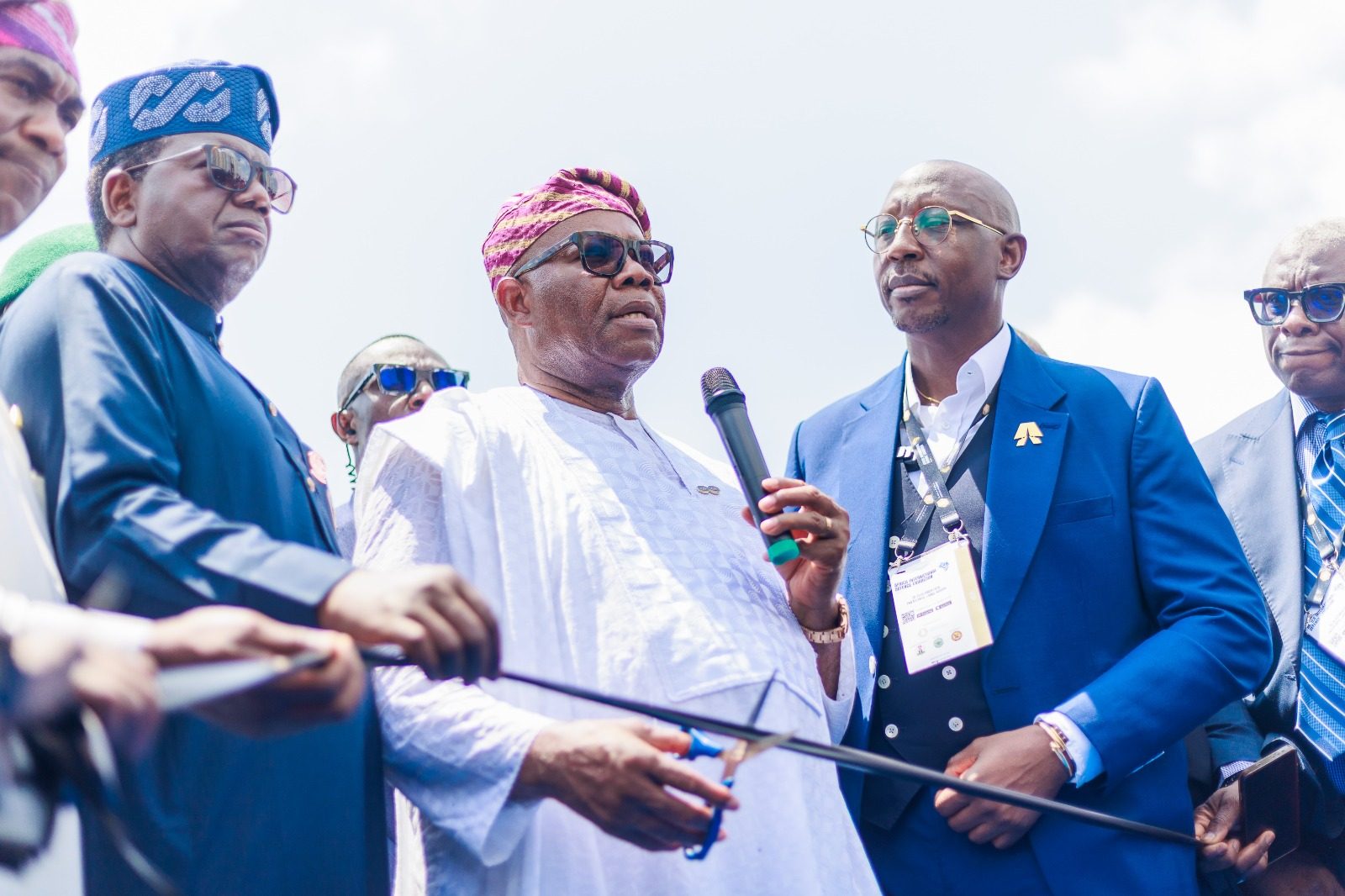
Nigeria has unveiled its first indigenously developed autonomous surface vessel, the ADX-Barra 200. Arridex Group, formerly RusselSmith Group, built it through Helagon, its defence joint venture with the Defence Industries Corporation of Nigeria (DICON).
The vessel was unveiled on 26 October at the inaugural Africa International Defence Exhibition (AFRIDEX 2026) at Eko Atlantic, Lagos. The exhibition ran from 26 to 29 October.
President Bola Ahmed Tinubu was represented by Senate President Godswill Akpabio. He said the administration prioritises defence industry growth because a nation is more secure when it can build and maintain its own capability. He described the vessel as that capability taking shape, designed and built by local engineers in partnership with DICON, and said it deserves government support and the confidence of the armed forces.
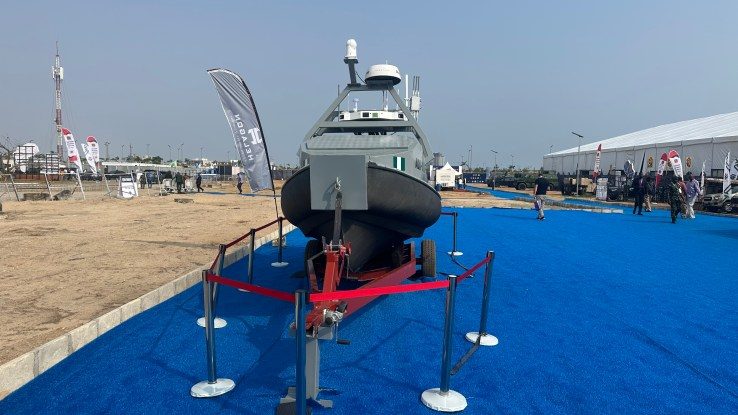
ADX-Barra 200
Arridex Group CEO Kayode Adeleke presented the vessel. He said Helagon was set up to design autonomous systems and that the ADX-Barra 200 is the result. For the forces that will use it, he called it a force multiplier.
The ADX-Barra 200 is one of two platforms in the ADX-Barra series launched at the exhibition. The other is the ADX-Barra 100. Arridex says both were designed, built and integrated in Nigeria by its engineers.
Adeleke tied the platforms to Gulf of Guinea security. He said the region’s waters carry its trade, support its coastal communities and hold much of its energy wealth, and that protecting them calls for capability the region can build, sustain and improve itself. He invited the armed services and other stakeholders to arrange demonstrations and to help shape later generations of the vessels.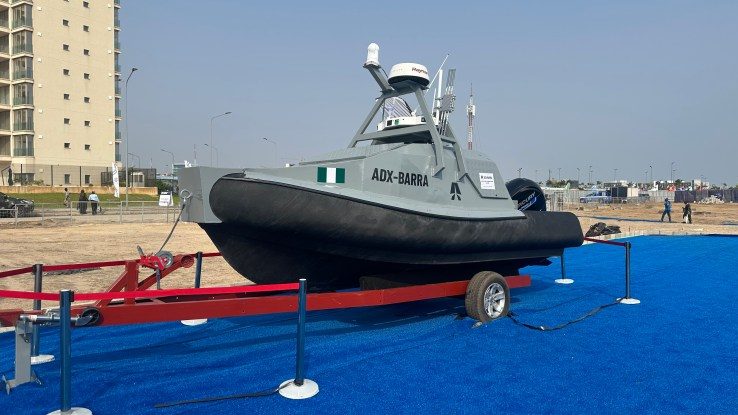
Others at the unveiling included Lagos State Deputy Governor Dr Obafemi Hamzat and the Minister of State for Defence, Dr Bello Matawalle. DICON Director-General Major General Babatunde Ibrahim Alaya, Helagon Chief Operating Officer Engr. Precious Omo-Agege and Arridex senior management were also present.
Arridex has not published the vessel’s technical specifications, including its length, endurance, payload and sensors. Both vessels remained on display at the exhibition.
NIGERIA WATCH
A home-built answer to a long-standing maritime problem: Nigeria’s waters have long needed more patrol capacity than its platforms and budgets can supply. A locally designed vessel that “can be supported, adapted and improved by the team that made it,” as Arridex puts it, addresses one persistent weakness. Imported hulls and systems often sit idle for want of spares, support and trained hands.
The questions that matter next: Unveilings are not deployments. The Navy, NIMASA’s Deep Blue Project and other agencies will want to know the vessel’s range, endurance, sensors and sea-state limits. They will also want to know whether it can work in the Gulf of Guinea. Until Arridex publishes specifications and arranges trials, the “game-changing” claim remains the company’s own.
Beyond defence: Waterways News readers should watch whether this technology filters into civil uses such as inland waterway surveillance, anti-vandalism patrols and search and rescue. The country’s inland operators, including those represented by WABOTAN and ATBOWATON, face insecurity and safety gaps that policy announcements have not closed. Local manufacturing capacity matters to them only if it eventually reaches the waterways where they work.
The accountability test: The industrial-policy argument is sound. It is build locally and maintain locally. It will be judged by procurement, deployment and sustained operation, not by launch-day speeches.
Editor's Choice
Australia Bars Repeat-Offender Bulk Carrier for 90 Days Over Falsified Crew Rest Records
Australia Bars Repeat-Offender Bulk Carrier for 90 Days Over Falsified Crew Rest Records
By Okeoghene Onoriobe | Waterways News
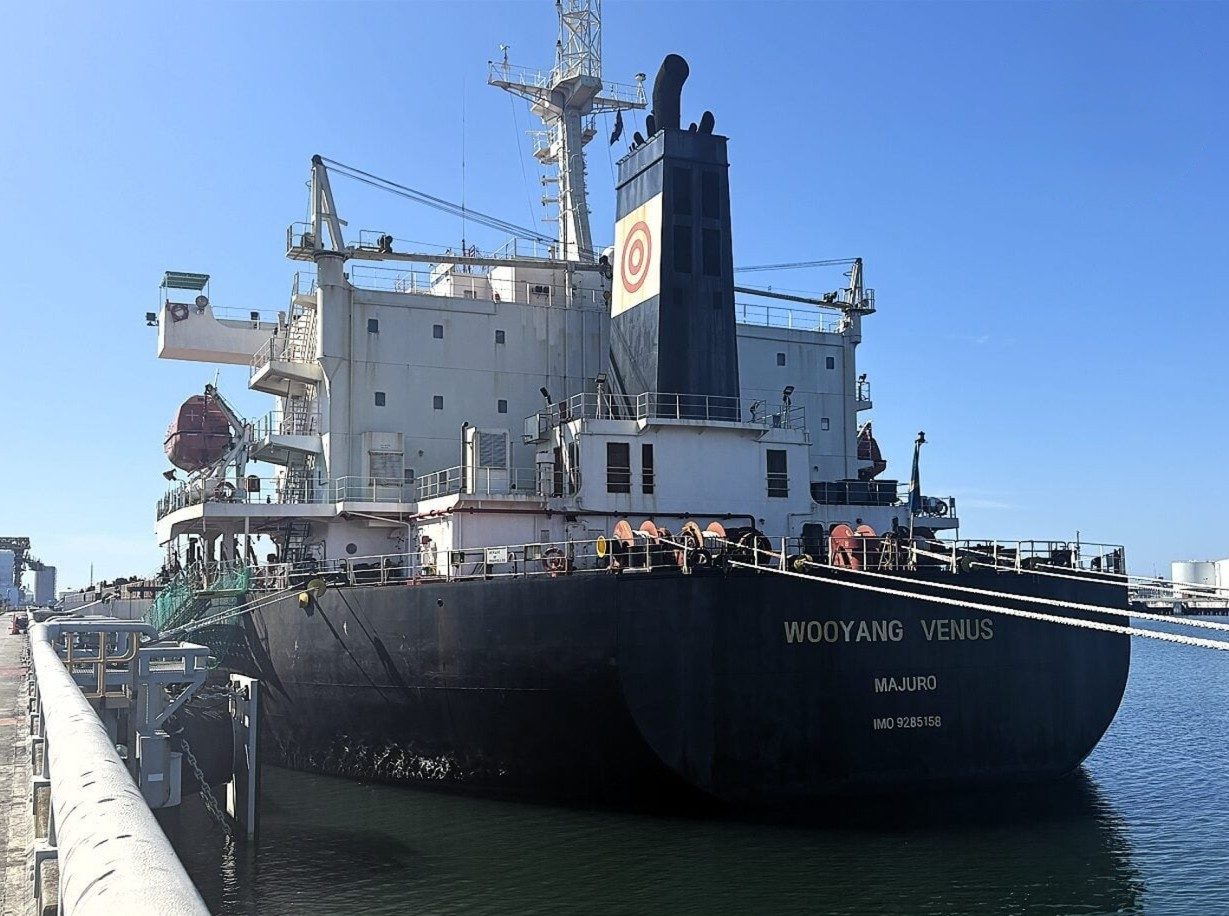
Australian maritime authorities have banned the Marshall Islands-flagged bulk carrier Wooyang Venus from its ports and waters for 90 days. Inspectors found that the ship’s crew work and rest-hour records had been deliberately falsified to hide excessive working hours.
The Australian Maritime Safety Authority (AMSA) boarded the vessel at the Port of Newcastle on 29 October after a complaint under the Maritime Labour Convention (MLC). Its port state control inspection found that the records did not match the hours the crew actually worked. The ship left Newcastle on 31 October for Korea, and the ban took effect afterwards.
This is the vessel’s third brush with Australian enforcement in under three years. AMSA detained it in August 2026 when crew hours were neither properly recorded nor monitored. It was first detained in December 2023, after a complaint from the International Transport Workers’ Federation (ITF).
That inspection found falsified hours records, poor food provisions and an allegation that the master had assaulted a crew member. AMSA’s annual MLC report says the operator then submitted a corrective action plan covering repatriation, better provisions and training on rest-hour compliance. The latest findings suggest those measures did not take hold.
AMSA Executive Director for Maritime Safety and Environmental Compliance, Greg Witherall, said falsifying records meant to protect seafarers undermines both crew welfare and ship safety. He warned that fatigue dulls judgement and slows reaction times, raising the risk of collisions, groundings and injuries, particularly during navigation and watchkeeping.
The ban was imposed under Section 246 of Australia’s Navigation Act 2012. AMSA cited the deliberate falsification, the repeated breaches and doubts over the effectiveness of the owner’s and operator’s safety management systems.
Nigeria Watch
The case matters for Nigeria for three reasons:
Records are the enforcement tool. Fatigue rules only work if rest-hour logs can be trusted. Australia treated falsification as a safety-system failure, not a paperwork lapse, and banned the ship rather than detaining it again.
Repeat offenders need escalating penalties. Two detentions and a corrective plan did not change this operator’s behaviour. Nigerian port state control should ask whether its own follow-up on repeat deficiencies has real consequences.
Seafarer welfare is a Nigerian issue. Nigerian seafarers serve on foreign-flagged ships, and those working boats and ferries on domestic waters face fatigue and welfare gaps too, often with no records at all.
The MLC regime Australia is enforcing shows what accountability looks like. It is the benchmark NIMASA and the inland regulators should be measured against, and one this publication will keep pressing.

 Oil and Gas8 months ago
Tantita’s Pipeline Deal: $144m Contract, Rising Output, and the Questions that Deserve Answers
 MARITIME TRADE & SHIPPING8 months ago
World’s Largest Container Ship Sets New Maritime Record with 22,233 TEUs on Single Voyage
 Blue Economy9 months ago
Nigeria’s Coast Guard Bill: A Solution in Search of a Problem?