Security & Safety
Blood Cargo: Justice, Impunity, and the Road to Fixing Nigeria’s Arms Crisis

PART TWO: What the Courts Have Done — and What the Government Must Do Next
WATERWAYSNEWS.NG | Ports & Security | Investigative Report Lagos/Abuja — February 2026
In Part One of this investigation, we traced how thousands of illegal weapons enter Nigeria through its seaports — hidden in cement bags, misdeclared on shipping manifests, and shepherded through port terminals by corrupt clearing agents and complicit officials. In this concluding part, we examine whether justice has been served in the cases brought before Nigerian courts, why impunity remains the norm rather than the exception, and — most critically — what concrete steps Nigeria must take to shut down the supply chain feeding its cycle of armed violence.


The Courtroom: Progress, But Not Enough
The most significant judicial outcome in Nigeria’s recent history of arms trafficking prosecutions is the conviction arising from the 2017 Tincan Island seizure. After years of proceedings at the Federal High Court in Lagos, Great James Oil and Gas Limited, Ifeuwa Moses Christ, and Emeka Umeh Festus — also known as Amankwa — were found guilty on all eight counts against them under Suit No. FHC/L/339C/2018.
It was a watershed moment. For the first time, a corporate entity, its principal, and a clearing agent were simultaneously convicted for orchestrating a major arms importation operation. Customs Comptroller-General Adeniyi declared it proof of the service’s “zero-tolerance stance against arms trafficking.” Legal observers welcomed the outcome as a signal that Nigeria’s courts could process these complex, multi-defendant cases to a conclusion.
The 2024 Onne Port case — involving 844 rifles and 112,500 rounds of ammunition intercepted from a Turkey-origin container — is now before the courts. The principal suspect, Ali Samson Ofoma, and nine accomplices are facing charges under the Miscellaneous Offences Act. Their prosecution will be watched closely as a test of whether the system can deliver consistent results.
Why Convictions Remain Dangerously Rare
For all its symbolic weight, the Great James conviction stands out precisely because it is an exception. Security analysts and legal practitioners who track arms trafficking cases in Nigeria speak candidly about the barriers that obstruct accountability.
Nigeria’s courts are chronically overburdened. Complex multi-defendant cases involving smuggling rings can take five to ten years from charge to verdict, as the Tincan Island case itself demonstrated. In that time, evidence degrades, witnesses become unavailable, memories fade, and the commercial incentives driving the illegal trade do not pause.
Witnesses and informants face real danger. Those who report suspicious cargo or testify against trafficking networks operate without meaningful protection frameworks, and the networks they expose often have the resources and connections to reach them. Several cases have collapsed or stalled after witnesses withdrew cooperation.
The financing behind major arms shipments frequently connects to interests with political or business influence. Legal teams mounted on behalf of trafficking syndicates are often better resourced than the prosecuting authorities. Bail applications succeed, adjournments multiply, and the momentum of prosecution slows.
At the port level, the culture of impunity is sustained by low detection risk, high financial reward, and inadequate sanctions. A clearing agent who is caught loses a licence. One who is not caught earns commissions on multi-million-dollar transactions. The calculus, for too many, favours the risk.
The Legislative Foundation: A Necessary but Incomplete Step
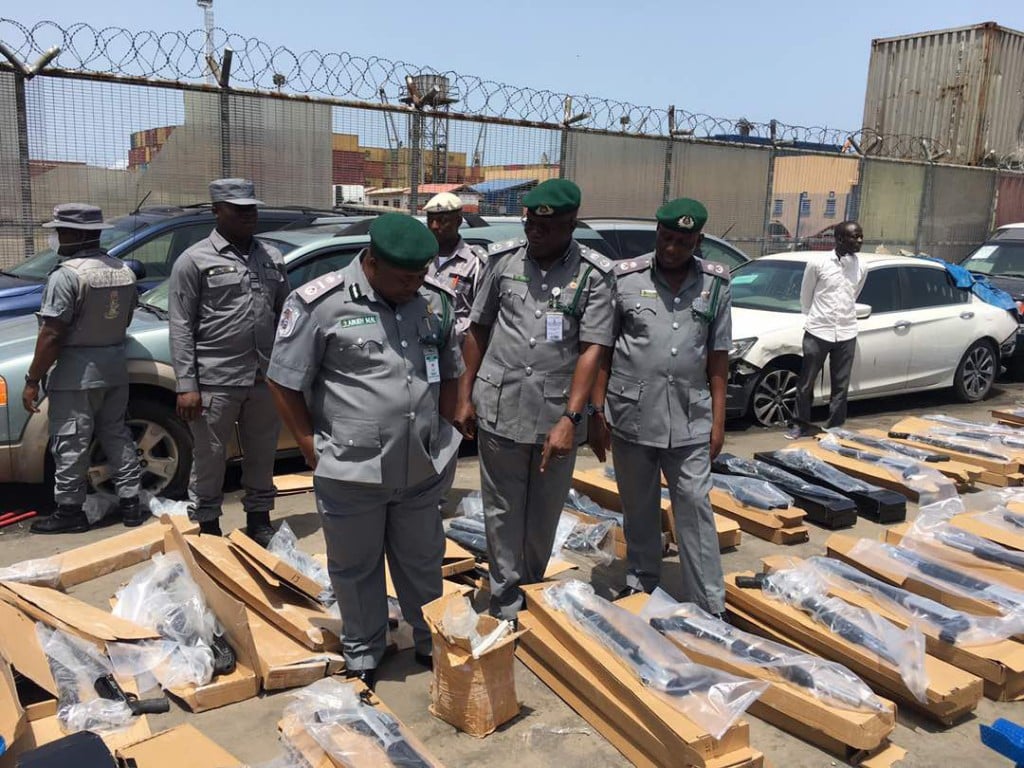
The signing of the Control of Small Arms and Light Weapons Act 2024 by President Tinubu on June 4, 2024 was an important and overdue development. The law provides a far more comprehensive framework than the ageing Firearms Act of 1959, covering interdiction, tracing, stockpile management, and international cooperation mechanisms.
But legislation is only as effective as its implementation. Nigeria has a long record of passing strong laws and implementing them weakly. The SALW Act 2024 will only change outcomes if it is matched by prosecutorial capacity, judicial prioritisation, inter-agency coordination, and — critically — the political will to pursue powerful actors, not just low-level couriers and clearing agents.
The question is not whether Nigeria now has the right law on paper. The question is whether it has the institutional commitment to enforce it.
Recommendations: What Nigeria Must Do Now
The evidence gathered in this investigation points to a set of concrete, actionable reforms across five areas. None of them are beyond Nigeria’s capacity. All of them are urgent.
1. Establish a Dedicated Arms Trafficking Court
The most immediate bottleneck in the justice chain is case processing speed. Nigeria should establish a specialised Federal High Court division — or designate specific judges — to handle arms trafficking cases exclusively. Fast-tracking these prosecutions would reduce the window during which witnesses can be intimidated, evidence can be tampered with, and syndicates can regroup. Ghana and South Africa have used specialised courts for organised crime and financial crime with measurable results. Nigeria should learn from those models.
2. Mandate 100% Container Scanning at All Major Ports
Currently, not all containers entering Nigerian seaports pass through X-ray or non-intrusive inspection (NII) scanners. The gaps in scanning coverage are precisely the gaps that traffickers exploit. The federal government should set a binding compliance target — 100 percent scanning for all containers at Apapa, Tincan Island, Onne, and Calabar within a defined timeline — and fund the procurement and maintenance of the equipment required to achieve it. Automated alerts for manifest anomalies, weight discrepancies, and containers from high-risk corridors should be built into the scanning workflow.
3. Create a Protected Whistleblower and Witness Scheme for Port Informants
Dismantling smuggling networks depends on inside information. Port workers, shipping line employees, terminal operators, and even mid-level clearing agents will often know when something irregular is being planned. Without credible protections — identity shielding, relocation support, financial incentives, and legal immunity for informants acting in good faith — that information will remain unshared. Nigeria’s Witness Protection Act exists but is poorly resourced and inconsistently applied. A specific, funded mechanism for port and maritime whistleblowers should be created under the NCCSALW or the Office of the NSA.
4. Prosecute and Publicly Sanction Complicit Officials — At Every Level
The deterrent effect of prosecutions depends entirely on who gets prosecuted. If only couriers and low-level clearing agents face charges while the port officials, warehouse operators, and senior figures who enabled them walk free, the message to the system is that the risk sits at the bottom of the chain. Nigeria must demonstrate — through high-profile, publicly reported prosecutions — that seniority is no protection. The suspension of licences following the Onne seizure was a start. Criminal charges, asset forfeiture, and prison terms for officials found complicit must follow, and must be publicised.
5. Activate Regional and International Intelligence Sharing
The weapons entering Nigeria are manufactured abroad — primarily in Turkey, Eastern Europe, and parts of Asia — shipped through international freight networks, and financed by transnational criminal syndicates. Nigeria cannot disrupt this supply chain by acting alone. It must fully engage ECOWAS mechanisms on small arms control, activate bilateral intelligence-sharing agreements with source countries including Turkey, and work with INTERPOL’s Firearms Programme and the UN Office on Drugs and Crime to map trafficking networks at their origin. The fact that multiple recent seizures trace back to Turkey as a point of origin should already have triggered formal diplomatic and law enforcement exchanges.
6. Conduct a National Audit of Port Personnel Vetting Practices
How are Customs officers, terminal staff, and clearing agents vetted before being granted access to sensitive cargo inspection roles? What are the financial disclosure requirements for port officials? Are there lifestyle auditing mechanisms that flag sudden unexplained wealth? In most Nigerian port agencies, the honest answer is that these systems are inadequate or non-existent. A national audit of vetting and integrity management practices — commissioned by the Office of the NSA and the Ministry of Finance, which oversees Customs — should be completed within 12 months, with mandatory reforms to follow.
The Guns Will Keep Coming Until the System Makes Them Stop
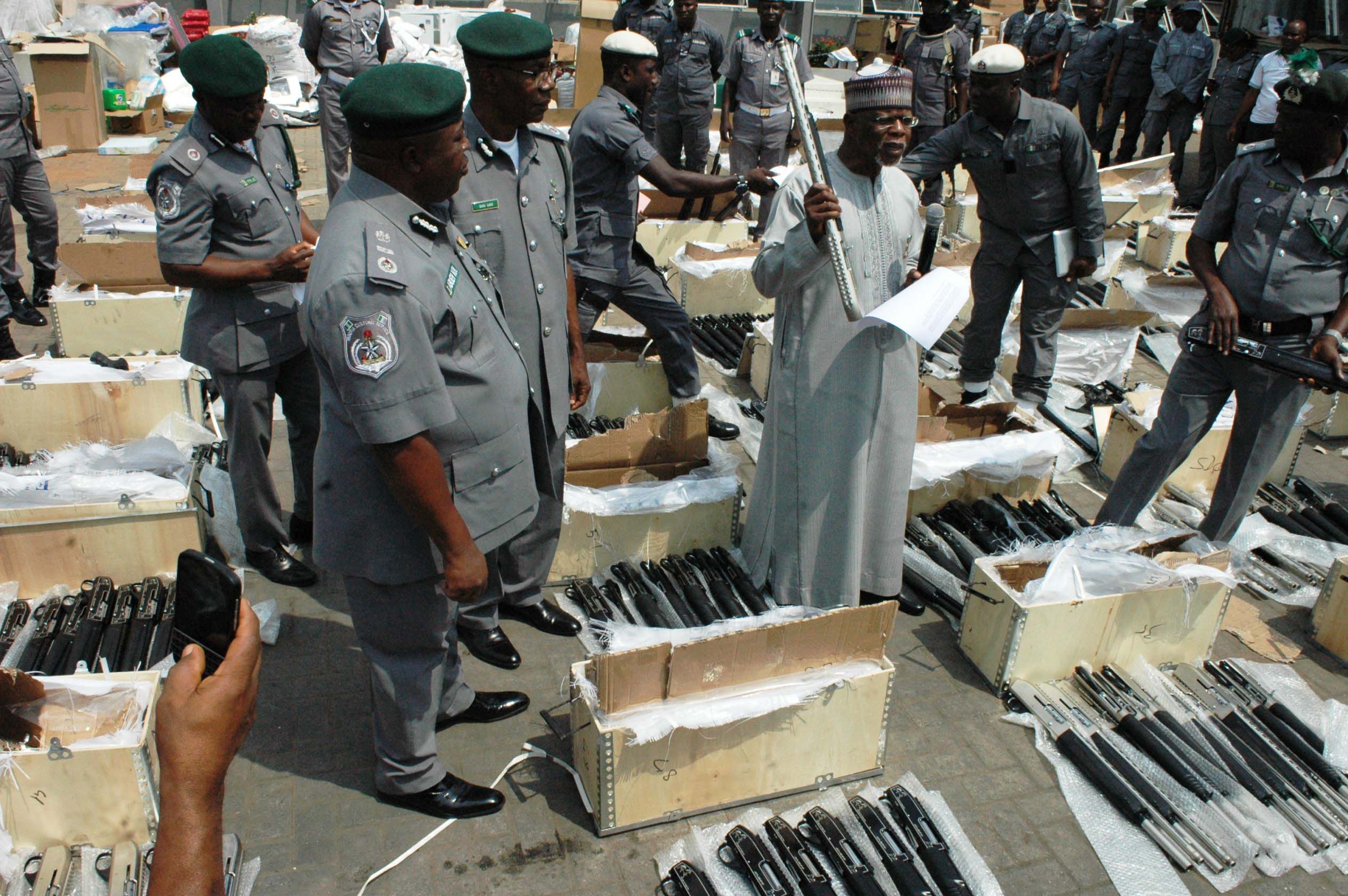
The handover of 1,599 firearms to NCCSALW at Ikeja is, in the most immediate sense, a success. The weapons were found. Cases were prosecuted. The guns are now locked away. But measured against the 350 million illegal weapons estimated to be circulating in the country, it is a drop in an ocean of violence.
The supply chain sustaining illegal weapons imports into Nigeria is not a mystery. It runs through underfunded border agencies, through falsified shipping documents, through corrupt clearing agents and complicit officials, through underpowered courts, and through an enforcement culture in which the risk of doing wrong remains, for too many people, acceptably low.
Every component of that chain is fixable. Nigeria has the legal architecture — newly strengthened by the SALW Act 2024 — and the institutional capacity to make ports genuinely hostile territory for arms traffickers. What has been missing, historically, is the sustained political will to deploy that capacity against powerful networks with powerful friends.
President Tinubu’s government has taken meaningful steps. The Onne seizure, the Ikeja handover, the ongoing prosecutions — these are not nothing. But the families in Zamfara, in Anambra, in Plateau State, in the Niger Delta who live under the shadow of weapons that should never have entered this country deserve more than incremental progress.
They deserve a system in which the next container full of rifles never makes it past the scanner — and the person who tried to wave it through faces the full weight of the law.
That is the standard. Nigeria’s ports, and its government, must now be held to it.
This concludes Waterwaysnews.ng’s two-part investigative series on illegal arms smuggling through Nigerian ports.
Read Part One: “Blood Cargo: How Thousands of Illegal Weapons Flow Through Nigeria’s Ports — And the Men Who Let Them In”
— Waterwaysnews.ng | Ports & Security Investigative Desk