Blue Economy
Oron Marine Hub: Akwa Ibom’s Bold Bid to Reclaim Its Waterfront Legacy

Oron Marine Hub: Akwa Ibom’s Bold Bid to Reclaim Its Waterfront Legacy
By Okeoghene Onoriobe, Waterways News Correspondent
There is a certain quiet confidence building along the waterfront of Oron, the ancient coastal town that sits at the southeastern tip of Akwa Ibom State, where the Cross River empties into the Atlantic and where, for generations, fishermen and traders have made their living from the sea. That confidence has a name: the Oron Marine Hub — a sweeping, multi-component marine development project that, when completed, promises to fundamentally transform not just the physical landscape of Oron, but the economic fortunes of an entire coastal corridor in southern Nigeria.
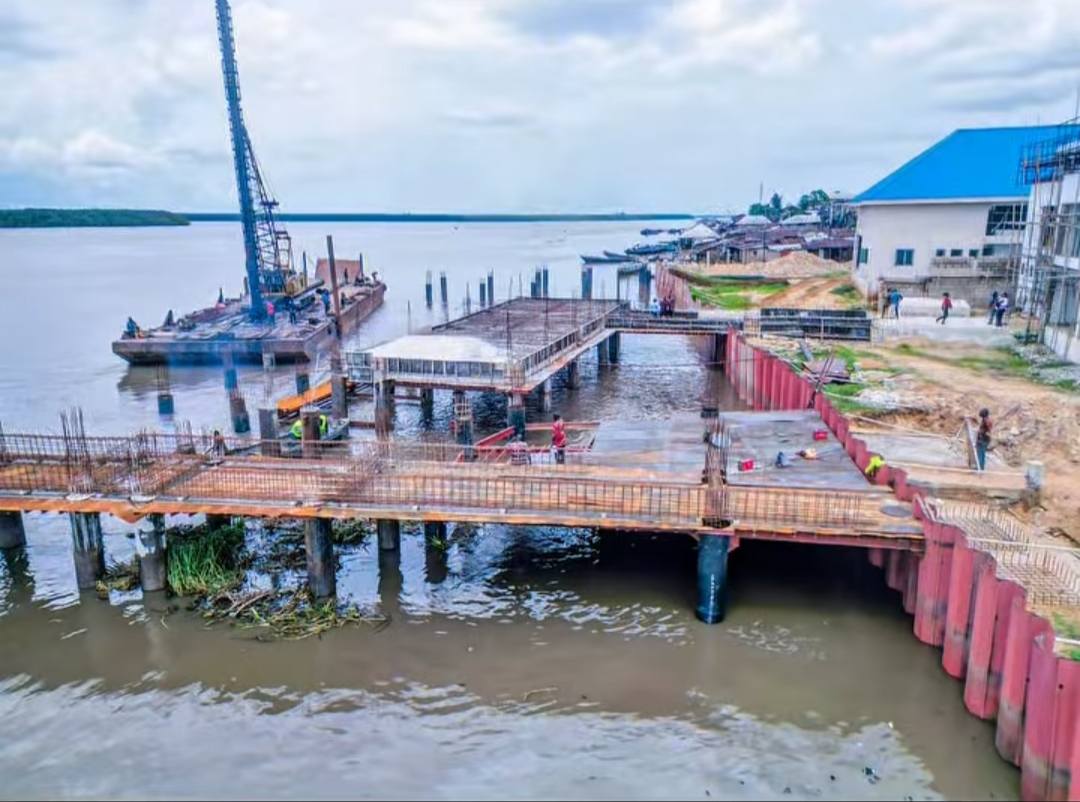
Ongoing construction at the site signals that this is no pipe dream. For a town whose maritime heritage once made it one of the most strategically important waterfront communities in the Niger Delta region, the hub represents something long overdue: a structured, modern infrastructure investment that takes the sea seriously.


More Than a Jetty
It would be a mistake to describe the Oron Marine Hub simply as a jetty project. The development is taking shape as a fully integrated marine terminal and economic complex — one designed to simultaneously address the needs of passengers, cargo operators, fishermen, security agencies, tourists, and traders.
At its core are four modern jetties, purpose-built to accommodate different categories of vessels. Passenger boats, cargo craft, and security and patrol vessels will each have dedicated berths, ending the chaotic informality that has long plagued waterfront operations across the Niger Delta. Alongside these jetties, a central terminal building is under construction to manage the flow of passengers — providing proper ticketing infrastructure, waiting areas, and the kind of organized movement that modern marine transport demands.
For too long, Nigeria’s inland and coastal waterways have operated as an afterthought to road transport, underfunded and underserved. The Oron Marine Hub is a direct challenge to that status quo.

Logistics, Trade, and the Cold Chain
Perhaps the most commercially significant aspect of the project lies in its cargo and trade infrastructure. A network of warehouses and cargo handling facilities is being integrated into the hub, designed to support marine-based trade and logistics along the Akwa Ibom coastline and beyond.
But it is the inclusion of cold storage systems, dry storage units, and fish processing facilities that may prove most transformative for the local economy. Oron sits in one of Nigeria’s most productive fishing zones, yet for decades, post-harvest losses have eaten deeply into the incomes of artisanal fishermen who lack the infrastructure to properly store or process their catch. With these facilities in place, the hub will create a direct value chain — from catch to processing to market — that could significantly increase revenues across the fishing sector, reduce waste, and open new export possibilities.
For fishing communities in Oron, Ibeno, and the broader coastline, this is not a small detail. It is potentially life-changing.
A Recreational and Tourism Offer
The Oron Marine Hub is also being designed with an eye on tourism — a sector that Nigeria’s coastal states have chronically underinvested in, despite possessing some of West Africa’s most scenic and culturally rich waterscapes.
Plans include a recreational waterfront zone, complete with leisure spaces and floating facilities that will offer residents and visitors an experience currently unavailable anywhere along this stretch of the Akwa Ibom coastline. Waterfronts, when properly developed, become magnets for economic activity — drawing restaurants, hospitality businesses, boat hire services, and cultural tourism.
Oron has history on its side. Home to one of Nigeria’s oldest and most significant traditional museums — the Oron Museum — and with a cultural identity deeply tied to water, the town has the raw ingredients for a compelling tourism offer. The Marine Hub gives it the platform.
Built to Last: Shoreline Protection and Infrastructure
Development along Nigeria’s coastline carries inherent risks. Erosion, tidal surge, and the long-term effects of climate change are real concerns for any coastal infrastructure project. The developers of the Oron Marine Hub appear to have accounted for this, incorporating shoreline protection works into the design — a feature that will be critical to the facility’s long-term viability.
Supporting the terminal operations are internal road networks, dedicated parking areas, and security infrastructure — provisions that speak to the operational complexity of running a busy marine hub and the importance of ensuring safety and order within the facility.
Restoring the Corridors
Beyond its physical footprint, the Oron Marine Hub carries significant strategic weight. Analysts and transport observers have long noted that marine routes connecting communities across the Niger Delta and the Gulf of Guinea coastline remain vastly underutilised, despite offering faster and often cheaper alternatives to road travel.
The hub is strategically positioned to restore key marine transport routes — most notably the Oron–Calabar corridor, a historically important waterway link between Akwa Ibom and Cross River States. Reviving this corridor alone would reduce travel times, ease pressure on road infrastructure, and reconnect communities that share deep commercial and cultural ties.
Wider connectivity to waterway routes in Rivers State and beyond is also within the project’s long-term vision, which could eventually reposition this corner of southern Nigeria as a genuine hub in the regional maritime network.
A Gateway City in the Making
When Nigerian leaders and planners speak of harnessing the country’s 853-kilometre coastline and vast inland waterway network, they are often speaking in abstractions. The Oron Marine Hub is concrete — literally and figuratively. It is bricks, steel, jetties, cold rooms, and warehouses rising from the waterfront of a town that has waited a long time for this moment.
When completed, Oron will not merely be a coastal town tucked into the southeastern corner of Akwa Ibom. It will be a functioning marine gateway — a point of departure and arrival for passengers, goods, and vessels; a processing hub for the fishing industry; a leisure and tourism destination; and a commercial node connecting southern Nigeria’s waterways in ways they have not been connected in a generation.
The sea has always defined Oron. With the Marine Hub, Oron is finally building something worthy of it.
NIGERIA WATCH: Tracking the ministries, departments, and agencies with a stake in this story
The Oron Marine Hub sits at the intersection of several federal mandates, making it one of the most regulatory-dense infrastructure projects currently underway in southern Nigeria. Here are the key government bodies whose oversight, policy direction, and funding priorities are directly relevant to this development:
Federal Ministry of Marine & Blue Economy — As the apex ministry for Nigeria’s maritime sector following its establishment by the Tinubu administration, this ministry holds primary federal interest in a project of this nature. The Oron Marine Hub aligns directly with the Blue Economy agenda, which seeks to monetise Nigeria’s coastal and inland water resources. The ministry’s engagement — or absence — in supporting and coordinating this project will be closely watched.
National Inland Waterways Authority (NIWA) — NIWA holds statutory responsibility for the development, maintenance, and regulation of Nigeria’s inland waterways, including the river and creek routes that connect Oron to Calabar, Warri, and Port Harcourt. The restoration of the Oron–Calabar corridor in particular falls squarely within NIWA’s operational mandate, and the agency’s role in dredging, charting, and regulating traffic on these routes will be essential to the hub’s commercial viability.
Nigerian Ports Authority (NPA) — To the extent that the Oron Marine Hub handles cargo and commercial vessel traffic, it may fall within the NPA’s licensing and regulatory jurisdiction. The NPA’s framework for recognising and regulating smaller regional terminals and marine hubs will determine how smoothly the facility integrates into Nigeria’s broader port ecosystem.
Nigerian Maritime Administration and Safety Agency (NIMASA) — NIMASA’s mandate covers vessel registration, seafarer certification, and maritime safety enforcement. With passenger and cargo vessels set to operate from Oron’s new jetties, NIMASA’s safety standards and enforcement presence will be critical to ensuring that the hub operates to international benchmarks and that lives on the water are protected.
Federal Ministry of Agriculture & Food Security — The hub’s fish processing facilities, cold storage systems, and post-harvest infrastructure connect directly to federal agricultural policy, particularly initiatives targeting aquaculture development and the reduction of post-harvest losses in the fisheries sub-sector. Federal support through this ministry could significantly accelerate the fishing industry components of the project.
Federal Ministry of Tourism — With a dedicated recreational waterfront zone forming part of the hub’s design, the Federal Ministry of Tourism has a clear interest in ensuring that the Oron Marine Hub is incorporated into Nigeria’s national tourism development framework and promotional campaigns.
Nigerian Meteorological Agency (NiMet) & Nigerian Hydrological Services Agency (NIHSA) — For a coastal infrastructure project that incorporates shoreline protection works, accurate weather forecasting and hydrological data are non-negotiable. Both agencies have roles to play in providing the environmental intelligence needed to protect the hub’s long-term structural integrity against tidal and climate risks.
Akwa Ibom State Government — While not a federal body, the state government is the most proximate authority driving and financing this project. Its relationship with federal agencies — particularly NIWA, NIMASA, and the Ministry of Marine & Blue Economy — will largely determine how quickly approvals, corridor licensing, and regulatory clearances are obtained.
Waterways News will continue to monitor federal agency engagement with the Oron Marine Hub project. Relevant ministries and agencies are invited to share updates, policy positions, and timelines with our editorial team.
Send tips and reports to the Waterways News editorial desk at www.waterwaysnews.ng