Security & Safety
NIGERIA’S MARINE ECONOMY CRISIS: CAN ₦10.5 BILLION SAVE A SECTOR THAT HANDLES 90% OF TRADE?

Minister Oyetola’s Budget Plea Exposes Decade of Systematic Neglect

A Waterways News Special Report
Abuja, February 11, 2026
When Dr. Adegboyega Oyetola, Minister of Marine and Blue Economy, stood before a joint session of the National Assembly on Tuesday to defend his ministry’s ₦10.5 billion budget proposal for 2026, his presentation was less a defense and more an indictment—not of his ministry, but of a fiscal system that has systematically starved the very sector responsible for keeping Nigeria’s economic lifeline open.

The numbers tell a damning story. A ministry overseeing subsectors that collectively handle over 90 percent of Nigeria’s international trade by volume, manage national food security through fisheries, and coordinate the nation’s maritime safety apparatus has been allocated less money than what some individual federal legislators spend on constituency projects annually.
But the crisis runs deeper than mere underfunding. What Oyetola revealed to the joint committee was a perfect storm of fiscal strangulation: excessive revenue deductions, structural misalignments, infrastructural decay, and a budget release mechanism so dysfunctional that in 2025, only 1.7 percent of the ministry’s revised capital budget actually reached its coffers.
THE ANATOMY OF A GROSSLY INADEQUATE BUDGET
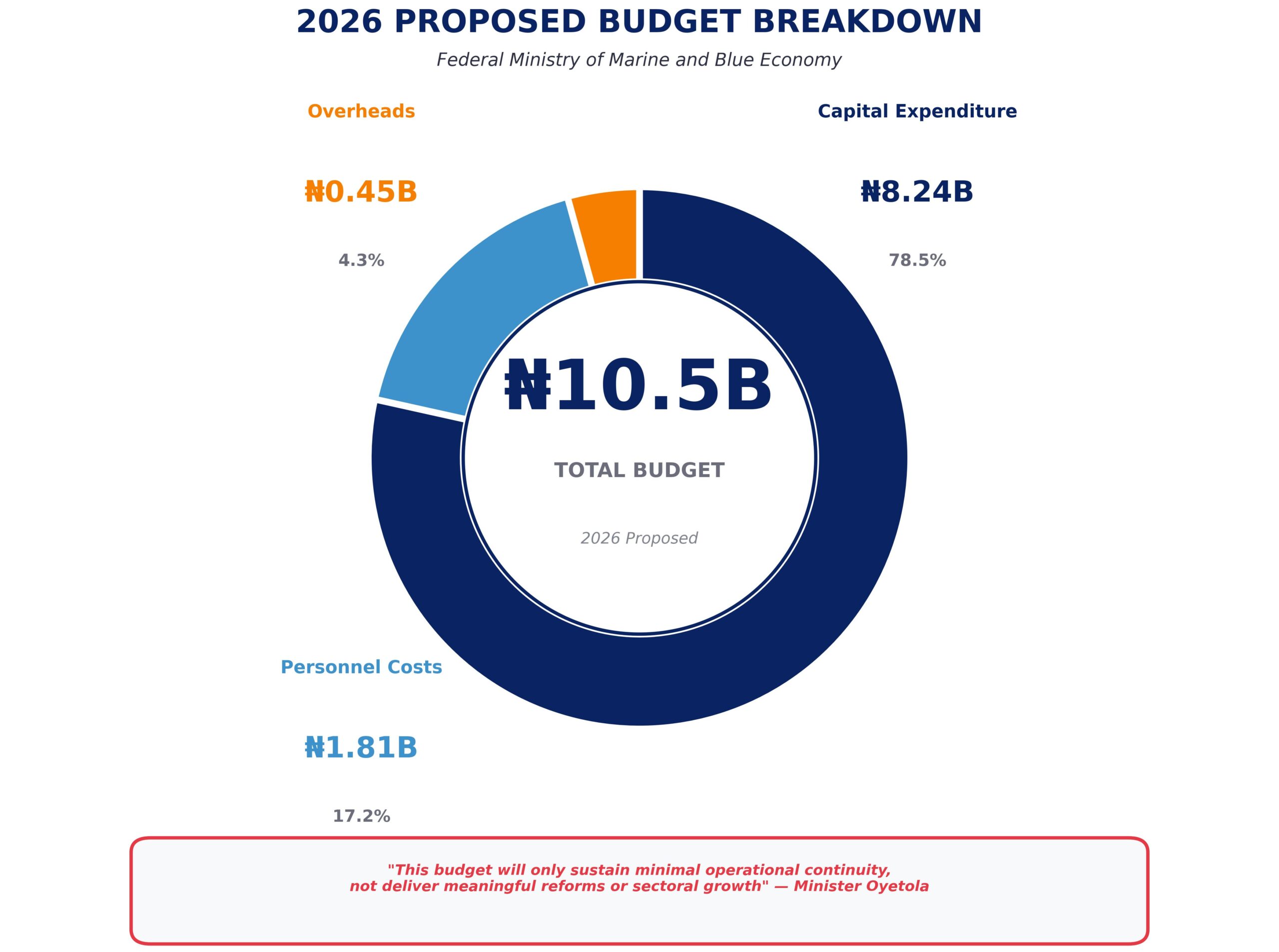
The proposed ₦10.5 billion breaks down into three components, each revealing the ministry’s straitjacket. Capital expenditure receives the lion’s share at ₦8.24 billion—78.5 percent of the total allocation. Personnel costs account for ₦1.81 billion (17.2 percent), while overhead expenses receive a mere ₦453.86 million (4.3 percent).
On paper, the capital-heavy allocation suggests infrastructure focus. In reality, Oyetola was blunt: this budget “would only sustain minimal operational continuity rather than deliver meaningful reforms or sectoral growth.”
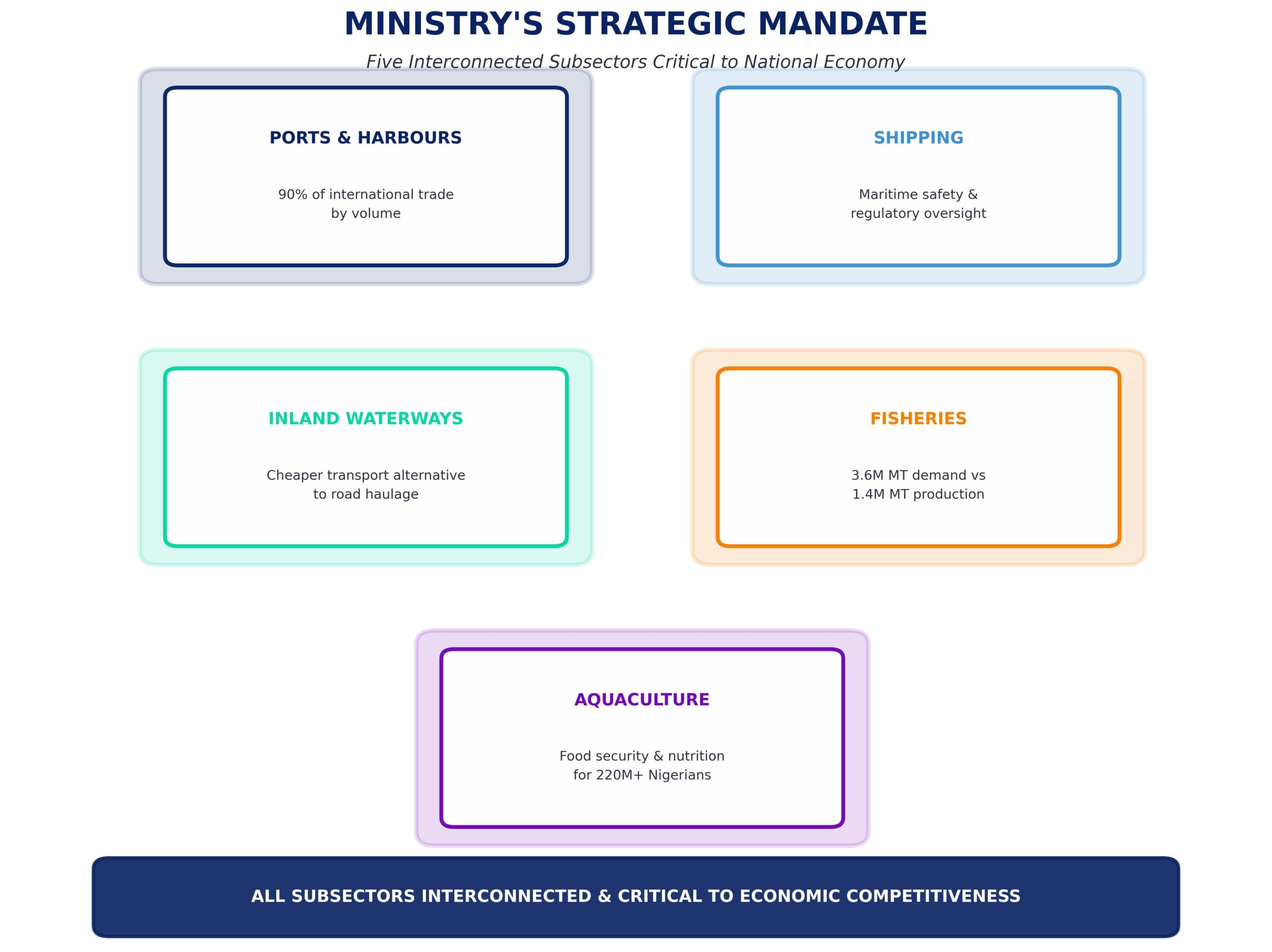
Consider what “minimal operational continuity” means for a ministry responsible for:
- Ports operations that process 90 percent of international trade
- Maritime safety across Nigeria’s territorial waters
- Inland waterways that could revolutionize freight transport
- Fisheries and aquaculture feeding a nation of over 220 million people
- Regulatory oversight of shipping, freight forwarding, and ocean resources
This is not a ministry that can afford to merely “continue operations.” It must innovate, expand, modernize, and regulate. Yet its budget suggests it will be fortunate to keep the lights on.
THE 2025 LESSONS: WHEN APPROVED BUDGETS BECOME FICTION
Perhaps the most revealing aspect of Oyetola’s presentation was the autopsy of 2025’s budget performance. The ministry’s revised capital budget stood at ₦3.53 billion. The actual cash release? A paltry ₦202.47 million—representing just 1.7 percent of the approved amount.
Overhead releases fared marginally better at 35 percent, but even this seemingly respectable figure masks operational paralysis. When you cannot access funds for capital projects, and only a third of your operational expenses are released, “minimal continuity” becomes an aspiration rather than a guarantee.
This pattern of approval-without-release has become endemic in Nigeria’s budget process, but its impact on the maritime sector is particularly catastrophic. Unlike many ministries whose inefficiency affects only internal operations, maritime sector dysfunction radiates through the entire economy.
When ports experience congestion due to inadequate investment, importers bear the cost. When cargo movement slows, manufacturers feel the pinch. When logistics costs spike, consumers pay higher prices. The ₦3.3 billion that never reached the ministry in 2025 wasn’t merely a bureaucratic shortfall—it was a stealth tax on the entire economy.
THE DEDUCTION PARADOX: STARVING REVENUE-GENERATING AGENCIES
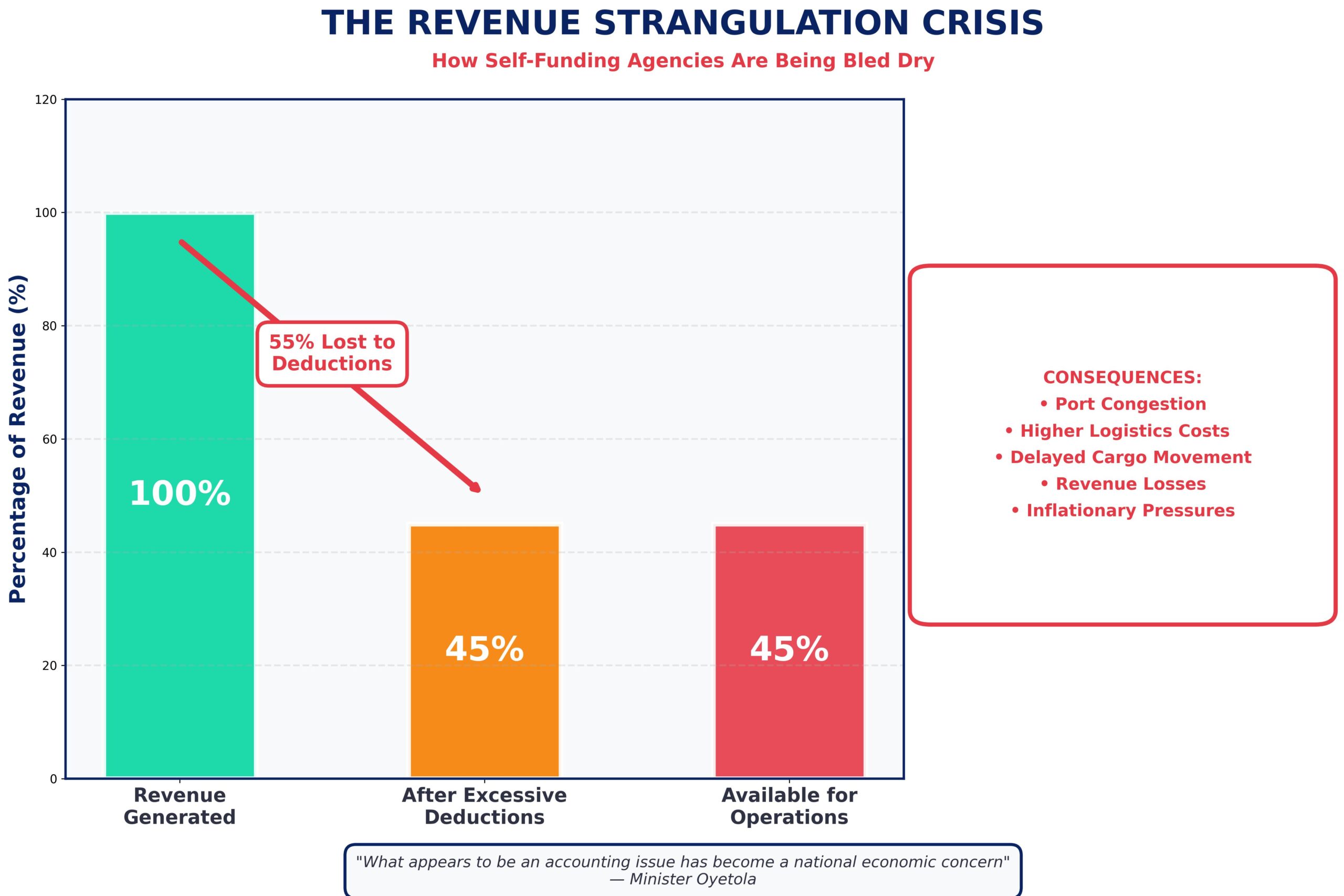
One of Oyetola’s most pointed criticisms targeted what he termed “excessive deductions at source” by the Office of the Accountant-General of the Federation. This practice targets self-funding agencies under the ministry—the Nigerian Ports Authority (NPA), Nigerian Maritime Administration and Safety Agency (NIMASA), and the Nigerian Shippers’ Council.
These agencies are remarkable entities within Nigeria’s federal structure. Unlike most government agencies that depend entirely on budgetary allocations, they generate substantial revenue from their operations and remit significantly to the Consolidated Revenue Fund. They are, in effect, profit centers that contribute to federal coffers rather than drain them.
Yet the very success of these agencies has made them targets for what economists might call “predatory extraction.” The Accountant-General’s office deducts so heavily at source that the agencies’ liquidity has been “severely constrained,” according to the minister.
The consequences are both immediate and far-reaching:
- Port congestion that delays cargo clearance and increases demurrage costs
- Higher logistics expenses that cascade through supply chains
- Delayed cargo movement that disrupts just-in-time manufacturing
- Revenue losses as inefficiency drives business to competing ports
- Inflationary pressures as imported goods become more expensive
Oyetola’s characterization was precise: “What appeared to be an accounting issue had become a national economic concern.”
This is fiscal policy at its most counterproductive. The federal government effectively weakens revenue-generating entities to capture short-term cash flow, sacrificing long-term productivity and economic efficiency. It is akin to a farmer who, desperate for immediate food, slaughters his breeding livestock instead of waiting for them to reproduce.
STRUCTURAL DYSFUNCTION: THE CRFFN MISALIGNMENT
Adding insult to injury, the minister revealed that the 2026 budget of the Council for the Regulation of Freight Forwarding in Nigeria (CRFFN) was wrongly placed under the Federal Ministry of Transportation by the Budget Office, despite CRFFN being an agency under the Marine and Blue Economy Ministry.
This may seem like bureaucratic minutiae, but such misalignments have real consequences. They undermine oversight clarity, weaken policy coherence within the maritime logistics value chain, and create confusion about accountability and reporting lines.
More fundamentally, they reflect the casual disregard with which the maritime sector is treated within federal budget architecture. If budget officials cannot even correctly align agencies with their parent ministries, what hope exists for nuanced understanding of the sector’s resource needs?
Bode Animashaun is our correspondent who coves maritime, fiscal policy and economic development.


NIGERIA AND CAMEROON SIGN SEARCH AND RESCUE AGREEMENT — A WIN FOR REGIONAL SAFETY
The deal extends emergency cooperation beyond the skies, with implications for maritime and cross-border rescue operations across the Gulf of Guinea.
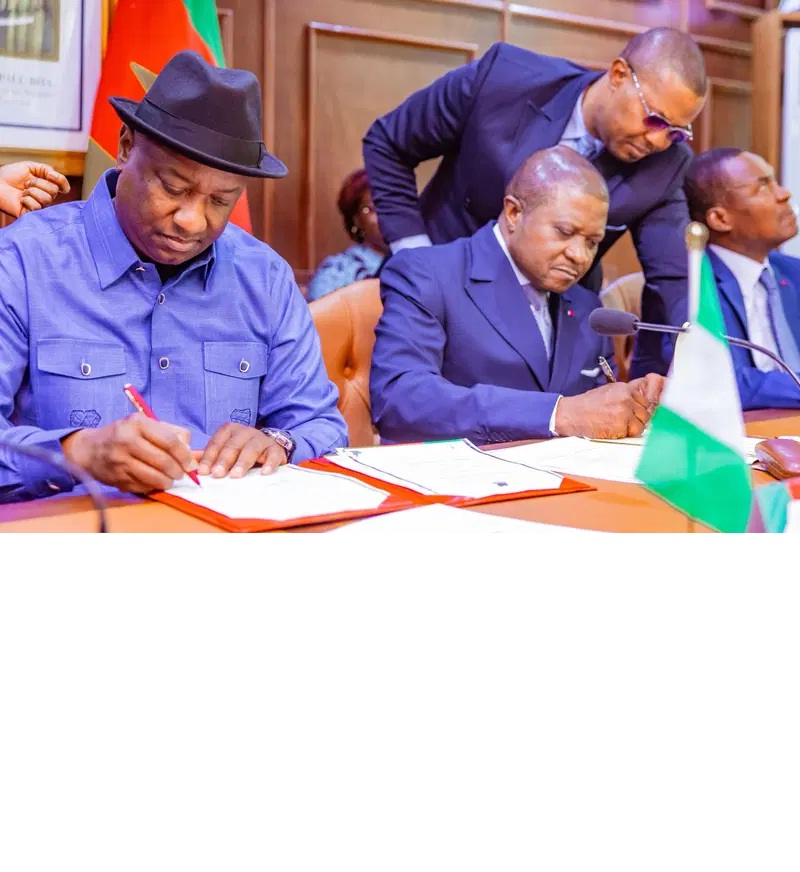
Nigeria and Cameroon have formalised a Technical Aeronautical Search and Rescue (SAR) Agreement, marking a significant step in cross-border emergency response cooperation between the two neighbouring nations.
Aviation Minister Festus Keyamo signed the agreement during a working visit to Cameroon, accompanied by the Director-General of the Nigeria Civil Aviation Authority (NCAA), Capt. Chris Najomo. The signing was confirmed in a statement by the minister’s Special Adviser on Media and Communications, Tunde Moshood.
“Search and rescue cooperation is not simply a regulatory requirement under ICAO Annex 12; it is a humanitarian imperative and a moral responsibility” Festus Keyamo, Minister of Aviatioon and Aerospace Space Development
Why It Matters Beyond Aviation
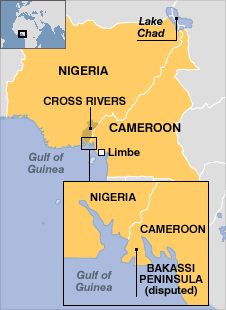
While framed as an aeronautical agreement, the deal carries broader significance for Nigeria’s maritime and coastal emergency response community. Nigeria and Cameroon share not only a land border but also overlapping maritime zones in the Gulf of Guinea — one of the world’s most strategically important and operationally challenging waterways. Strengthened SAR coordination between the two countries sets a precedent and a practical framework that could, in time, extend to joint maritime rescue operations in shared waters.
For Waterways News NG readers — port operators, shipping agents, seafarers, and maritime regulators — the agreement signals a regional shift toward more integrated emergency response, one that the maritime sector has long called for.
What the Agreement Does
The pact establishes clear communication protocols between the Rescue Coordination Centres (RCCs) of both countries, facilitates joint search and rescue operations, and strengthens rapid response mechanisms within their respective Search and Rescue Regions (SRRs). It brings both nations into closer alignment with international safety standards, particularly ICAO Annex 12, which governs SAR obligations for signatory states.
Speaking at the signing ceremony, Minister Keyamo was direct about the stakes involved. “Search and rescue cooperation is not simply a regulatory requirement under ICAO Annex 12; it is a humanitarian imperative and a moral responsibility,” he said.
He added: “In moments of distress, response time saves lives. Borders must never become barriers to humanitarian intervention.”
Framed Within the Tinubu Agenda
The agreement has been positioned by the Federal Government as part of President Bola Tinubu’s Renewed Hope agenda, which prioritises institutional strengthening, regional cooperation, economic revitalisation, and the protection of lives and property.
Keyamo described aviation — and by extension, the broader transport sector — as a strategic driver of economic growth and regional integration, while stressing that such growth must be grounded in safety and effective emergency preparedness.
“Today, Nigeria and Cameroon demonstrate that cooperation — not fragmentation — defines our regional approach to aviation safety,” the minister said, calling the agreement a practical expression of African solidarity and good neighbourliness.
A Building Block for Gulf of Guinea Cooperation
For the maritime community, the deal is worth watching closely. The Gulf of Guinea remains one of the most piracy-affected maritime regions in the world, and coordinated SAR capacity between Nigeria and Cameroon — two of its most significant coastal states — is a building block toward more robust regional maritime security architecture.
Nigeria’s maritime agency, NIMASA, has in recent years worked to strengthen its own SAR and anti-piracy capabilities through initiatives such as the Deep Blue Project. A complementary bilateral framework with Cameroon could reinforce those efforts and improve response times in the event of incidents near shared waters.
The agreement reinforces both countries’ commitment to international safety standards and, for those watching Nigeria’s place in regional maritime affairs, offers a quiet but meaningful signal of diplomatic momentum.
Waterways News NG will continue to track developments in Nigeria-Cameroon maritime and aviation cooperation.
— Waterways News NG | www.waterwaysnews.ng
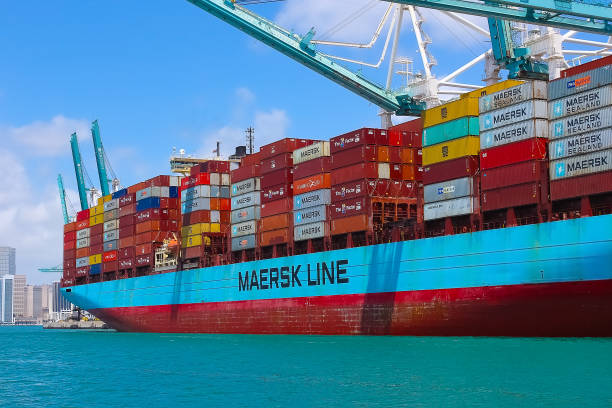
MAERSK PULLS BACK FROM RED SEA AGAIN — WHAT IT MEANS FOR WEST AFRICAN SHIPPING
The world’s largest container line has reversed course on its Red Sea comeback, raising fresh concerns for Nigerian importers and shippers already navigating tight supply chains.
Danish shipping giant Maersk has announced a temporary withdrawal from the Suez–Red Sea corridor on two of its major services, just weeks after cautiously resuming transits through the troubled waterway.
In a customer advisory dated February 27, the carrier described the move as “temporary adjustments” affecting its ME11 and MECL services — but for cargo interests across West Africa, the implications could be anything but temporary.
Why Maersk Is Turning Back
The company cited what it called “unforeseen constraints” stemming from the wider operating environment in the Red Sea region. After consultations with security partners, Maersk concluded that reliably avoiding delays through the area had become too difficult to guarantee.
As a result, several upcoming voyages on both affected services will be diverted away from the Suez Canal and rerouted around the Cape of Good Hope — adding thousands of nautical miles, additional sailing days, and higher fuel costs to each voyage.
The Services Affected
The MECL service — an independently operated route linking Saudi Arabia and other Middle East ports with the U.S. East Coast — will see its next three eastbound and westbound sailings rerouted via southern Africa through mid-March.
More significantly, the ME11 service connecting India and the Middle East to the Mediterranean will have its next three westbound and four eastbound voyages diverted around the Cape. The ME11 operates under the Gemini Cooperation, the vessel-sharing alliance between Maersk and Germany’s Hapag-Lloyd, giving the decision added weight across the industry.
Maersk said it was giving customers three weeks’ notice to adjust supply chain plans, with updated transport schedules to follow.
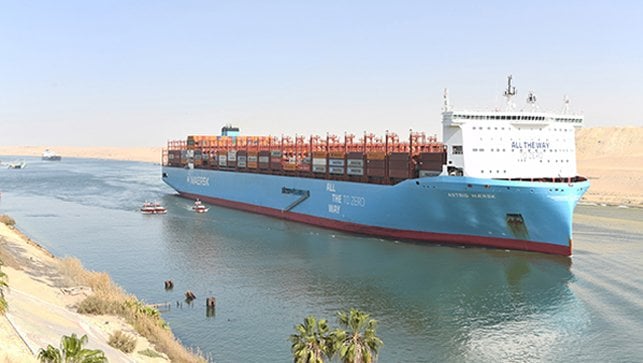
A Fragile Return Unravels
The reversal is notable for its timing. Just over two weeks ago, a Maersk vessel completed the first eastbound Suez transit on the reinstated ME11 route — a carefully watched moment that many in the shipping world had hoped signalled a durable return to the corridor.
That optimism now appears premature. Earlier in January, Maersk had cautioned that sailings through the region would depend on stable security conditions and reliable naval protection. Those conditions, it now says, are not holding consistently enough.
Security Challenges Persist
The broader security picture in the Red Sea remains uneasy. Yemen’s Houthi movement has made intermittent threats, though no confirmed attacks on merchant vessels have been recorded since last September. Meanwhile, rising U.S.-Iran tensions and an expanded American naval presence in the Middle East have added layers of unpredictability to the region.
On the protection side, the European Union’s maritime security mission, Operation Aspides — which deploys three warships to escort commercial vessels through the corridor — was recently extended through February 2027. However, limited escort capacity has created scheduling bottlenecks, with French carrier CMA CGM previously flagging long waits for available naval cover as a major operational headache.
What This Means for Nigerian Shippers
For cargo stakeholders in Nigeria and across the Gulf of Guinea, renewed Red Sea disruptions carry direct consequences. Longer Cape of Good Hope routings push up transit times and freight costs — pressures that typically filter through to Nigerian importers and end consumers.
The ME11 service in particular feeds cargo flows between Asia, the Middle East, and Europe, with knock-on effects for connecting services that serve West African ports. Any sustained return to Cape routing by major carriers would likely tighten vessel availability and complicate scheduling on feeder and direct services calling at Nigerian terminals.
Industry watchers say Maersk’s decision could prompt other carriers to slow or reconsider their own Red Sea comeback plans — further prolonging a disruption that has reshaped global shipping patterns since late 2023.
Maersk maintains the rerouting is short-term and continues to describe the Suez corridor as the fastest, most sustainable option for customers. But as confidence in the route proves fragile once again, the Cape of Good Hope remains, for now, the safer bet.
Waterways News NG will continue to monitor developments in the Red Sea and their implications for Nigerian and West African maritime trade.
— Waterways News NG | www.waterwaysnews.ng
CASABLANCA PORT SHUT DOWN AFTER VESSEL LOSES 85 CONTAINERS — SHIP SERVES NIGERIAN ROUTES
Port authorities in Morocco have suspended all vessel movements at the Port of Casablanca following a container overboard incident involving a ship that regularly calls at Nigerian ports.
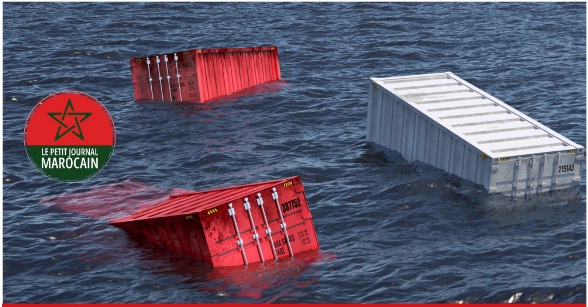
Morocco’s National Ports Agency ordered the suspension at approximately 11:00 PM local time on Thursday, February 26, after the containership Ionikos lost an estimated 85 containers into the water near the harbour entrance while departing the port in heavy seas.
As of Friday, operations at one of Africa’s busiest container ports remained halted, with numerous boxes still reported floating in the channel, posing serious navigational hazards.
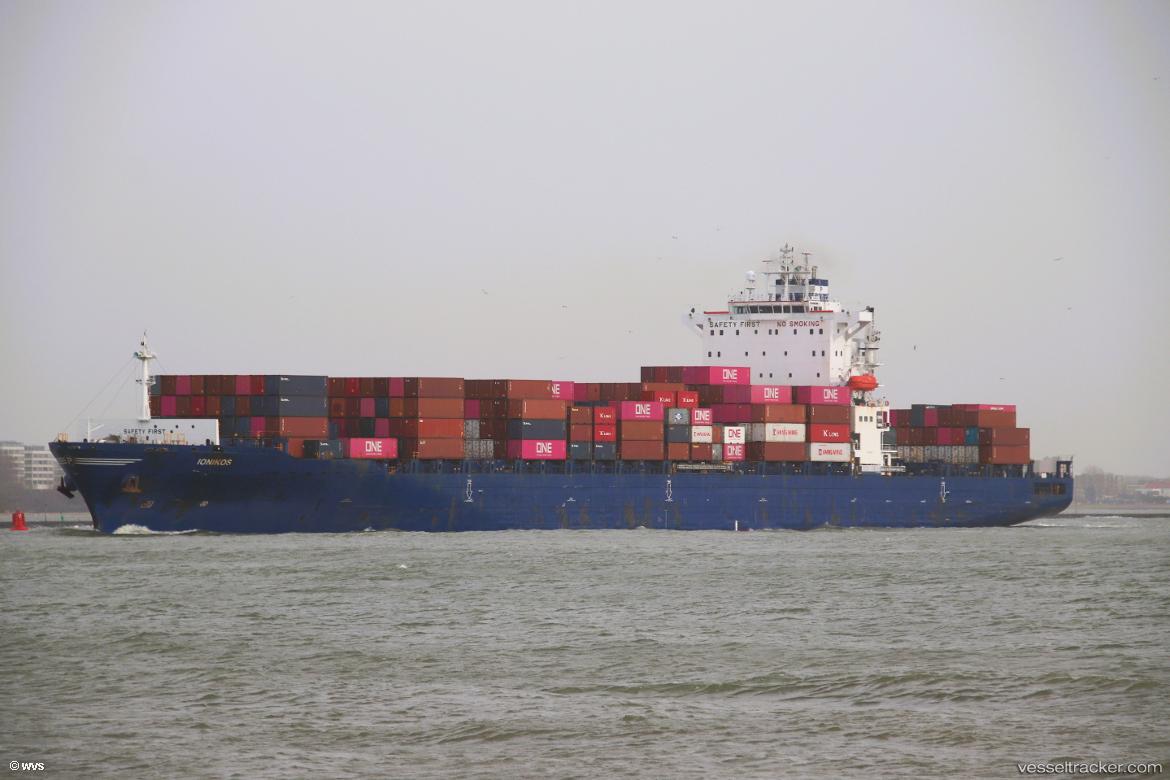
The Ionikos — a 52,427-deadweight-tonne vessel owned by Greek shipping interests and registered under the Liberian flag — is of particular interest to Nigerian shippers and port stakeholders. The ship operates on a service connecting Turkey and the eastern Mediterranean with ports in the Gulf of Guinea, including regular calls at Nigerian terminals and other West African destinations.
According to initial reports, the vessel had completed cargo operations in Casablanca and was bound for Barcelona when it encountered heavy swells on departure. The rough sea conditions caused the ship to roll violently, sending an estimated 85 containers overboard.
The Ionikos, built in 2009, measures 258 metres in length and has a capacity of 4,360 twenty-foot equivalent units (TEU). The vessel is currently anchored approximately six nautical miles offshore as authorities assess the damage and coordinate recovery efforts.
An overnight search and recovery operation was launched involving five vessels from Morocco’s Royal Maritime Gendarmerie and Royal Navy, alongside helicopter aerial support. Officials noted that darkness hampered early efforts to locate and secure the drifting containers. Tugboats have since been stationed near several floating units to prevent further hazards to passing traffic.
Local media in Morocco reported that the lost containers were carrying a range of cargo, including car parts, furniture, and consumer goods. At least one container is reported to have broken open and washed ashore on a nearby beach, where boxes of Nestlé-branded cereal were found scattered.
The incident compounds operational difficulties already affecting the port this winter. Reports indicate that a series of storms and persistent Atlantic swells have disrupted maritime traffic at Casablanca in recent months.
Port authorities said vessel movements would resume only when conditions in the harbour channel are deemed safe for navigation.
The disruption is being monitored closely by Nigerian shipping agents and cargo interests given the vessel’s regular Gulf of Guinea service schedule. Waterways News NG will provide updates as the situation develops.
— Waterways News NG | www.waterwaysnews.ng
-
 Blue Economy2 weeks ago
Nigeria’s Coast Guard Bill: A Solution in Search of a Problem?
-
 News2 weeks ago
From Awareness to Action: How SWAAADO is Rewriting Nigeria’s Waterways Safety Story
-
 Blog3 weeks ago
SWAAADO Intensifies Waterways Safety Sensitization Campaign to Waterfront Communities in Lagos State.