
Special Report
NIGERIA’S MARINE ECONOMY CRISIS: CAN ₦10.5B SAVE A SECTOR THAT HANDLES 90% OF TRADE? 2

Minister Oyetola’s Budget Plea Exposes Decade of Systematic Neglect

A Waterways News Special Report
Abuja, February 11, 2026
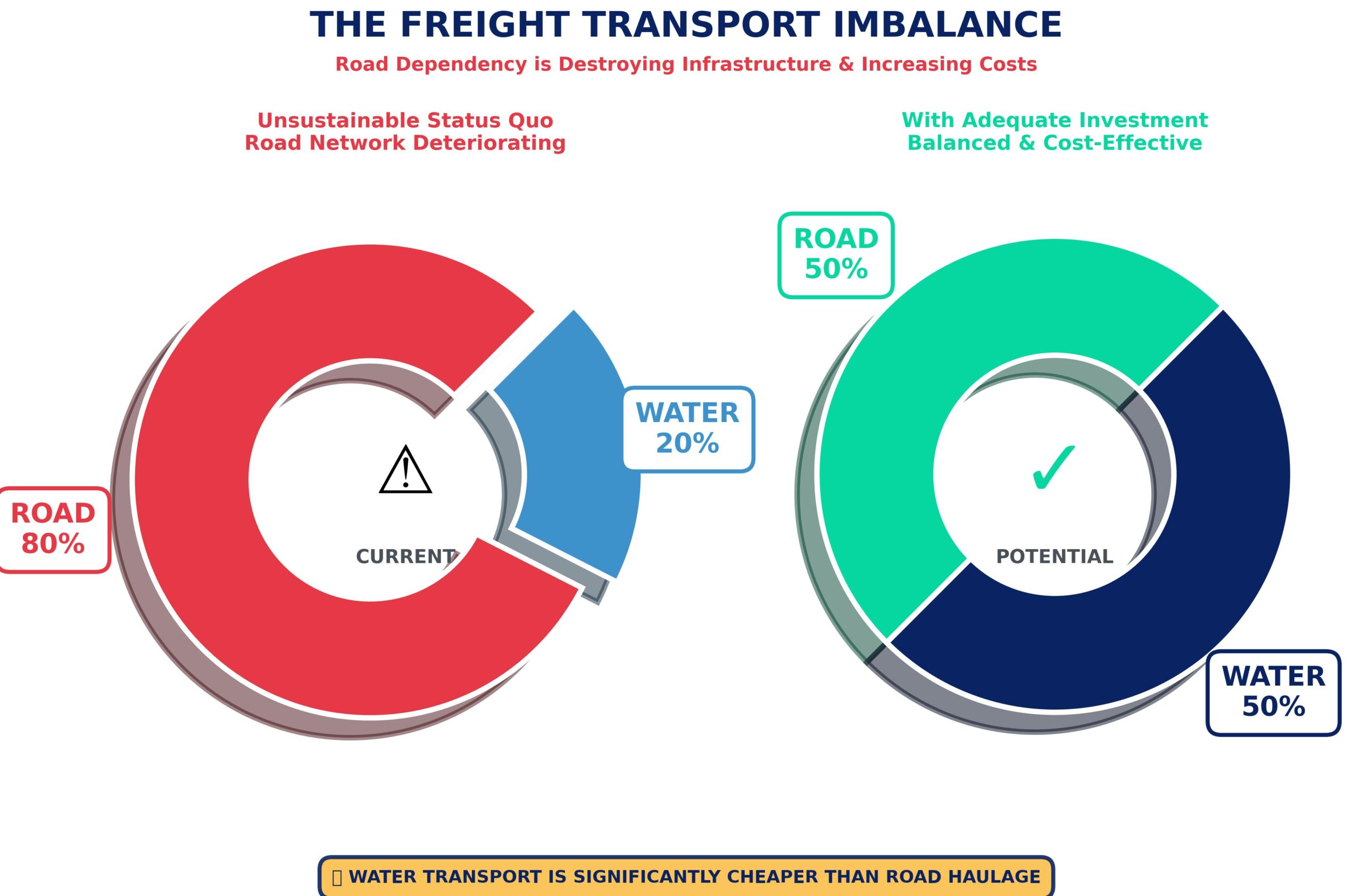
THE INLAND WATERWAYS OPPORTUNITY: CHEAP, SAFE, IGNORED
Nigeria’s heavy reliance on road transport for over 80 percent of freight movement is both economically irrational and infrastructurally destructive. Water transport is globally recognized as significantly cheaper than road haulage, yet Nigeria’s inland waterways remain chronically underfunded, unsafe, and underutilized.
The minister’s appeal for increased waterways funding was framed around safety—curbing accidents and loss of lives. But the economic argument is equally compelling. Shifting even 20 percent of current road freight to waterways would:

- Reduce road deterioration, extending the lifespan of highway infrastructure
- Lower logistics costs for manufacturers and distributors
- Decrease carbon emissions from heavy truck traffic
- Ease urban congestion in cities along major freight corridors
- Create new economic activity around river ports and inland terminals
Yet year after year, waterways receive token allocations that barely cover operational costs, much less the investment needed to make them viable alternatives. The proposed 2026 budget continues this pattern of benign neglect.
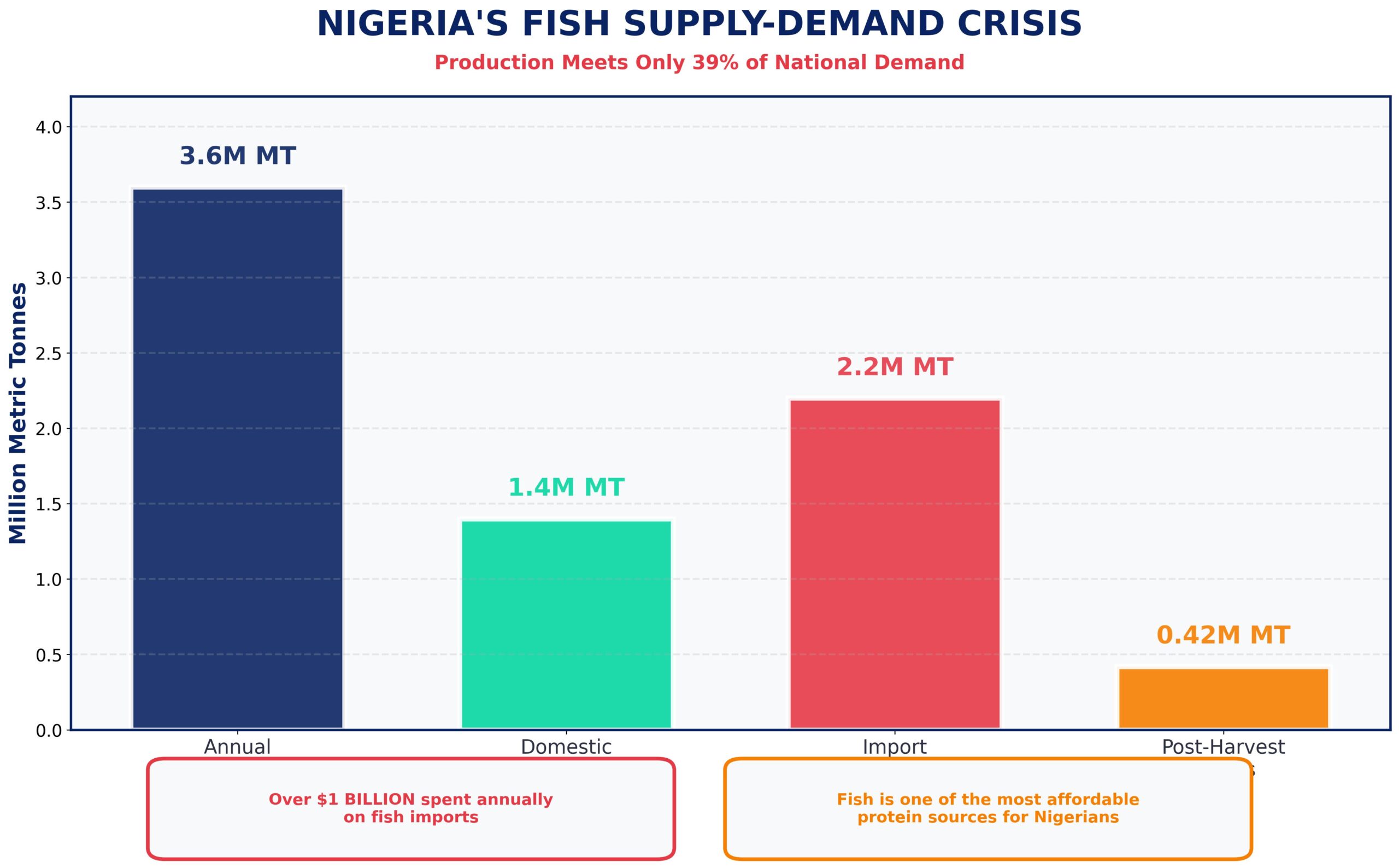
THE FISH IMPORT TRAP: FOOD SECURITY MEETS FOREX DRAIN
Nigeria’s fish sector presents one of the clearest cases for urgent investment. Annual demand exceeds 3.6 million metric tonnes. Domestic production struggles to reach 1.4 million metric tonnes. The deficit—over 2.2 million metric tonnes—is met through imports valued at more than one billion dollars annually.
This is not a luxury import situation. Fish is one of the most affordable sources of animal protein for Nigerian households, particularly in coastal and riverine communities. Yet the country spends over $1 billion yearly to import what it could theoretically produce domestically.
The situation is made worse by post-harvest losses of up to 30 percent, which further reduce already inadequate supply. These losses stem from poor storage facilities, inadequate cold chain infrastructure, and inefficient processing methods—all problems that require capital investment to solve.
The minister assured the committee that the ministry is “working hard to increase local fish production and reduce importation.” But without substantial budgetary support, such assurances ring hollow. You cannot build cold storage facilities, establish fish processing plants, or develop aquaculture infrastructure without capital.
The math is brutal but simple: spending ₦10.5 billion domestically to build fish production capacity makes far more economic sense than spending $1 billion (roughly ₦1.5 trillion at current exchange rates) annually on imports. Yet the budget reflects no such strategic thinking.
WHAT THIS BUDGET CAN ACHIEVE: A REALISTIC ASSESSMENT
If the ₦10.5 billion is approved and—critically—actually released, what might the ministry accomplish?
Minimal operational continuity is the minister’s own assessment, and there is no reason to dispute it. The budget allows for:
- Basic administrative functions: Paying salaries, maintaining offices, conducting routine oversight
- Essential maintenance: Keeping existing infrastructure from complete collapse
- Selective interventions: Perhaps a handful of small-scale pilot projects in priority areas
- Crisis management: Responding to immediate problems as they arise
What the budget cannot achieve:
- Meaningful port modernization to reduce congestion and improve efficiency
- Waterways infrastructure development to shift freight from road to water
- Aquaculture expansion to meaningfully close the fish production gap
- Maritime safety upgrades beyond bare-minimum equipment replacement
- Regulatory capacity building to match international standards
- Blue economy initiatives to tap ocean resources sustainably
In essence, this is a budget for survival, not growth. It keeps the ministry alive but does not enable it to fulfill its mandate. For a sector handling 90 percent of international trade, this represents a catastrophic failure of prioritization.
CRITICAL OVERSIGHTS: WHAT THE BUDGET IGNORES
Several glaring omissions undermine the budget’s already limited potential:
1. No Strategy for Reversing Agency Revenue Deductions
The budget proposal identifies excessive deductions as a core problem but offers no mechanism or dedicated allocation to negotiate, compensate for, or legally challenge these deductions. The agencies will continue bleeding revenue.
2. Insufficient Allocations for Safety and Emergency Response
Given the minister’s emphasis on waterways safety and recurring accidents, the budget should have included dedicated safety infrastructure spending—life jackets, rescue boats, communication equipment, training programs. These appear absent or inadequately funded.
3. No Meaningful Aquaculture Investment
Closing a 2.2 million metric tonne fish deficit requires industrial-scale aquaculture development. This demands hatcheries, feed mills, extension services, and farmer financing programs. The capital allocation shows no evidence of such ambition.
4. Port Technology Deficits Unaddressed
Modern ports run on digital systems—automated cargo handling, electronic documentation, real-time tracking. Nigeria’s ports lag decades behind. The budget includes no visible allocation for technology upgrades that could radically improve efficiency.
5. Climate Adaptation Ignored
As a maritime and fisheries ministry, climate change should be central to planning. Rising sea levels, ocean warming, and weather pattern changes directly affect all subsectors. The budget reflects no climate adaptation or mitigation strategy.
6. Private Sector Partnership Mechanisms Absent
Given fiscal constraints, the ministry should be aggressively pursuing public-private partnerships for infrastructure development. The budget includes no dedicated allocation for PPP structuring, feasibility studies, or transaction advisory services.
7. Human Capital Development Overlooked
Maritime expertise—naval architects, marine engineers, aquaculture specialists, port managers—requires continuous training and development. There is no evidence of a robust capacity-building allocation.
THE BOTTOMLINE: A SECTOR TOO CRITICAL TO FAIL, TOO NEGLECTED TO SUCCEED
Minister Oyetola’s budget presentation was, in essence, a cry for help dressed in bureaucratic language. Behind the technocratic terminology and fiscal jargon lies a stark reality: Nigeria is systematically undermining one of its most strategically vital sectors.
The marine and blue economy is not a discretionary concern. It is the foundation upon which Nigeria’s trade, commerce, and food security rest. When 90 percent of international trade moves through your ports, maritime efficiency becomes synonymous with economic competitiveness. When over 40 million people depend on fishing for livelihood, aquaculture becomes a matter of social stability.
Yet the budget treats this sector as an afterthought—not because policymakers are ignorant of its importance, but because immediate fiscal pressures consistently override long-term strategic thinking. The federal government’s approach resembles a homeowner who, facing a cash crunch, stops paying for roof repairs while the ceiling leaks. The short-term savings are real; the long-term costs are catastrophic.
Three fundamental truths emerge from this budget crisis:
First, the current model of funding the maritime sector is economically irrational. Self-funding agencies that generate substantial revenue should not be bled dry through excessive deductions. They should be strengthened, allowed to retain more of their earnings, and encouraged to expand operations. The federal government’s current approach is like taxing a successful business into bankruptcy.
Second, the disconnect between budget approval and budget release has become a farce. When only 1.7 percent of capital allocations actually reach the implementing ministry, the budget process itself loses credibility. Either approve realistic budgets and release funds, or stop pretending the paper allocations mean anything.
Third, the ministry needs at minimum a ten-fold budget increase to begin addressing its mandate seriously. ₦100 billion annually would still be modest for a sector of this importance, but it would at least enable strategic interventions rather than mere survival.
Senator Wasiu Eshilokun’s assurance that the National Assembly will “carefully examine the proposals” is welcome, but examination alone will not solve the underlying structural problems. The Senate and House committees have an opportunity—perhaps an obligation—to fundamentally rethink how Nigeria funds its maritime sector.
This might mean:
- Legislation protecting self-funding agency revenues from excessive deductions
- Multi-year funding commitments for major infrastructure projects
- Automatic budget release mechanisms tied to fiscal performance indicators
- Establishment of a dedicated blue economy development fund with guaranteed annual allocations
- Congressional oversight of the Accountant-General’s deduction policies
Without such structural reforms, the ₦10.5 billion budget—whether approved or not, whether released or not—will remain what Minister Oyetola himself acknowledged: enough to survive, insufficient to succeed.
Nigeria’s maritime sector deserves better. More importantly, Nigeria’s economy requires better. The question is whether those holding the purse strings will recognize this reality before the cost of neglect becomes insurmountable.
The minister has done his job. He has sounded the alarm, presented the evidence, and made the case. Now the responsibility shifts to the National Assembly and, ultimately, to the presidency.
Will they respond with the urgency this crisis demands, or will they approve another aspirational budget that remains largely unimplemented, consigning the marine and blue economy to another year of “minimal operational continuity”?
The answer to that question will reverberate far beyond the ministry’s offices. It will be felt in every port, on every waterway, in every fishing community, and ultimately, in the price Nigerians pay for goods and food.
The time for carefully examining proposals has long passed. The time for decisive action is now.
A Waterways News Special Report
Abuja, February 11, 2026


Blue Economy
FROM OCEAN TO ENGINE: How Seawater-to-Hydrogen Technology Could Reshape the Future of Maritime Fuel

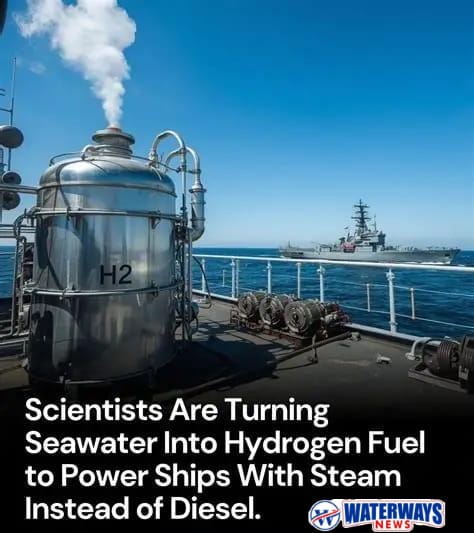
FROM OCEAN TO ENGINE: How Seawater-to-Hydrogen Technology Could Reshape the Future of Maritime Fuel
Breakthrough electrolysis systems promise to turn the world’s most abundant resource into clean shipping energy — and the implications for global shipping are profound
By Raymond Gold | Co-publisher and Research Reporter| Waterways News, Lagos
For centuries, the sea has been both highway and hazard for the world’s merchant fleets — a vast, untameable resource that ships cross but cannot consume. That relationship may now be on the verge of a fundamental transformation. Engineers and clean-energy researchers are advancing technology that converts seawater directly into hydrogen fuel, potentially allowing vessels to generate their own power from the very ocean beneath their hulls.
The concept, long theorised in academic and engineering circles, has in recent years moved closer to practical application. And for an industry under mounting pressure to decarbonise — shipping accounts for nearly three percent of global greenhouse gas emissions annually — the implications could hardly be more consequential.
What the Technology Does
At its core, seawater-to-hydrogen conversion exploits a deceptively simple chemistry: water, whether fresh or saline, is composed of hydrogen and oxygen atoms that can be separated through electrolysis — the application of electrical current to drive a chemical reaction. In conventional electrolysis, this process uses purified water. The innovation driving current research is the ability to perform this separation efficiently using raw seawater, bypassing the costly and energy-intensive step of desalination.
The challenge is considerable. Seawater is not merely water with dissolved salt; it is a complex mineral solution containing chlorides, sulphates, magnesium, calcium, and dozens of trace elements that aggressively corrode standard electrolysis equipment and compromise catalytic efficiency. Overcoming this requires specialised membrane materials, corrosion-resistant electrode coatings, and advanced catalyst designs capable of selectively extracting hydrogen without triggering the destructive chlorine evolution reactions that plague conventional systems.
Several research institutions — including teams at Stanford University and in China’s leading materials science faculties — have demonstrated functional seawater electrolysis cells in laboratory conditions. The next frontier is ruggedising these systems for the rolling, salt-spray environment of an operational vessel on an ocean crossing.
Once extracted, the hydrogen can be deployed aboard ship in two primary ways: through hydrogen fuel cells, which generate electricity through an electrochemical reaction between hydrogen and oxygen with water as the only byproduct; or through combustion in modified engine systems, including hydrogen-driven steam turbines — a technology that echoes the steam age of maritime history but points firmly toward a zero-emission future.
Why This Matters for Shipping
The global shipping industry moves approximately 90 percent of world trade by volume. It runs almost entirely on heavy fuel oil and marine diesel — fossil fuels that produce sulphur oxides, nitrogen oxides, particulate matter, and carbon dioxide at scale. The International Maritime Organisation (IMO) has set a target of net-zero greenhouse gas emissions from international shipping by or around 2050, with intermediate milestones that are already forcing operators and flag states to act.
Alternative fuels — LNG, methanol, ammonia, and green hydrogen — are being explored across the industry. Each carries its own infrastructure challenge. LNG requires cryogenic bunkering terminals. Ammonia is toxic and demands careful handling protocols. Green hydrogen, produced from renewable electricity, depends on an entirely new supply chain that does not yet exist at the scale shipping requires.
Onboard seawater electrolysis sidesteps this infrastructure dependency entirely. A vessel equipped with the technology would, in principle, generate its own fuel continuously during a voyage, powered by renewable energy sources — solar arrays, wind-assisted propulsion, or wave energy convertors — installed on the ship itself. The bunkering port visit, one of the central logistics events in any ocean voyage, could eventually become optional rather than obligatory.
“The vision is genuine maritime energy autonomy,” one marine engineer familiar with current research described it. “You leave port, and the ocean provides.”
The Engineering Obstacles
The path from laboratory demonstration to commercial deployment is rarely short, and seawater electrolysis faces specific engineering obstacles that require resolution before any shipowner will commit capital to a retrofit or newbuild specification.
Foremost among these is the corrosion problem. The electrolytic cell, the filtration system, and all downstream hydrogen handling components must withstand not only the mineral aggressiveness of seawater but also the physical stresses of a marine operating environment — vibration, temperature cycling, and the mechanical demands of continuous operation over voyages measured in weeks. Catalysts and membranes that perform well in controlled conditions may degrade rapidly under these stresses, driving up maintenance costs and reducing reliability.
Filtration is a related challenge. Seawater must be processed through multi-stage filtration to remove particulates, biological matter, and the heaviest dissolved minerals before it reaches the electrolysis cell. The design and maintenance of these filtration trains — compact enough to fit within a vessel’s existing hull footprint without displacing cargo capacity — is itself an active area of engineering research.
Energy efficiency is perhaps the most critical metric. Electrolysis is not thermodynamically free; splitting water requires energy input, and on a vessel where every kilowatt-hour must be generated or stored, the round-trip efficiency of the fuel generation cycle determines whether the system is economically viable. Current state-of-the-art electrolysers operate at between 60 and 80 percent efficiency in ideal conditions. Marine seawater systems are not yet at the upper end of that range.
Scale is the final variable. A research cell producing grams of hydrogen per day is a proof of concept. A commercial system capable of fuelling a Panamax bulker or a large container vessel across the Pacific must produce hydrogen at a rate orders of magnitude higher, consistently and safely, in a package that integrates with existing ship systems and satisfies classification society and flag state safety requirements.
Nigeria Watch: What This Means for West Africa’s Maritime Sector
For Nigerian shipping stakeholders — from the Nigerian Maritime Administration and Safety Agency (NIMASA) to the Nigerian Ports Authority (NPA), private shipowners, and the Federal Ministry of Marine and Blue Economy — seawater-to-hydrogen technology warrants close attention even at this early stage of development.
Nigeria’s maritime sector is undergoing a strategic pivot. The revival of a national carrier through partnerships with DP World and AD Ports Group, the deepening of Lekki Deep Sea Port operations, and the Federal
Government’s blue economy agenda all signal ambitions to position Nigeria as a maritime hub rather than merely a transit market. The vessels and fleets that will carry those ambitions — whether coastal tankers, offshore support vessels, or deep-sea cargo ships — will be subject to increasingly strict international emissions standards as they operate in foreign ports and trade lanes.
The European Union’s Emissions Trading System now applies to shipping, and vessels calling at European ports are already paying a carbon price on their voyages. The IMO’s Carbon Intensity Indicator (CII) regulations are tightening year on year. Nigerian-flagged vessels, and Nigerian operators trading internationally, cannot remain insulated from these requirements indefinitely.
A technology that enables onboard fuel generation from seawater would be particularly valuable for the offshore oil and gas support sector — a significant component of Nigeria’s maritime economy — where vessels operate far from shore for extended periods and fuel logistics represent a meaningful proportion of operating costs. Patrol and surveillance vessels operated by NIMASA and the Nigerian Navy, which must sustain extended coastal and offshore operations, represent another potential application domain.
The immediate priority for Nigerian maritime regulators and industry associations is awareness and engagement: monitoring the development trajectory of seawater electrolysis systems, participating in IMO technical working groups on alternative fuels, and ensuring that when commercial systems begin to reach the market — an eventuality most analysts place in the 2030s — Nigerian operators and shipyards are positioned to adopt rather than adapt belatedly.
Looking Ahead
The conversion of seawater into hydrogen fuel will not decarbonise global shipping overnight. The technology faces real, unresolved engineering challenges, and the capital cycle of the shipping industry — where vessels are built to operate for 25 years or more — means that transformation is necessarily gradual. But the direction of travel is clear, and the pace of research is accelerating.
What was speculative a decade ago is now demonstrable in laboratory conditions. What is demonstrable today will, with sustained investment and engineering ingenuity, be deployable at sea within the decade. For an industry that has powered itself with fossil fuels since the coal age, the prospect of drawing energy from the ocean itself represents not merely a technical advance but a philosophical one: a shift from consuming the earth’s finite reserves to harvesting the planet’s most inexhaustible resource.
The sea, in other words, may one day fuel the ships that sail in it.
Raymond Gold is Co-publisher and Research Reporter for Waterways News
Waterways News covers the Nigerian and West African maritime sector. For enquiries, advertising, and editorial submissions, visit www.waterwaysnews.ng
Editor Choice
WORKERS’ DAY SPECIAL REPORT: Between the Tide and the Struggle — The State of Nigeria’s Maritime Workers in 2026
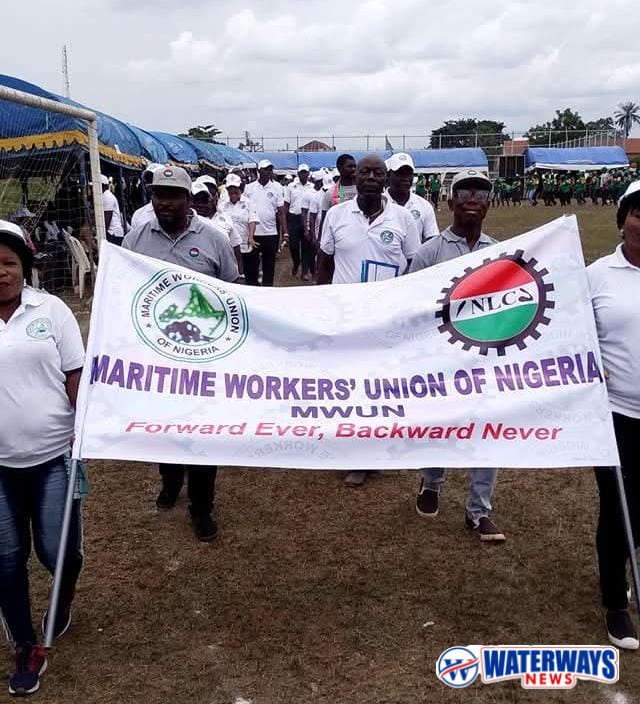
WORKERS’ DAY SPECIAL REPORT: Between the Tide and the Struggle — The State of Nigeria’s Maritime Workers in 2026
A Waterways News Special Investigation | May 1, 2026
By Larry Osaweren | Waterways News
As the world marks International Workers’ Day, the men and women who keep Nigeria’s ports, terminals, and waterways moving remain among the most underserved labour forces on the continent. From the creeks of the Niger Delta to the crowded jetties of Apapa, their stories are ones of grit against institutional neglect, unpaid wages, and structural abandonment — set in sharp relief against a global maritime labour framework that Nigeria has ratified but struggles to enforce.
The Wage Gap That Indicts a System
Begin with the most basic measure of worker dignity: pay.
In April 2025, the International Labour Organization concluded minimum wage negotiations in Geneva, setting the global maritime floor at USD $690 per month for an able seafarer — effective January 2026, rising to $704 in 2027 and $715 in 2028. That figure, the product of decades of collective bargaining between the International Chamber of Shipping and the International Transport Workers’ Federation, represents the baseline below which no seafarer anywhere in the world should legally fall.
Nigerian seafarers fall below it routinely.
Testimonies gathered by industry investigators indicate that Nigerian seafarers earn five to seven times less than their international counterparts in comparable roles. One seafarer, speaking anonymously, confirmed that the minimum wage document — a tripartite instrument midwifed by the Nigerian Maritime Administration and Safety Agency (NIMASA) and the National Joint Industrial Council of the Federal Ministry of Labour — is routinely disregarded, with shipping companies paying figures well below what is stipulated. Calls for Nigerian seafarers to be paid in US dollars, in line with the global nature of the profession, have gone largely unanswered.
On land, Nigeria’s national minimum wage stands at ₦70,000 per month — roughly USD $45 — signed into law by President Bola Tinubu in July 2024. The average monthly salary across all sectors hovers around ₦339,000 (approximately $220). Against this already-depressed baseline, maritime workers on the waterways — canoe pilots, boat skippers, and jetty workers who move millions of Nigerians daily — frequently earn below even these modest benchmarks.
The Stranded Cadet Crisis
Nigeria’s maritime workforce challenge is not simply about low wages. At its core, it is a crisis of structural abandonment — one that wastes billions of naira in training investments and condemns thousands of qualified young Nigerians to idleness.
Across the country’s maritime training institutions — from the Maritime Academy of Nigeria (MAN) in Oron to private offshore training centres — hundreds of cadets graduate every year. They emerge certified, ambitious, and trapped. The bottleneck is sea-time: to become a licensed international seafarer, a cadet must complete mandatory onboard training. That requires vessels. And Nigeria, bluntly, lacks a meaningful national fleet.
The Cabotage Vessel Financing Fund (CVFF), established under the Cabotage Act of 2003 to help indigenous shipowners acquire vessels, sat largely un-operationalised for over two decades despite billions of naira in accumulated contributions — a damning verdict on successive administrations. NIMASA under Director-General Dr. Dayo Mobereola has taken visible steps to revive the CVFF, launching an application portal in January 2025, with meaningful disbursements to indigenous operators anticipated through 2026.
But the human cost of the delay is already tallied: over 4,000 trained Nigerian seafarers — deckhands, officers, cadets, and marine engineers — are currently adrift in the job market, qualified but largely idle. Meanwhile, industry insiders report that over 80 per cent of vessels flying the Nigerian flag or trading in Nigerian waters no longer carry Nigerian cadets. The roles are going to foreign nationals while Nigerian-trained talent withers on the vine.
The comparison is instructive. The Philippines exports over 400,000 seafarers globally and earns an estimated $6 to $7 billion yearly in remittances. Nigeria’s seafarers, with the country’s enormous coastline, river systems, and maritime heritage, represent one of the nation’s most squandered economic assets.
The Certificate Recognition Problem
A further dimension of the crisis is the global non-recognition of Nigerian maritime credentials. Certificates of Competency (CoC) issued by NIMASA are not widely accepted aboard international vessels, dramatically curtailing the professional reach of Nigerian seafarers compared to peers from India, Greece, or the Philippines.
Captain (Dr.) Abdulrasheed Onakoya, a researcher and member of the Nigerian Association of Master Mariners, has publicly highlighted that Nigeria’s maritime training institutions suffer from inadequate funding, outdated equipment, and limited access to sea-time — a combination that makes it difficult to meet standards set by the International Maritime Organization (IMO). Shipowners, aware of this gap, use it as justification to underpay or refuse to employ Nigerian seafarers altogether.
NIMASA has responded: the agency has dispatched over 235 cadets to premier institutions in India and Greece, and has integrated technology for verifying Certificates of Competency. These are the right moves. But they must be accelerated and matched with domestic sea-time opportunities at home.
MWUN: Progress, but Not Enough
The Maritime Workers Union of Nigeria (MWUN) has recorded genuine milestones. Under President-General Comrade Francis Bunu, the union secured a landmark Collective Bargaining Agreement with shipping companies in August 2024 — the first meaningful minimum conditions framework in twenty years of failed negotiations with the Shipping Agencies, Clearing and Forwarding Employers Association. The agreement, brokered with the involvement of NIMASA and the Nigerian Shippers’ Council, established minimum standards covering wages, working hours, and health and safety.
In July 2025, MWUN also concluded a peace accord with Melsmore Marine Nigeria Limited following a protracted dispute over workers’ welfare and pension remittances, with Bunu declaring a “new dawn for Nigerian seafarers” and announcing full unionisation of Melsmore’s workforce.
These are genuine victories. But they remain islands of progress in a sea of structural deficit. Union penetration remains incomplete. Pension remittances by shipping companies to workers’ retirement savings accounts continue to be a site of dispute. And the broader Nigerian labour landscape — with over 75 million informal sector workers excluded from the Contributory Pension Scheme — means maritime workers outside the formal MWUN structure are particularly exposed.
The Inland Waterways: Nigeria’s Forgotten Workforce
Beyond the seafarers, there is a second maritime labour force even more invisible to policy: the operators of Nigeria’s inland waterways — the boat skippers, canoe pilots, and jetty workers who carry millions of Nigerians across rivers, creeks, and lagoons every day.
Nigeria’s approximately 10,000 kilometres of navigable waterways connect 28 of its 36 states and link to five neighbouring countries. This is an extraordinary geographic asset — one that remains criminally underutilised, and whose workers remain almost entirely unprotected.
The National Inland Waterways Authority (NIWA) has intensified training efforts, completing a three-day Boat Navigation and Safety Training for 75 operators from Lagos, Ogun, and Ondo states in December 2025, and distributing 42,000 life jackets across 12 riverine states. These are commendable steps. But NIWA remains overwhelmingly dependent on government grants and generates barely 20 per cent of its required funding — a structural fragility that constrains both infrastructure development and worker welfare.
Boat operators themselves have historically borne multiple, overlapping levies from competing agencies — a burden so contentious it required a Supreme Court judgment in January 2024 to settle the jurisdictional boundary between NIWA and the Lagos State Waterways Authority (LASWA).
Nigeria Watch: What Must Change
This Workers’ Day, Nigerian maritime labour stands at a crossroads. The legal architecture exists — Nigeria has ratified the Maritime Labour Convention (MLC) 2006 — but enforcement remains uneven and frequently dependent on the goodwill of individual shipping companies rather than institutional compulsion.
The path forward is clear, even if the political will to walk it is not yet assured. NIMASA must convert CVFF momentum into actual vessel acquisitions that create the sea-time berths stranded cadets desperately need. Training reform must be matched by domestic opportunity. MWUN must extend its reach to the informal and inland waterway operators who remain outside its protection. And the Federal Ministry of Marine and Blue Economy must treat maritime labour not as a residual concern, but as a strategic pillar of the blue economy agenda it has championed.
Nigeria’s waterway workers have kept the nation moving — through floods, fuel crises, and fiscal austerity. On this Workers’ Day, the question is not whether they deserve better. It is whether the institutions charged with their welfare will finally deliver it.
Waterways News | waterwaysnews.ng
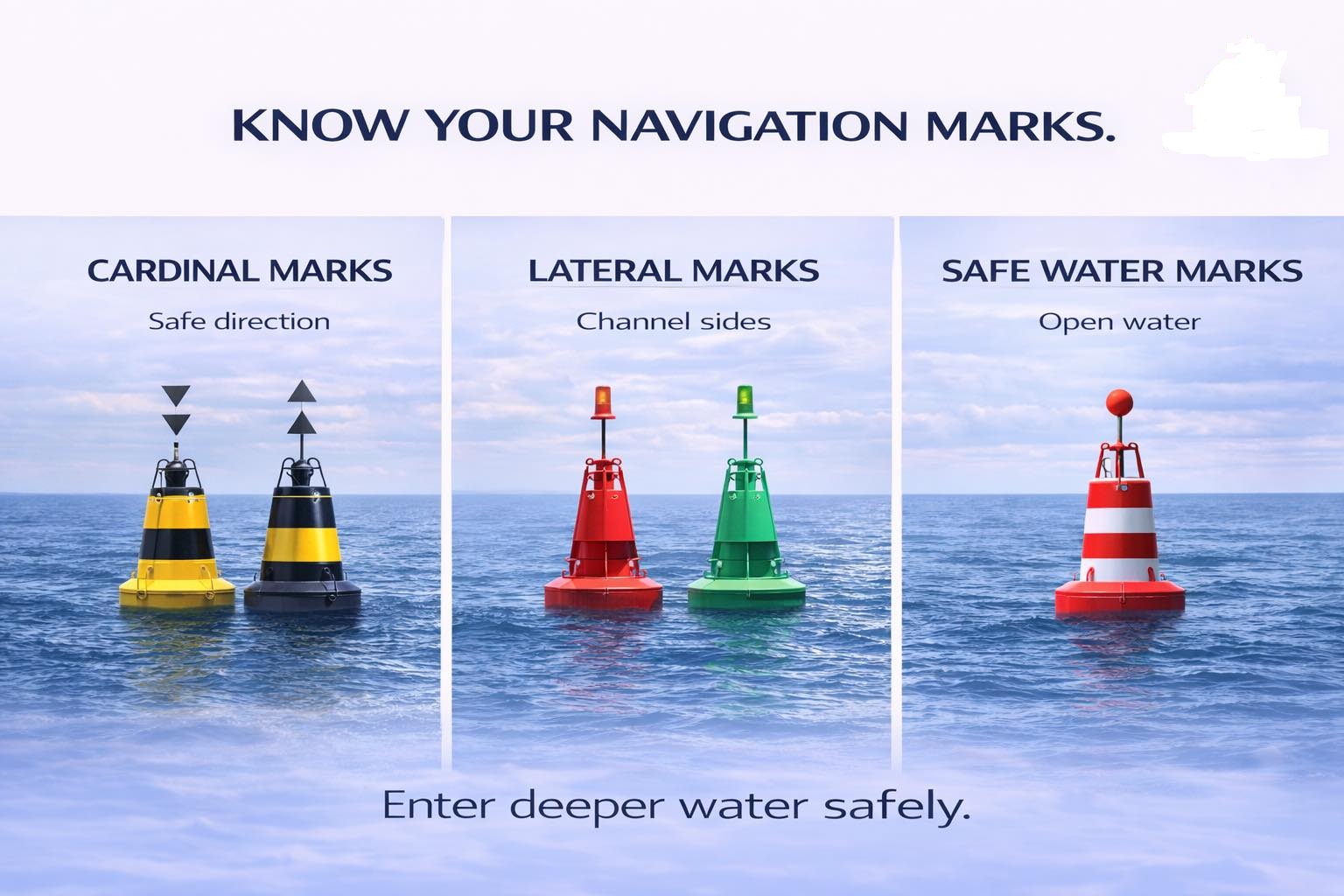
KNOW YOUR NAVIGATION MARKS
Out at sea, there are no roads, no lanes, no traffic lights — yet ships move safely every single day. Here is how.
SPECIAL REPORT | NAVIGATION & SAFETY :By Raymond Gold O. | Co-publisher & Research Reporter | Waterways News
The ocean is vast, unforgiving, and utterly unmarked by the familiar grid of roads that govern movement on land. No white lines divide one lane from another. No traffic officers wave ships into position. No overhead signs point toward a distant port. And yet, in one of the oldest and most remarkable feats of human coordination, thousands of vessels — from artisanal canoes to thousand-foot supertankers — navigate these waters in disciplined, near-flawless order. The secret is not technology alone. The secret is a universal language of marks.
Navigation marks are the vocabulary of the sea. They are the silent sentinels posted at critical junctures in the waterway — warning of danger here, confirming safe passage there, defining the channels through which commerce and livelihood flow. To the untrained eye, a buoy bobbing off the Lagos shoreline or the Niger Delta estuary may look like a modest piece of hardware. To the mariner who knows the system, it is as clear and authoritative as a highway sign. This special report, produced by the research desk of Waterways News, unpacks the three primary families of navigation marks that govern maritime movement the world over: Cardinal Marks, Lateral Marks, and Safe Water Marks.
“At sea, you don’t rely on instinct. You rely on marks, systems, and rules — and that discipline is what keeps every vessel alive.”
PART ONE: CARDINAL MARKS — WHERE SAFETY LIVES
Of all the mark types in use across the world’s shipping lanes, cardinal marks carry perhaps the most important directive: they do not tell you where to go, they tell you where it is safe to go. Positioned around a hazard — a reef, a shoal, a shallow bank, a submerged wreck — cardinal marks are named after the four principal compass directions: North, South, East, and West. Each mark tells the approaching mariner the side on which safe, navigable water lies.
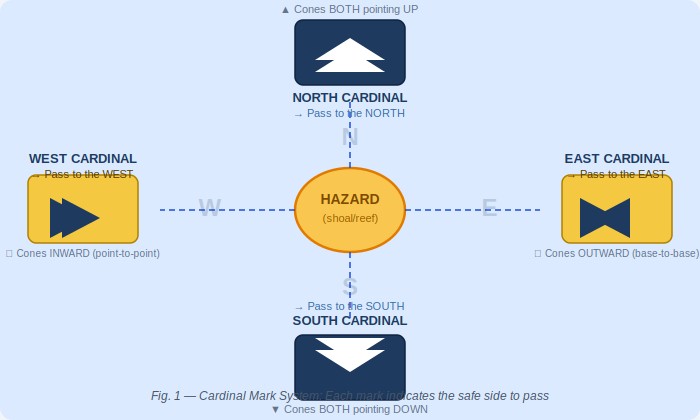
Fig. 1 — The Cardinal Mark System: Each mark signals safe water on its named compass side
The visual identity of cardinal marks is internationally standardised and deeply intentional. Each mark carries a combination of black and yellow bands, with the arrangement of those bands — and of the double-cone topmarks above — varying by direction:
- North Cardinal: both cones pointing UPWARD — pass to the north
- South Cardinal: both cones pointing DOWNWARD — pass to the south
- East Cardinal: cones base-to-base (pointing outward) — pass to the east
- West Cardinal: cones point-to-point (pointing inward) — pass to the west
After dark, each cardinal mark also displays a distinct flash pattern, ensuring that mariners relying on their night-watch do not need to approach closely to read the mark’s identity. The North Cardinal displays a continuous quick flash (Q); the South Cardinal a Q(6) plus a long flash every fifteen seconds; the East Cardinal a Q(3) every ten seconds; and the West Cardinal a Q(9) every fifteen seconds. These patterns are published in the Admiralty List of Lights and are reproduced on every official nautical chart.
In Nigerian waters — across the Gulf of Guinea, through the Niger Delta’s intricate web of channels, and along the coastline from Badagry to Calabar — cardinal marks play a critical role wherever shifting sediment, sandbars, or underwater obstacles create seasonal and permanent hazards. The lesson of the cardinal mark system is fundamental: knowing which side of the mark to pass is not optional knowledge. It is survival knowledge.
PART TWO: LATERAL MARKS — THE ROAD AT SEA
If cardinal marks define where the danger is, lateral marks define where the road is. The lateral mark system is among the oldest and most universally recognised in maritime navigation. It uses red and green buoys — and their associated shapes, light colours, and topmarks — to delineate the safe navigable channel through a port approach, a river, an estuary, or any defined waterway. Follow them like lanes on a highway, and your vessel stays in safe water.
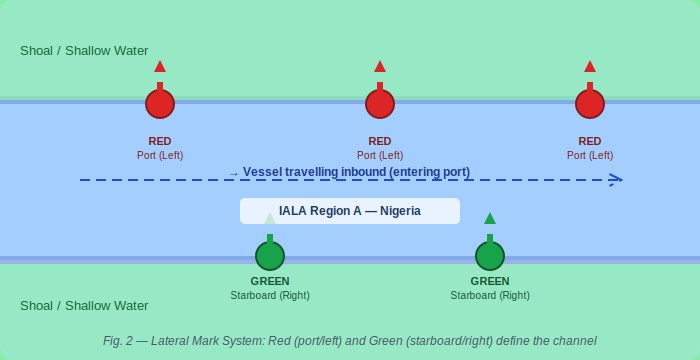
Fig. 2 — Lateral Mark System: Red (port/left) and Green (starboard/right) define the navigable channel
The world’s lateral mark system operates under two broad frameworks: IALA Region A and IALA Region B. Nigeria, like all African nations, falls under IALA Region A — meaning that when entering a channel from seaward, red marks are kept on the port (left) side and green marks on the starboard (right) side. This distinction is not academic. A vessel that mistakes its IALA region risks driving itself directly onto the hazard the lateral system was designed to avoid.
Red and Green: The Universal Lane Markers
Red lateral marks (port hand) in IALA Region A are cylinder- or can-shaped buoys displaying a red light. They mark the left side of the channel when entering port — the port hand. Green lateral marks (starboard hand) are conical buoys displaying a green light, marking the right side of the channel — the starboard hand. At channel junctions, modified lateral marks with red-green or green-red banding indicate the preferred route through divided waterways.
For fishermen operating in the creeks of the Niger Delta, for ferry operators crossing Lagos Harbour, for the crew of an LNG carrier threading the Escravos Channel, the lateral mark system is the spine of safe navigation. These marks define where the dredged channel lies, where water depth is adequate, and where the walls of the safe corridor begin and end. Ignore them and the consequences are mechanical, commercial, and sometimes fatal.
PART THREE: SAFE WATER MARKS — THE OPEN SEA SALUTE
If cardinal marks warn of danger and lateral marks define the channel, safe water marks do something simpler and altogether more reassuring: they confirm that you are in open, deep, unobstructed water. No shoals beneath you. No rocks to port or starboard. No channel restrictions. The safe water mark is the maritime equivalent of finding clear, open highway after hours of careful city driving.
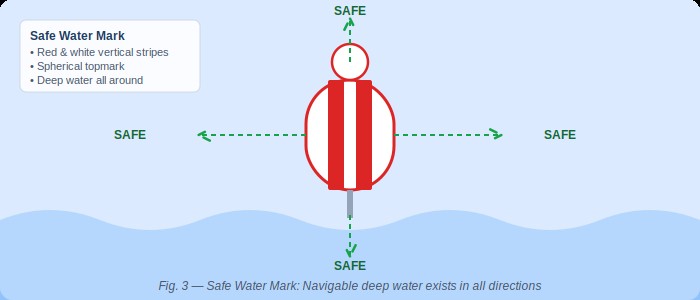
Fig. 3 — Safe Water Mark: Red and white vertical stripes signal navigable deep water in all directions
What a Safe Water Mark Tells You: A safe water mark — characterised by red and white vertical stripes, a spherical topmark, and either an Isophase, Occulting, or single long flash every ten seconds — signals that navigable deep water exists in all directions. No hazards. No restrictions. These marks are commonly positioned at the seaward approach to port channels, at the entrance to fairways, and at mid-channel positions in wide open passages. They are an invitation to proceed with confidence.
Safe water marks are frequently the first official marks a vessel encounters when approaching from deep ocean. Positioned at the start of a fairway, they signal to the navigator: the channel begins here — deep water, all clear. From that mark, the mariner picks up the lateral mark system and follows the defined channel inward toward berth.
For vessels approaching the Bight of Benin, making for the Tin Can Island terminals or the Apapa complex in Lagos, safe water marks serve as critical reference points for initial positioning. Offshore supply vessels heading for the deep-water oil terminals of the Niger Delta use them to confirm their approach corridors. Coastal traders rounding Cape Formoso watch for them as they transition from open sea to coastal navigation. In every case, the safe water mark is a confirmation, not a warning — a green light at the gateway to the port.
THE ARCHITECTURE OF MARITIME ORDER
It is worth pausing to consider the full elegance of what the navigation mark system represents. Across the world’s oceans — from the Arctic shipping lanes to the busy equatorial corridors of the Gulf of Guinea — vessels of every nation, crewed by seafarers of every language, follow the same colour codes, the same shapes, the same flash patterns. A Nigerian deck officer trained in Lagos can read the marks in Rotterdam harbour. A Dutch pilot brought aboard in Port Harcourt reads the marks in Bonny River as fluently as at home.
“The mark system is a universal language — one of the few truly global standards that requires no translation.”
The International Association of Marine Aids to Navigation and Lighthouse Authorities (IALA) maintains and evolves this system. Nigeria is a signatory to the IALA conventions, and the Nigerian Maritime Administration and Safety Agency (NIMASA), along with the Nigerian Ports Authority (NPA), bears responsibility for the placement, maintenance, and integrity of marks in Nigerian waters. Where marks are missing, damaged, or incorrectly positioned, the consequences range from commercial delay — a vessel that must anchor pending guidance — to catastrophe: a grounding that blocks a channel, spills cargo, or claims lives.
In recent years, concerns have been raised within the Nigerian maritime community about the state of navigational marking in some of the country’s secondary waterways — the creeks, river approaches, and coastal channels that serve Nigeria’s inland and nearshore maritime economy. The fishermen, ferry operators, and small cargo carriers who depend on these waterways navigate with imperfect information, sometimes relying on local memory rather than confirmed marks. Waterways News has documented incidents in the Niger Delta where absent or damaged marks contributed to groundings and near-misses. The case for investment in comprehensive, well-maintained navigation marking infrastructure along Nigerian waterways is not merely technical — it is an economic and safety imperative.
WHAT EVERY NIGERIAN SEAFARER MUST KNOW
Whether you are a vessel master bringing a bulk carrier into the Tin Can Island terminal, a crew-boat operator ferrying workers to an offshore platform, a fisherman navigating the channels of the Ijaw creeks, or a student at the Nigerian Maritime University in Okerenkoko preparing for your first sea posting — the navigation mark system is not optional knowledge. It is the foundation of safe maritime practice.
The three families of marks — Cardinal, Lateral, and Safe Water — together form a complete vocabulary for communicating hazard, direction, and clearance. They operate day and night, in clear weather and in fog, and they do so in silence, at a fraction of the cost of any active monitoring system. They require no electricity to understand. They require only training, attention, and respect for the system.
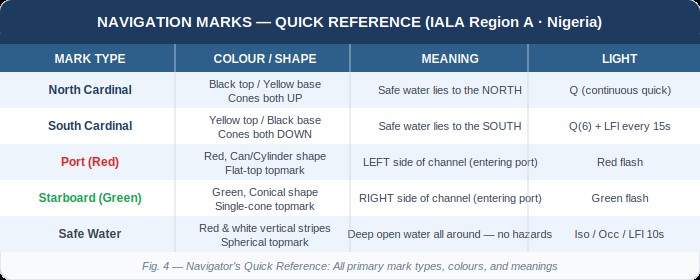
Fig. 4 — Navigator’s Quick Reference: Primary mark types, colours, and meanings at a glance
Enter deeper water safely. That is the promise — and the demand — of every navigation mark on every waterway in the world. It is a promise that only holds if mariners know the language, if authorities maintain the marks, and if the system is treated with the seriousness it deserves.
Waterways News will continue to monitor and report on the state of navigational infrastructure in Nigerian waters. We will advocate for adequate marking of the creeks, estuaries, and coastal approaches that form the backbone of Nigeria’s maritime economy. And we will continue to educate — because knowledge of the marks is the first line of safety at sea.
WATERWAYS NEWS | Report by Raymond Gold O., Co-publisher & Research Reporter | Navigation & Safety Desk • waterwaysnews.ng
-

 Oil and Gas2 months ago
Tantita’s Pipeline Deal: $144m Contract, Rising Output, and the Questions that Deserve Answers
-
 Blue Economy2 months ago
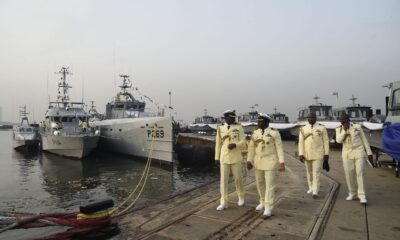
Nigeria’s Coast Guard Bill: A Solution in Search of a Problem?
-
 MARITIME TRADE & SHIPPING2 months ago
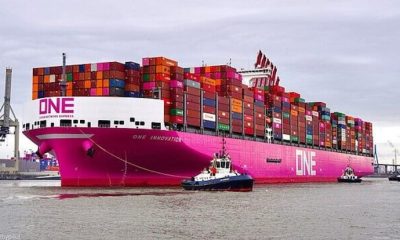
World’s Largest Container Ship Sets New Maritime Record with 22,233 TEUs on Single Voyage